
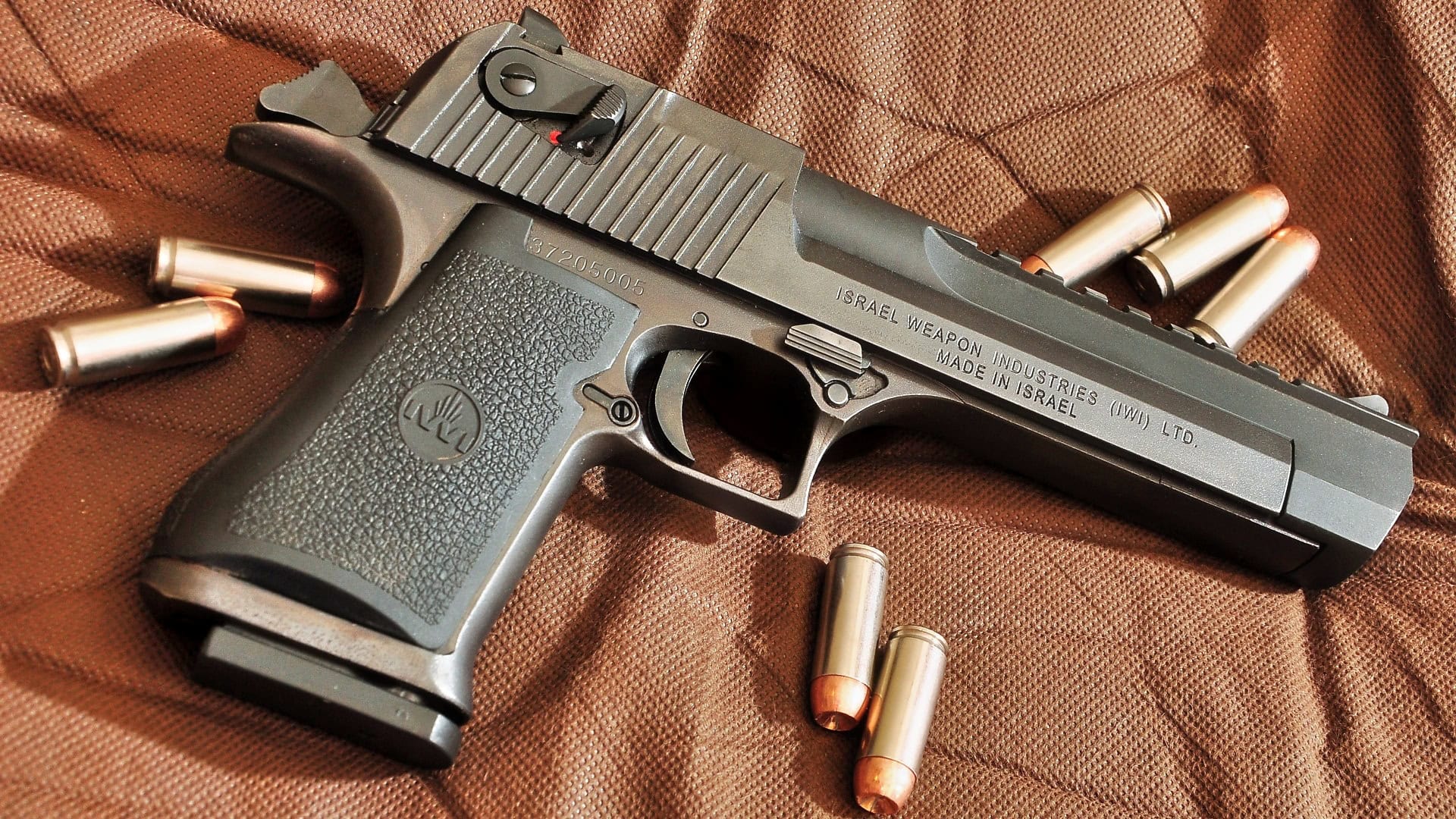
The Magnum Research Desert Eagle .50 AE is a massive, gas-operated hand cannon weighing over 4.5 pounds. It fires the powerful .50 Action Express cartridge. No handgun has done more work on screen and less work in a holster than the Desert Eagle. It’s been in more than 600 movies, TV shows, and video games, carried by half of Hollywood’s action heroes and none of its actual SWAT teams. My favorite was in the Guy Ritchie film “Snatch,” where Vinnie Jones and his Desert Eagle steal every scene that they are in. But there are several others.
That reputation obscures what the gun actually is: a rifle action squeezed into a pistol frame, built to fire a cartridge no other magazine-fed semi-auto handgun can handle.
Desert Eagle: A Semi-Automatic Design With Two Passports
The Desert Eagle wasn’t a pure American project. Magnum Research, a small Minneapolis outfit, teamed up with Israel Military Industries in the late 1970s to design it, with the first U.S. patent filed in January 1983 under Magnum Research’s Bernard White and IMI engineer Arnold Streinberg.
Production has bounced around ever since: Israel first, then Saco Defense in Maine starting in 1995, back to Israel Weapon Industries in 1998, and finally home to Magnum Research’s own plant in Pillager, Minnesota, in 2009. Kahr Arms bought the company a year later and still runs it today.
It debuted on screen in 1985 in “Commando,” showed up again the next year in “Police Academy 2” and “Year of the Dragon,” and didn’t become a cultural fixture until Neo unloaded one in “The Matrix” in 1999.
Magnum Research embraced the image and the gun, sending them to Hollywood prop houses rather than treating the movie exposure as an accident.
By most counts, it appeared in more than 40 films by 2000 alone, and the total has only grown since.
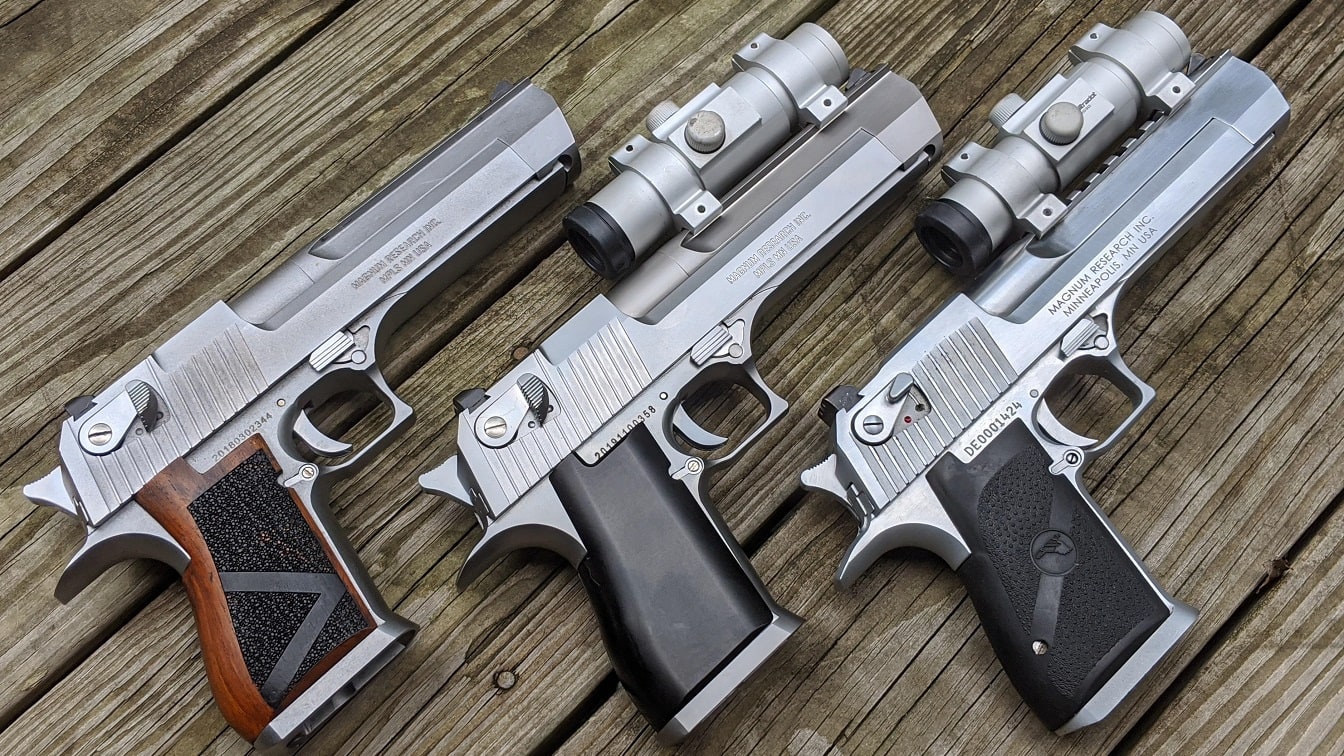
Desert Eagle. Image Credit: Creative Commons.
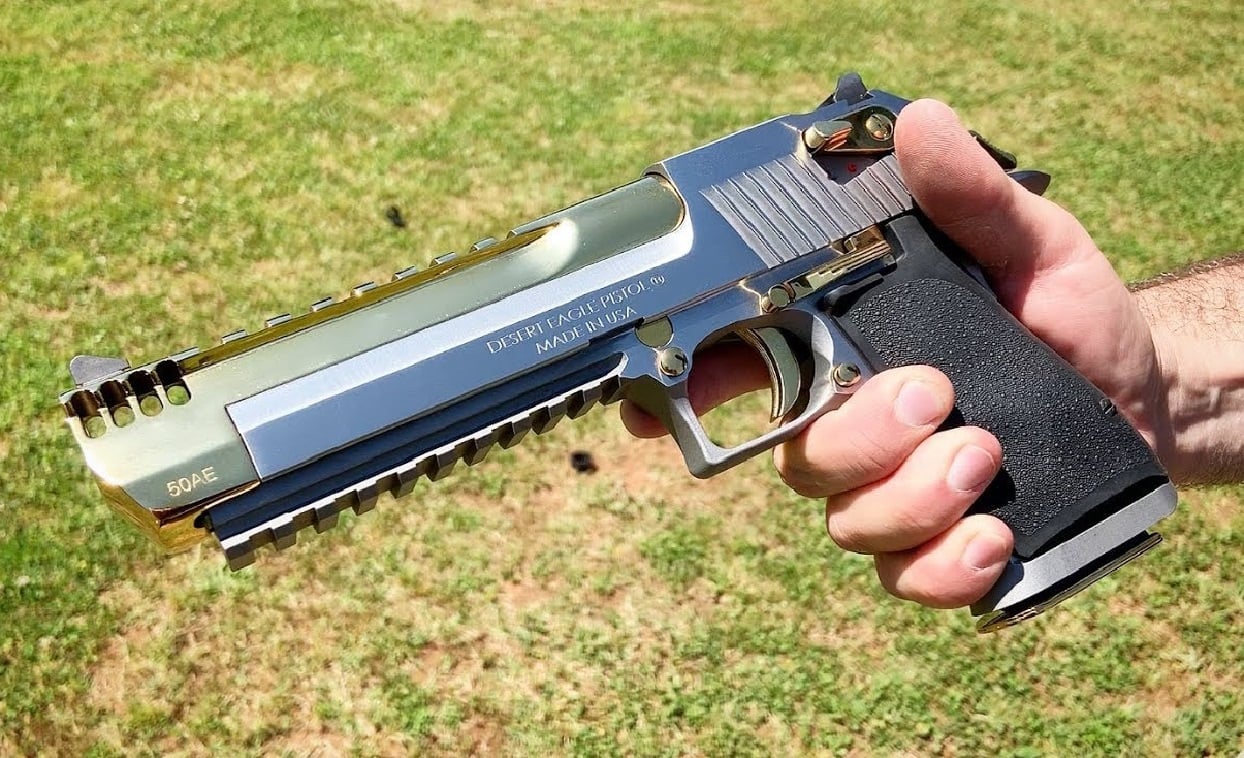
Image: Creative Commons.
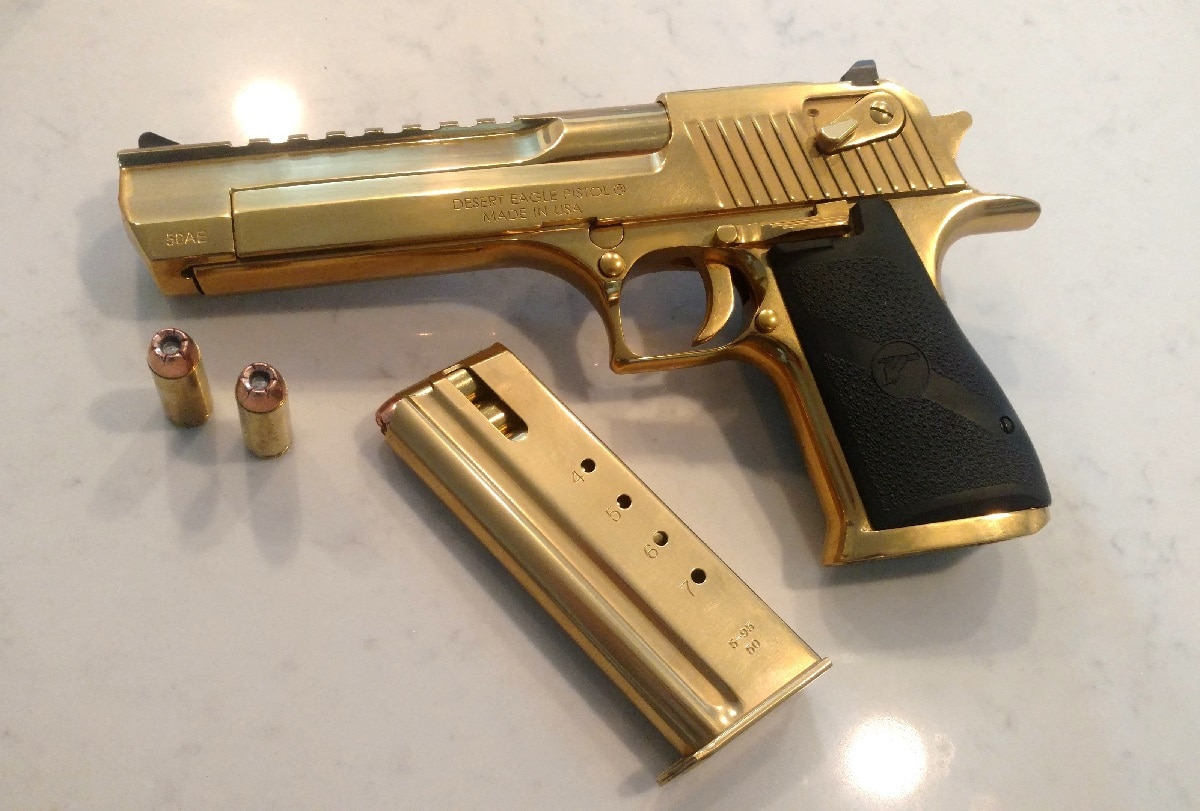
Desert Eagle. Image: Creative Commons.
The Action Is Borrowed From Rifles
Here’s the part most people carrying the “biggest handgun” reputation around never think about.
Nearly every semi-auto pistol on the market, from a Glock to a 1911, cycles off recoil: the barrel and slide move together for a short distance before unlocking.
The Desert Eagle doesn’t work that way. It’s gas-operated, using the same basic system as an AR-15 or an AK, with a rotating bolt with three locking lugs and a fixed barrel that never moves during firing.
Gas tapped from the barrel drives a piston that unlocks the bolt and cycles the action.
That’s not a gimmick.
A fixed barrel is inherently more accurate than one that tips or tilts every shot, and a gas system spreads recoil out over a longer cycle instead of dumping it all at once, which is the only reason a hand-held .50-caliber semi-auto is manageable at all.
It’s the engineering equivalent of borrowing a rifle’s trick to solve a pistol’s problem.
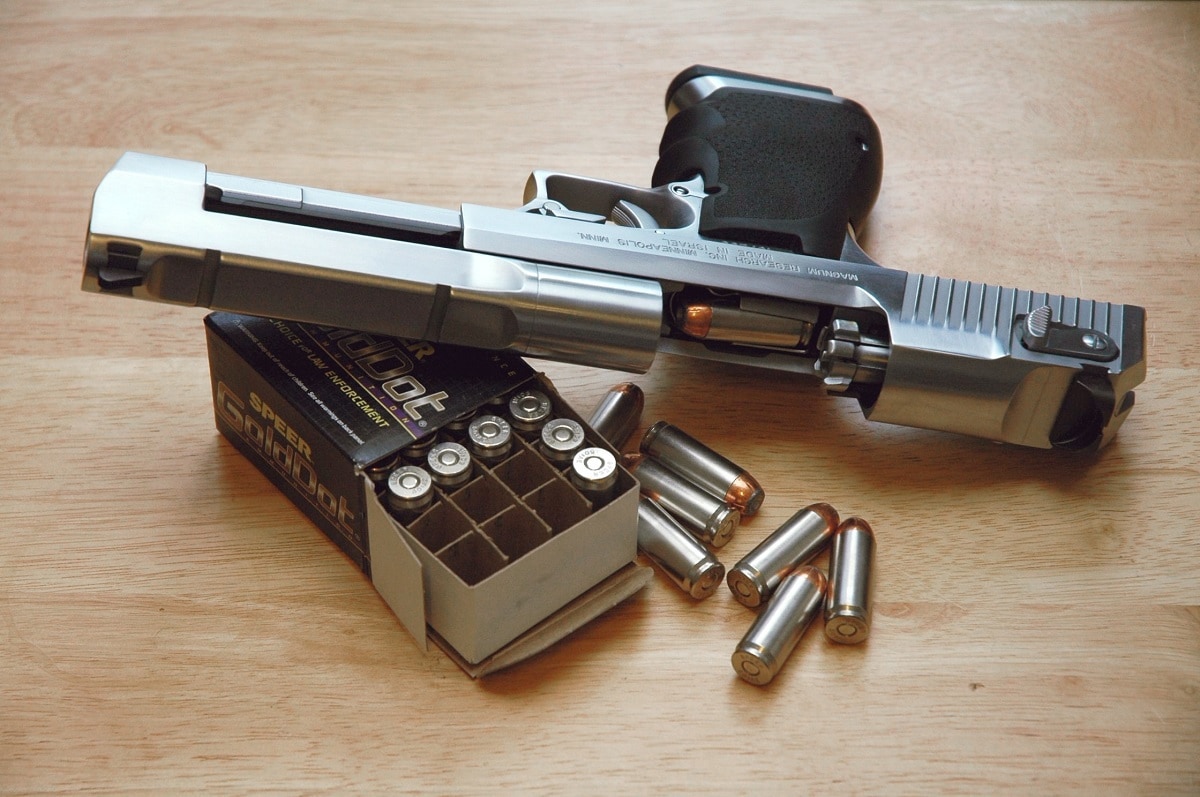
Mark XIX Desert Eagle pistol with a box of Speer 325-grain .50 AE ammunition.
Meet the Desert Eagle .50: Specs
The standard Desert Eagle ships with a 5-inch barrel, measures 9.69 inches overall, and weighs a genuine 3 pounds empty, more than double that of a full-size 1911.
Add the 6-inch stainless model, and the weight climbs to over 3 pounds 7 ounces.
A 10-inch barrel option exists for people who apparently found the standard gun too concealable. (insert sarcasm font here)
Magazines hold seven rounds of .50 Action Express, and the trigger breaks clean at right around 4 pounds in single-action pull weight, light for a gun this size.
A good friend of mine had the Desert Eagle in .44 Magnum many moons ago, and I gleefully shot hundreds of rounds through it.
And it was everything you would expect.
Something to consider: the Desert Eagle’s muzzle flash is enormous, even in bright daylight. Firing one at night will be an experience; actually firing it at all is a one-of-a-kind event.
Desert Eagle Cost
Prices start at around $1,900 for the standard black model and go up to over $2,250 for the stainless model. None of that is cheap, and none of it is meant to be.
Construction is an aluminum frame and steel slide, with an integral muzzle brake to tame recoil and a rail up top for a red dot.
The sights are fixed, the safety is ambidextrous, and the fit and finish run from a plain black slide up through polished stainless and, if you want to spend the money, a gold-plated version that has nothing to do with function and everything to do with looking like a movie prop.
Despite the reputation as a one-trick .50-cal cannon, the Desert Eagle platform also chambers .357 Magnum, .44 Magnum, and a handful of other magnum rounds on the same frame, which is worth remembering before writing it off as a novelty gun that only does one thing.
More Energy Than The Movies Need
A 300-grain .50 AE bullet leaves the barrel at around 1,542 feet per second and carries about 1,500 foot-pounds of energy, comfortably ahead of a full-power .44 Magnum load from a handgun and closer to what a lever-action rifle produces than anything else fired from a hand-held semi-auto.
Say what you want about whether a self-loading .50-caliber pistol solves a problem anyone actually has. That’s beside the point.
Nothing else in a magazine-fed handgun gets close, and that alone has kept it in production for more than forty years.
However, carrying that monster concealed is definitely out, even for someone the size of an NFL player.
But for a backwoods handgun where bears and the like are a real threat, it is a very capable weapon.
The Desert Eagle earned its Hollywood career honestly: it looks exactly like what it is, a rifle’s worth of engineering in a pistol’s shape.
The movies just noticed first. Such as “Bullet-Tooth Tony and his Desert Eagle point five oh.”
About the Author: Steve Balestrieri
Steve Balestrieri is a National Security Columnist. He served as a US Army Special Forces NCO and Warrant Officer. In addition to writing on defense, he covers the NFL for PatsFans.com and is a member of the Pro Football Writers of America (PFWA). His work was regularly featured in many military publications.