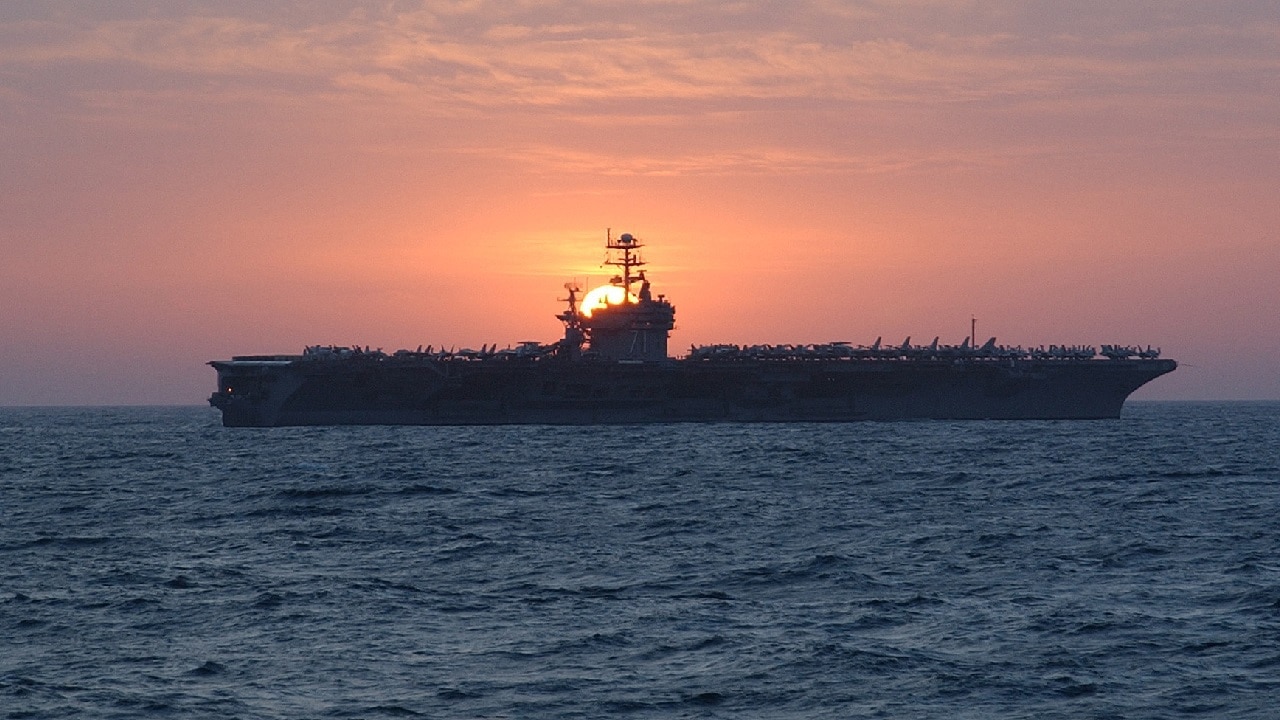
The collision between the USS John F. Kennedy and the guided-missile cruiser USS Belknap during maneuvers in the Mediterranean Sea is considered one of the worst ship collisions in United States Navy history.
Having occurred at night in 1975, the collision triggered all manner of fires and explosions — within 40 feet of nuclear weapons aboard the cruiser — and resulted in eight sailors dying, with an additional 48 wounded.
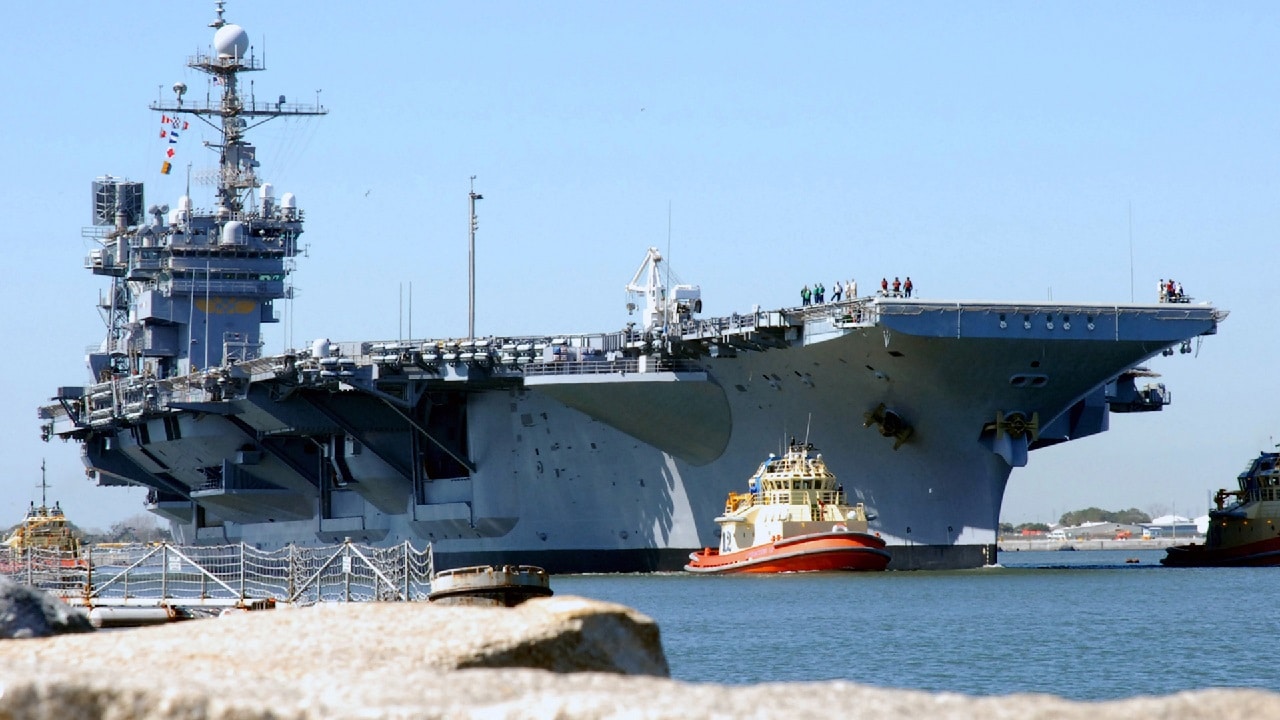
Mayport, Fla (Feb. 20, 2007) – USS John F. Kennedy (CV 67) departs Naval Station Mayport for the last underway period before her decommissioning in March. U.S. Navy photo by Mass Communication Specialist 2nd Class Elizabeth Williams (RELEASED)
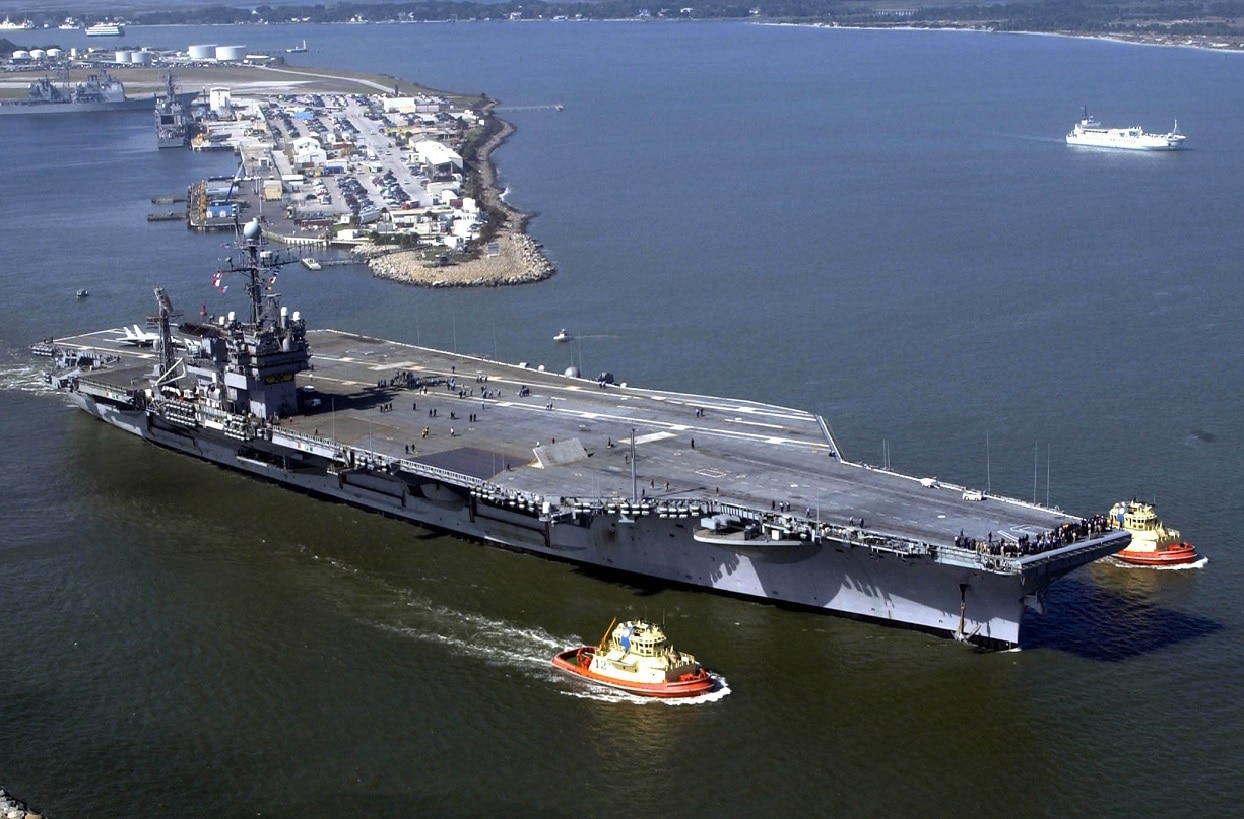
Mayport, Fla. (Nov. 11, 2003) — USS John F. Kennedy (CV 67) departs Naval Station Mayport under her own power following a ten month Extended Service Repair Availability (ESRA). During a short at sea period the ship will test numerous systems installed or upgraded while in port. The $300 million maintenance period included renovation of berthing compartments, and new navigational radar system. U.S. Navy photo by Photographer’s Mate 1st Class Greg Curry. (RELEASED)
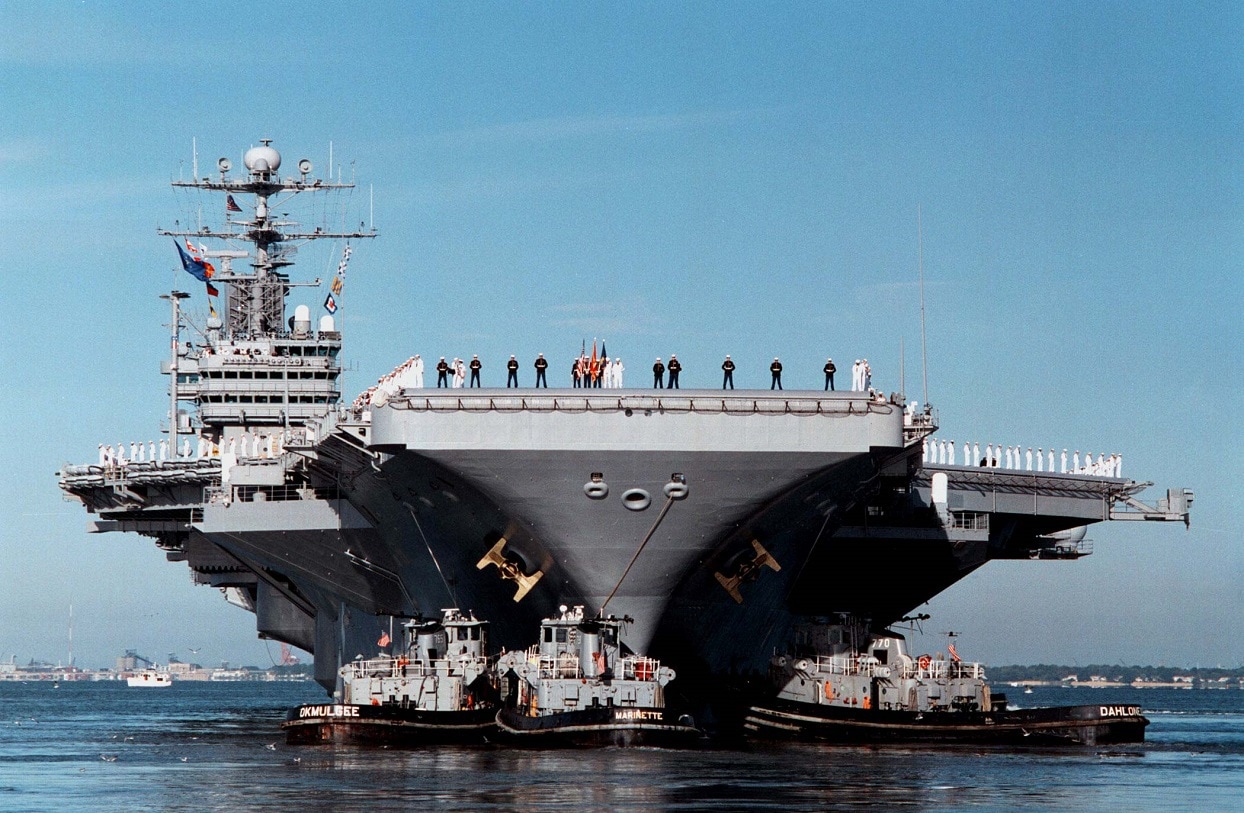
Sailors and Marines man the rail as three harbor tugs push the aircraft carrier USS George Washington (CVN 73) away from Pier 11 at Norfolk Naval Base on Oct. 3, 1997, for a scheduled six-month deployment. The George Washington will relieve the USS John F. Kennedy (CV 67) to conduct operations in the Mediterranean Sea. DoD photo by Petty Officer 2nd Class Christopher Vickers, U.S. Navy.
The damage to the USS Belknap was so severe that the cruiser sat in the shipyard for four years afterward.
The Exercise Goes Badly
During the exercise in the Mediterranean Sea, the USS Belknap was carrying a W-45 nuclear warhead that was used on Terrier anti-aircraft missiles.
The accidental collision with the John F. Kennedy was so severe that it nearly resulted in what’s known as a “broken arrow” accident.
Rear Adm. Eugene Carroll, the flag officer aboard the John F. Kennedy, sent the “broken arrow” message back to headquarters, likely sparking its own bureaucratic conflagration.
The John F. Kennedy was a conventionally powered Kitty Hawk-class aircraft carrier, about 1,052 feet long and displacing more than 80,000 tons fully loaded.
The Belknap was much smaller, measuring about 547 feet long and displacing only 8,000 tons fully loaded.
When the John F. Kennedy and Belknap collided, sailors at the time remarked that it was like using a “can opener” on the top of the Belknap.
That’s because the carrier’s flight deck sliced off the smaller warship’s top, like a can opener cutting off a can’s top.
As the JFK’s flight deck sliced through the Belknap, the carrier’s aviation fuel lines exploded.
JP-5 aviation fuel poured onto the damaged cruiser.
Onboard the stricken cruiser, severed electrical wiring ignited the JP-5 fuel flooding the smaller warship. As a result, fires erupted on both ships.
But Belknap was the worst damaged of the two.
The ship had an aluminum superstructure. Once the flames reached that superstructure, they weakened the aluminum, causing it to collapse under the heat.
Cooking Off a Nuke?
When the flames reached the ammunition stored in a three-inch gun’s ready-service locker, the ammunition there began detonating.
This created even more chaos on the Belknap. Soon, burning fragments were sent across the ship and beyond.
But the big worry, of course, was the fact that there was a nuclear warhead on the stricken Belknap.
Rear Adm. Carroll was compelled to send the “broken arrow” alert to fleet headquarters, but that fact wasn’t revealed until it was leaked to the anti-nuclear activist group Greenpeace several years later.
Had the fires on the Belknap not been contained, it is very possible that they would have reached the nuclear weapon.
While safeguards exist to prevent accidental detonations, the man commanding the exercise clearly worried something could go terribly wrong.
The John F. Kennedy was not immune to the crisis. Fires worsened and threatened the safety of ongoing flight operations during the collision.
The command crew ordered the evacuation of the ship’s machinery spaces, fearing the fire would compromise them.
On the JFK, firefighting crews contained the flight-deck fire within ten minutes of it starting.
Yet the fires spread below decks and lasted for hours.
It was a travesty at sea. Multiple other US warships rushed to aid the stricken ships.
The guided-missile destroyer USS Claude V. Ricketts (DDG-5) and the destroyer USS Bordelon (DD-881) approached the burning cruiser despite inclement weather and the USS Belknap’s constantly exploding ammunition.
The Ricketts helped evacuate wounded personnel from the Belknap.
Meanwhile, the frigate USS Pharris (FF-1094) aided the John F. Kennedy.
Helicopters from Helicopter Anti-Submarine Squadron 11 also conducted medical evacuation and rescue flights.
In fact, Aviation Geek Club reports that the helicopter crews transported 88 personnel during an astonishing 36 hours of continuous operations.
Fallout
The accident devastated the USS Belknap.
She remained afloat, though fires melted the aluminum and destroyed much of her superstructure.
Concerns had long existed about using aluminum in these warships’ superstructure design.
This accident completely reopened that debate among naval engineers.
The cruiser was taken to the Philadelphia Naval Shipyard for major reconstruction. She returned to service in 1980.
Indeed, the Belknap went on to have a storied career. Belknap was ultimately decommissioned in 1995 and sunk during a naval exercise in 1998.
As for the John F. Kennedy, she kept her nickname, “The Can Opener,” and suffered nowhere near the damage the Belknap did.
The incident is a continual reminder of how dangerous life at sea can be–and how serious even exercises involving nuclear weapons can become.
About the Author: Brandon J. Weichert
Brandon J. Weichert is the Senior National Security Editor at 19FortyFive.com. He also manages The Weichert Brief on Substack. Weichert is the co-host for The Mario Nawfal Show on Twitter/X. He is the author of four bestselling national security books, most recently A Disaster of Our Own Making: How the West Lost Ukraine (Encounter Books). His next book, Fortress Americas: A New Monroe Doctrine (Tucker Carlson Books), is due out December 8. Follow him via Twitter/X @WeTheBrandon.