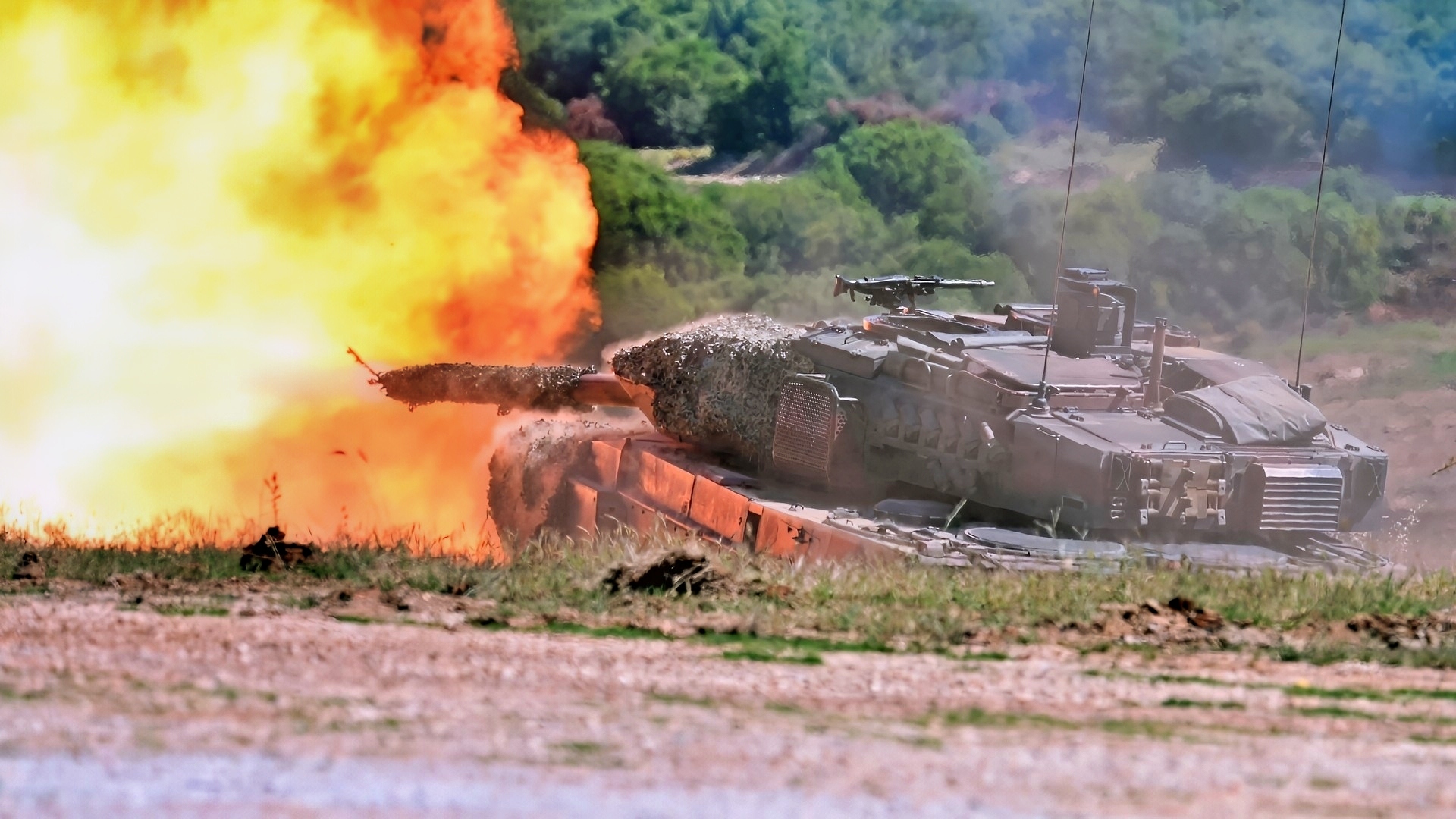
Summary and Key Points: Berlin-based journalist Caleb Larson tracks Germany’s Zeitenwende, the rearmament Olaf Scholz launched after Russia’s February 2022 invasion of Ukraine with a one-off €100 billion fund for a Bundeswehr that had not reached 1.5 percent of GDP since 1996. Its most visible product is a 4,800-strong brigade permanently based in Lithuania near Kaliningrad and Belarus to secure the Suwałki Corridor, the first such basing since World War II. The NATO-skeptic AfD’s 44 percent win in Sachsen-Anhalt clouds it.
Germany Rearms
BERLIN, GERMANY – February 2022 marked one of Germany’s most significant post-Cold War policy shifts.
Catalyzed by Russia’s invasion of Ukraine, former Chancellor Olaf Scholz declared that Moscow’s actions marked a Zeitenwende, a turning point and a new era in which Germany would cut through its deeply embedded bureaucracy and red tape to rebuild its long-ignored military.
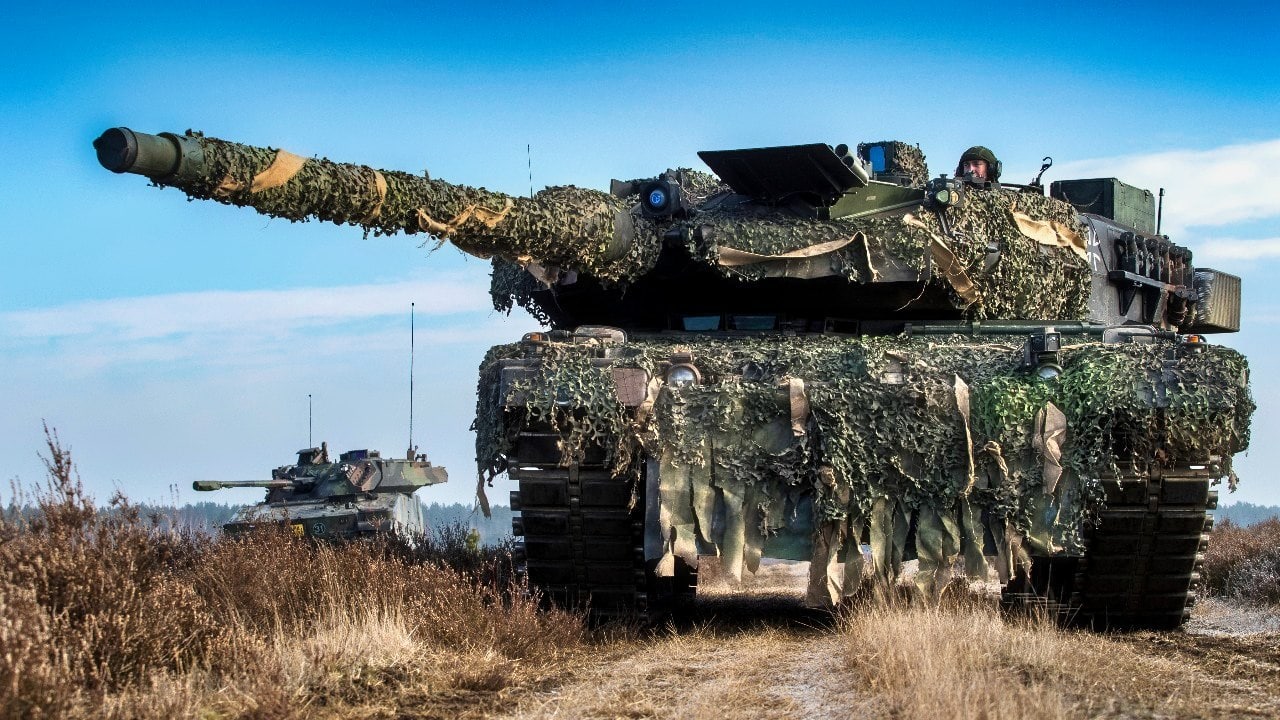
Germany Military Leopard 2 Tank.
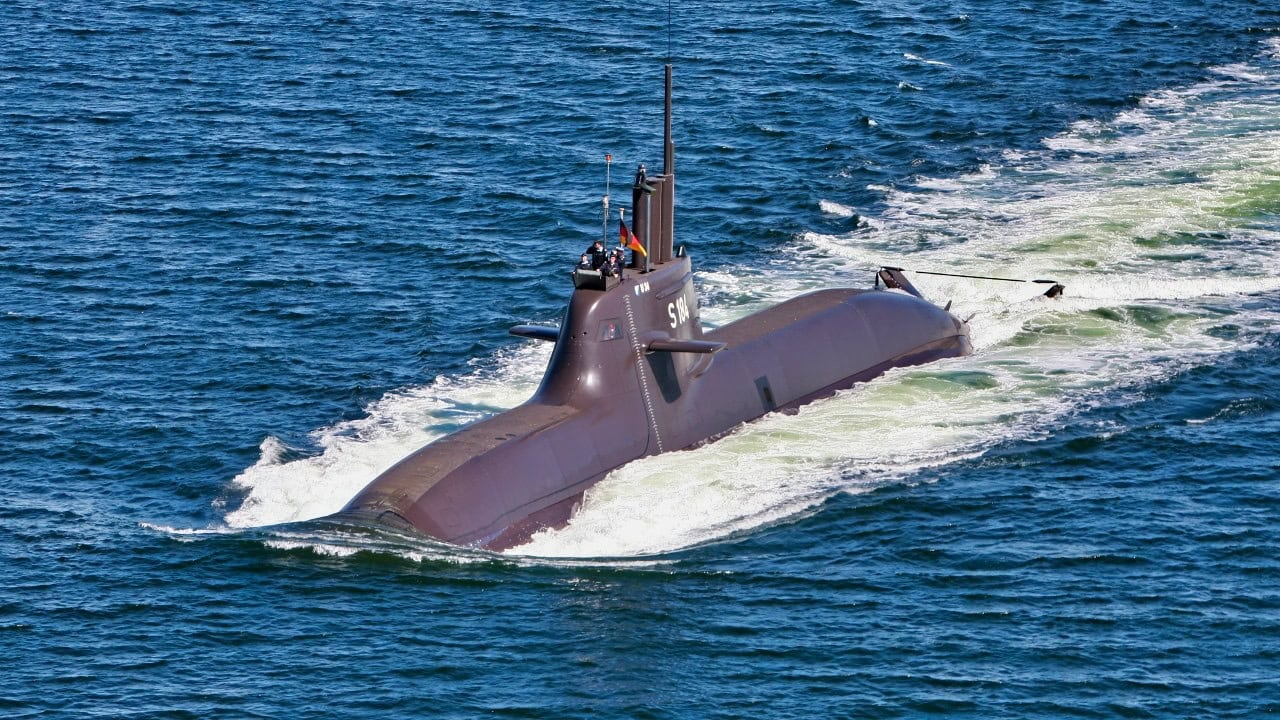
Type 212A Submarine from Germany.
A Military Revived
Following the Russian invasion of Ukraine, Berlin injected a once-unbelievable sum into its ailing military.
A once-off €100 billion cash injection into the military was, to paraphrase the chancellor, part of a broader effort to revive a military that had been virtually on life support.
Though the continent’s largest economy, the German military had long been neglected in the years following the end of the Cold War, nominally obligated to meet the NATO alliance’s two percent of GDP toward defense spending target, that must was seen as optional in Berlin.
In fact, Germany had not spent more than 1.5 percent of GDP on defense since 1996.
In a time of peace, stability, and strong economic growth after the end of the Cold War, why—so the argument went — should Germany put Euros into the military when that money could be better spent on society itself? Preschools, pensions, and other social benefits often took priority.
But the deeply pacifist streak that runs through German society was significantly upended by Russia’s full-scale invasion of Ukraine in February 2022.
Germany’s ongoing rearmament is the largest since the fall of the Berlin Wall. One of the most visible aspects of Berlin’s newfound military vigor is the Bundeswehr’s Lithuania Bridge.
The brigade, 4,800 strong, is deployed to Lithuania, part of NATO’s push to bolster the alliance’s eastern flank following Russia’s full-scale invasion of Ukraine.
The deployment is remarkable for its duration—the first time in the Bundeswehr’s history it has been deployed abroad.
It is also the first time since the Second World War Germany has been permanently stationed abroad.
“The permanent basing of the brigade comes against the backdrop of a fundamentally altered European security environment, shaped by the Russian Federation’s aggression against Ukraine and persistent tensions across NATO’s eastern borders,” NATO explains, providing the rationale for the deployment.
“Lithuania’s proximity to both Kaliningrad and Belarus renders it a vital component in securing the Suwałki Corridor—a narrow but critical land corridor linking the Baltic States to the rest of NATO.”
New Voting Patterns — and New Policies?
Germany’s far-right party, the Alternative for Germany (AfD), is coming off its biggest electoral success in 13 years.
The party won a stunning victory in Germany’s eastern state of Sachsen-Anhalt, taking nearly 44 percent of the vote.
The party is an avowed skeptic of NATO and advocates closer, more amicable relations with Russia.
It has also tried to eschew Germany’s culture of guilt related to its Nazi past.
While the AfD does head the government in one of Germany’s sixteen states — which has fueled the debate about the party’s national ambitions — it does not enjoy as staunch support outside of the former East Germany, and winning elections in other states, let alone on the national level, would be a tall order for a party that is seen by many as extremely right-wing.
Still, should the AfD assume power more broadly within Germany, the party has the potential to alter the direction of Germany’s rearmament and, in particular, its stance toward Moscow — the party has repeatedly voiced skepticism of the NATO alliance as well as the European Union — which would be much to the chagrin of other countries on the continent.
Into the Future
Despite domestic political headwinds, future electoral uncertainty, and a flagging economy, Germany’s rearmament is unlikely to cool down soon.
Speaking at the White House and flanked by his American counterpart Pete Hegseth, German Defense Minister Boris Pistorius did not mince his words. “Germany is strengthening its defense capabilities and acts as a driving force in Europe,” Pistorius said. “We Europeans want to take some of the burden off the U.S. and assume primary responsibility for conventional deterrence in Europe over time.”
About the Author: Caleb Larson
Caleb Larson is an American multiformat journalist based in Berlin, Germany. His work covers the intersection of conflict and society, focusing on American foreign policy and European security. He has reported from Germany, Russia, and the United States. Most recently, he covered the war in Ukraine, reporting extensively on the shifting battle lines in Donbas and the war’s civilian and humanitarian toll. Previously, he worked as a Defense Reporter for POLITICO Europe. You can follow his latest work on X.