
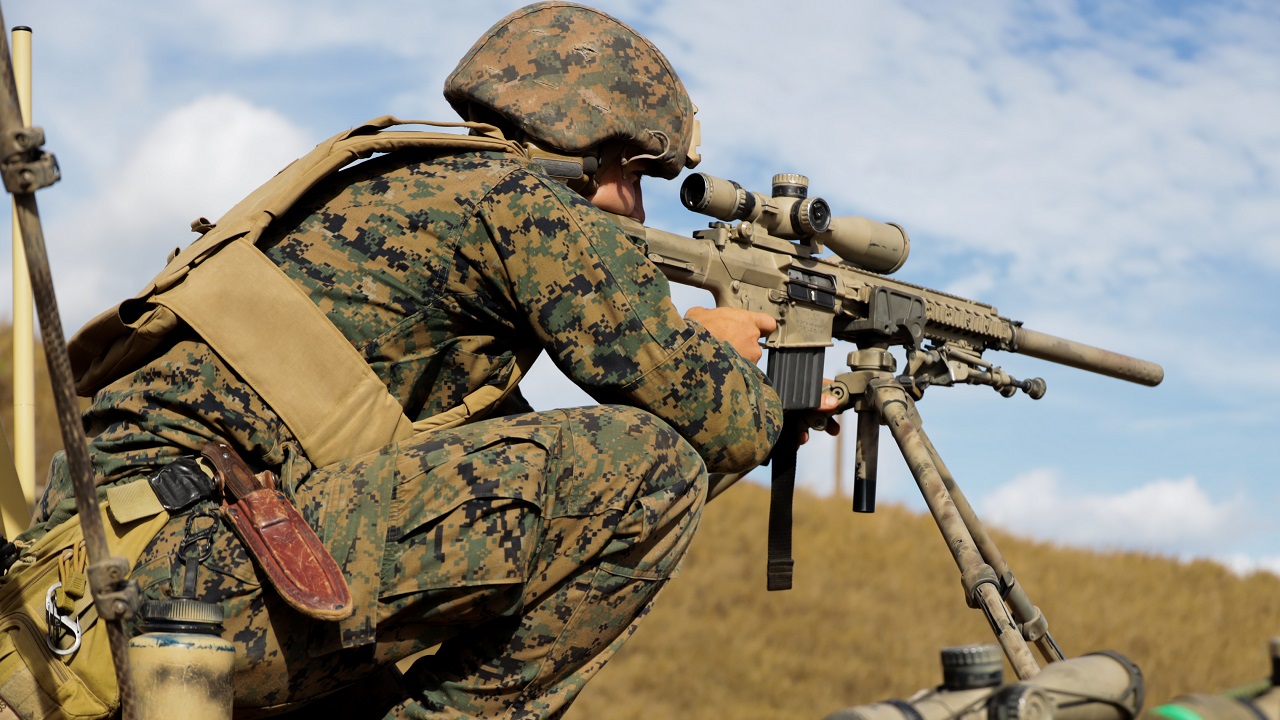
Summary and Key Points: On August 14, 2025, a Ukrainian sniper team killed two Russian soldiers with one 14.5mm Snipex Alligator round at 4,000 meters 2.49 miles, through the window of a building on the Pokrovsk-Myrnohrad line. The Alligator, built in Kharkiv by XADO, has an official effective range of 2,000 meters; a drone and AI software corrected the trajectory. It is Ukraine’s second sniper record in under two years, after a 2023 shot of over two miles.
A Sniper Attack That Made Military History
Two and a half miles is more of an artillery problem than a rifle shot. However, on August 14, 2025, a Ukrainian sniper team from the Pryvyd, or “Ghost,” unit solved it anyway. Firing a 14.5mm Snipex Alligator on the Pokrovsk-Myrnohrad line, the team killed two Russian soldiers with a single round at 4,000 meters, or 2.49 miles.
The bullet went through the window of a building where the Russians were holed up.
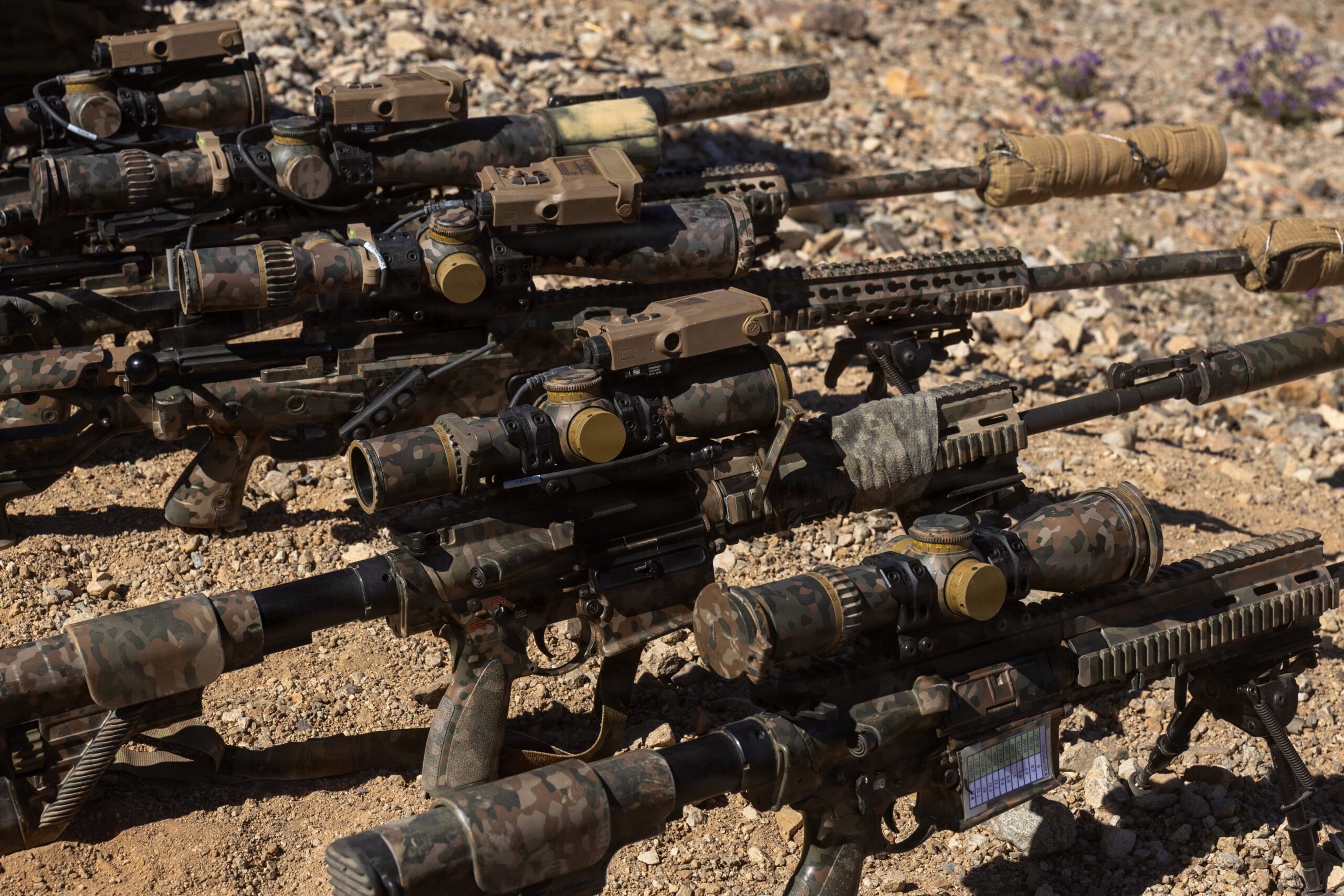
Rifles staged during a foreign training exercise as part of a live-fire exercise at Range 400, Marine Corps Air Ground Combat Center, Twentynine Palms, California, Feb. 13, 2026. The Netherlands Marine Corps visited MCAGCC to promote interoperability, strengthen partnerships and enhance strategic and tactical cooperation between U.S. and Dutch Marines. (U.S. Marine Corps photo by Lance Cpl. Jozef P. Majewski)
Military journalist Yuri Butusov posted the video, and the platoon commander, Oleksandr “Pryvyd,” later confirmed the shot to Ukrinform.
For those keeping score at home, that’s 4,374 yards. Call it 44 football fields laid end to end.
One bullet, two kills. For comparison, the maximum effective range of a standard modern 60 mm mortar (such as the U.S. M224 LWCMS) is 3,489 to 3,500 meters.
It’s also the second time in less than two years that a Ukrainian has rewritten the sniping record book.
The Alligator Was Never Meant For This
XADO builds the Snipex Alligator in Kharkiv, a company that until a few years ago was best known for making lubricants.
That’s not a joke.
Their first 14.5mm prototype was widely mocked.
Nobody is laughing now.
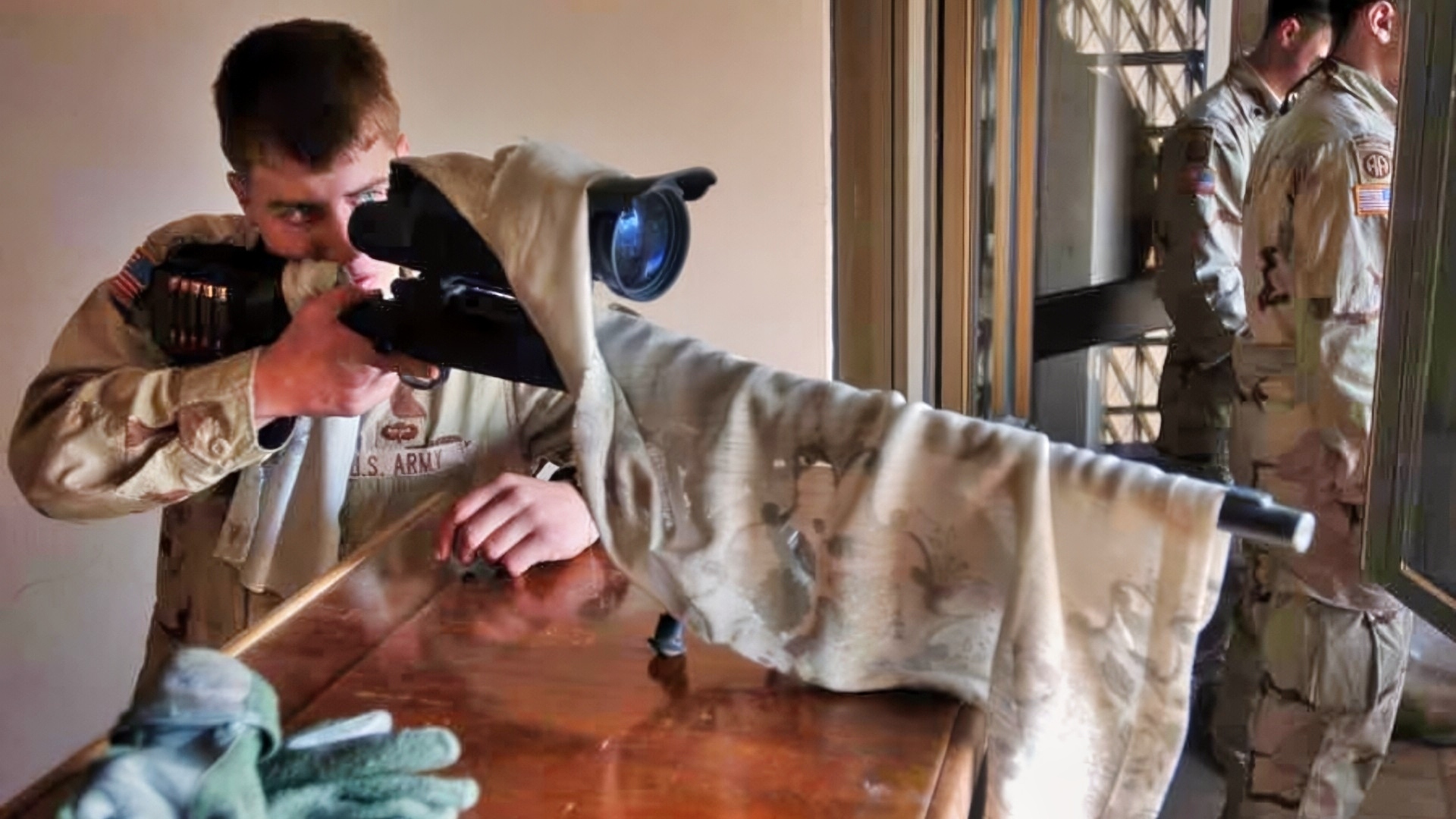
Spc. Scott Kuzminski, a sniper with Scout Platoon, Headquarters Company, 3rd Battalion, 325th Airborne Infantry Regiment, 82nd Airborne Division, provides overwatch protection for troops on the ground with his M21 sniper weapon during an operation Jan. 8 in Baghdad (US Army photo by Pfc. Mike Pryor, 82nd Airborne Division Public Affairs)
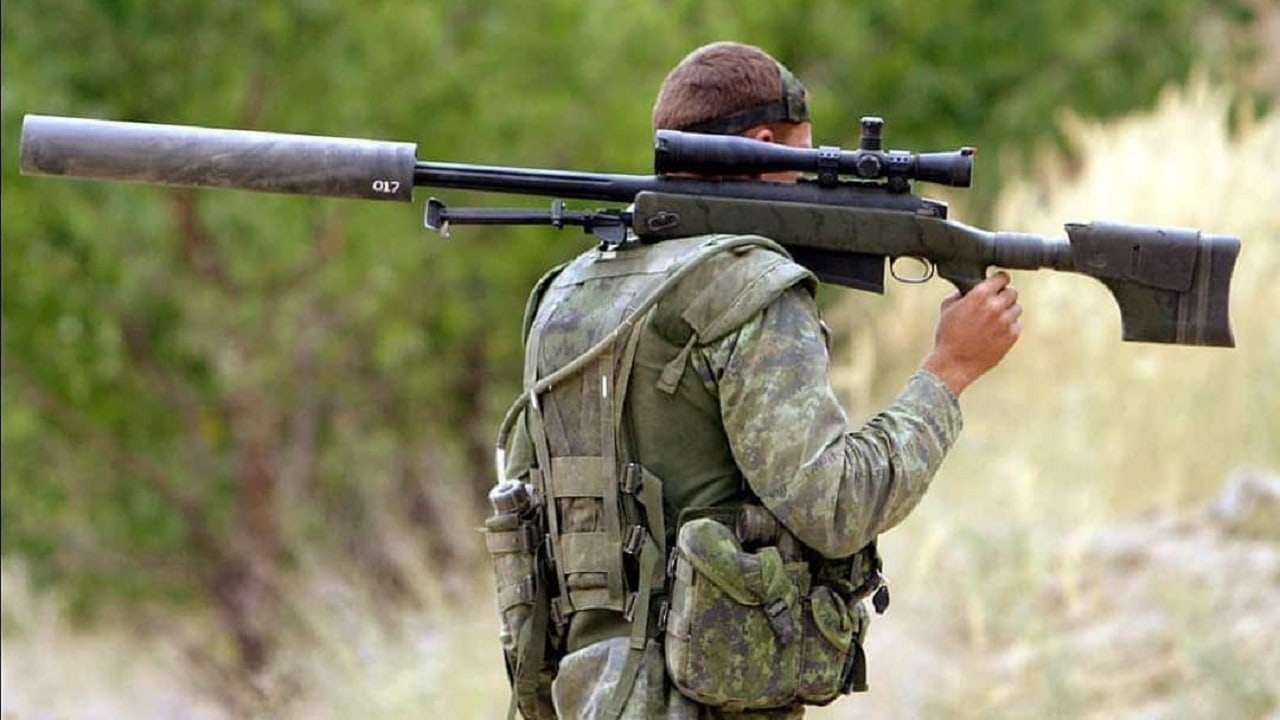
The rifle is a magazine-fed bolt gun firing the old Soviet 14.5x114mm round, the same cartridge that fed the KPV heavy machine gun.
According to Ukrinform’s report on its adoption, it weighs 22.5 kilograms (49.6 pounds) without a magazine, has a 1,200mm (47-inch) barrel, and measures 2,000mm, just under seven feet.
Muzzle velocity is 980 meters per second. At 1,500 meters, the bullet punches through 10mm of armor plate.
Here’s the part that matters.
The official effective range is 2,000 meters.
As Euromaidan Press noted, this anti-materiel rifle was designed to kill radar sets, light armor, and fuel tanks.
The Ghost unit doubled it.
That isn’t the rifle working as designed.
That’s the team working around the rifle.
This Was A Team Shot, Not A Lone Wolf
So how do you hit anything at 4,000 meters?
You don’t do it alone.
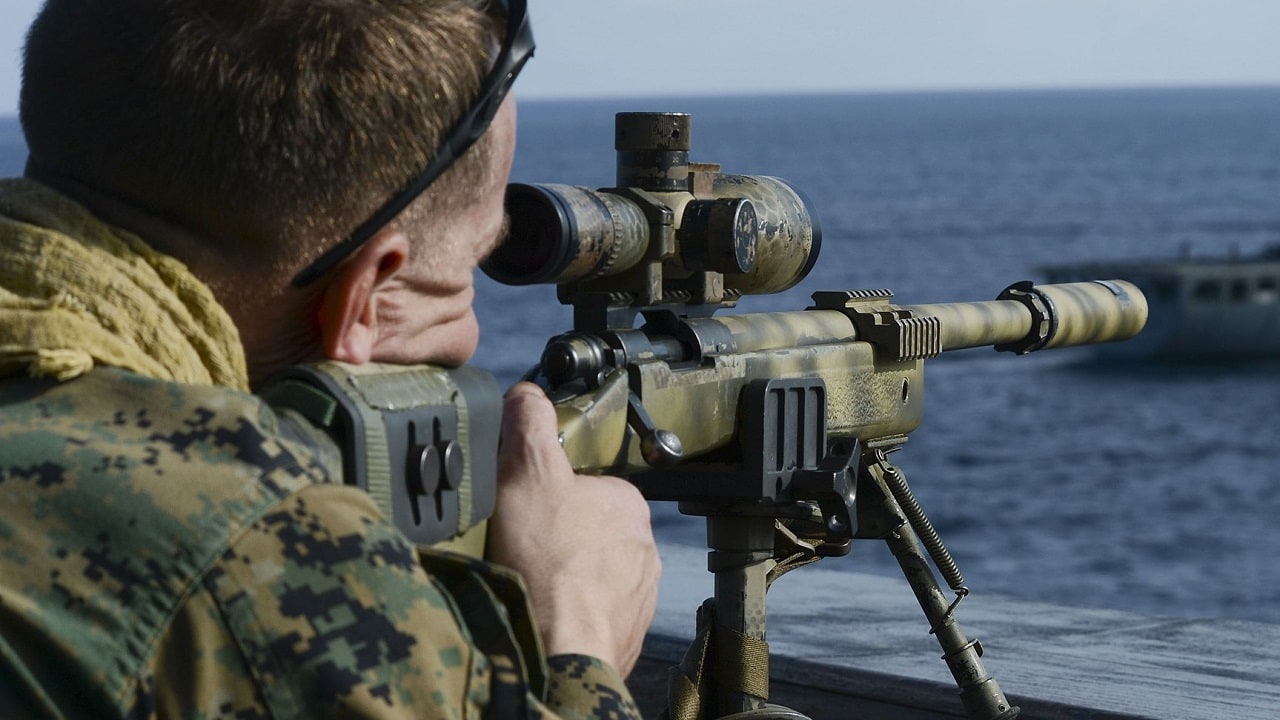
M40 Sniper Rifle. Image Credit: Creative Commons.
A drone complex paired with AI-assisted software handled the trajectory correction.
Pryvyd was blunt about it.
His team includes the shooters, the spotters who handle corrections, the people running the AI and ballistic calculations, and the drone operators who fly, film, and adjust fire.
It’s a sniper cell that looks a lot more like a fire direction center than the two-person teams I grew up around.
Consider the math the Canadians had to solve in 2017.
At 3,540 meters, the JTF2 sniper dialed 113 mils of elevation and 6.5 mils of windage, and the bullet was in the air for roughly 10 seconds.
Add another 460 meters, and every gust, every degree of temperature, and the Earth’s spin itself gets a vote.
TAC-50 Sniper Rifle. Image Credit: Creative Commons.
The ammunition doesn’t help much. Defense Express, as cited by the Kyiv Post, noted that the 14.5mm round’s normal dispersion already forms a circle about a meter wide at 1,500 meters.
At 4,000 meters, the team almost certainly fired a series of shots. The video backs that up, with multiple rounds fired before the decisive hit.
One shot, one kill? Not quite. One hit, two kills.
Ukraine Broke Its Own Record
In 2023, a 58-year-old Ukrainian sniper set the previous world record for a sniper kill, at a distance of over two miles. The Russian soldiers in the line of fire would not have even heard the gunshot.
In fact, since Russia invaded Ukraine, three of the top six sniper kills have been made by Ukrainian snipers.
Where did the term “sniper” come from?
An outstanding guide for the art of sniping (and it IS an art) is Sniper Central. The site is an outstanding reference about the art, what a sniper is, and where the term originated…
What Is a Sniper, And How Did The Term Originate?
When referring to the role of a sniper in a military environment, we are referring to a soldier who engages the enemy with precision fire from their individual rifle, often operating from a concealed position on their own or with a small team.
Sniping is a more calculated and precise attack than a typical infantry unit attack, where countless rounds are expended in the general direction of the enemy to provide suppression as well as direct attack.
The word sniper originated during the British occupation of India in the 19th century and referred to hunters who hunted snipe.
The Snipe is a game bird, and at the time, hunters often shot it in the head to preserve the meat, which required excellent marksmanship.
As a result, these snipe hunters became known as “snipers,” a tribute to the high level of marksmanship required to be proficient.
The Role Of A Sniper Has Evolved Over Time
The role of the sniper has never been more recognized than it is today.
All countries have sniper programs, and while many use different tactics they teach and emphasize as necessary, most follow the same two missions.
Engage and eliminate key select targets and targets of opportunity with long-range precision rifle fire, and provide reconnaissance and intelligence gathering to battlefield commanders.
As training has improved, so have the weapons.
Today, many snipers have dedicated sniper rifles that can “reach out and touch someone” from a mile away.
Some have rifles that can eliminate targets even farther away.
When snipers make these incredible long-distance shots, it isn’t like a made-for-TV movie where the hero lays his weapon down, adjusts the scope, and “BOOM!” No, much more goes into the shot, which may take a long time to set up.
Snipers have to account for and correct a whole host of factors.
They need to estimate every external force working on the bullet—wind speed, wind direction, elevation, angle, air density, gravity, and more—from the moment it leaves the barrel until it reaches its target.
Depending on the distance, they might even have to account for the Earth’s curvature and rotation. Earth’s curvature affects distances farther than 2.9 miles.
That’s what makes the longest shot so incredible.
The Specialized Rifle, Dwarfs A .50 Caliber Sniper Rifle
The Ukrainian-made weapon is known as “Horizons Lord,” and it was already well known among weapons makers before it broke the world record.
The Ukrainian company that makes it, MAYAK, claims that a “good” sniper can reach targets at approximately 8,202 meters with the weapon.
By comparison, the MacMillan Tac-50, which the previous record holder in Iraq used, ranged to 5,905 meters.
Both guns fall under the anti-material rifle (AMR) category, originally designed to hit tanks in the First World War before being reinvented for modern warfare.
The ammunition Kovalskiy used in his rifle was approximately 6.2 inches long. This size is considered extremely large for a sniper round, halfway between a .50 caliber and a 20 mm cannon round.
This type of custom-manufactured ammunition is made in Ukraine specifically to travel long distances. And it certainly did.
Coincidentally, in World War II, courtesy of Sniper Central, the top female sniper was also from Ukraine: Lyudmila M. Pavlichenko, who is credited with killing 309 enemy soldiers.
There is a sign at the USMC sniper school that reads, “The average rounds expended per kill with the M16 in Vietnam was 50,000. Snipers averaged 1.3 rounds. The cost difference was $ 2,300 vs. 27 cents.”
About the Author: Steve Balestrieri
Steve Balestrieri is a National Security Columnist. He served as a US Army Special Forces NCO and Warrant Officer. In addition to writing on defense, he covers the NFL for PatsFans.com and is a member of the Pro Football Writers of America (PFWA). His work was regularly featured in many military publications.