
The anti-Tutsi genocide in Rwanda was not spontaneous. French archival documents demonstrate beyond doubt that the orgy of violence that killed up to 800,000 Tutsi and moderate Hutus. Hutu militants and génocidaires raped an addition quarter million Tutsi women.
In 2021, Robert Muse, a well-respected Washington lawyer, led a team to research documentary and diplomatic evidence from the time, much of which was stored at the Quay d’Orsay, the French Foreign Ministry. His subsequent report is damning. The French trained and encouraged some of the worst elements, knew in advance about plans for Hutus to slaughter Tutsis. Some French soldiers even manned checkpoints alongside the Interahamwe—then Hutu equivalent of Germany’s SS—as the genocide unfolded. The French then spun a cynical narrative that the Tutsis had provoked the genocide. This is akin to arguing the Jews provoked the Holocaust. The génocidaires’ supporters in the Democratic Republic of Congo and Belgium still promote the myths France amplified. A month after Muse released his report, French President Emmanuel Macron visited Kigali and acknowledged the French role.
The documentary evidence suggests that a prime motivator for then-French President François Mitterrand was antagonism to the Tutsi for seeking to go Anglophone. While first the Germans and then the Belgians—not France—were the colonial powers in Rwanda, Mitterrand and many in the French policymaking class sought to preserve Francophone regimes, even at the cost of genocide.
The Rwandans welcomes Macron’s half-apology with grace. After all, Rwanda is a very different place today than it was three decades ago. President Paul Kagame has defeated dysfunctional corruption and he has sought to erase the Tutsi-Hutu distinction crafted by the Germans and the Belgians during the age of eugenics; he has also reintegrated and rehabilitated Rwandans who participated in the 1994 slaughter so long as they subjected themselves to a truth and reconciliation process.
Today, Rwanda is well on its way to becoming the Singapore of Africa.
While Rwandans have learned lessons and moved on, have the French? Unfortunately, here, the answer appears to be non.
Like Rwanda, Germany initially colonized “Kamerun” though after World War I, the United Kingdom and France assumed responsibility for different portions of the territory: The British administered Northern and Southern Cameroons, a strip of land alongside Nigeria, while the French ran the rest of the territory. French Cameroun gained independence in 1960 as the Republic of Cameroun, but the British-run trusteeship adjacent to Nigeria resisted joining Cameroun, preferring to join Nigeria instead. Ultimately, a plebiscite led Muslim dominated northern sections to join Nigeria while Southern Cameroons joined Cameroun to create the Federal Republic of Cameroon; the plebiscite did not offer independence as an option for the two British-run Cameroons.

Cameroon failed as a state following the incorporation of southern British Cameroons into the new federal republic. The basis of the union was that both British Southern Cameroons, also called Ambazonia, and the former French territories would be equal.
Post-independence Cameroon has had only two leaders, both dictators. Ahmadou Ahidjo, ran Cameroon from independence and through the forced merger with British Southern Cameroons, Paul Biya became president in 1982 and has dominated the country for the past 43-years. Under Biya’s rule, Cameroon has become an increasingly brutal dictatorship. Freedom House ranks its freedom as on part with Nicolás Maduro’s Venezuela and Vladimir Putin’s Russia. Its civil liberties ranking falls below China and Cuba. Cameroonian Americans often describe the interrogations and often arbitrary imprisonment to which they are subject by Cameroonian security services should they visit home. Many now choose only to keep in touch with their families by Whatsapp, since the danger of being in Cameroon is too great, even for U.S. passport holders.
Ahidjo and Biya treated Ambazonia’s English-speakers with disdain. In 1972, Ahidjo unilaterally and illegally abolished the federation. First Ahidjo and then Biya sought to systematically marginalize Ambazonia’s English speakers in governance, education, and economic development. They imposed French as the official language in the English-speaking regions. Through it all, French leaders offered Cameroon’s dictators their full support, while the United Kingdom largely turned its back on its former territory. Even as human rights violations skyrocketed, France has doubled down on bilateral military relations and sales. Paris also relies on Cameroon for much of its uranium needs.
There is only so much abuse the English-speakers could take. The International Court of Justice’s finding against South Africa in its illegal annexation of Namibia suggests Ambazonia has international law on its side.
In 2016, protests erupted in Ambazonia as teachers, lawyers, and civil society activists took to the streets. Cameroon’s military cracked down violently; not only protestors but also the region’s professionals are subject to arbitrary arrest, torture, and worse. The Cameroonian regime had reportedly killed thousands and displaced more than a million more. The violence is ongoing.
Rwanda and Cameroon are not the same, of course. There was not a separatist component to the Hutu repression of Tutsis; theirs was pure ethnic animosity compounded by the legacy of German and Belgian colonial policy and French cynicism and incitement. The Ambazonians wan to right historic wrongs; in their case, they have more in common with the Isaaqs of Somaliland who seek recognition for the abrogation of a 1960 merger between British and Italian Somaliland that was never legally consummated and ended in genocide.
Still, the parallels between the Rwandan genocide and events ongoing in Ambazonia are growing. Again, France gives blind support for a racist Francophone regime simply because its victims prefer English. The Quay d’Orsay puts France’s commercial interests and, in Cameroon’s case uranium, above human rights.
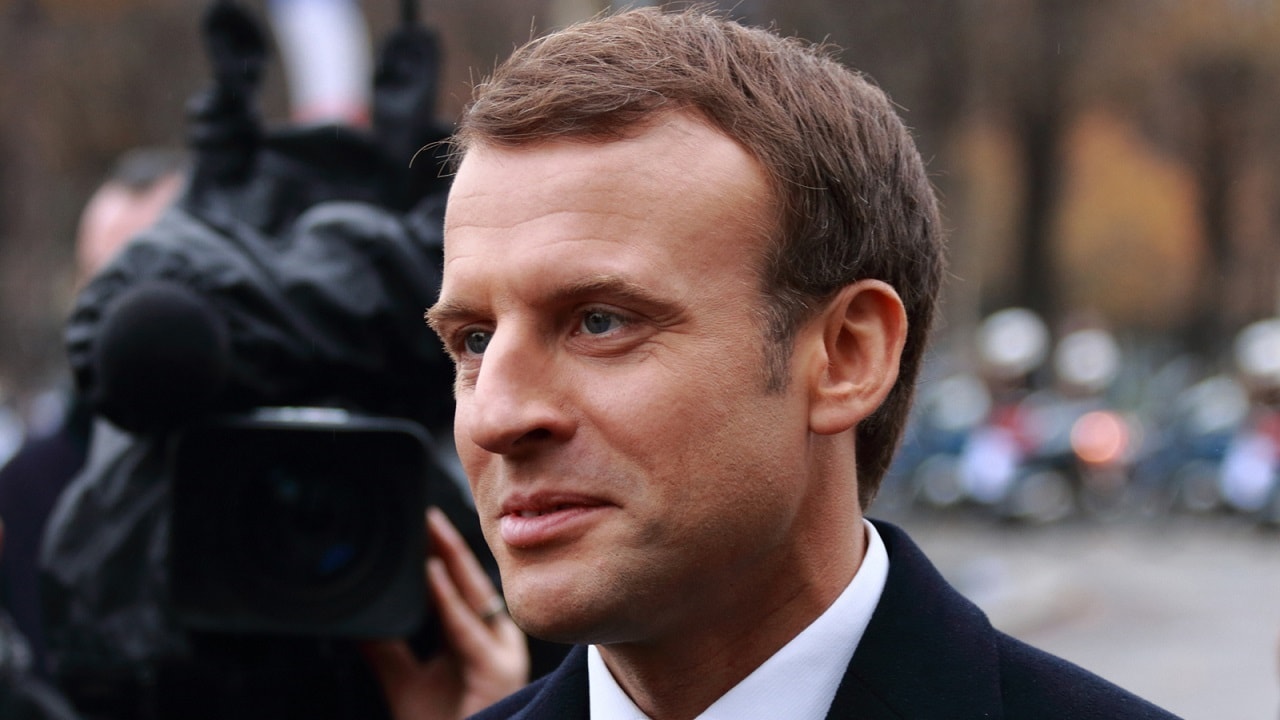
French President Macron from 2017. Image Credit: Creative Commons.
Macron, President Bill Clinton, and UN Secretary-General Kofi Annan have each apologized for their country’s or the UN’s negligence in the run-up to the anti-Tutsi genocide in Rwanda and promised never again. While Norway cites the Rwanda’s anti-Tutsi genocide to virtue signal about human rights, its arrest of Ambazonian leader Lucas Ayaba Cho shows that Norway, like France, today prioritizes cash above moral clarity. Today, Washington, Paris, Oslo and Turtle Bay repeat the same mistakes they did in Rwanda.
This is shameful and should not stand.
About the Author: Dr. Michael Rubin
Michael Rubin is a senior fellow at the American Enterprise Institute and director of policy analysis at the Middle East Forum. A former Pentagon official, Dr. Rubin has lived in post-revolution Iran, Yemen, and both pre- and postwar Iraq. He also spent time with the Taliban before 9/11. For more than a decade, he taught classes at sea about the Horn of Africa and Middle East conflicts, culture, and terrorism, to deployed US Navy and Marine units. Dr. Rubin is the author, coauthor, and coeditor of several books exploring diplomacy, Iranian history, Arab culture, Kurdish studies, and Shi’ite politics.
Note: The author’s views are his own.