
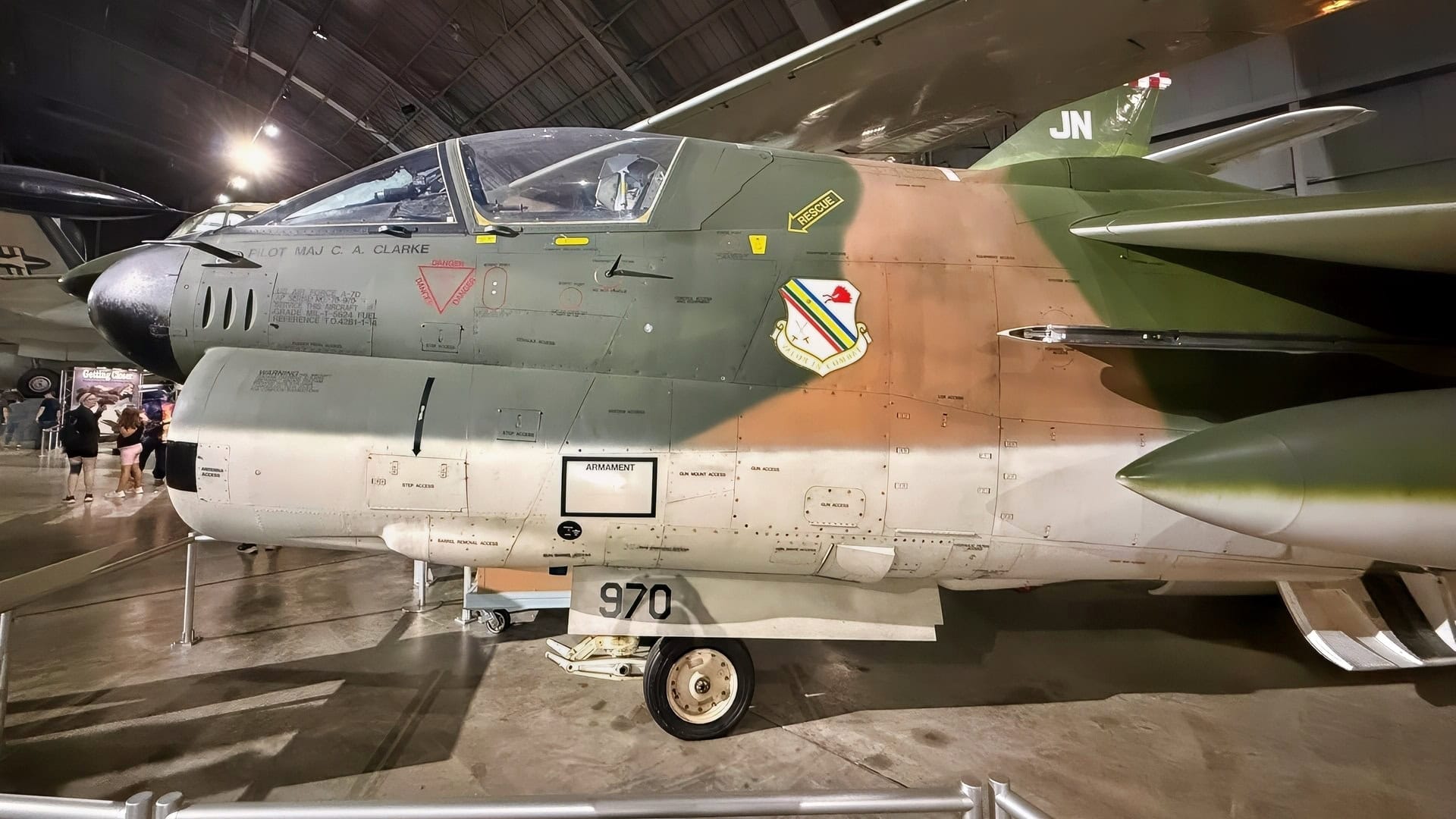
19FortyFive Photographed the A-7 at the National Museum of the U.S. Air Force at Wright-Patterson
In academia (as well as the culinary world of beef and eggs), the “A” grade certifies a top-quality finished product. Meanwhile, in casino gambling, “7” is considered a lucky number (which is why Elvis sang the line “Let me shoot a 7 with every shot” in “Viva Las Vegas“). So, by that rationale, the Ling-Temco-Vought (LTV) A-7D Corsair II (AKA the “SLUF”) light attack aircraft should’ve been the luckiest and most successful warplane ever made, right?
Well, this didn’t exactly turn out to be the case, but the Cold War era
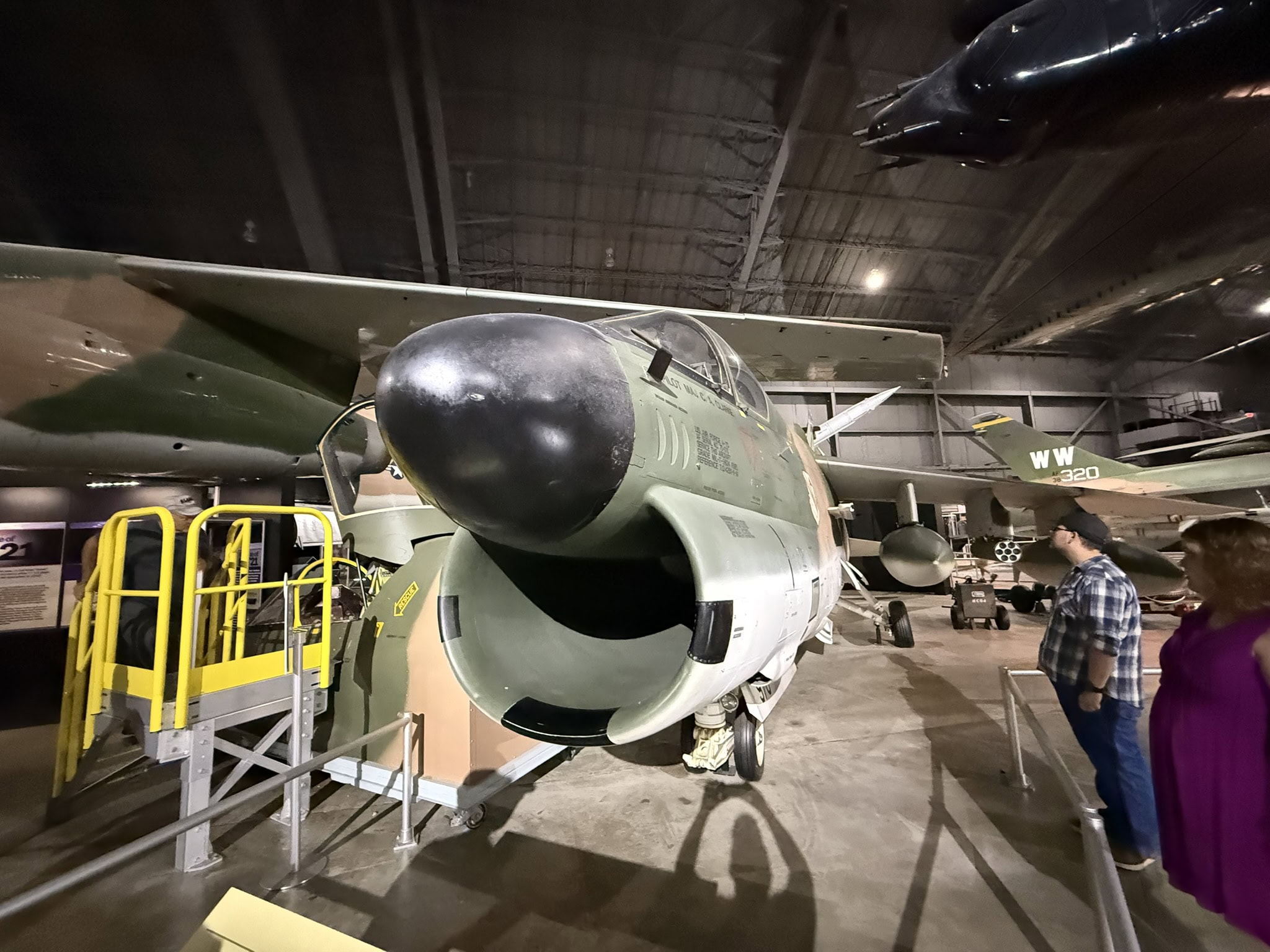
A-7 Corsair II. 19FortyFive.com Image.
A-7 was still pretty darn successful all the same. Accordingly, we now profile the proud history of this stubby little warbird.
What’s In a Name? Corsair II v. SLUF
As for the plane’s official name and unofficial moniker, let’s start with the official one first.
Ironically, Merriam-Webster defines the word corsair as “PIRATE especially: a privateer of the Barbary Coast,” and those Barbary privateers were the first non-Western enemy that the United States Navy ever fought (1801-1805). “Corsair” still became a proud naming tradition in US Naval Aviation in the 20th century. Most famously, there was the Vought F4U Corsair prop-driven fighter plane of World War II, which made life a living hell for Imperial Japan’s aviators (who nicknamed it “Whistling Death“) and immortalized in pop culture via the 1970s TV series “Baa Baa Black Sheep” AKA “Black Sheep Squadron.”
As for the jet-powered LTV Corsair II, it wasn’t a fighter plane, but rather (as already indicated) a light attack warbird. Nonetheless, it turned out to be a ironically appropriate choice to carry on the Corsair moniker, as it ended up performed the majority of its combat service during the Vietnam War (more on this in a bit), wherein the Communist foes referred to American military aviators in general as “Yankee air pirates” (even though, as noted by Vietnam War F-4 Phantom pilot Dick Jonas [Lt. Col., USAF, Ret.], “some of us ain’t Yankees a’tall”).
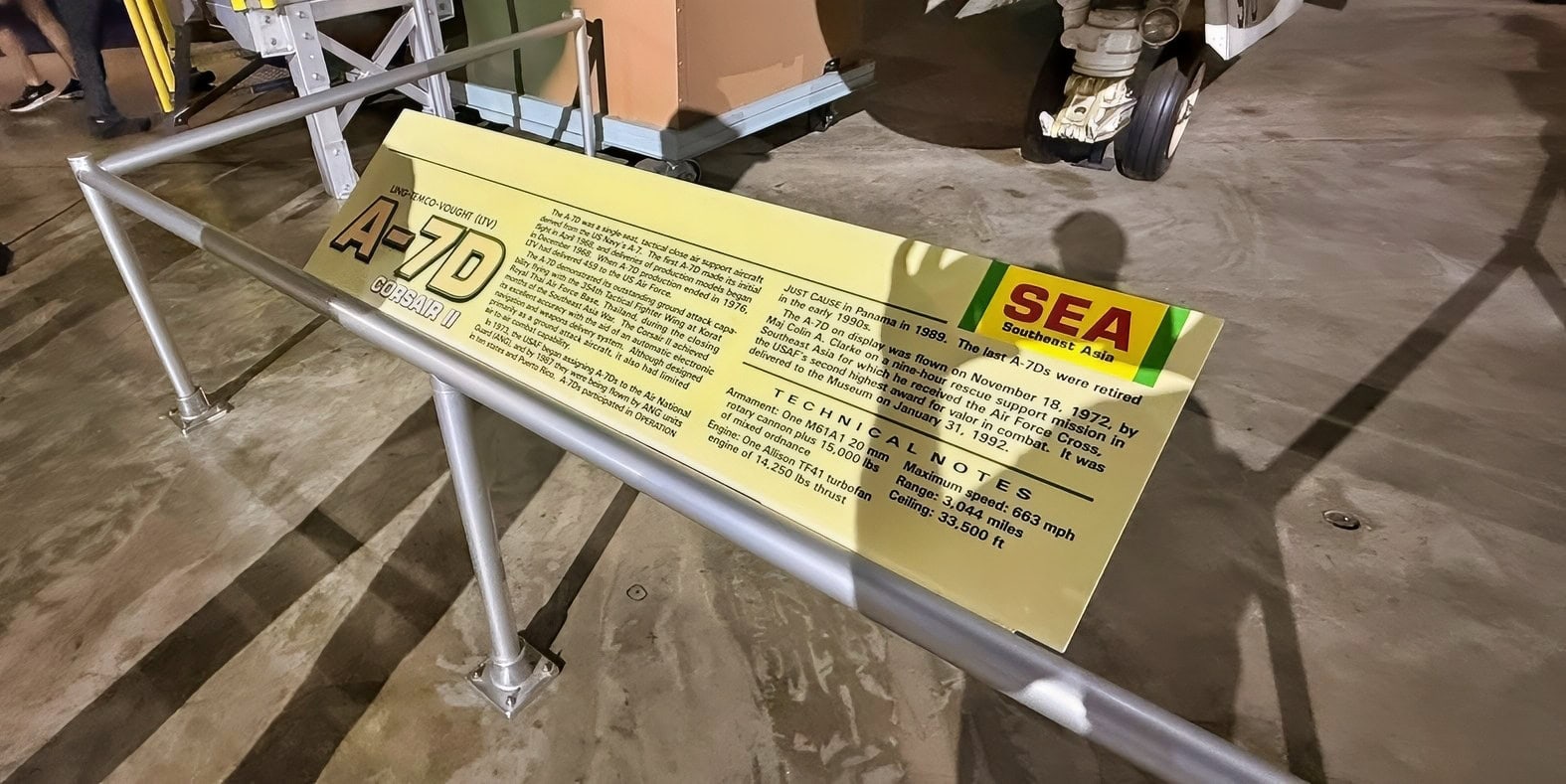
A-7 Corsair II Display. 19FortyFive.com Image.
As for the unofficial, affectionate nickname of “SLUF,” it stands for “Short Little Ugly F—-r” (or “Short Little Ugly Fellow” if you’re in polite company), akin to calling the behemoth Boeing B-52 Stratofortress strategic bomber the “BUFF (Big Ugly Fat F—-r/Fellow).”
Well, as Kinky Friedman put it, “Beauty is in the eye of the beer holder.” The first time I saw a picture of the Corsair – via the box cover photo on Monogram’s 1:48 scale plastic model kit – as a six-year-old lad (too young back then to be a literal “beer holder,” obviously), I actually liked the look of the darn thing as well as the way its (official) name rolled off the tongue! Eh, what can I say? I was a weird kid; I also liked the look of the Empire’s TIE fighters better than the Rebellion’s X-wings in the original Star Wars trilogy, and I preferred the look of the villainous Cylons’ Raider fighters to those of the heroes’ Colonial Viper fighters in the original “Battlestar Galactica” TV series.
A-7 Corsair II Initial History and Premise
The Corsair II was conceived in 1963 as a replacement for the Douglas A-4 Skyhawk in the light attack role. The SLUF made her maiden flight in September 1965, and though she didn’t completely replace the A-4, she did boast nearly double the ordnance payload (15,000 lb. vs. 8,200 lb.) and a greater range (1,070 nautical miles vs. 1,008 nautical miles).
And unlike the A-4, the A-7 was adopted by both the U.S. Air Force and the U.S. Navy. The USN ordered it first, with the USAF following suit by accepting deliveries of production models beginning in December 1968. An estimated 1,545 airframes were built.
(Alas, the LTV Corporation went defunct in 2001.)
Operational History/Combat Performance Part I: Vietnam
As already noted, this little “Yankee Air Pirate” first wielded her proverbial “cutlass” during the Vietnam War. More specifically, she first drew enemy blood in December 1967 when she flew her first combat missions over North Vietnam, courtesy of Attack Squadron 147 (VA-147), aka “The Argonauts.”
As for her performance in Air Force hands during that controversial Southeast Asian conflict, the National Museum of the United States Air Force states, “The A-7D demonstrated its outstanding ground attack capability flying with the 354th Tactical Fighter Wing at Korat Royal Thai Air Force Base, Thailand, during the closing months of the Southeast Asia War. The Corsair II achieved its excellent accuracy with the aid of an automatic electronic navigation and weapons delivery system.
A-7 pilots of the Navy and Air Force alike ended up participating in some of the most important air battles of the Vietnam War, including the mining of Haiphong Harbor, Operations Linebacker I and Linebacker II, and the destruction of Thanh Hoa Bridge. Indeed, the last U.S. air strike over Cambodia was made by an A-7D on August 15, 1973.
As for air-to-air combat, as already noted, the “SLUF” wasn’t designed for that role; for one thing, her max airspeed topped off at 663 mph (Mach 0.86), which paled in comparison to the supersonic F-4 Phantom II and F-105 Thunderchief. That said, the A-7 did carry a 20mm M61-A1 Vulcan rotary cannon and two AIM-9 Sidewinder missiles for self-defense. The only known instance of a Corsair II driver engaging an enemy fighter was on May 10, 1972 – the first day of Operation Linebacker I – when then-Navy Lieutenant George T. Goryanec took on a North Vietnamese Air Force MiG-17 “Fresco” and may have scored some hits with his cannon.
As a major plus, the A-7 had a refreshingly low loss rate.
Operational History/Combat Performance Part Deux: Post-Vietnam
The end of the Vietnam War did not signify the end of the Corsair II’s combat career. The warbird served in multiple conflicts during the final decade of the Cold War. For example, during Operation Urgent Fury in Grenada in 1983, Vice Admiral Joseph P. Metcalf III, overall operational commander of the mission, credited the airplane thusly: “The A-7 provided the turning point in the battle of St George’s [capital of the Caribbean island nation], allowing the multinational force to quickly gain the upper hand.”
The SLUF would have her last combat hurrah in the 1991 Persian Gulf War, AKA Operation Desert Storm. Therein, 16 A-7 pilots of VA-46 and VA-72 embarked from the USS John F Kennedy (CVA-67) in the predawn hours of January 17, 1991–the opening day of the conflict—carrying AGM-88 HARM missiles, which they used to attack radar sites in and around Saddam Hussein’s Baghdad. All told, A-7Es finished their contribution to the Gulf War with 725 sorties flown and 3,100 combat flight hours logged. No Corsair IIs were lost to enemy action, thus ending their wartime service record with an even better loss ratio than they had in Nam.
Where Are They Now?
The USN and USAF retired their chunky little “air pirates” in 1991 (right on the heels of re-proving their worth in the Gulf War), and the Air National Guard (ANG) followed suit in 1993. However, the Portuguese Air Force, the Royal Thai Navy, and the Hellenic Air Force of Greece kept their Corsairs operational until 1999, 2007, and 2014, respectively.
According to the A-7 Corsair II Association, Inc., “there are nearly 200 A-7 aircraft on display around the world.” Besides the aforementioned National Museum of the United States Air Force (which is located at Wright-Patterson Air Force Base, Ohio, where we took these pictures), some surviving examples of the A-7D variant can be found at the Quonset Air Museum in North Kingstown, Rhode Island, and the Commemorative Air Force (CAF) Highland Lakes Squadron in Burnet, Texas.
About the Author: Christian D. Orr, Defense Expert
Christian D. Orr is a Senior Defense Editor. He is a former Air Force Security Forces officer, Federal law enforcement officer, and private military contractor (with assignments worked in Iraq, the United Arab Emirates, Kosovo, Japan, Germany, and the Pentagon). Chris holds a B.A. in International Relations from the University of Southern California (USC) and an M.A. in Intelligence Studies (with a concentration in Terrorism Studies) from American Military University (AMU). He is also the author of the book “Five Decades of a Fabulous Firearm: Celebrating the 50th Anniversary of the Beretta 92 Pistol Series, the second edition of which was recently published.