
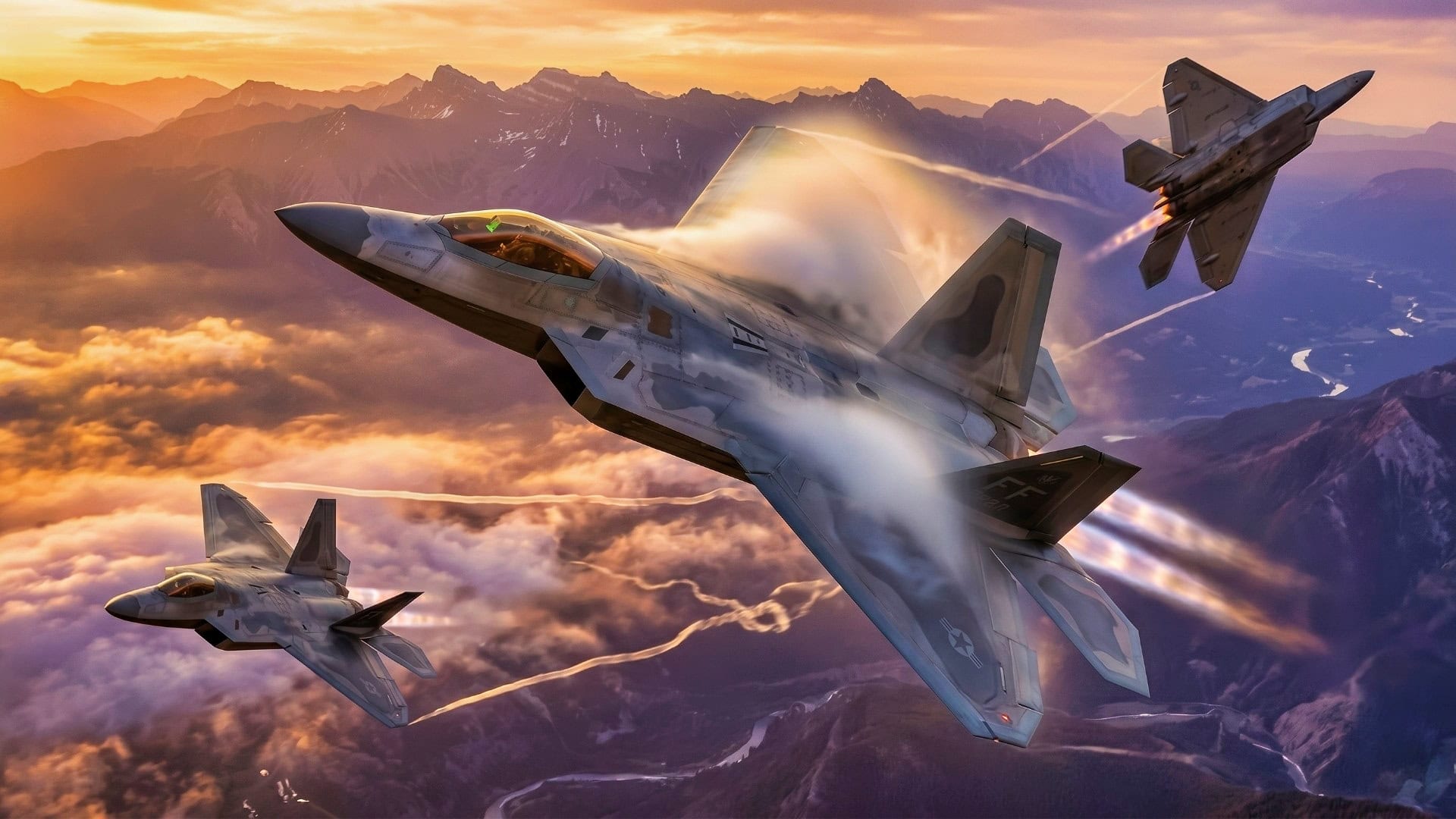
How Much Longer Can The F-22 Raptor Rule The Sky?: The F-47 NGAD is already in limited production and will eventually replace the iconic F-22 Raptor, which was initially planned for 2030 but may be extended a few more years.
Despite upgrades and the addition of Block 20 aircraft and the advent of conformal, stealthy extra fuel tanks to expand the fleet, the USAF plans to retire the F-22 Raptor sooner rather than later, primarily due to two reasons: the F-22’s high operating costs and its obsolescence in several areas, with the obsolescence being the primary factor.
How much longer would the F-22 Raptor be able to dominate the skies?
The US Air Force Is Gearing Up For The F-47 NGAD:
Early last spring, President Trump confirmed that Boeing secured a contract to develop the U.S. military’s F-47 Next Generation Air Dominance (NGAD) program, a project valued at over $20 billion.
The NGAD sixth-generation stealth fighter will replace the F-22 Raptor. Trump confirmed the long-held rumors that the NGAD stealth fighter has been flying for the past five years. The new F-47, as it has been named, is slated to replace the F-22 within the next decade.
“The F-47 will be the most advanced, most capable, most lethal aircraft ever built,” Trump told reporters. “America’s enemies will never see it coming,” he added.
The new aircraft will feature state-of-the-art stealth capabilities, engines capable of exceeding Mach 2, and the ability to operate as a quarterback for stealth drone fighters, thereby maintaining American air dominance.
But what are the reasons that the Raptor is being replaced?
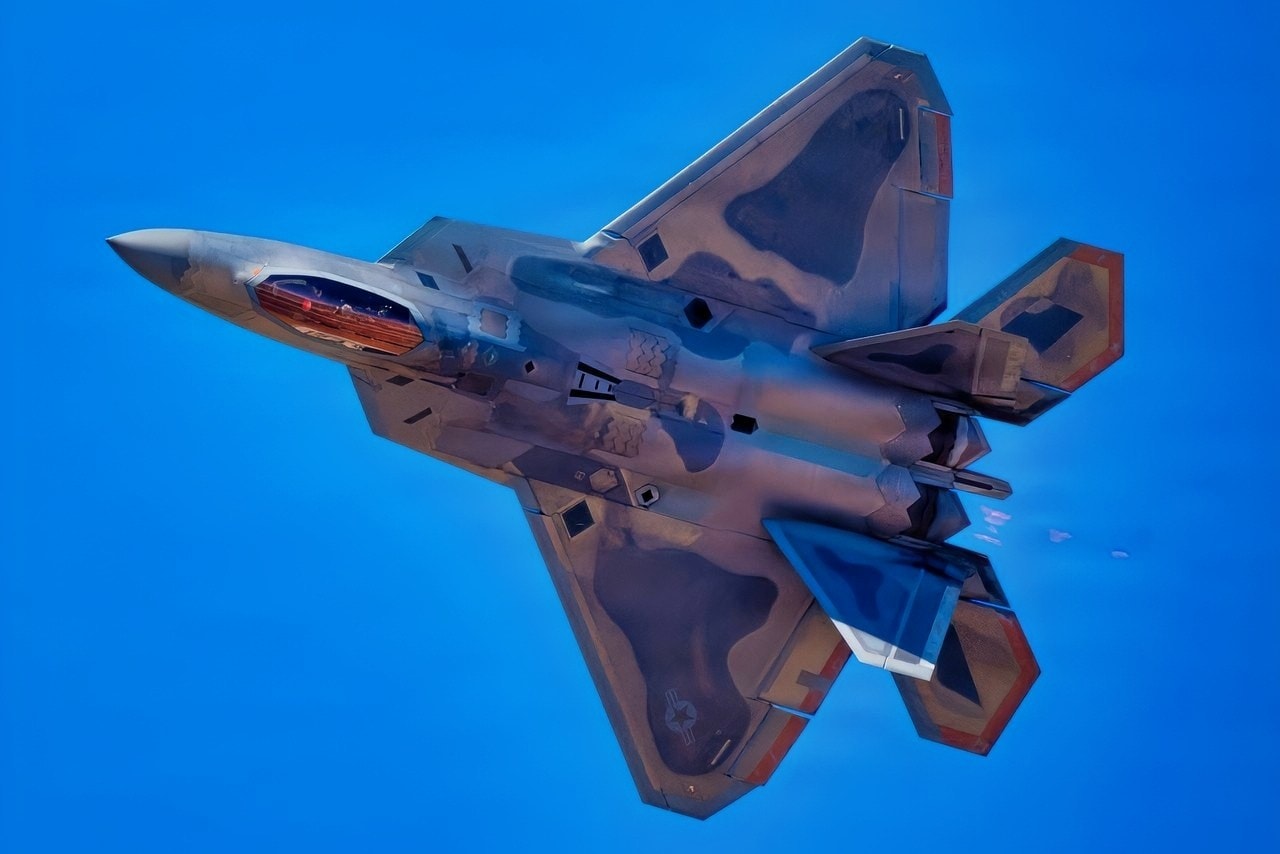
U.S. Air Force Capt. Samuel “RaZZ” Larson, F-22 Raptor Aerial Demonstration Team pilot and commander, performs during FIDAE 2024, Santiago, Chile, April 4th, 2024. The F-22 Raptor Aerial Demonstration showcases the unmatched maneuverability of the airframe by executing a series of combat maneuvers to inspire Americans and their allies, and deter foreign adversaries. (U.S. Air Force video by Staff Sgt. Michael Bowman)

U.S. Air Force Capt. Samuel “RaZZ” Larson, F-22 Raptor Aerial Demonstration Team pilot and commander, performs during FIDAE 2024, Santiago, Chile, April 4th, 2024. The F-22 Raptor Aerial Demonstration showcases the unmatched maneuverability of the airframe by executing a series of combat maneuvers to inspire Americans and their allies, and deter foreign adversaries. (U.S. Air Force video by Staff Sgt. Michael Bowman)
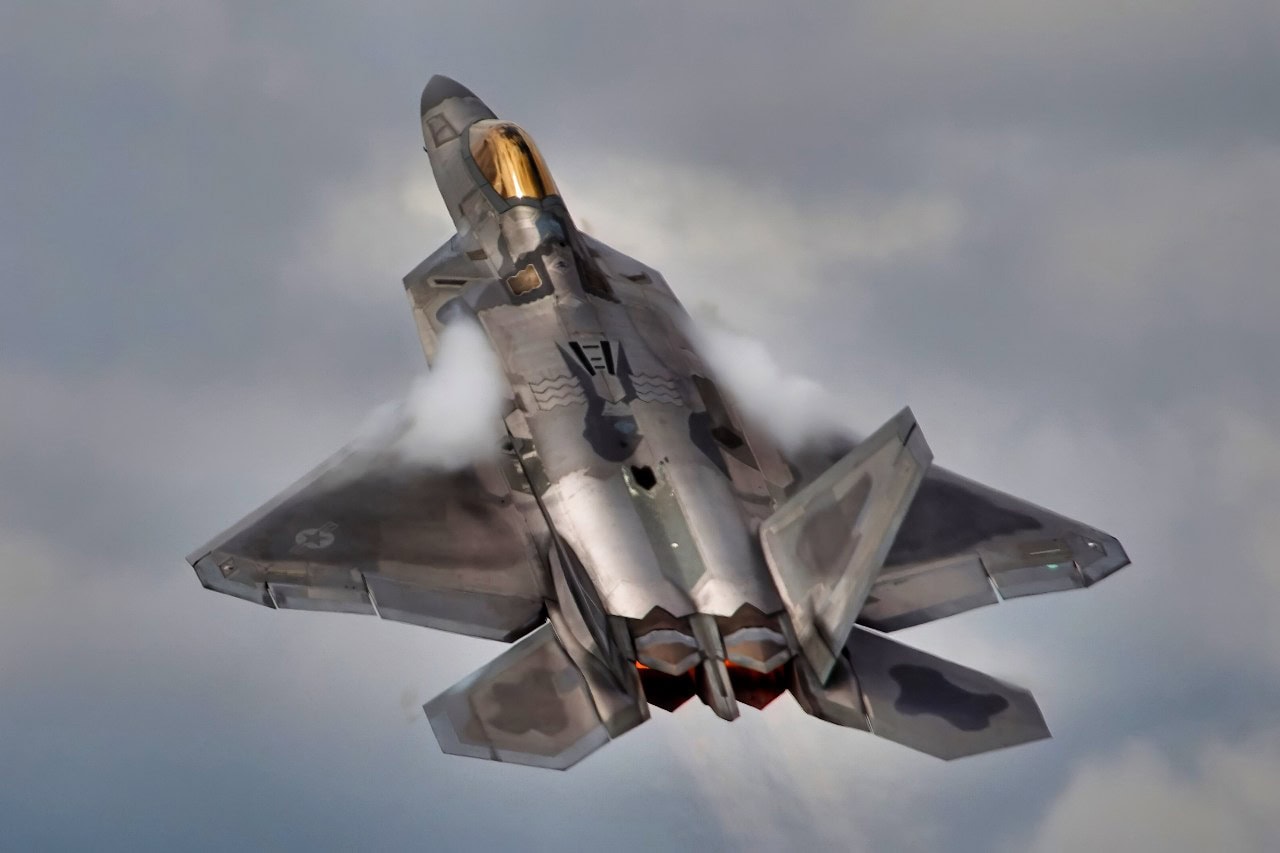
F-22 Raptor in Flight Back in 2017. Image Credit: Creative Commons.
The Raptor Is Very Expensive To Fly And Maintain:
Due to its high operating costs, the F-22 fleet was capped at 186 at the end of the Cold War, resulting in small numbers to replace the F-15. Consequently, its logistics and supply chain do not benefit from economies of scale as much as those of jets like the F-16 and the F-35.
The F-22 also utilizes older stealth materials, which increase maintenance costs. Properly retrofitting the F-22 with the F-35’s more durable complete material stack is also not possible without replacing the composite panels of every F-22.
These composites are not the same, so the structural strength of the jet and, possibly, the thickness of its skin would be affected, requiring recertification of its life limit and likely some redesigns of panels and doors to accommodate the altered geometry.
Several other technological advances enable fighters to be cheaper to maintain, but these require redesigns of the F-22, some of which are extensive.
The F-22’s Limited Range For an Indo-Pacific War:
Aviation analyst James Smith wrote on Quora that the F-22 was designed for a different war.
“The F-22 was designed primarily for fighting in Europe and turn of the millennium era threats, and so its combat radius of approximately 590 nautical miles (less with any use of supercruise) is not ideal for a war with China.
“This is because jets may need to be flying from locations like Guam and relying on tankers only ~400 nautical miles (if F-22s are using supercruise) behind the F-22’s, which would then be threatened by new very long range missiles and enemy stealth fighters that may be able to slip sufficiently far past fighter screens to take those tankers out.
“By comparison, the F-35A (land-based variant) has an air-to-air combat radius of 760 nautical miles, with a new engine being developed for it which would boost that to nearly 1000 nautical miles. The F-22’s NGAD successor is also anticipated to have an approximately 1000+ nautical miles combat radius.”
However, the Low Drag Tank and Pylon (LDTP) program is a Lockheed Martin effort to develop stealth-compatible external fuel tanks for the F-22 Raptor, significantly extending its combat range for Pacific operations without sacrificing low-observability. These tanks feature a low-drag, sleek design and can be jettisoned to leave a clean, stealthy aircraft profile or left in place.
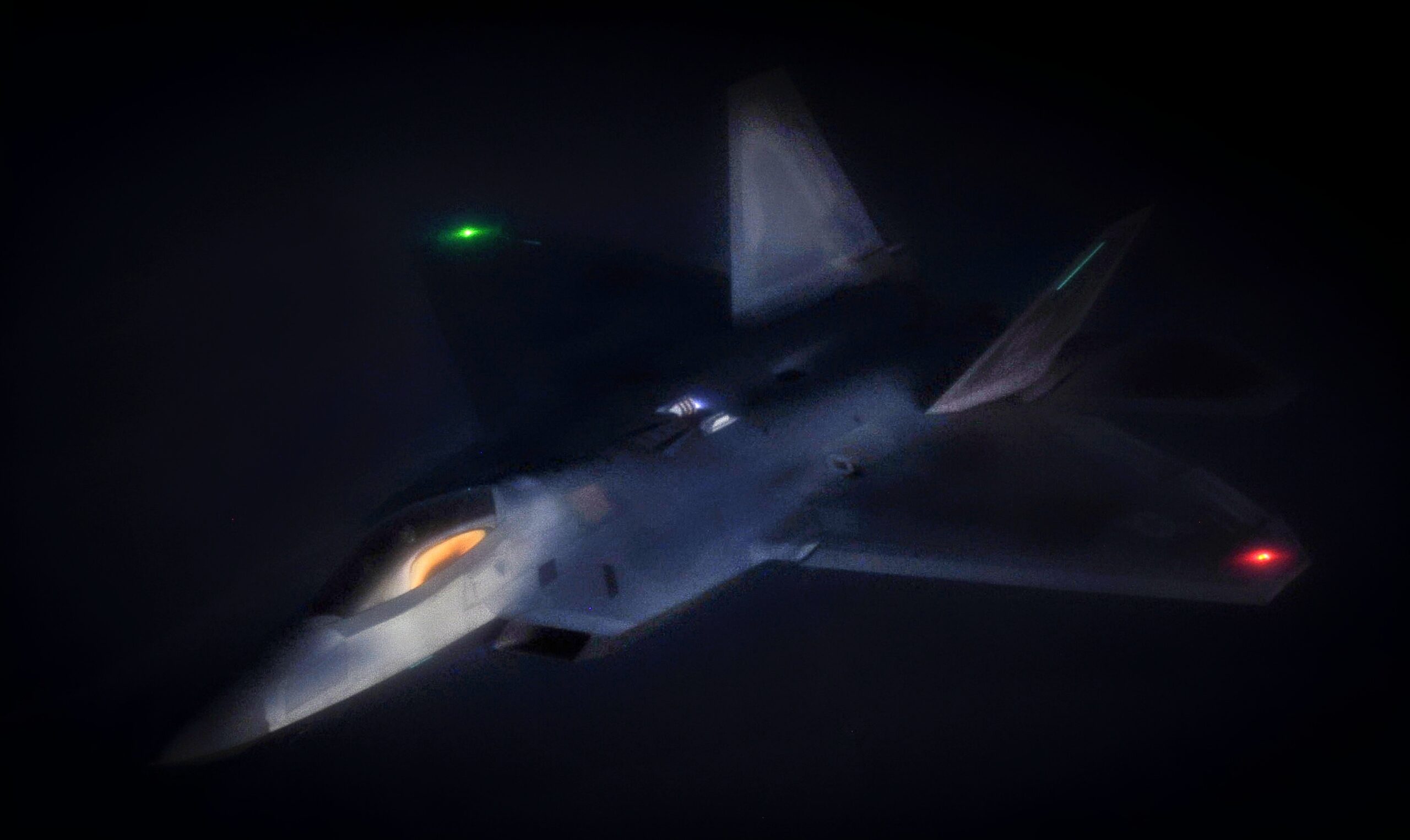
An F-22 Raptor fighter jet, assigned to the 433rd Weapons Squadron at Nellis Air Force Base, Nev., maneuvers after being refueled by a KC-135 Stratotanker during a Weapons School Integration mission over the Nevada Test and Training Range June 8, 2012. One of the most important planned aspects of this mission is holding it during the hours of darkness. (U.S. Air Force photo by Senior Airman Kevin Tanenbaum/Released)
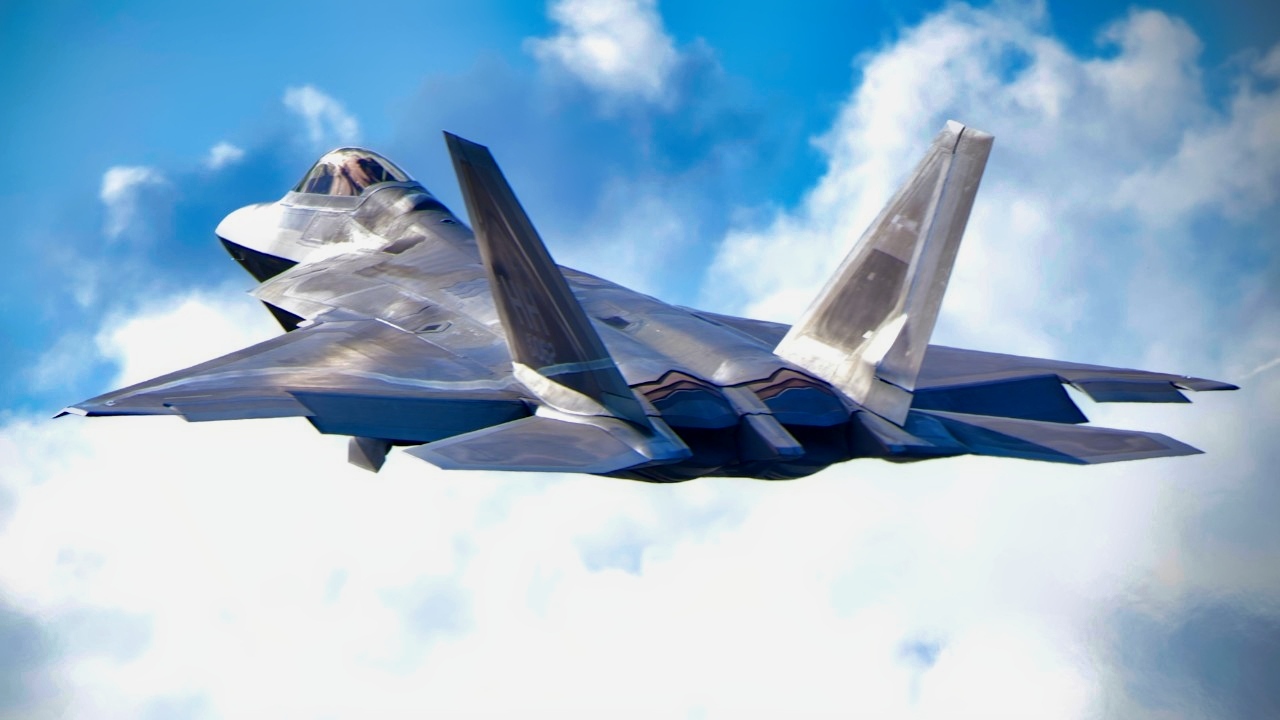
An F-22 Raptor aircraft takes off from Joint Base Pearl Harbor-Hickam, Hawaii, Aug. 8, 2024. The F-22 Raptor is a fifth-generation stealth fighter designed for air dominance, with capabilities in precision attack, advanced avionics, and unparalleled maneuverability. (U.S. Air National Guard photo by Tech. Sgt. Joseph Pagan) Screenshot
“These can go into combat,” says Katie Ciccarino, vice-president of Lockheed’s F-22 program.
“They are droppable if they need to be,” she added. “But the idea would be not to drop them, and to retain them throughout whatever the pilot is doing and then coming home and being able to use them again.”
Both the current and new external tanks provide F-22s with an extra 850 nautical miles (1,570km) of range, according to Lockheed.
So, if they can produce these in enough numbers, it may prolong the life of the Raptor for a bit longer.
Aging Technology: The Real Air Force Problem
Some subsystems are becoming obsolete, particularly the Common Integrated Processor (CIP) and Intra-Flight Data Link (IFDL), which struggle in high-intensity electronic warfare.
The F-22 Block 20 the Air Force plans to use refers to the 32 older, non-combat-configured F-22 Raptors the U.S. Air Force has been trying to retire, but Congress has repeatedly blocked.
These aircraft are used for training purposes but lack modern communications, electronic warfare systems, and the ability to fire modern weapons, unlike the combat-ready Block 30 and 35 versions.
The debate continues over whether to retire them to fund next-generation aircraft or to upgrade them to increase the total number of combat-capable Raptors.
The F-47 Is Stealthier Than The Raptor
The F-22 Raptor is the world’s oldest stealth fighter; it was designed in the 1990s and has been flying for more than 20 years. Despite this, it remains the stealthiest fighter, bar none. With a radar cross-section that’s generally estimated to be as much as 15 times smaller than the F-35 and maybe 100 times smaller than China’s J-20.
The F-22 is still the standard by which every other stealth fighter is measured. Even after 20 years of service, it is still the best stealth fighter in the world. But the rest of the world is slowly catching up. And it’s time, as #1 will soon end and be replaced by the F-47.
The Airframes Have A Lot of Hours On Them
The airframes, while still having plenty of life left, have a lot of hours on them. More than anything, the Raptor was just a victim of bad timing. The USAF had this incredible fighter, but with no one left to fight, the Soviet Union had collapsed. The US was spending trillions of dollars fighting two wars in Iraq and Afghanistan, and budget cuts were looming.
Then, the US made a big mistake. It didn’t pause the F-22 production line—it shut it down. Yes, the F-22 was incredibly expensive, but if they had kept producing them, the cost would have been reduced. But the assembly line was shut down.
Only 186 Raptors were produced, and currently, there are only between 150-180 combat-capable aircraft. The US has been pouring money into upgrades to keep it atop the heap, but that 180 number is a hard stop. If an aircraft suffers an accident or is lost in combat, it can not be replaced.
The high cost of maintenance and operation is prohibitive. And the Chinese have produced hundreds of J-20s. The NGAD F-47 will have a larger technology advantage over anything our enemies have.
With a production line pushing out F-47s, the F-22 Raptors will still be around until the fleet of F-47s is manned and ready. The good thing is that with the host of new technologies for the F-47, the F-22 will benefit from some of them, as the Air Force upgrades the Raptors to keep them equipped with the best technology.
The Air Force wants to retire 32 older Block 20 F-22s that can’t be used in combat. The Block 20s were primarily designed for training purposes and are not combat-coded. The Eurasian Times reported, “Additionally, these jets belong to the early production models known as Block 20 jets, primarily designed for training purposes and are not combat-capable.”
Regarding this batch of older F-22s, LTG Richard Moore states, “They will never be a part of the combat force.” By retiring them, the Air Force could save around $500 million a year. It would cost the Air Force $3.5 billion to bring these 32 F-22s to combat capability.
The Air Force loves the F-22, but it simply doesn’t have enough of them, and with no production line to make more, it is time to transition to the F-47, and the F-35. The strange part of the long saga of the F-22 is that it will be retired before the plane it replaced, as the F-15EX will continue to fly on.
It is an expensive machine. As Alex Hollings wrote, “The F-22 upgrade budget is enough to purchase 132 new F-35As and still have enough left over for a very comfortable retirement. In terms of the 150 combat-coded F-22s in America’s stable, that shakes out to roughly $72.6 million in upgrades allocated to each individual Raptor.
In the meantime, with the F-47 and the F-35 having the capability to operate the Air Force’s Collaborative Combat Aircraft (CCA) program, which is a multi-pronged initiative to test, develop, and implement new autonomous and manned-unmanned aircraft teaming concepts.
It is also known as the Loyal Wingman concept, capable of flying independently or in small groups to counter China’s anti-access/area-denial (A2/AD) capabilities. The F-22 will also be able to deploy with these.
The Raptor is still the King of the dogfighters, but it has an expiration date. And as much as no one wants to see them retired, Father Time remains undefeated.
About the Author: Steve Balestrieri
Steve Balestrieri is a National Security Columnist. He served as a US Army Special Forces NCO and Warrant Officer. In addition to writing on defense, he covers the NFL for PatsFans.com and is a member of the Pro Football Writers of America (PFWA). His work was regularly featured in many military publications.