
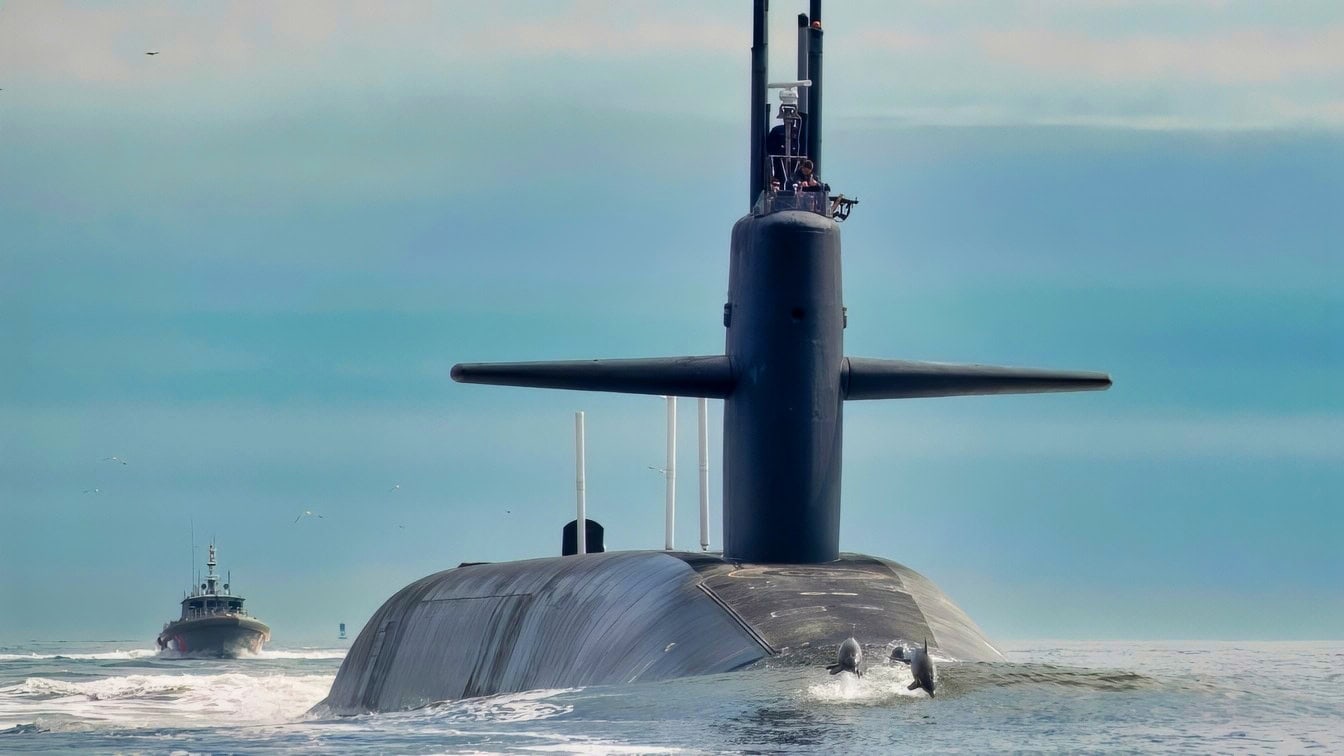
Ask what a single Ohio-class ballistic missile submarine could do in a war, and the answer arrives in two numbers: roughly 90 nuclear warheads aboard, and roughly 540 Hiroshimas of explosive force among them, riding on a vessel designed to be impossible to locate. The arithmetic is public, verified by the world’s standard references, and worth walking through carefully, because it is both more modest than the internet version and more staggering than most people imagine. It is also the entire reason these boats exist: firepower this absolute is meant to guarantee it is never used.
The Real Loadout: Ohio-Class Math
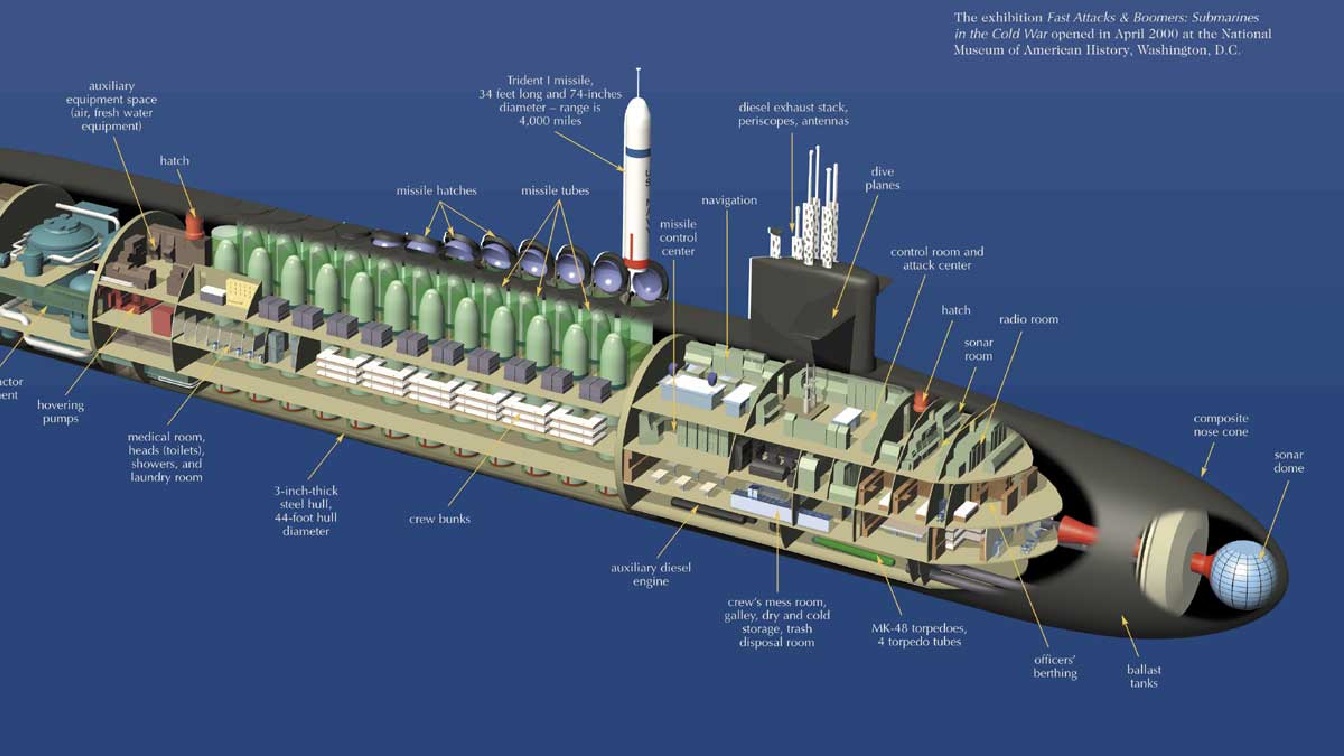
Ohio-Class SSBN. Image Credit: Creative Commons.
It would make sense to begin with what one boat actually carries, because the popular version is out of date. The Navy operates 14 Ohio-class ballistic missile submarines, eight based at Bangor, Washington, and six at Kings Bay, Georgia, each able to carry up to 20 Trident II D5 missiles. The often-repeated claim that each boat packs 24 missiles and 192 warheads describes the original design; four of the 24 tubes were deactivated on every boat under the New START treaty roughly a decade ago, and the loading below the maximum matters even more.
Each Trident can carry up to eight independently targetable warheads, but in practice the missiles average four to five apiece, for a load-out of approximately 90 warheads per submarine, according to the Bulletin of the Atomic Scientists’ authoritative Nuclear Notebook.
The mix is two main types, the 90-kiloton W76-1 and the 455-kiloton W88, plus a wrinkle added in 2019: one or two missiles on some boats carry the low-yield W76-2, a roughly five-kiloton weapon of which only about 50 were built, first deployed aboard USS Tennessee and justified by the Pentagon as closing a perceived gap in deterring limited nuclear use.
The Arithmetic
Now run the numbers, conservatively. Assume every one of the 90 warheads is the smaller W76-1. Ninety warheads times 90 kilotons is 8,100 kilotons, or 8.1 megatons, aboard one submarine.
The bomb that destroyed Hiroshima yielded about 15 kilotons, which makes a single boat’s conservative load the equivalent of roughly 540 Hiroshimas, and every W88 in the real mix raises the figure, since one W88 alone equals about 30 Hiroshimas. Load the boat to its treaty-era maximum of eight warheads on all 20 missiles, and the count reaches 160. The hardware could go further still: SIPRI notes each D5 was counted under the original START treaty as carrying eight warheads and was initially flight-tested with 14, and the missile’s design lineage supports up to a dozen reentry vehicles, with a range on the order of 12,000 kilometers, meaning a boat in the open Pacific holds continents at risk without moving.
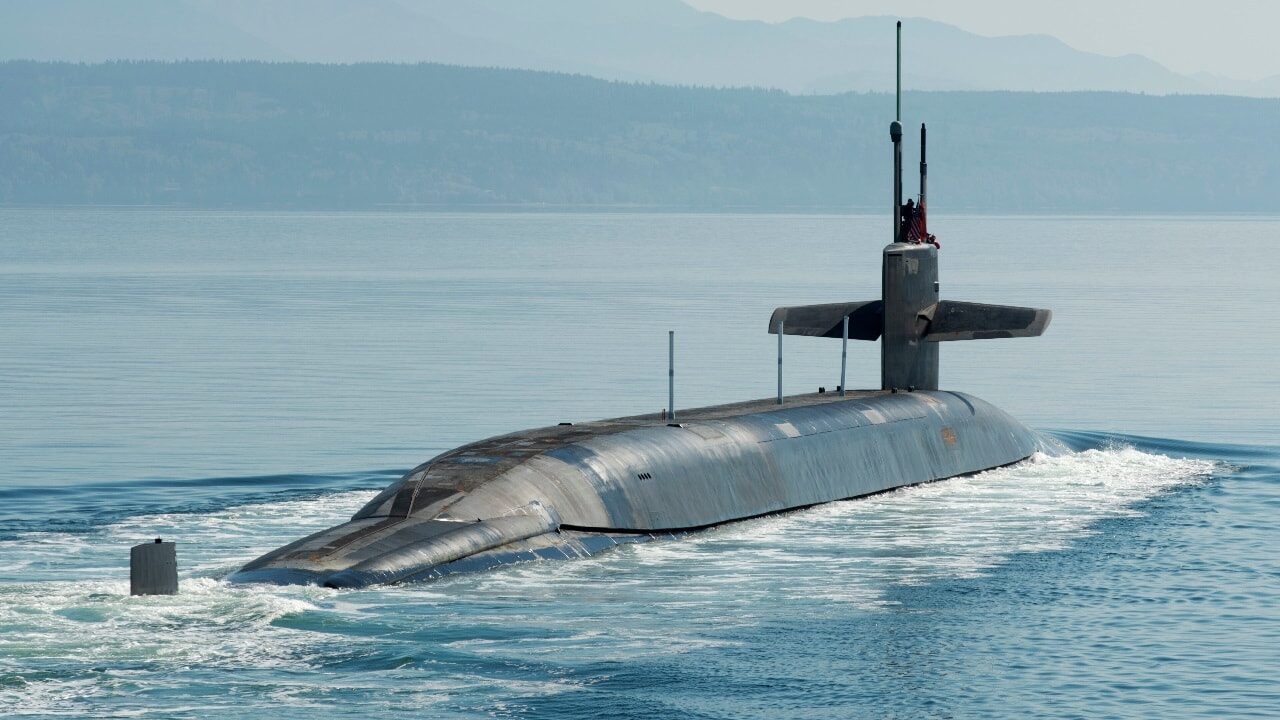
The Blue crew of the ballistic-missile submarine USS Henry M. Jackson (SSBN 730) transits the Hood Canal as it returns home to Naval Base Kitsap-Bangor following a routine strategic deterrent patrol on Sept. 30, 2015. US Navy photo.
However, the load is counted, one hull carries more nuclear firepower than most nuclear-armed nations field in their entire arsenals. Those 90 warheads do not travel to one place, either: independently targetable means the missiles of a single submarine can distribute their weapons across dozens of separate aimpoints in a single salvo.
There is also a hidden multiplier in the accounting. SIPRI counts roughly 1,920 warheads assigned to the submarine force in total, about double the number actually deployed at sea, a reserve that exists precisely so the missiles could be uploaded back toward their maximum if the arms-control era ended. That era, for practical purposes, has ended: New START lapsed in February 2026 without a successor, and with it went the last legal ceiling on how many warheads these tubes may carry. The 90-warhead boat of today is, by design, a 160-warhead boat in waiting.
Why One Boat Is Enough
The number only becomes a strategy when paired with the boat’s defining feature: nobody can find it. An Ohio on patrol runs silent and deep for months, its position unknown even to most of the Navy, and several are at sea at any given moment; each hull carries two alternating crews, Blue and Gold, so the boats spend the great majority of their lives on patrol rather than pierside.
The same Nuclear Notebook accounting puts roughly 950 to 970 warheads on the submarine force at a time, about 70 percent of all deployed U.S. strategic warheads, riding on the one leg of the nuclear triad that cannot be caught on the ground or dug out of a silo.
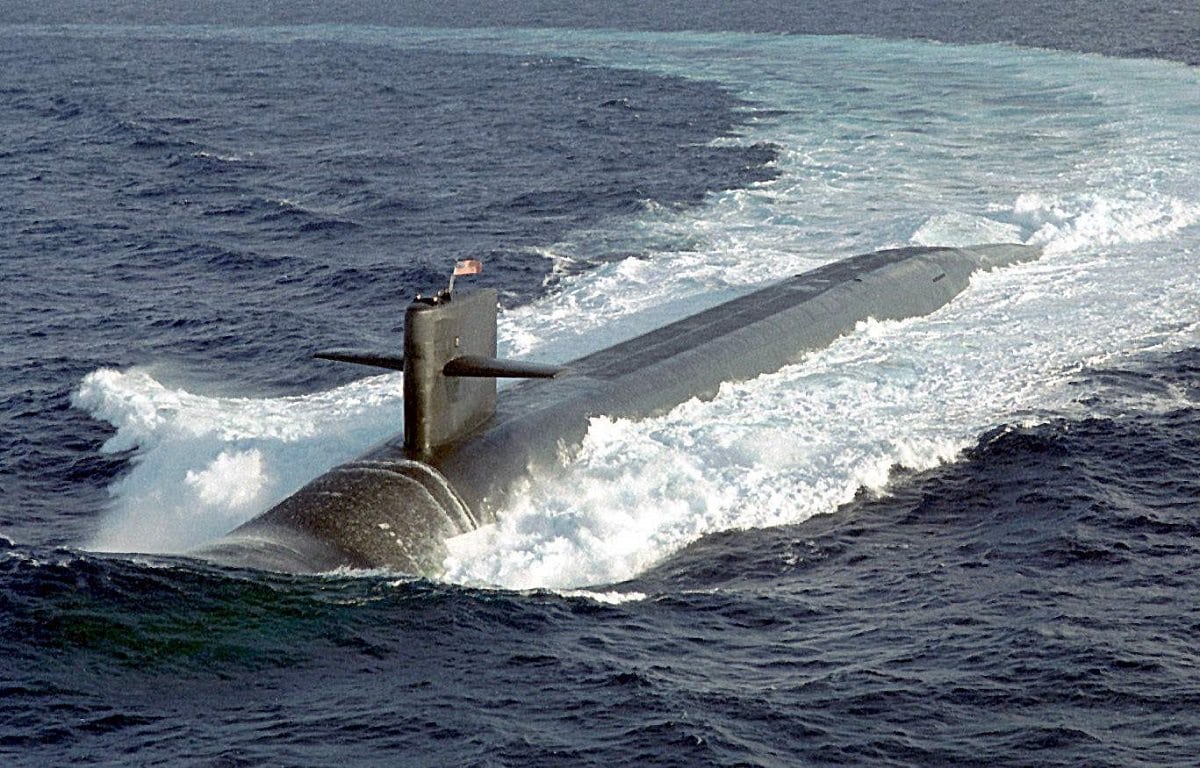
USS Maine (SSBN-741). Image: Creative Commons.
The commander of U.S. Strategic Command put the formula in eight words at the force’s 1,000th-patrol milestone, crediting the boats’ “inherent stealth, unparalleled firepower and nearly limitless endurance.” The doctrine follows directly: any adversary contemplating a first strike on the United States must assume that at least one untouched submarine survives, and one submarine is national ruin. That is the mutual-assured-destruction logic in its purest form, and it is precisely the same calculus Russia runs with its own ballistic missile submarines, which is why both nations guard their boomer fleets above almost everything else they own.
The Handoff
The sobering footnote is the age of the platform carrying all this. The Ohio-class boats entered service in the 1980s, were built for 30 years, and have been stretched to 42, and their replacement is the most expensive shipbuilding program in American history, the Columbia class, running years behind its original schedule against a lifecycle bill approaching $350 billion, even as its construction recovery gathers pace.
The twelve Columbias will each carry 16 tubes rather than 20, armed with the same Trident II missiles at first, a deliberate bet that fewer tubes on a quieter, always-available boat preserve the same unanswerable arithmetic. And the arithmetic, in the end, is the point.
The Ohio class has conducted thousands of deterrent patrols over more than four decades, and, as the Navy noted at the 1,000-patrol milestone, the nation has never fired one of these missiles in anger.
Ninety warheads and 540 Hiroshimas per boat are the most destructive cargo ever taken to sea, and its entire purpose, achieved every single day since 1981, is to ensure the question of what it could do in a war remains forever theoretical.
About the Author: Harry J. Kazianis
Harry J. Kazianis (@Grecianformula) was the former Senior Director of National Security Affairs at the Center for the National Interest (CFTNI), a foreign policy think tank founded by Richard Nixon based in Washington, DC. Harry has over a decade of experience in think tanks and national security publishing. His ideas have been published in the NY Times, The Washington Post, The Wall Street Journal, CNN, and many other outlets. He has held positions at CSIS, the Heritage Foundation, the University of Nottingham, and several other institutions related to national security research and studies. He is the former Executive Editor of the National Interest and the Diplomat. He holds a Master’s degree focusing on international affairs from Harvard University.