
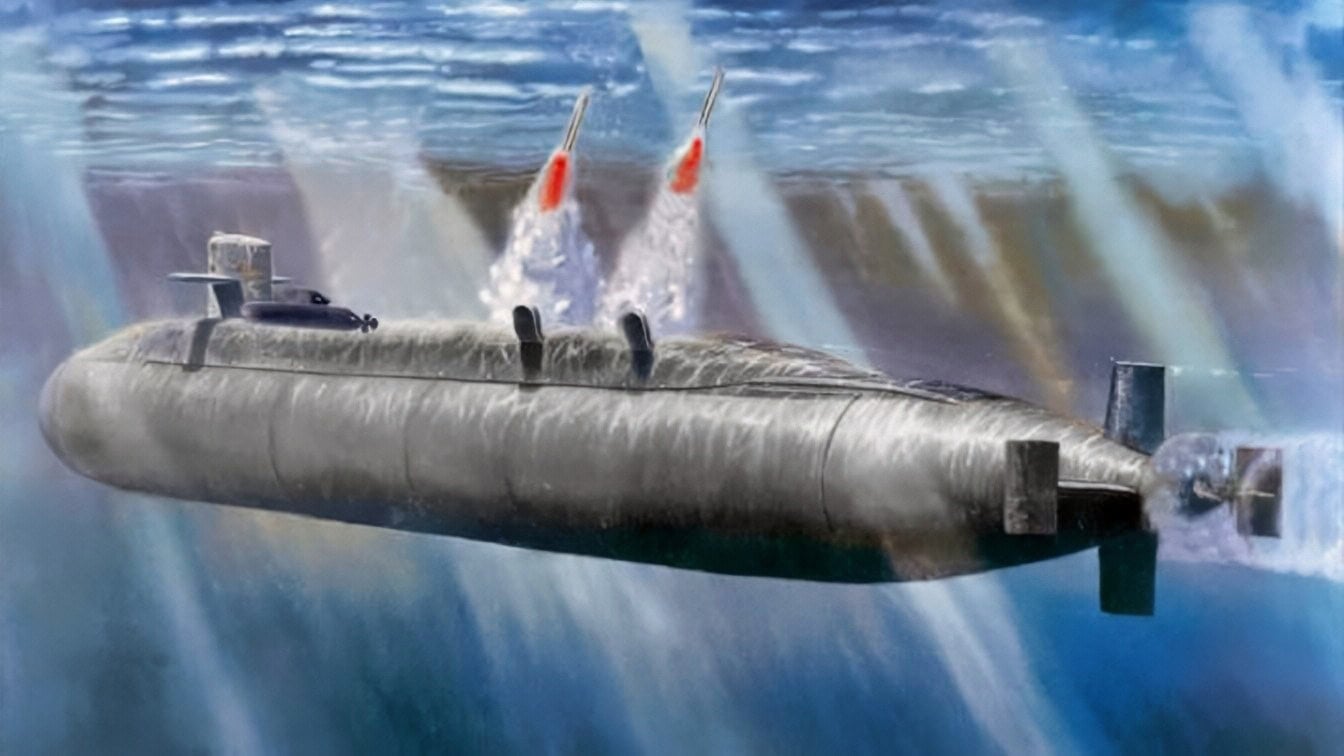
The U.S. Navy is about to begin retiring one of its largest concentrations of conventional firepower. USS Georgia is scheduled to enter inactivation on July 31, 2026. The Navy’s latest shipbuilding plan places USS Ohio in fiscal 2027, USS Florida in fiscal 2028 and USS Michigan in fiscal 2029.
Each Ohio-class guided-missile submarine, or SSGN, has 22 launch tubes able to hold as many as seven Tomahawk cruise missiles apiece. That produces a maximum load of 154 Tomahawks per boat and 616 across the four-submarine force. Two additional large tubes support special operations forces.
Retiring the submarines does not remove Tomahawks from storage, but it eliminates the ability to deploy hundreds of them aboard four stealthy, long-endurance platforms. The Iran war exposed how quickly the Tomahawk stockpile was being depleted. The U.S. military fired at least 850 during the first four weeks, while the current inventory and cumulative number expended remain classified.
The Navy received funding for 58 new Tomahawks in fiscal 2026 and has requested 785 in fiscal 2027. RTX has agreed to expand annual production beyond 1,000 under agreements lasting as long as seven years. The larger output remains future capacity, while Georgia’s scheduled inactivation is four days away.
One Ohio SSGN Carries Nearly Four VPM-Equipped Virginia Submarines’ Missile Load
The Virginia Payload Module is the Navy’s planned long-term answer. The 84-foot hull section contains four large launch tubes and adds 28 Tomahawk positions to an attack submarine, raising its vertical-launch capacity from 12 to 40. Matching one SSGN’s 154-missile maximum therefore requires roughly four VPM-equipped Virginias.
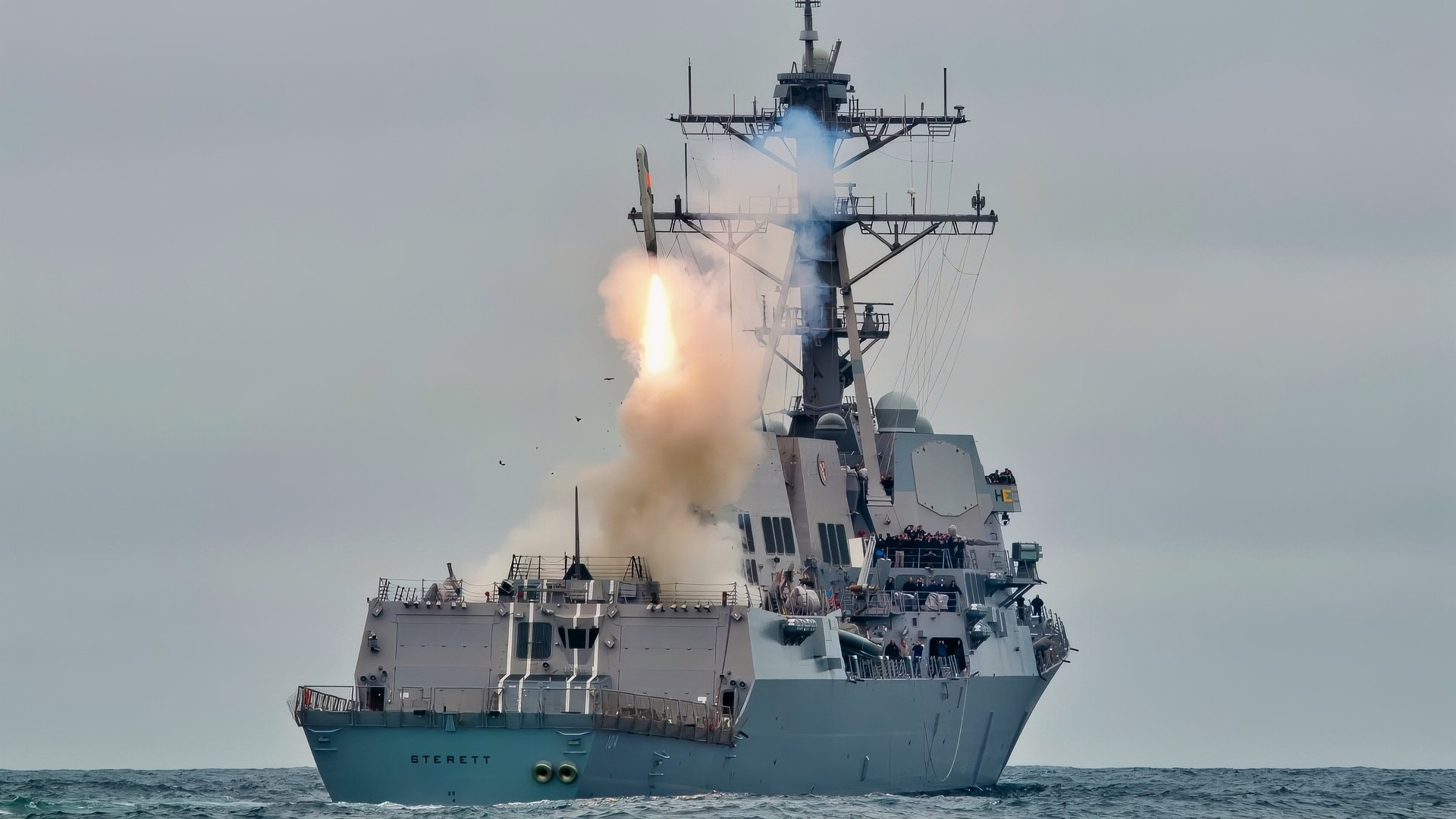
Tomahawk Missile USN Photo
Congressional Research Service uses an even more revealing fleet calculation. Since a standard Virginia already has 12 vertical-launch positions, each VPM contributes 28 new ones. The Navy needs 22 VPM-equipped boats to restore the 616 additional positions lost with the four SSGNs. The Ohio boats’ concentrated missile capacity has no one-for-one successor.
The first Block V Virginia, the future USS Oklahoma, does not include the payload module. The first VPM-equipped boat is the future USS Arizona, which remains under construction. Even after Arizona enters service, it restores only 28 of the 616 additional launch positions under the Navy’s fleet accounting, and the submarine will retain all of its other attack-boat missions.
The Virginia Production Line Cannot Close the Gap Quickly
The replacement math collides with the condition of the submarine industrial base. Shipyards have produced only about 1.1 to 1.2 Virginia-class submarines per year since 2022, despite a procurement objective of two. Projected deliveries are running 24 to 36 months late, and the Navy wants production to reach 2.33 boats annually to cover U.S. requirements and submarines planned for Australia under AUKUS.
Every new Virginia also has missions beyond cruise-missile attack. It must hunt submarines, collect intelligence, attack ships and support special operations. Assigning several of the Navy’s most heavily tasked attack submarines to reproduce one SSGN salvo consumes scarce hulls elsewhere. The absence of a dedicated replacement turns a missile-capacity problem into a broader submarine-force problem.
Surface Warships Do Not Reproduce the Same Undersea Magazine
Destroyers and cruisers also launch Tomahawks, but their vertical-launch cells carry air-defense weapons, anti-submarine rockets and other missiles. Loading more land-attack weapons leaves fewer cells for defending the fleet against aircraft and ballistic missiles. Surface launchers also cannot routinely reload at sea, forcing ships to return to a suitable port after a major salvo.
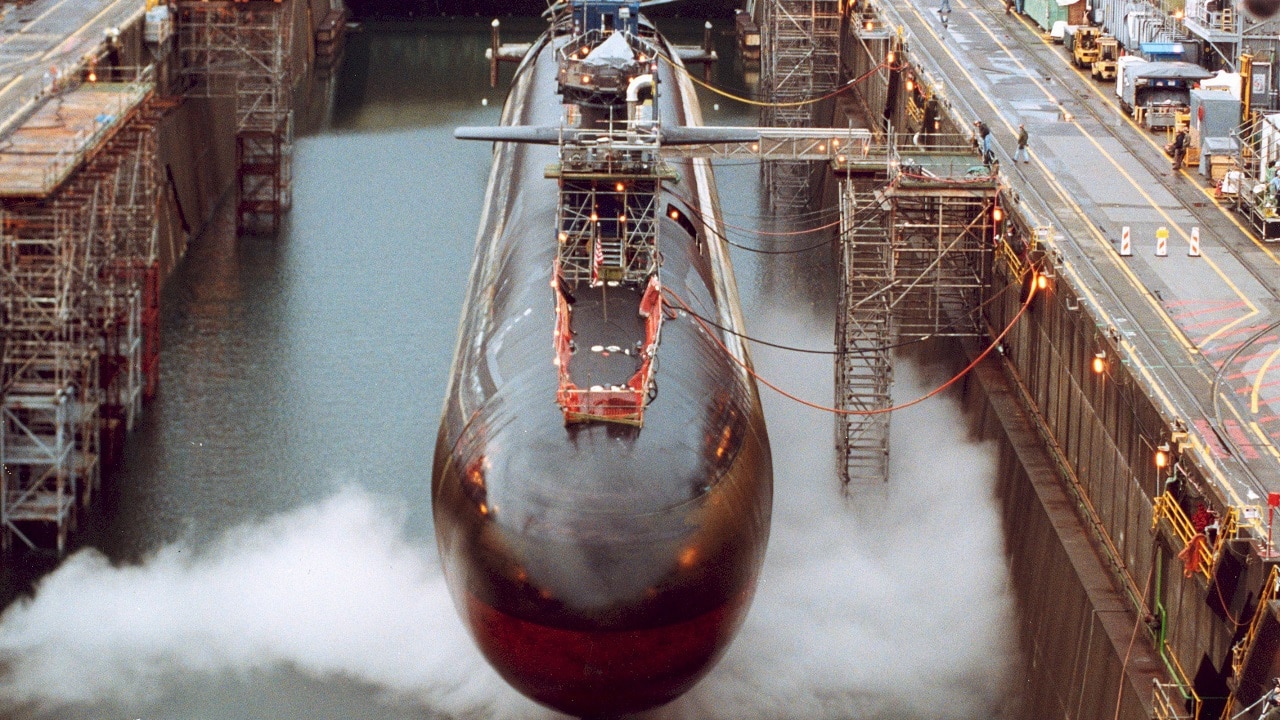
Puget Sound Naval Shipyard, Wash. (Aug. 14, 2003) — USS Ohio (SSGN 726) is in dry dock undergoing a conversion from a Ballistic Missile Submarine (SSBN) to a Guided Missile Submarine (SSGN) designation. Ohio has been out of service since Oct. 29, 2002 for conversion to SSGN at Puget Sound Naval Shipyard. Four Ohio-class strategic missile submarines, USS Ohio (SSBN 726), USS Michigan (SSBN 727) USS Florida (SSBN 728), and USS Georgia (SSBN 729) have been selected for transformation into a new platform, designated SSGN. The SSGNs will have the capability to support and launch up to 154 Tomahawk missiles, a significant increase in capacity compared to other platforms. The 22 missile tubes also will provide the capability to carry other payloads, such as unmanned underwater vehicles (UUVs), unmanned aerial vehicles (UAVs) and Special Forces equipment. This new platform will also have the capability to carry and support more than 66 Navy SEALs (Sea, Air and Land) and insert them clandestinely into potential conflict areas. U.S. Navy file photo. (RELEASED)
An SSGN concentrates a large opening strike on one hidden platform. In June 2025, an Ohio-class SSGN launched more than two dozen Tomahawks during the attack on Iranian nuclear facilities. USS Florida returned in 2024 from a 727-day deployment spanning several regions. Endurance, stealth and payload allow the boats to hold a large first-strike magazine near defended territory without tying up several surface combatants.
Keeping the Ohio SSGNs Longer Would Buy Time, Not a New Fleet
The four boats entered service as ballistic-missile submarines between 1981 and 1984 before conversion into SSGNs. Their age limits the extension option. USS Ohio completed a three-year maintenance period involving more than 512,000 resource days in February 2025, yet the Navy still plans to recycle it in fiscal 2027. Further extensions require engineering reviews, shipyard labor and confidence in aging hulls and nuclear systems.
A dedicated replacement based on the Columbia-class ballistic-missile submarine has been discussed, but no funded near-term SSGN program exists. Columbia construction already carries the Navy’s highest shipbuilding priority because those boats replace the sea-based leg of the nuclear deterrent. A Columbia-derived guided-missile submarine would not enter service before the mid-2040s under current industrial assumptions.
As of right now, USS Georgia remains scheduled to begin inactivation on July 31. The first VPM-equipped Virginia remains under construction, and the Navy has not announced either a dedicated replacement submarine or another extension for Georgia.
MORE – Canada Is Looking at the GCAP Stealth Fighter
About the Author: Harry J. Kazianis
Harry J. Kazianis (@Grecianformula) is the former Senior Director of National Security Affairs at the Center for the National Interest (CFTNI), a foreign policy think tank founded by Richard Nixon based in Washington, DC. Harry has over a decade of experience in think tanks and national security publishing. His ideas have been published in the NY Times, The Washington Post, The Wall Street Journal, CNN, and many other outlets worldwide. He has held positions at CSIS, the Heritage Foundation, the University of Nottingham, and several other institutions related to national security research and studies. He is the former Executive Editor of the National Interest and the Diplomat. He holds a Master’s degree focusing on international affairs from Harvard University.

