
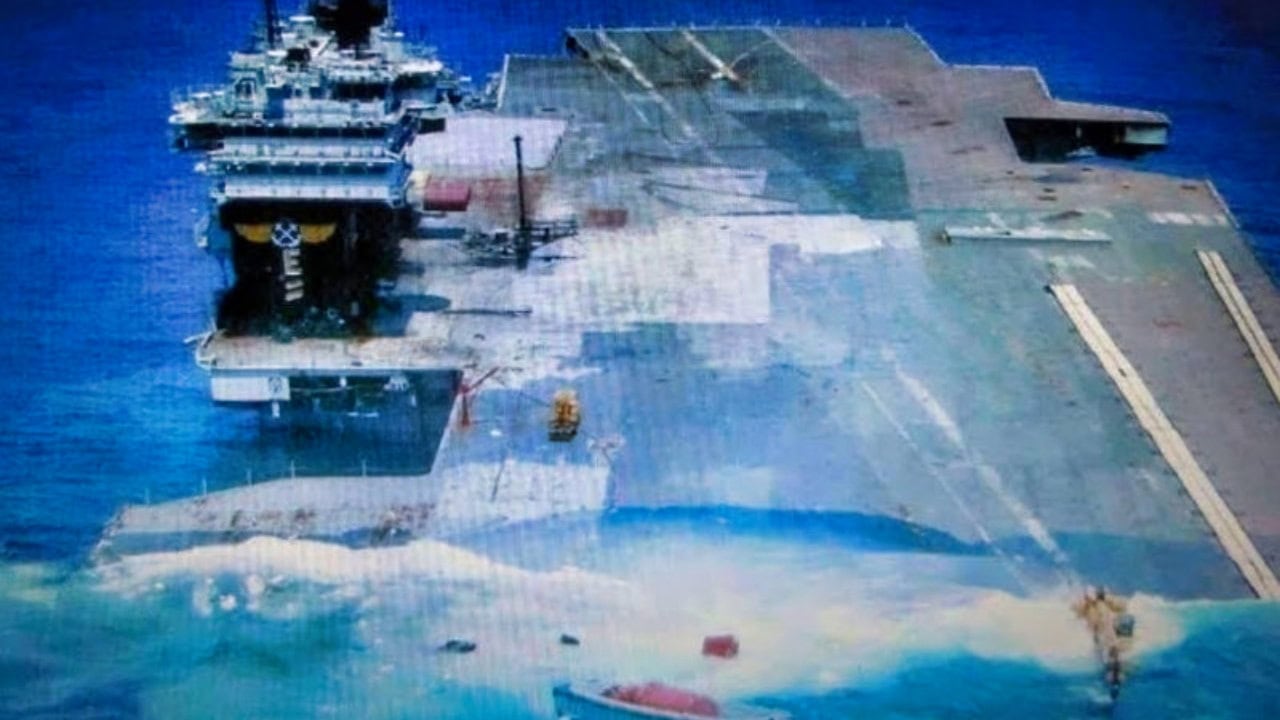
Curiously, the USS America (CV-66) wasn’t lost in combat or to enemy fire, but was deliberately sunk by the US Navy in 2005.
Rather than being scrapped or established as a museum piece, as with most other retired carriers, the Navy chose to use the USS America for a full-scale live-fire test.
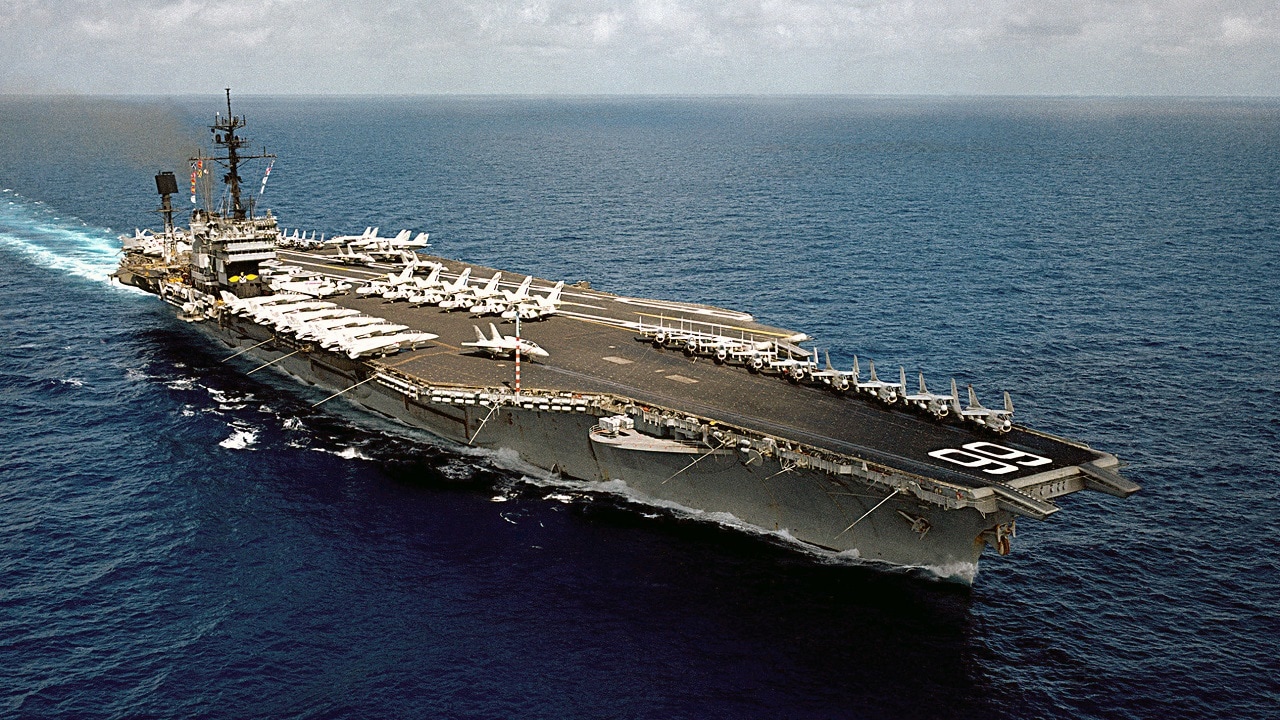
The U.S. Navy aircraft carrier USS America (CV-66) underway in the Indian Ocean, 24 April 1983. America, with assigned Carrier Air Wing 1 (CVW-1), was deployed to the Mediterranean Sea and the Indian Ocean from 8 December 1982 to 2 June 1983.
So, over nearly four weeks, the 81,000-ton supercarrier absorbed explosions from bombs, missiles, underwater blasts, and internal charges before finally going down in the Atlantic.
Of course, the Navy’s goal wasn’t just to destroy the carrier but to learn exactly how difficult sinking such a carrier was.
Now, two decades later, with China building anti-ship ballistic missiles designed to target American carriers, the information gleaned from the USS America sinking remains relevant.
Sinking Aircraft Carrier USS America
Why sink an entire aircraft carrier? The USS America served from 1965 to 1996, and its retirement created a rare opportunity.

At Sea (Aug. 9, 2004) -USS Kitty Hawk (CV 63) plows through the waters of the Pacific Ocean as it makes its approach to the oiler USNS Yukon (T-AO 202) before commencing a replenishment-at-sea (RAS) evolution. A RAS is the on- and off-loading of fuel and stores while ships are under way. Currently underway in the 7th Fleet area of responsibility (AOR), Kitty Hawk demonstrates power projection and sea control as the world’s only permanently forward-deployed aircraft carrier, operating from Yokosuka, Japan.
U.S. Navy photo by Photographer’s Mate 3rd Class Jason T. Poplin
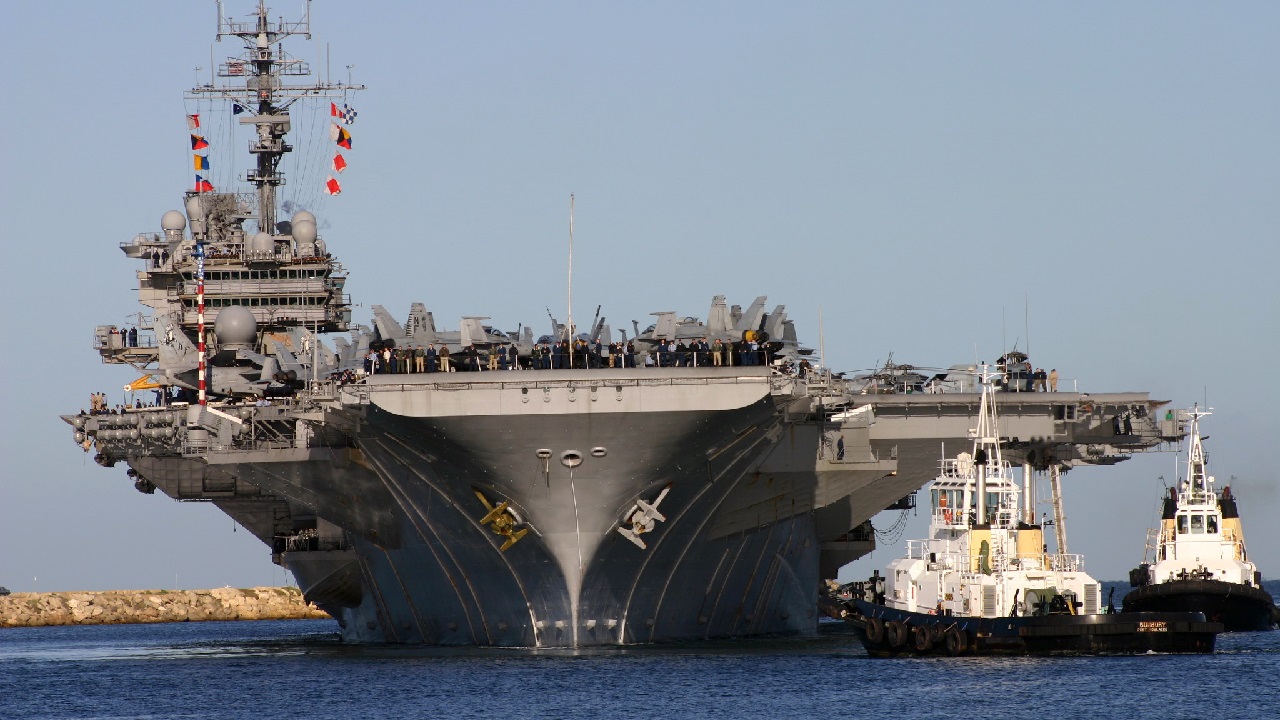
Fremantle Harbour, Australia (Apr. 22, 2004) – Tug boats escort USS Kitty Hawk (CV 63) and embarked Carrier Air Wing Five (CVW-5) into Fremantle Harbour, Australia where the crew will enjoy a five day port call. This was Kitty Hawk’s fifth visit to Fremantle and the ninth for CVW-5. Kitty Hawk is one two remaining conventionally powered aircraft carriers in the U.S. Navy, and is currently homeported in Yokosuka, Japan.
The Navy needed some data on real-world survivability that computer models simply could not replicate.
The Navy needed to better understand the fleet’s structural resilience, compartment flooding, fire propagation, blast effects, and damage control lessons.
Full-scale testing provides information that cannot be replicated with scale models, so the Navy just needed something for it.
The USS America turned out to be an ideal candidate.
Conducted approximately 250 miles off the US East Coast, the Ship Sink Exercise (SINKEX) lasted almost four weeks and featured a carefully controlled sequence of attacks.
Engineers monitored flooding rates, hull deformation, internal explosions, and structural failures—carefully collecting data before each new phase.
Surprisingly Survivable
USS America proved extraordinarily difficult to sink. Contrary to popular perception, one missile or bomb was nowhere near enough to sink the vessel. For weeks, USS America absorbed repeated punishment day after day.
Internal compartmentalization was crucial in slowing the spread of flooding, and the vessel’s large reserve buoyancy kept it afloat despite extensive damage.
Multiple watertight compartments prevented rapid catastrophic flooding. Massive displacement worked in the ship’s favor.
So how was it that the USS America was so survivable? The vessel was designed from the outset to absorb battle damage.
Features included armored critical spaces, redundant power systems, multiple fire suppression systems, distributed machinery, and extensive compartmentalization.
Damage control was not incidental; it was built into the very design philosophy.
Crew training is also considered as important as physical armor, though the crew was obviously removed for the live-fire test.
During wartime, carriers face continuous flooding, meaning thousands of sailors train extensively in firefighting, plugging hull breaches, rerouting electrical power, and restoring propulsion.
So had the USS America had the crew aboard during SINKEX, conducting repairs and such, the vessel’s survivability likely would have been even greater than it was.
This demonstrates why the US Navy places enormous emphasis on damage-control training.
Limits of the Experiment
It’s important to note that SINKEX was a controlled test—not a true combat replication.
The weapons employed and the sequence within which they were employed remain largely classified.
The carrier wasn’t simultaneously attacked by submarines, aircraft, cruise missiles, and ballistic missiles in the way it likely would have been in real combat.
And modern saturation attacks create a different challenge entirely.
Were China to hypothetically attack an American carrier, that attack would likely look much different from whatever sequence was employed against the USS America.
The PLA Navy undoubtedly studied public details on SINKEX, which confirmed several realities, including the fact that carriers are exceptionally resilient, that single-hit “carrier killer” narratives are unrealistic, and that ultimately, mission kill may be more achievable than outright sinking.
Instead of trying to send a carrier to the bottom, adversaries may aim to disable flight operations, damage catapults, crater the flight deck, destroy sensors, or force withdrawal for repairs—all of which is more attainable than sending the carrier to the bottom of the ocean.
SINKEX did reinforce several enduring principles.
Large warships are remarkably resilient, for example. And flooding, not explosions alone, often determines survival.
Damage control remains a decisive factor, and redundancy and crew training can save a ship under attack. No warship is invulnerable, not even a US supercarrier. But SINKEX proved the vessel’s resiliency under fire.
MORE – The US Navy’s Biggest Aircraft Carrier Has a Toilet Problem
About the Author: Harrison Kass
Harrison Kass is a writer and attorney focused on national security, technology, and political culture. His work has appeared in Tablet, City Journal, The Hill, The Spectator, and The Cipher Brief. He holds a JD from the University of Oregon and a master’s in Global & Joint Program Studies from NYU. More at harrisonkass.com.