
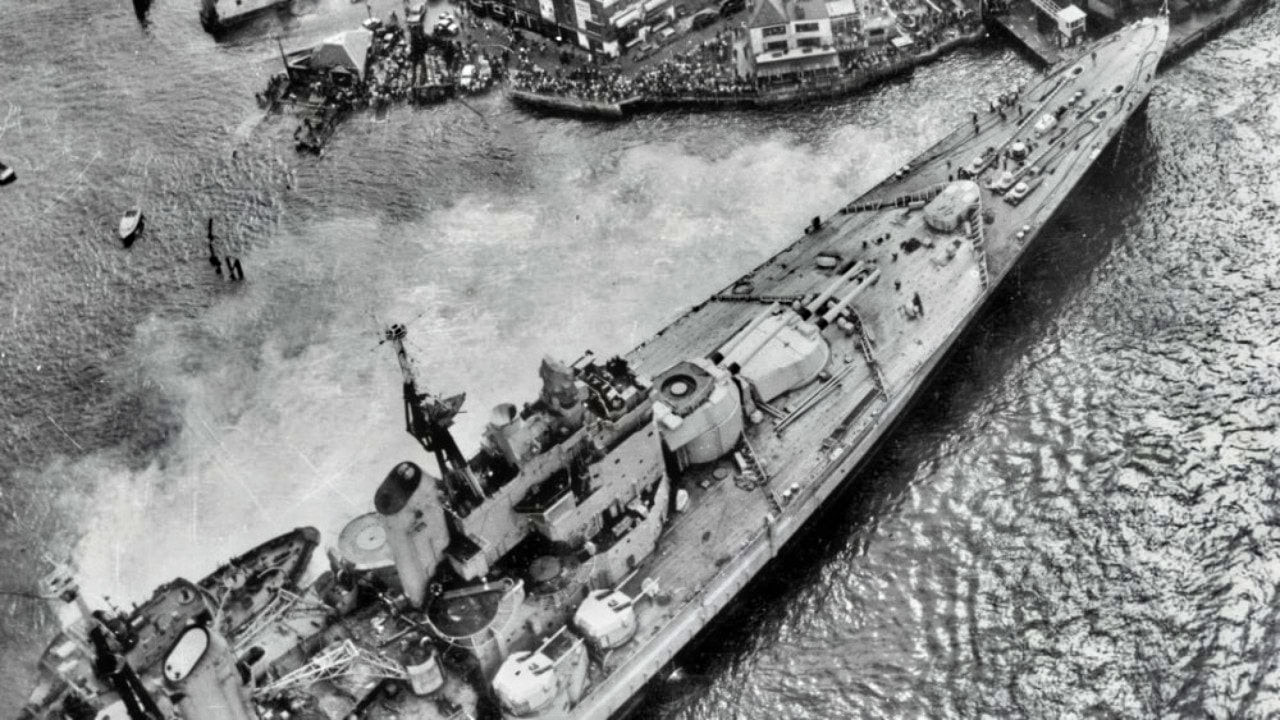
HMS Vanguard by the Numbers: The £11,530,503 Last Battleship With Eight 15-Inch Guns – Britain spent £11,530,503 building HMS Vanguard, a figure that excluded the original value of her main guns and turrets. The Royal Navy received its final battleship, and the last battleship launched anywhere in the world, but the enormous ship entered service too late to fight in World War II.
Vanguard displaced 44,500 long tons at standard load and 51,420 long tons at deep load. She measured 814 feet 4 inches overall, had a beam of about 108 feet and drew roughly 36 feet of water. She was the largest and fastest battleship completed for the Royal Navy.
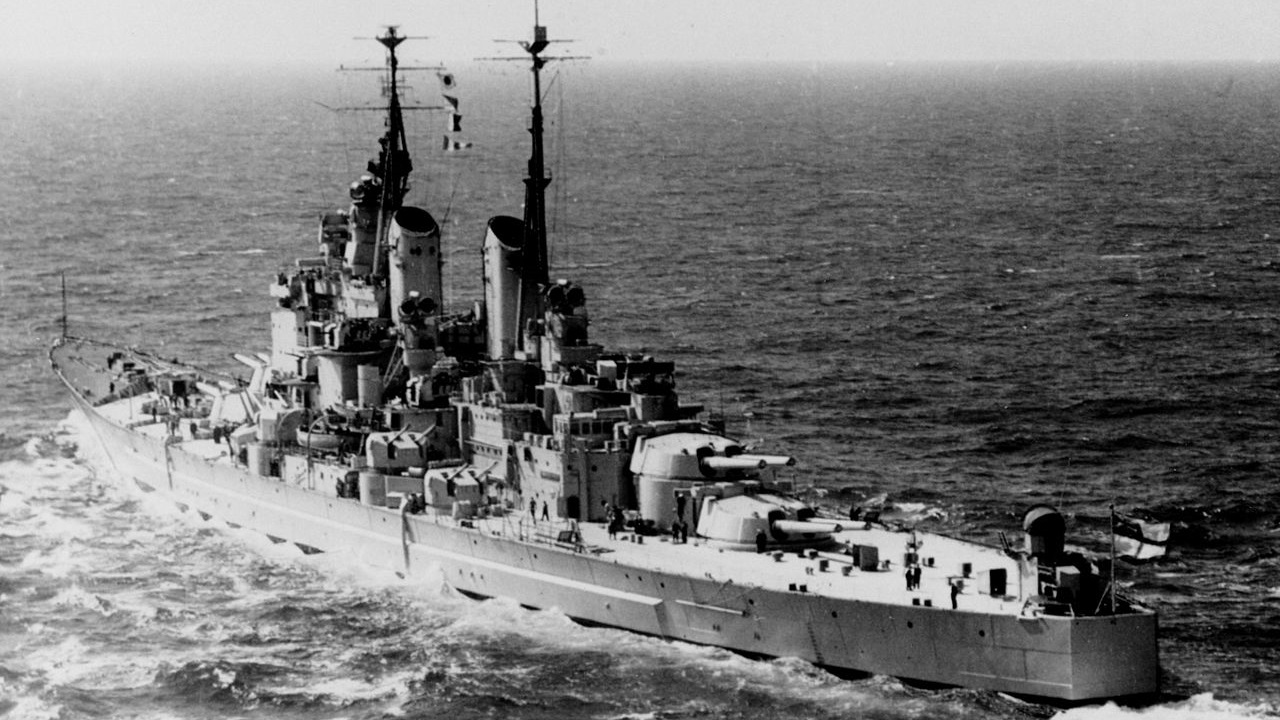
Stern quarter view of the Royal Navy battleship HMS Vanguard (23).
Her main battery consisted of eight 15-inch/42 Mark I guns in four twin turrets. Each gun fired a 1,938-pound projectile, giving Vanguard a 15,504-pound broadside, nearly seven long tons of shells. The guns were rated at two rounds per minute and the ship carried 100 projectiles for each barrel.
Vanguard entered service in 1946 and was decommissioned in 1960, a 14-year span that included exercises, fleet duties and a royal tour. She never fired at an enemy, never fought another battleship and never deployed for combat.
130,000 Horsepower Moved 51,420 Tons at 30 Knots
Eight Admiralty three-drum boilers supplied four sets of Parsons geared turbines turning four shafts. Designed output reached 130,000 shaft horsepower, enough for 30 knots. Range reached roughly 8,250 nautical miles at 15 knots, giving Britain’s last battleship the endurance for Atlantic and imperial commitments.
The machinery, weapons, sensors and flagship spaces required a complement approaching 1,975 officers and sailors. Vanguard also carried sixteen 5.25-inch dual-purpose guns and 73 Bofors 40 mm barrels when completed. Her main armor belt reached 14 inches around the magazines, while the faces of the four main turrets carried as much as 13 inches of armor.
First World War Turrets Saved Years of Construction
The age of Vanguard’s main armament was one of the ship’s strangest numbers. The four twin mountings had been built for the battlecruisers Courageous and Glorious, then placed in storage after both ships were converted into aircraft carriers in the 1920s. Reusing them avoided the delay involved in producing new triple 16-inch turrets for the unfinished Lion class.
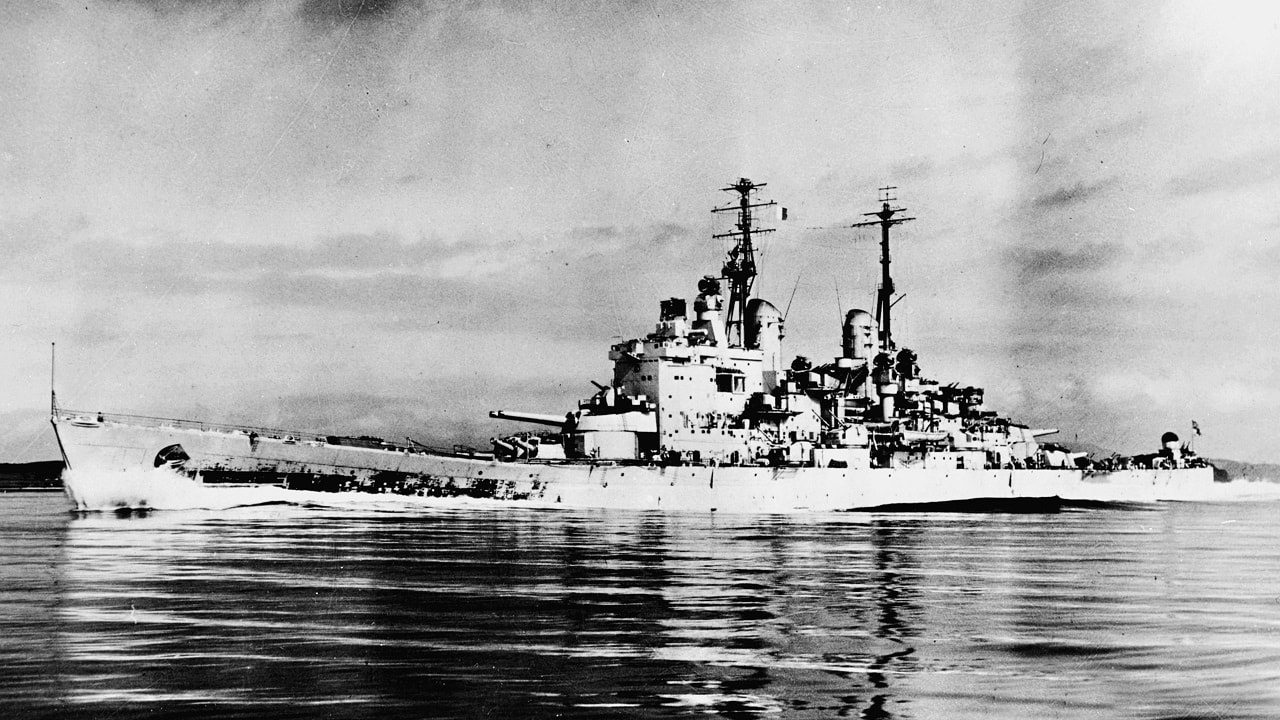
The Royal Navy battleship HMS Vanguard (23) steaming at high speed while running trials in 1946.
The old mountings were extensively rebuilt with stronger armor, new rangefinders, powered control and elevation increased to 30 degrees. The Mark I gun had entered service in 1915, yet Vanguard’s modernized battery fired streamlined shells to about 18 miles. The new hull and inherited guns joined two naval eras.
Vanguard was laid down at John Brown’s Clydebank yard on October 2, 1941. Skilled-labor shortages and priority for escorts and other urgently needed wartime ships slowed construction. Princess Elizabeth launched her on November 30, 1944, but the battleship era was already closing before the ship entered service.
Vanguard’s Largest Mission Was a Royal Tour
Vanguard’s most visible deployment came in 1947, when King George VI, Queen Elizabeth, Princess Elizabeth and Princess Margaret traveled aboard during the royal visit to South Africa. The ship was altered to accommodate the royal party.
The battleship later served with the Home Fleet and joined multinational exercises. She did not go to war in Korea and was already moving toward reserve status before the Suez Crisis. Her empty combat record became part of the larger story of battleships losing their place in postwar fleets.
The Royal Navy Needed Vanguard’s Crew for Newer Weapons
Vanguard moved toward reserve status in 1955. Contemporary reporting said 1,650 officers and sailors would be reassigned to the guided-weapons trials ship Girdle Ness and several smaller warships. Manpower shortages, limited money and nuclear developments all weighed against keeping one labor-intensive battleship fully active.
Historian Tim Benbow found that Britain temporarily retained a small battleship force as insurance against Soviet cruisers, especially before carrier aircraft and guided weapons could perform the same mission in poor weather and darkness.
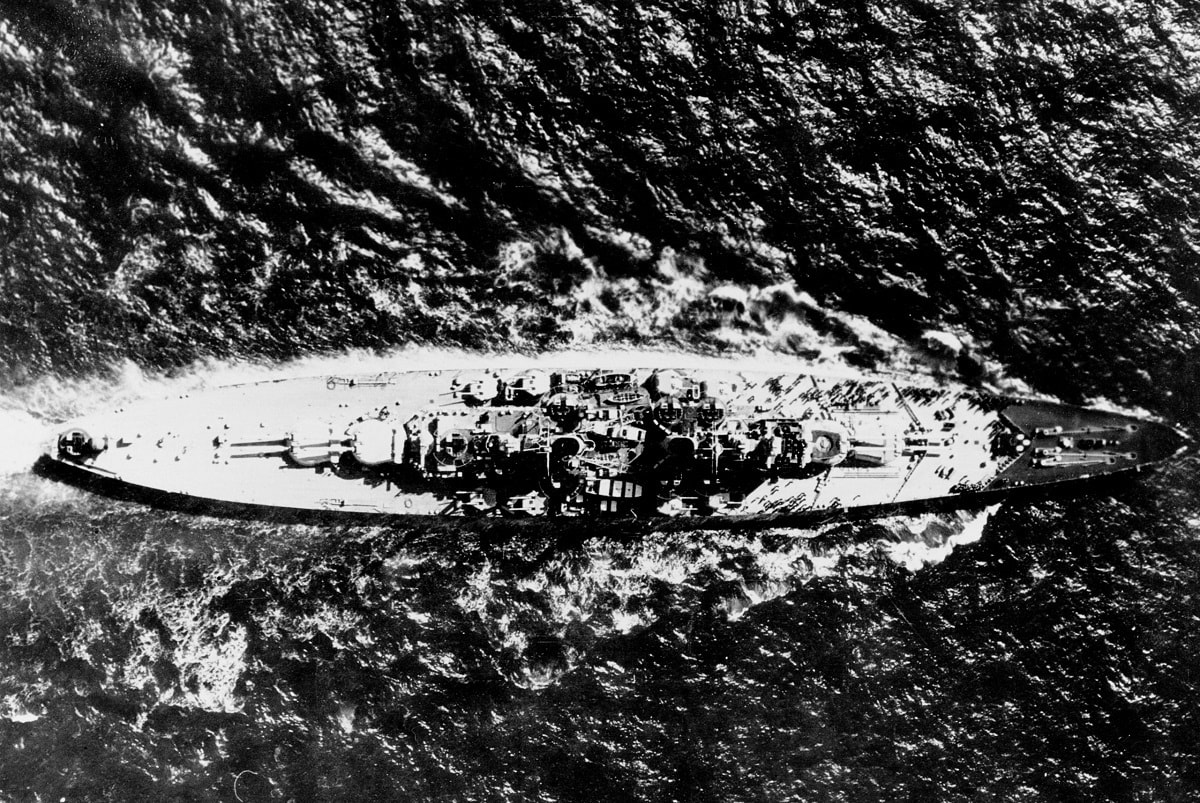
Overhead view of the Royal Navy battleship HMS Vanguard (23) underway.
Aircraft Carriers, Missiles and Submarines Ended Battleship Construction
Carrier aircraft reached far beyond the 18-mile range of Vanguard’s guns, searched wider areas and attacked ships, submarines and targets ashore. Anti-ship missiles placed heavy striking power aboard smaller vessels, while nuclear submarines offered another way to destroy major surface forces. The Royal Navy developed those replacements while rapidly reducing its postwar capital-ship force.
Cost and flexibility settled the remaining argument. One 51,420-ton battleship required nearly 2,000 people, specialized docks and large maintenance budgets. Cruisers, carriers, submarines, and frigates spread their capabilities across more hulls. That arithmetic still weighs against modern plans to revive battleships.
Vanguard Grounded While Leaving Portsmouth
Vanguard became the flagship of the Royal Navy Reserve in 1956, and the Admiralty placed her on the disposal list in 1959. She was formally decommissioned on June 7, 1960. On August 4, tugs began moving the 814-foot hull out of Portsmouth for the breaking yard at Faslane.
The Royal Navy records that Vanguard briefly wedged herself near the Still and West pub before the tugs pulled her free. She was taken north to Faslane, where cutting crews began dismantling the Royal Navy’s last battleship during the autumn of 1960.
About the Author: Harry J. Kazianis
Harry J. Kazianis (@Grecianformula) was the former Senior Director of National Security Affairs at the Center for the National Interest (CFTNI), a foreign policy think tank founded by Richard Nixon based in Washington, DC. Harry has over a decade of experience in think tanks and national security publishing. His ideas have been published in the NY Times, The Washington Post, The Wall Street Journal, CNN, and many other outlets worldwide. He has held positions at CSIS, the Heritage Foundation, the University of Nottingham, and several other institutions related to national security research and studies. He is the former Executive Editor of the National Interest and the Diplomat. He holds a Master’s degree focusing on international affairs from Harvard University.

