
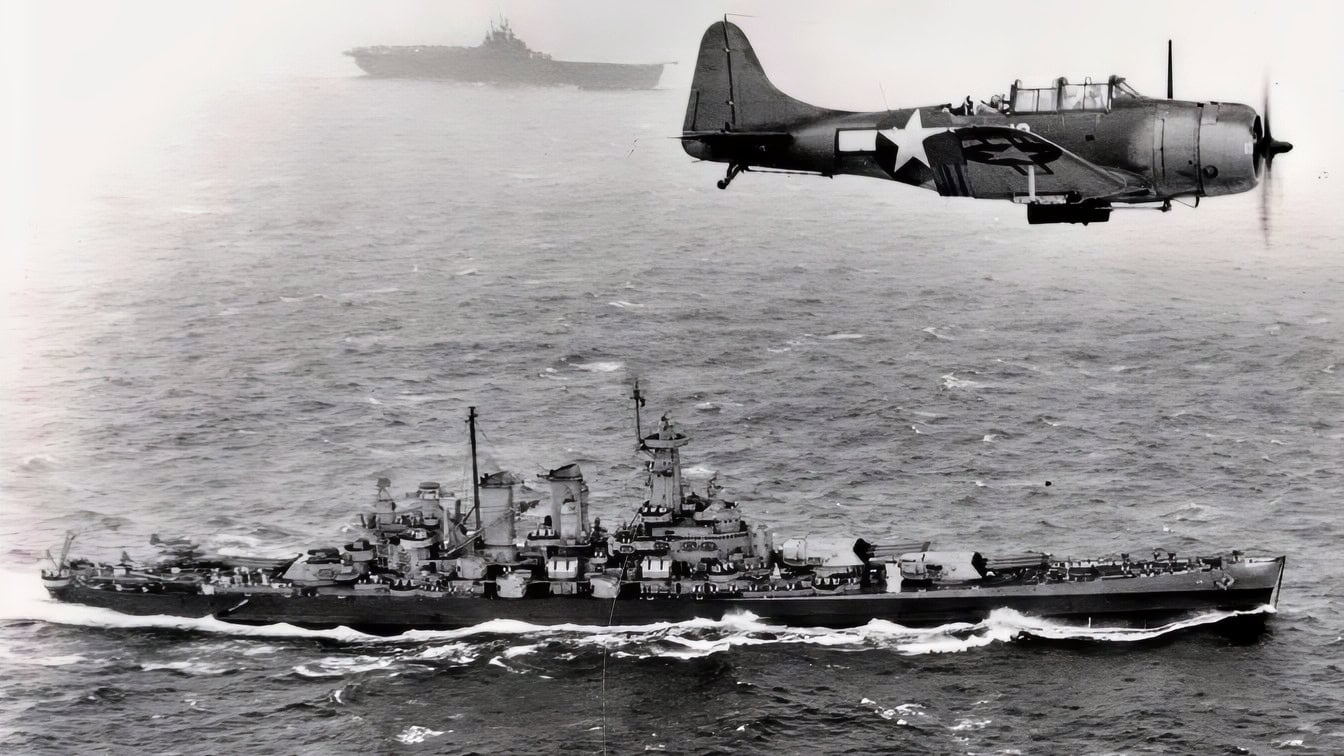
USS Washington Fired 75 16-Inch Shells in One of World War II’s Rarest Battleship Duels: USS Washington opened fire on the Japanese battleship Kirishima from 8,400 yards during the night of November 14–15, 1942. The range was less than five miles, close enough for Washington’s radar-directed 16-inch guns to tear through armor designed for a much longer engagement.
During the action, the American battleship fired 75 main-battery rounds and 107 rounds from its 5-inch guns. Official estimates credit Washington with at least nine 16-inch hits, while later Navy analysis places the total near 20, plus more than 40 secondary-battery hits. Kirishima lost steering, flooded heavily, and sank several hours later.
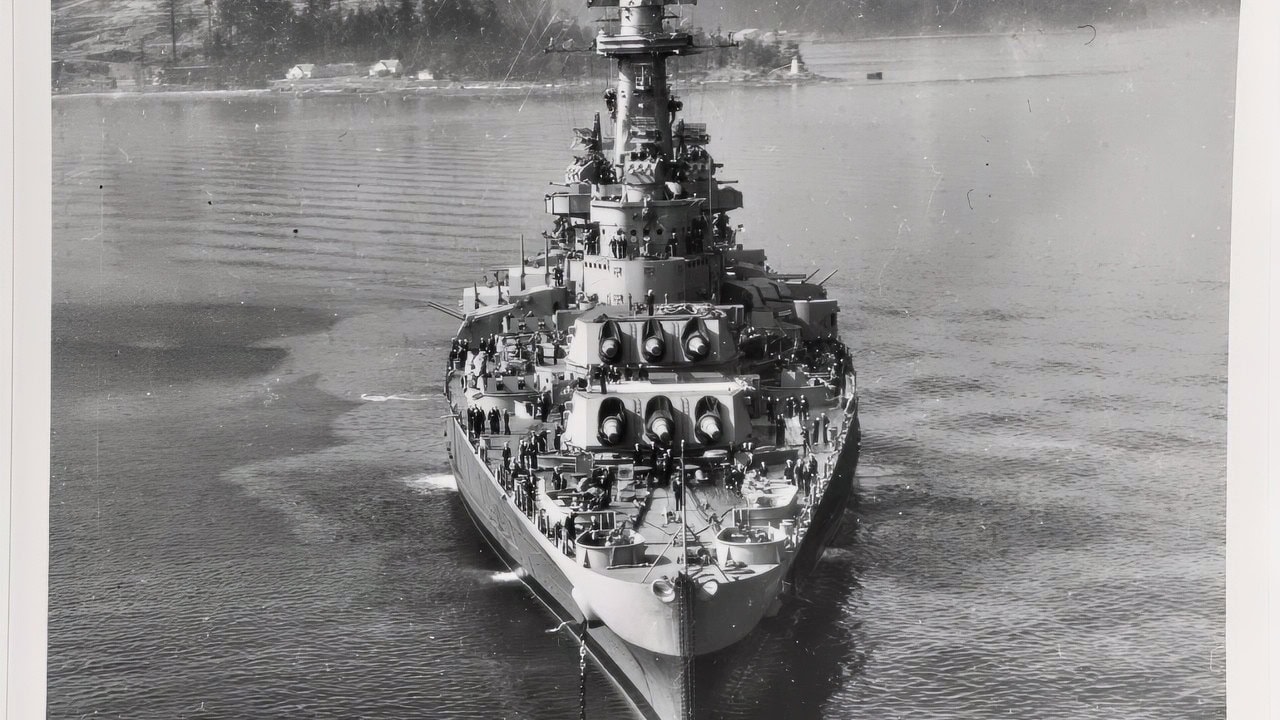
USS Washington Battleship. Image Credit: Creative Commons.
Washington was a 728-foot North Carolina-class fast battleship. She displaced 35,000 tons under treaty standards and about 44,800 tons at full combat load. Eight boilers fed four geared turbines producing 121,000 shaft horsepower, enough for 28 knots and a range of roughly 17,450 nautical miles at 15 knots.
Her career stretched from Arctic convoy duty to the western Pacific. Washington earned 13 battle stars, screened aircraft carriers, and survived a major collision with USS Indiana. The Navy decommissioned her in 1947 and sold her for scrap in 1961.
Treaty Limits Shaped the North Carolina Class
Washington was the second and final ship in the 44,800-ton North Carolina class, the first new American battleship class completed in nearly two decades. The design had to fit a 35,000-ton treaty limit while carrying heavy armor, high speed, and enough firepower to face modern Japanese warships.
The Navy first planned twelve 14-inch guns. Japan’s rejection of the Second London Naval Treaty’s gun limit activated an escalator clause, allowing nine 16-inch/45-caliber Mark 6 guns in three triple turrets. Each fired a 2,700-pound armor-piercing shell, giving Washington a 24,300-pound broadside. Twenty 5-inch/38-caliber guns defended the ship against aircraft and surface targets.
Philadelphia Navy Yard laid the keel on June 14, 1938, launched the hull on June 1, 1940, and commissioned the ship on May 15, 1941. Wartime anti-aircraft additions and larger gun crews eventually raised the complement from about 1,800 people to more than 2,300, part of the evolution behind America’s first modern fast-battleship class.
Washington Served With Britain Before Guadalcanal
Washington joined the British Home Fleet at Scapa Flow in 1942, covering Arctic convoy operations and strengthening the force guarding against a sortie by the German battleship Tirpitz. No Atlantic gun battle followed. After an overhaul, Washington moved to the South Pacific and became Rear Admiral Willis Lee’s flagship during the Guadalcanal campaign.
Radar Gave Washington the Opening Against Kirishima
Japan sent Kirishima, two heavy cruisers, and a large escort force toward Guadalcanal to bombard Henderson Field. Lee intercepted Washington, USS South Dakota, and four destroyers. The destroyer screen suffered heavily, while an electrical failure disrupted South Dakota’s radar, communications, and gun systems.
Japanese searchlights illuminated South Dakota and drew concentrated fire. Washington remained hidden behind burning American destroyers. Lee’s radar team tracked Kirishima and passed the range into the fire-control system, allowing the main battery to open at 8,400 yards.
Kirishima carried eight 14-inch guns and had been rebuilt from a World War I-era battlecruiser. Washington’s shells damaged turrets and steering machinery, opened the hull, and started fires near magazines. The Japanese crew flooded threatened spaces, worsening the list. Washington escaped without a direct enemy hit to the hull, although a blast from her own guns damaged fittings and a floatplane. The fatal damage to Kirishima became Washington’s defining action.
Kirishima’s loss forced the surviving Japanese bombardment ships away from Guadalcanal. Henderson Field remained operational, and Japanese troop transports approaching the island faced American aircraft the following morning. It became one of the few battleship-against-battleship victories won by the U.S. Navy during World War II.
Carrier Escort Became Washington’s Main Wartime Mission
The Guadalcanal duel was the exception. Washington later protected fast carriers through the Gilberts, Marshalls, Marianas, and the Battle of the Philippine Sea. She went on to support operations around the Philippines, Leyte, Luzon, Iwo Jima, and Okinawa. Carrier aircraft and submarines usually removed Japanese capital ships before American battleships reached gun range.
On February 1, 1944, Washington collided with USS Indiana during night maneuvers in the Marshall Islands campaign. The impact crushed the bow and forced the ship out of action. After temporary stabilization and permanent work at Puget Sound Navy Yard, Washington returned for the Marianas invasion in June.
Washington Returned Troops Home Before Entering Reserve
Washington was undergoing an overhaul when Japan surrendered. She later brought home more than 1,600 Army personnel from Britain during Operation Magic Carpet. The Navy decommissioned her on June 27, 1947, and placed her in the Atlantic Reserve Fleet.
Unlike the four Iowa-class battleships, Washington never returned for Korea or the Cold War. Her 28-knot speed and older machinery made a large modernization unattractive, while the Navy already had faster battleships available for reactivation.
Washington was struck from the Naval Vessel Register on June 1, 1960. The Lipsett Division of Luria Brothers bought the ship on May 24, 1961, and broke it up for scrap.
MORE – The Navy Almost Had a Nuclear Bomber Aircraft Carrier
About the Author: Harry J. Kazianis
Harry J. Kazianis (@Grecianformula) was the former Senior Director of National Security Affairs at the Center for the National Interest (CFTNI), a foreign policy think tank founded by Richard Nixon based in Washington, DC. Harry has over a decade of experience in think tanks and national security publishing. His ideas have been published in the NY Times, The Washington Post, The Wall Street Journal, CNN, and many other outlets worldwide. He has held positions at CSIS, the Heritage Foundation, the University of Nottingham, and several other institutions related to national security research and studies. He is the former Executive Editor of the National Interest and the Diplomat. He holds a Master’s degree focusing on international affairs from Harvard University.