
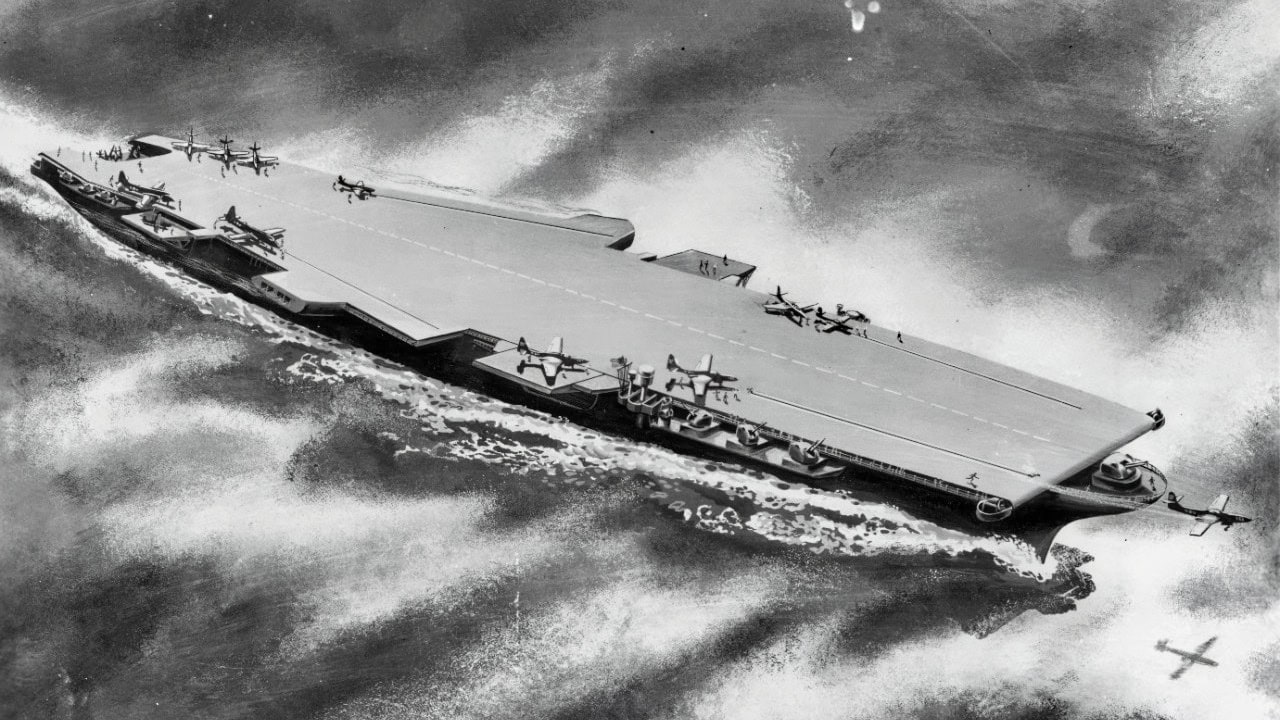
USS United States Was Canceled Five Days After Its Keel Was Laid and Set Off the Revolt of the Admirals: On April 18, 1949, a crane at Newport News Shipbuilding lowered a 15-ton steel plate onto keel blocks for USS United States. It was the first of 11 large plates planned for the carrier’s keel. Five days later, Defense Secretary Louis Johnson canceled the $189 million contract and ordered work to stop.
The decision concerned far more than one ship. United States, designated CVA-58, was the Navy’s attempt to secure a central role in atomic warfare after the creation of an independent Air Force. The Air Force regarded long-range strategic bombing as its primary mission and saw the carrier as an expensive institutional challenge.
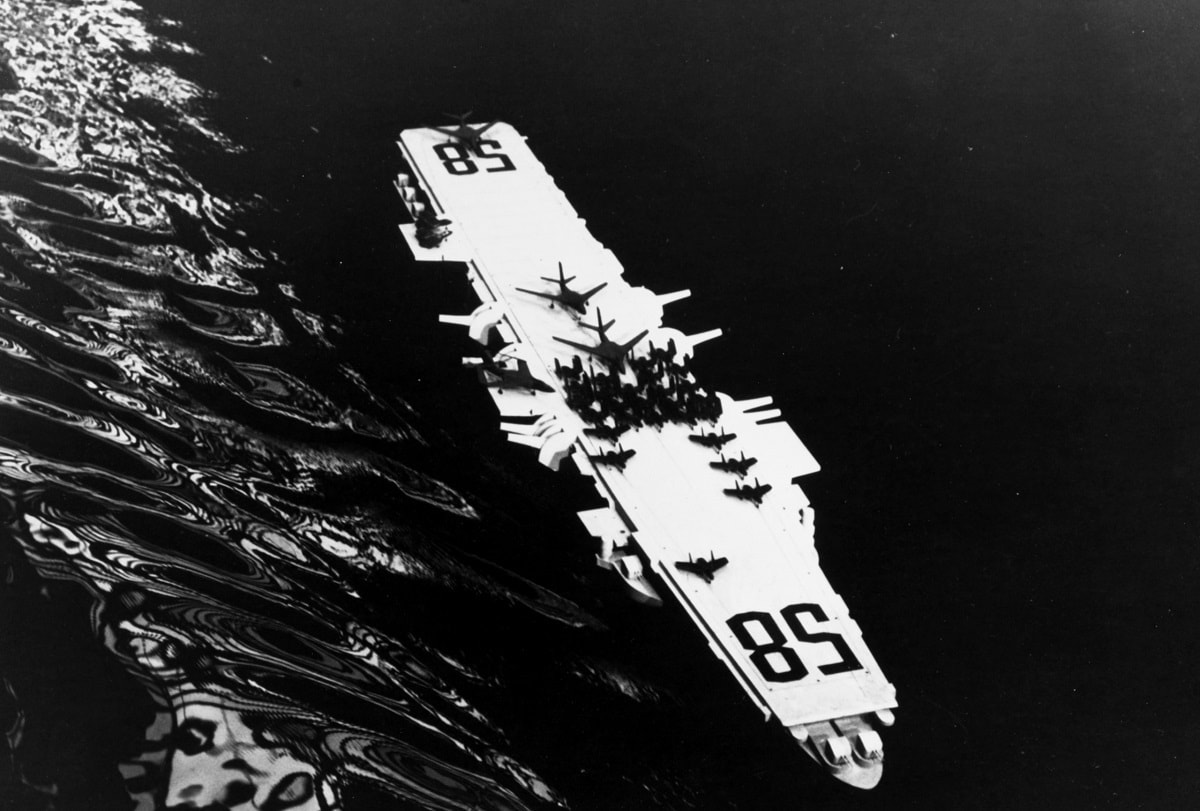
A preliminary design model of the proposed U.S. Navy aircraft carrier USS United States (CVA-58) undergoing seakeeping tests at the David Taylor Model Basin, Carderock, Maryland (USA), circa 1947. This is an early version of the CVA-58 design, without catapult sponsons. Note the folding smokestacks in the down position, as they would have been during flight operations. Aircraft models on the flight deck appear to represent the Vought F7U Cutlass fighter and a notional heavy attack bomber.
Because the design changed repeatedly, the published dimensions differ. The contract-era ship was generally described as 1,090 feet long and about 65,000 tons, while an earlier study reached 69,200 tons standard and 82,000 tons under trial conditions. Its flush deck avoided a permanent island, and four hydraulic catapults were intended to launch aircraft weighing as much as 100,000 pounds.
The ship alone was only part of the bill. Washington was trying to hold the fiscal 1950 defense budget near $15 billion after the services submitted requirements approaching $29 billion. The full carrier task force was estimated at $1.27 billion, with its planned aircraft adding another $500 million.
The Navy Wanted an Atomic Mission of Its Own
Naval aviators had watched carriers become the decisive offensive ships of the Pacific War. They did not want naval aviation reduced to fleet defense and tactical support in a strategy organized around nuclear weapons. Their answer was a carrier built around heavy nuclear-capable attack aircraft.
The planned air group changed with the design. One proposal called for 18 very heavy bombers and 80 fighters. Another paired 12 to 18 attack aircraft with 54 fighters. The bomber remained under development, leaving the Navy committed to a carrier whose defining aircraft had not flown.
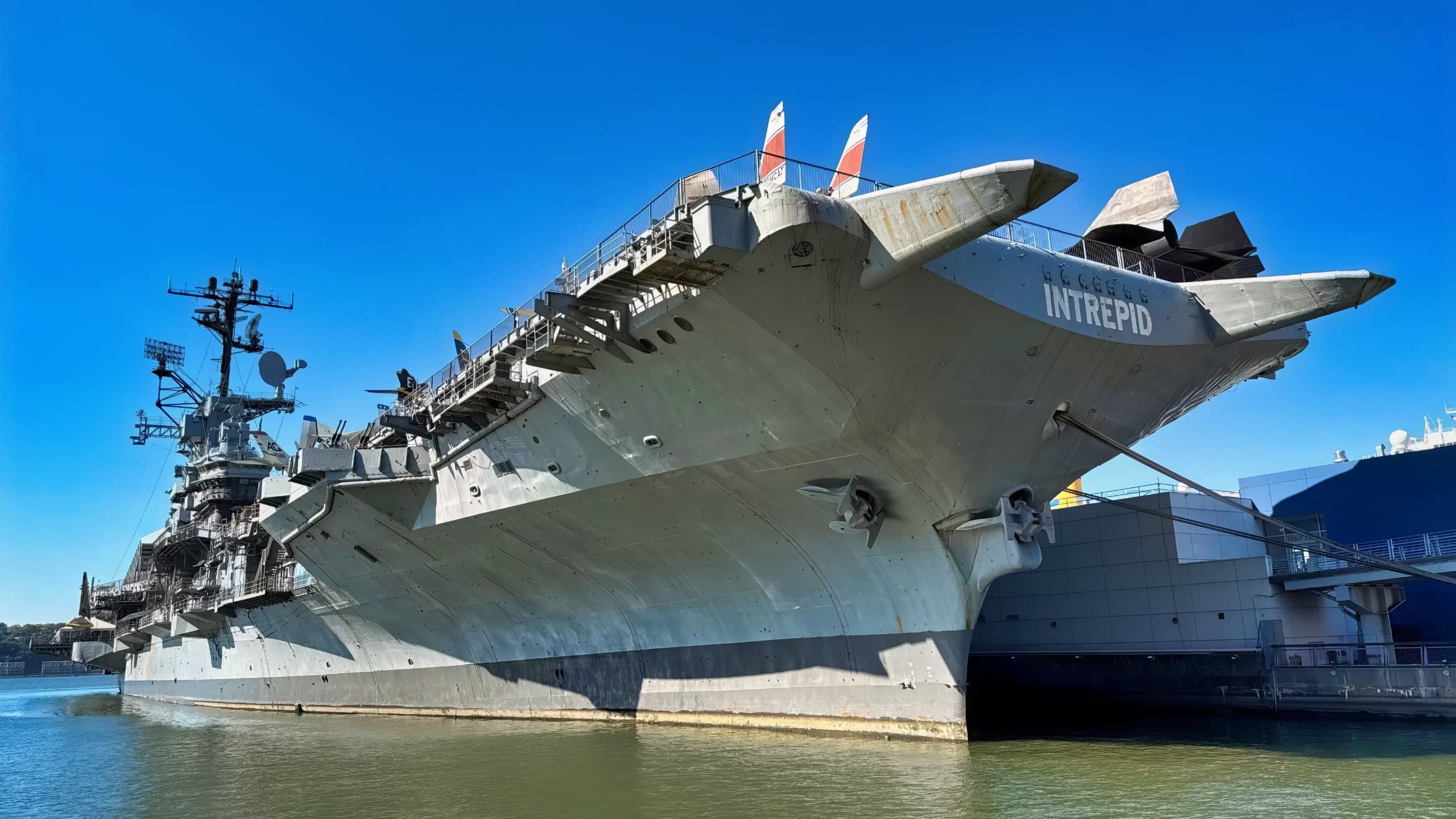
Essex-Class USS Intrepid 19FortyFive.com Photo

USS Intrepid USN Aircraft Carrier 19FortyFive Original Image.
Congress authorized CVA-58 in the fiscal 1949 program, and President Harry Truman approved construction in July 1948. The Navy originally discussed four ships, but Navy Secretary John L. Sullivan called the first a prototype and warned against ordering more before it had been tested. The radical USS United States design was still experimental when steel began moving at Newport News.
The B-36 Turned the Carrier Into a Roles-and-Missions Fight
The Air Force already possessed its candidate for the atomic mission. Strategic Air Command received its first operational B-36 in June 1948. The massive intercontinental bomber carried as much as 86,000 pounds of nuclear or conventional weapons and operated from land bases.
Navy supporters argued that a mobile sea base did not depend on foreign basing rights and could approach the Soviet Union from several directions. Critics answered that CVA-58 required escorts, supply ships, and aircraft still years from service. The dispute concerned budgets, military strategy, and the survival of naval aviation as an offensive arm.
Johnson entered office in March 1949, determined to cut spending and impose tighter control over the services. The Navy supported the carrier; the Army and Air Force opposed it. Johnson canceled the ship without consulting Sullivan, even though the yard had fabricated thousands of tons of steel and ordered about $10 million in parts and services.
The Cancellation Set Off the Revolt of the Admirals
Sullivan resigned, condemning an arbitrary decision that affected the Navy’s future without consultation. The phrase “Revolt of the Admirals” did not describe a mutiny. It referred to senior naval officers taking their strategic case to Congress and breaking publicly with civilian defense leaders.
A special Navy staff group known as Op-23, led by Captain Arleigh Burke, assembled material defending carrier aviation. The campaign became harder to defend when civilian Navy employee Cedric Worth helped produce an anonymous memo alleging corruption in B-36 procurement. Congress found no substance behind the charges.
The hearings continued because the larger argument remained. Admirals, including Arthur Radford, attacked dependence on strategic bombing and argued that war with the Soviet Union would still require sea control, tactical aviation, and ground forces. Air Force leaders defended the B-36 as the best available nuclear deterrent. The confrontation became the defining interservice fight of the early Pentagon.
Chief of Naval Operations Admiral Louis Denfeld tried to mediate, then testified that defense policy and unification were damaging the Navy. Navy Secretary Francis Matthews removed him on October 27, 1949. The House Armed Services Committee later called the firing retaliation for testimony given to Congress.
The Carrier Had Real Weaknesses Despite Johnson’s Handling
Johnson’s abrupt cancellation deepened mistrust, but CVA-58 was not a 1949 version of a modern multirole supercarrier. It was a specialized atomic-strike ship built around extremely large aircraft, an unconventional deck arrangement and an operating concept that depended on other carriers for protection.
The technology was moving faster than the ship. The North American AJ Savage entered service in September 1949 as the Navy’s first carrier aircraft designed specifically for nuclear delivery. Beginning in 1951, Savages operated from Midway-class carriers, giving the Navy an atomic role without CVA-58. Smaller weapons later allowed fighter-sized aircraft to assume the mission.
The Korean War Produced a Different Supercarrier
The admirals lost the immediate political fight. The B-36 continued, Op-23 was dissolved and the keel plates of United States were removed before the carrier developed into a recognizable hull. The Navy retained its larger claim that carriers served missions strategic bombers could not perform.
North Korea invaded South Korea in June 1950, creating immediate demand for conventional carrier aviation. Congress authorized a new large carrier on May 21, 1951. USS Forrestal entered service on October 1, 1955, beginning a new supercarrier line at Newport News, where work on United States had stopped six years earlier.
More – USS Alabama: The battleship you can visit right now.
About the Author: Harry J. Kazianis
Harry J. Kazianis (@Grecianformula) was the former Senior Director of National Security Affairs at the Center for the National Interest (CFTNI), a foreign policy think tank founded by Richard Nixon based in Washington, DC. Harry has over a decade of experience in think tanks and national security publishing. His ideas have been published in the NY Times, The Washington Post, The Wall Street Journal, CNN, and many other outlets worldwide. He has held positions at CSIS, the Heritage Foundation, the University of Nottingham, and several other institutions related to national security research and studies. He is the former Executive Editor of the National Interest and the Diplomat. He holds a Master’s degree focusing on international affairs from Harvard University.

