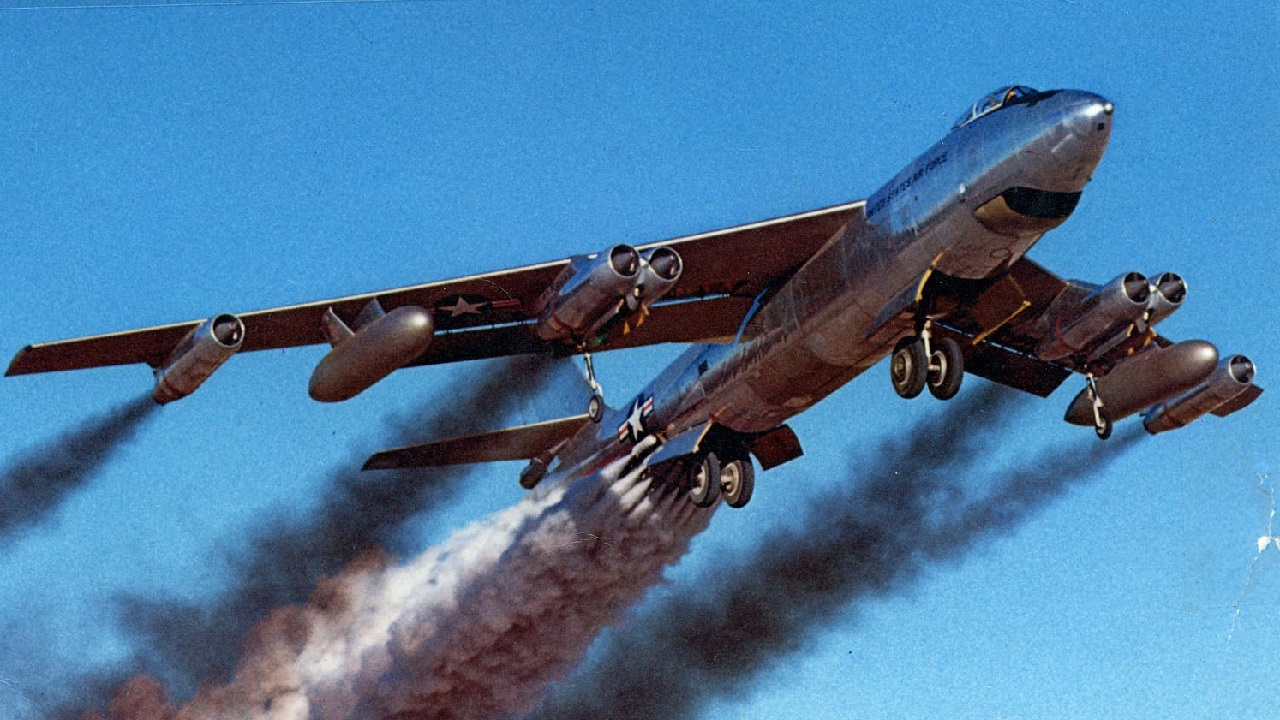
Boeing’s B-47 Stratojet was one of the most transformative planes the United States Air Force had during the early stages of the Cold War.
Up until the B-47’s arrival, the Air Force was dominated by propeller-driven bombers. The B-47 Stratojet represented the dawning of the jet age for America’s bomber force.
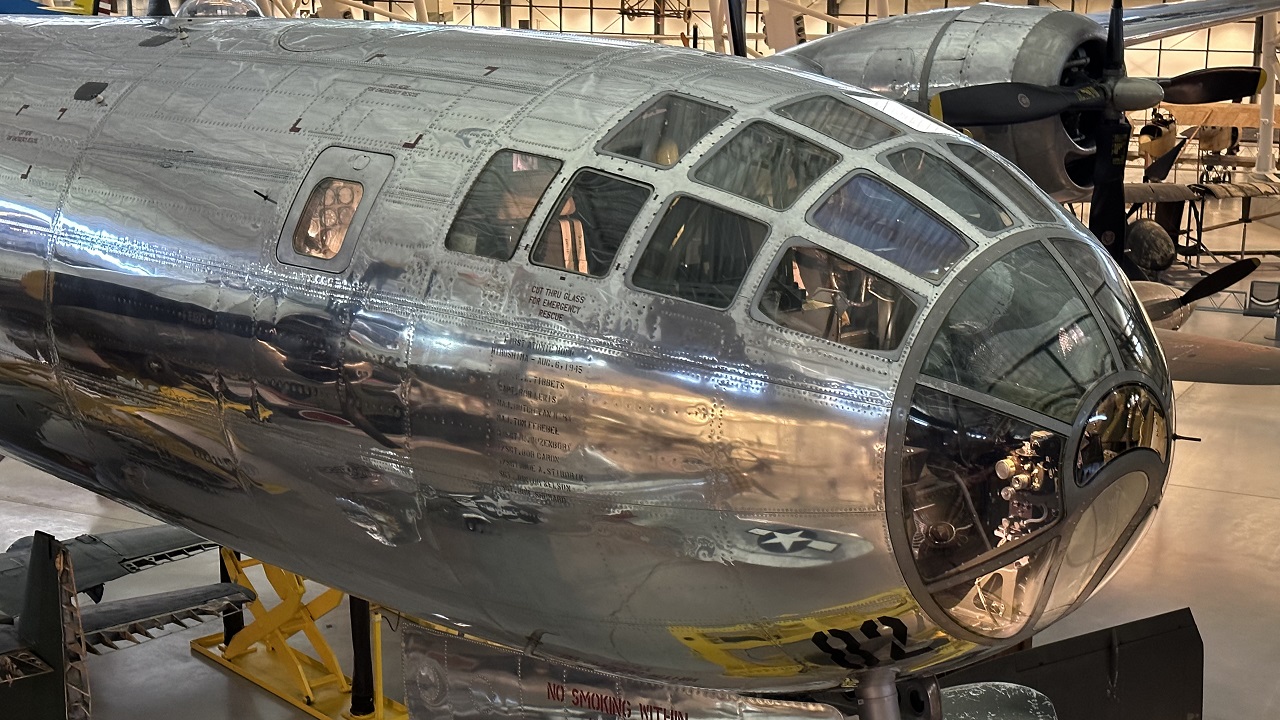
Enola Gay B-29. Image was taken on October 1, 2022. Image Credit: 19FortyFive.com
Indeed, the B-47 served as the backbone of Strategic Air Command (SAC) throughout the 1950s.
From the B-47, the Air Force learned many new aerodynamic and operational concepts that remain influential in modern bomber design.
The B-47 began its development shortly after the Second World War, when the US Air Force sought a new jet-powered strategic bomber that could carry nuclear weapons against the Soviet Union.
Boeing engineers redesigned the entire plane after they studied captured Nazi jet bomber designs at the end of the war. The resulting XB-47 prototype first flew in December 1947 and immediately demonstrated performance well beyond any competing designs.
The B-47 Stratojet
Several features of the B-47 were innovative for their time.
For example, the bomber had a 35-degree swept wing design that improved high-speed performance.
It had six powerful General Electric (GE) J47 turbojet engines mounted on pods beneath the wings (rather than buried inside the plane).
A tandem-seating cockpit controlled the plane from beneath a fighter-style canopy. There were bicycle-style landing gear with small outrigger wheels beneath the wings.
Although it was the 1950s, there was extensive automation that reduced the crew to only three people–making it truly cutting edge for its day.
Eventually, these unique design features influenced the overall design of civilian commercial jetliners, such as Boeing’s iconic 707.
Boeing’s Stratojet quickly replaced the Air Force’s B-29 and B-50 bombers.
While the B-47 carried the same bomb load as its prop-driven predecessors, it flew more than 200 miles per hour faster and could penetrate enemy defenses at greater speeds.
The year 1958 represented the peak of the B-47. More than 2,000 Stratojets were built in ten years between 1947 and 1957.
The B-47 never dropped a bomb in combat. Instead, the plane spent much of its career maintaining America’s nuclear deterrent by standing alert during the height of Cold War tensions.
Crews trained continuously for missions that, fortunately, never came.
As intercontinental ballistic missiles entered service and the longer-range B-52 assumed the strategic bombing mission, the B-47’s bomber role gradually came to an end in the mid-1960s.
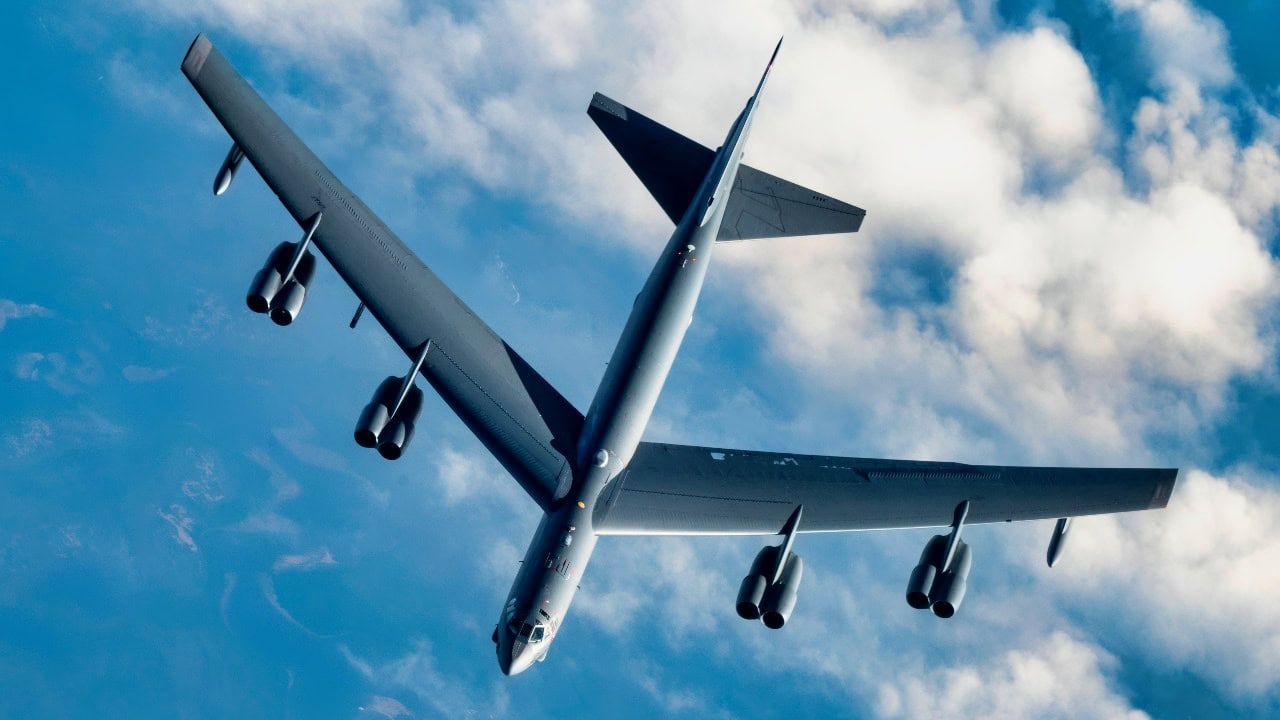
A U.S. Air Force B-52 Stratofortress departs after being refueled by KC-135 Stratotanker over the Pacific Northwest July 18, 2024. The 92nd Air Refueling Wing and 141st ARW’s ability to rapidly generate airpower at a moment’s notice was put to the test when Air Mobility Command’s Inspector General team conducted a no-notice Nuclear Operational Readiness Inspection, July 16–18, 2024. During the NORI, Airmen demonstrated how various capabilities at Fairchild AFB enable units to generate and provide, when directed, specially trained and equipped KC-135 Stratotanker aircrews to conduct critical air refueling of U.S. Strategic Command-assigned strategic bomber and command and control aircraft. (U.S. Air Force photo by Staff Sgt. Lawrence Sena)
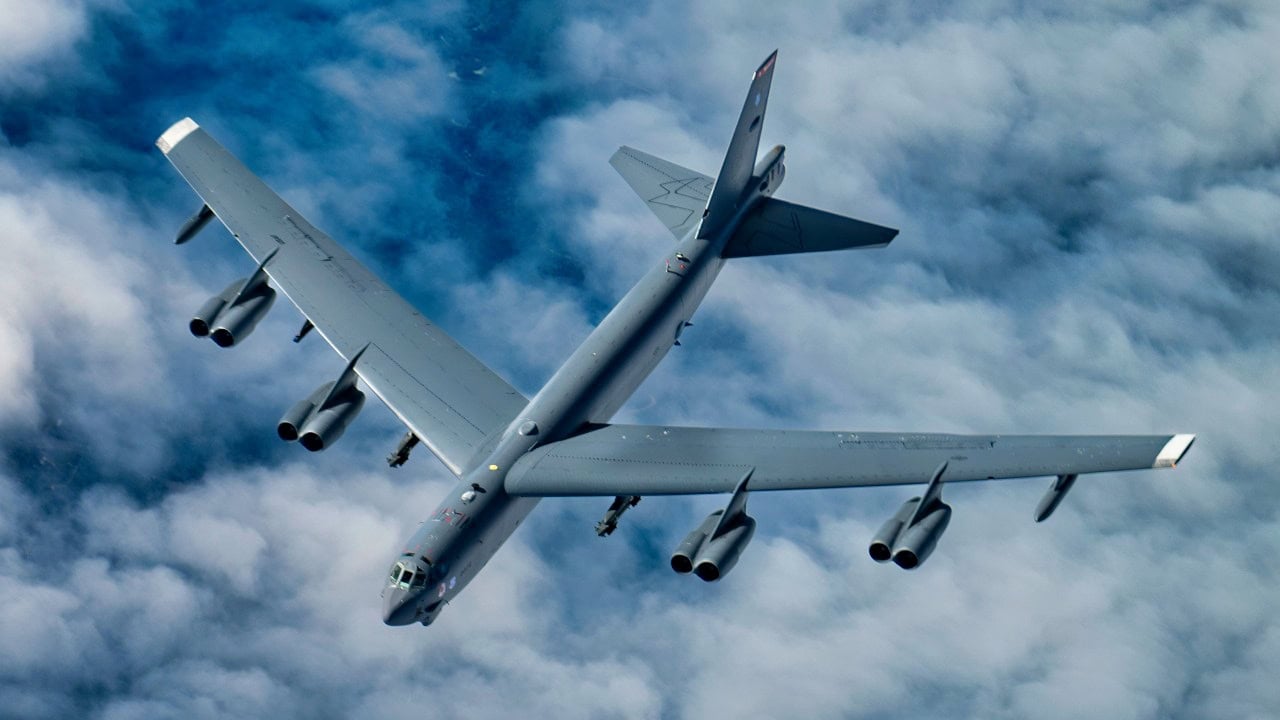
A B-52 Stratofortress assigned to the 2nd Bomb Wing, Barksdale Air Force base, Louisiana, approaches a KC-135 Stratotanker assigned to the 6th Air Refueling Wing, MacDill AFB, Florida, for fuel over the southeastern United States, Dec. 4, 2024. The B-52 Stratofortress is a long-range, heavy bomber that can perform a variety of missions. The aircraft can carry nuclear or precision guided conventional ordnance with worldwide precision navigation capability. (U.S. Air Force photo by Staff Sgt. Lauren Cobin)
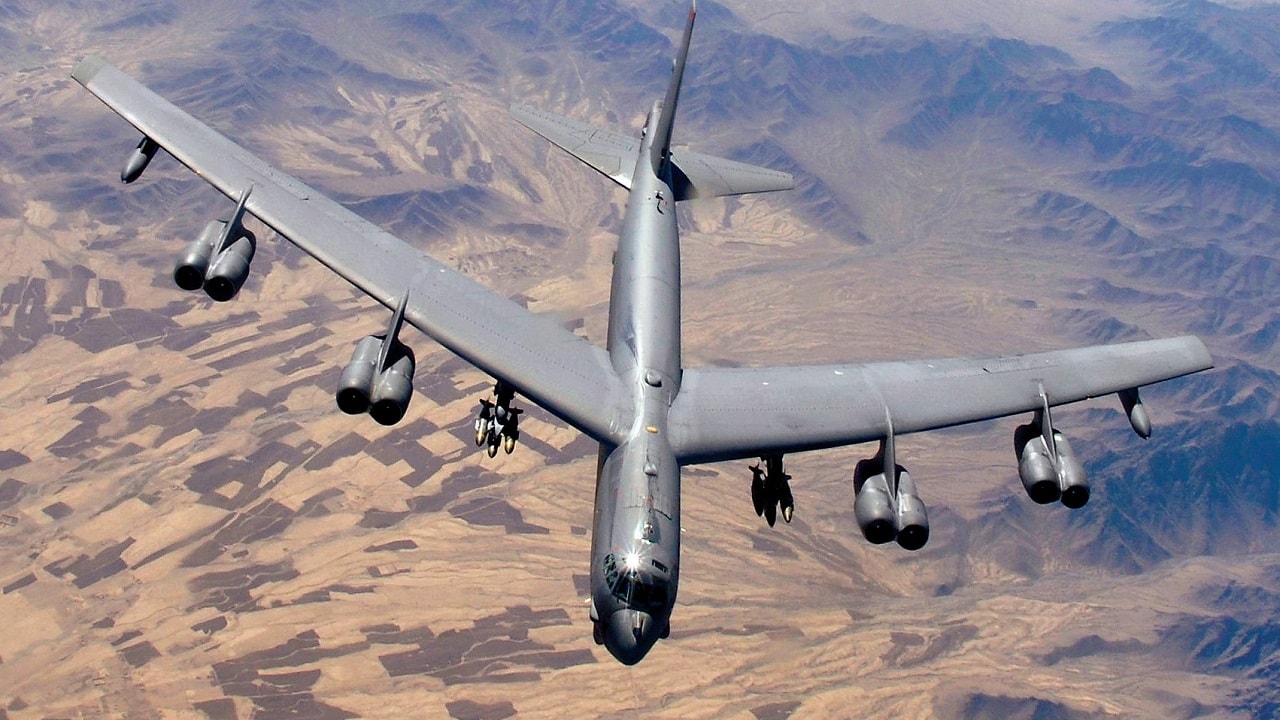
B-52H Stratofortress Primary function: Heavy bomber. Speed: 650 mph. Dimensions: Wingspan 185 ft.; length 159 ft. 4 in.; height 40 ft. 8 in. Range: 8,800 miles unrefueled. Armament: M117, Mk-56/62/65/82/84, CBU- 87/89/103/104/105, AGM-86B/C/D/129A/158A, GBU- 10/12/28/31/38; nuclear weapons. Crew: Five. (U.S. Air Force photo by Master Sgt. Lance Cheung)
Interestingly, some of the Stratojet’s most daring missions were not bombing runs. Instead, they were reconnaissance missions.
Variants of the B-47 known as RB-47s were designed to conduct deep-penetrating surveillance missions over enemy territory.
The planes were equipped with sophisticated electronic intelligence equipment designed to detect, identify, and map Soviet radar and air defense systems.
The most advanced version was the RB-47H. It entered service in 1955 after Boeing built 32 new aircraft and converted three existing bombers into the electronic reconnaissance configuration.
Losses and Legacy
Soviet fighters frequently intercepted the RB-47 while they conducted their missions within Soviet territory.
Interestingly, one RB-47 was lost near the Kamchatka Peninsula in 1955, and another was shot down over the Barents Sea on July 1, 1960, by a Soviet MiG-19. Four US airmen were killed.
Two others survived and were eventually released.
Other RB-47 crews survived attacks by relying on the aircraft’s speed, altitude, and defensive tailguns to escape pursuing fighters.
The last bomber variants left SAC service in 1965, while the final operational Stratojet, the WB-47 weather reconnaissance aircraft, retired in 1969.
The B-47 is remembered as the key technological evolution bridging the propeller-driven bomber era of World War II with the jet-powered era of the nuclear-tinged Cold War. It is one of the best Boeing designs in history.
About the Author: Brandon J. Weichert
Brandon J. Weichert is Senior National Security Editor. He also manages The Weichert Brief on Substack. Weichert also hosts “National Security Talk” on Rumble. He is the author of four bestselling national security books, the most recent of which is A Disaster of Our Own Making: How the West Lost Ukraine (Encounter Books). Follow him via Twitter/X @WeTheBrandon.