
The USS Oriskany (CV-34) was the last of the Essex-class carriers, the backbone of the US carrier fleet in World War II. She was named after a town in New York State and was the site of a bloody Revolutionary War battle.
The Oriskany was originally assigned to CV-18, but that hull was renamed Wasp when the keel was laid in 1942.
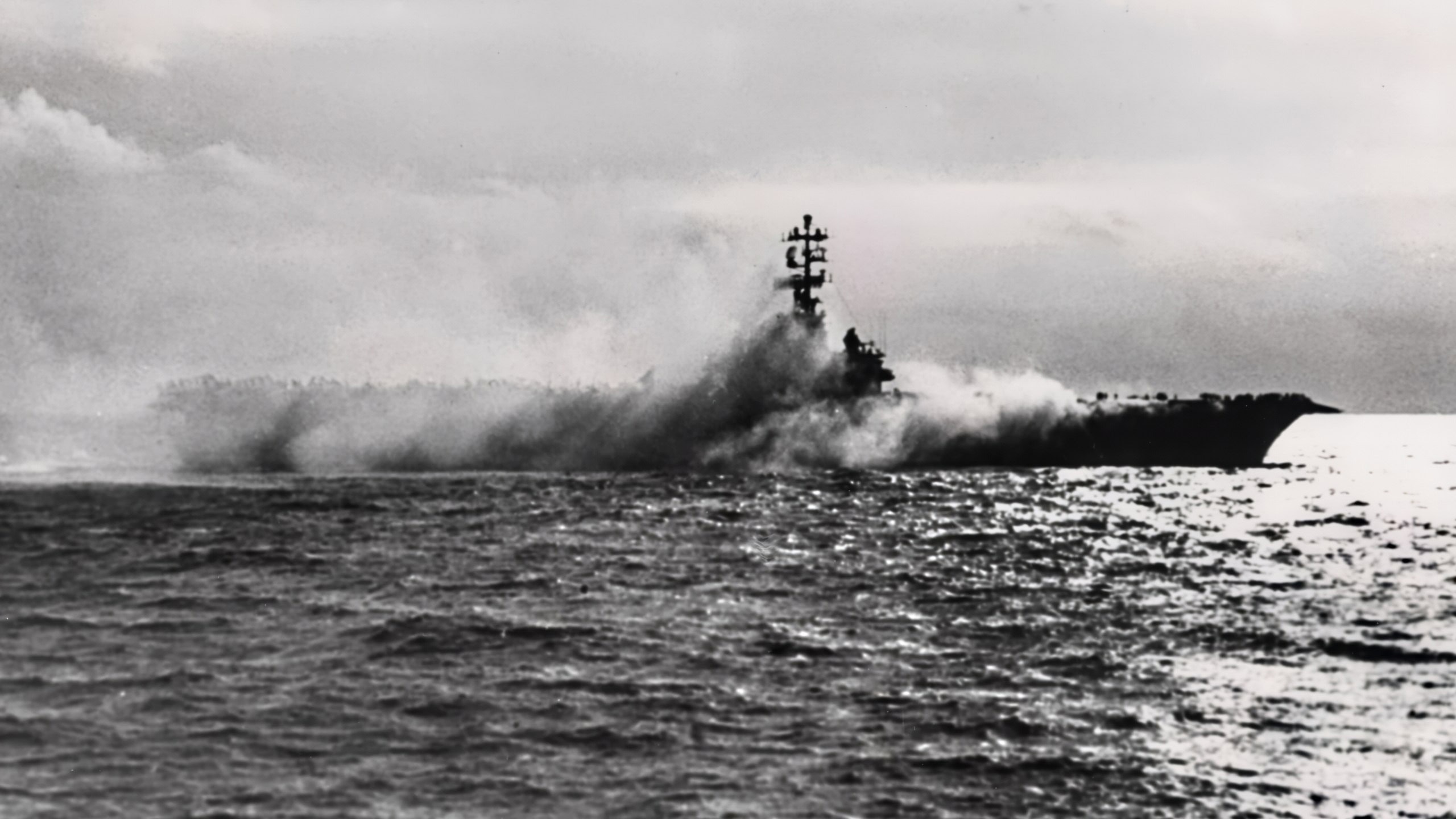
The U.S. Navy aircraft carrier USS Oriskany (CVA-34) on fire, 26 October 1966. Smoke pours from Oriskany’s Hangar Bay No.1, during the fire which killed 44 of her officers and men.
CV-34 was laid down on 1 May 1944 by the New York Naval Shipyard, and was launched on October 13, 1945, and sponsored by Mrs. Clarence Cannon.
However, due to the end of World War II, budgets were slashed, and the construction was suspended on August 12, 1947, when the ship was about 85 percent complete.
She sat dormant in the shipyard until the Korean Conflict erupted in June 1950. The Oriskany was then rushed to completion. She was commissioned on September 25, 1950.
The USS Oriskany (CV-34) Specs And Armaments
The USS Oriskany (CV-34) measured 888 feet at the waterline but was up to 911 feet long, with a 129-foot beam and a 30.5-foot draft.
The carrier’s standard displacement was 30,800 tons, but she weighed 44,700 tons under a full load.
Powered by 8 boilers and 4 Westinghouse turbines, she reached 33 knots and carried 80 to 100 aircraft depending on the operational era.
She had a range of 14,100 nautical miles at 15 knots. She was crewed by 2,600 to 3,460 officers and sailors.
Armaments included 4 x 5-inch (127 mm/38 caliber) twin gun turrets, 4 x 5-inch (127 mm/38 caliber) single gun turrets, 8 x 40 mm Bofors/ 56 caliber quad gun mounts, and 46 x 20 mm Oerlikon/78 caliber single gun mounts.
The USS Oriskany’s Service In Korea
After its first cruise in the Mediterranean with the 6th Fleet in 1951, she returned to New York for an overhaul which included the installation of a new flight deck, steering system, and bridge.
That was completed in mid-May 1952, and after loading ammunition and supplies, she sailed for the Pacific for duty in Korea.
The Oriskany joined the USS Bonhomme Richard (CVA-31) as part of Task Force (TF) 77 off the coast of Korea on Halloween 1952.
The carriers provided close air support to front-line combat forces, interdiction of enemy supply lines, and air support for naval gunfire strikes along the coast.
Its jet fighters, Grumman F9F Panthers, attacked North Korean positions near Wonsan.
In November 1952, four Panther fighters took on seven MiG-15 fighters in a battle that had the Americans shoot down two MiGs and damage two others without damage to themselves.
They shot down a third MiG about ten days later.
The Oriskany and TF-77 continued flying combat missions until March 29, 1953, and returned to the US via Hong Kong. In 1954, the carrier was loaned to Hollywood for the film about the Korean War, “The Bridges at Toko-Ri.”
The carrier earned two service stars for the Korean War.
Overhaul, Modernization, And The Vietnam War
In 1956, the Oriskany underwent a major overhaul, which included the installation of a new angled flight deck, an aft deck edge elevator, an enlarged forward elevator, and an enclosed hurricane bow.
Powerful new steam catapults replaced the older hydraulic catapults. The wooden flight deck planking of the WWII-era carriers was also replaced with aluminum planking.
In late April 1965, the Oriskany was sent to Vietnam, where from May 10 to December 6, 1965, her air wing carried out over 12,000 combat sorties and delivered nearly 10,000 tons of ordnance against North Vietnamese and Viet Cong forces.
One of the carrier’s losses was an A-4 Skyhawk, commanded by Cdr. James B. Stockdale, who was shot down on September 9, 1965, after bombing a railroad junction and was captured.
Stockdale remained a POW of the North Vietnamese until January 12, 1973.
Deadly Fire Kills 44 Sailors
The USS Oriskany deployed for a second tour in 1966. While on “Yankee Station” off the coast of Vietnam, on the morning of October 26, 1966, a huge fire erupted on the starboard side of the ship’s forward hangar bay and raced through five decks, killing 44 men.
Many who lost their lives were veteran combat pilots who had flown combat missions over Vietnam just a few hours earlier.
The cause of the fire was a magnesium parachute flare that caused an explosion in the forward flare locker of Hangar Bay 1, beneath the carrier’s flight deck.
Fighting the intense blaze took more than three hours. Injured sailors were treated onboard the carrier, with assistance from the carriers USS Constellation and the USS Franklin D. Roosevelt.
She continued service in the Vietnam War, earning ten service stars.
Retirement And Sinking As An Artificial Reef
The USS Oriskany returned to the United States in early March 1976. About a month and a half later, she was slated for decommissioning as her material condition was beginning to deteriorate.
She was officially retired on September 30, 1976, and put into mothball storage in Bremerton, Washington.
The Reagan administration briefly considered reactivating her, but her material condition made that an expense that Congress signaled was too costly.
She was officially struck from the Naval Vessel Register in 1989. The ship’s bell was removed and sent to the town of Oriskany, NY.
In April, 2004, the Navy announced that instead of scrapping the carrier, it would be sunk to become the first US warship to serve as an artificial reef.
The ship was towed to Corpus Christi, Texas, and completed the environmental preparation work in December.
Environmental issues were hammered out between the Navy and the EPA, a process that took nearly two years.
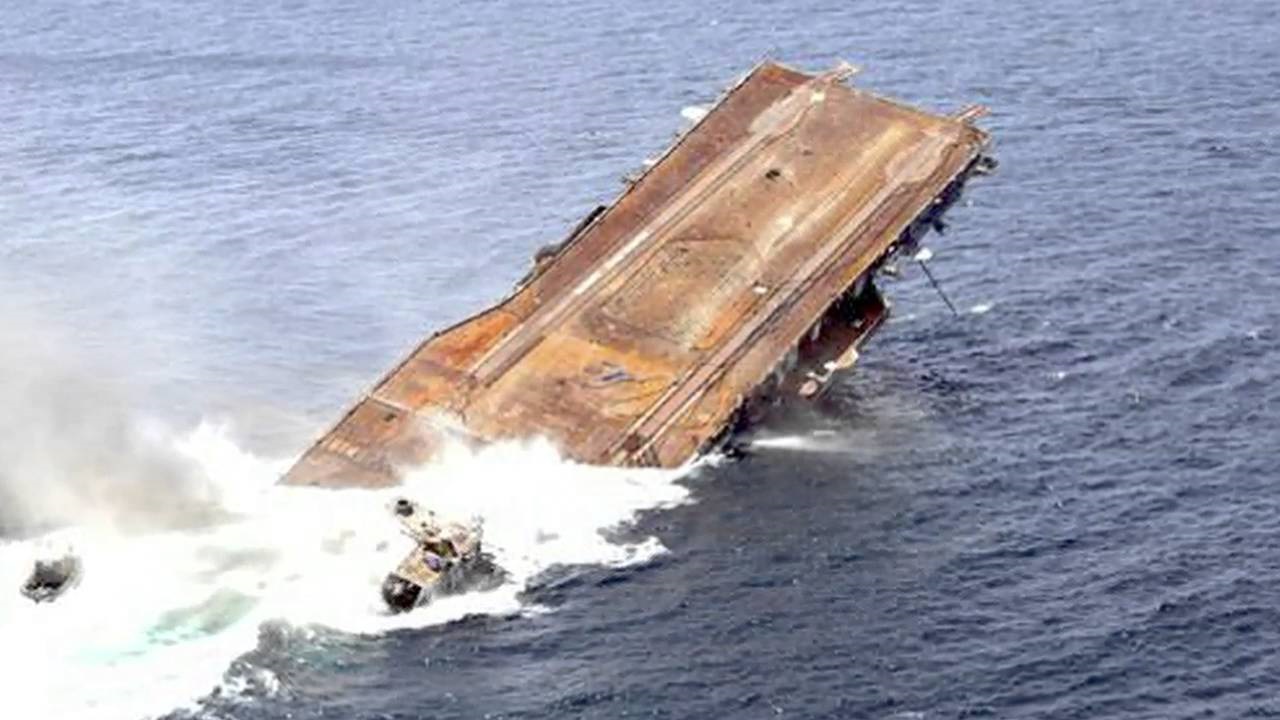
Finally, on May 17, 2006, a team of Navy divers detonated about 250 pounds of C4 explosives, strategically placed on board the ship, and she sank off the coast of Pensacola, Florida.
There she rests upright, with her flight deck at 145 feet beneath the surface. It is now a popular diving destination, known as the “Great Carrier Reef.”
MORE – Germany Wanted a WWII Battleship That Was Bigger Than the Iowa-Class
About the Author: Steve Balestrieri
Steve Balestrieri is a National Security Columnist. He served as a US Army Special Forces NCO and Warrant Officer. In addition to writing on defense, he covers the NFL for PatsFans.com and is a member of the Pro Football Writers of America (PFWA). His work was regularly featured in many military publications