During the Cold War, the United States Armed Forces experimented with a bevy of radical, innovative new designs for a variety of platforms.
The United States Navy, especially at the start of the Cold War, experimented with some of the most interesting concepts.
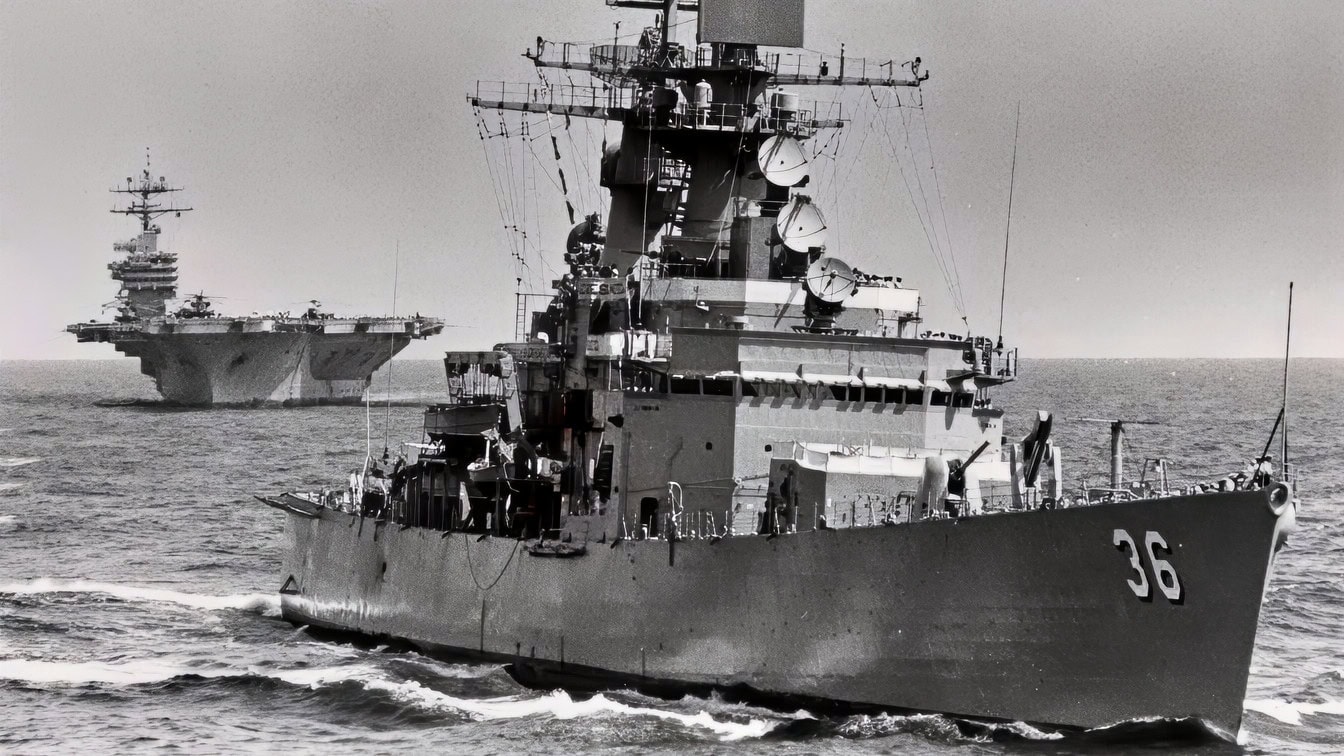
The USS California
One of those warships was the nuclear-powered cruiser, the USS California (CGN-36).
It was the lead ship of a two-vessel California-class that combined nuclear propulsion with long-range air defense, along with anti-submarine warfare, and even anti-ship capabilities.
All these capabilities were combined in this unique nuclear-powered cruiser at a time when Washington expected the Cold War to eventually turn hot.
Built by Newport News Shipbuilding in Newport News, Virginia, the USS California was launched on September 22, 1971, sponsored by First Lady Pat Nixon. She was later commissioned by the United States Navy in 1974.
At first, the USS California was designated as “DLGN-36,” a nuclear-powered guided missile frigate. A year later, though, the ship was redesignated as “CGN-36.” That’s because the Navy reclassified large missile escorts as cruisers.
The nuclear-powered ship was known throughout the Navy as the “Golden Grizzly.”
Specifications
-Length: 596 feet
-Displacement: 11,500 tons (fully loaded)
-Propulsion: Two General Electric (GE) D2G nuclear reactors
-Speed: More than 30 knots
-Crew: Around 584 officers and enlisted sailors
-Aircraft: Helicopter landing deck (no permanent hangar)
Armament: Two Mk 13 guided missile launchers for Standard missiles, an Anti-Submarine Rocket Launcher (ASROC), Harpoon anti-ship missiles, two five-inch/54-caliber guns, Phalanx Close-In Weapon Systems (CIWS), and Mk 46 torpedoes
California carried one of the Navy’s most capable air-defense suites in the fleet.
Her twin-arm missile launchers fired Standard surface-to-surface missiles, which defended against both aircraft and incoming missiles.
The ASROC launcher provided the anti-submarine warfare capabilities. Eventually, the Navy included the Harpoon anti-ship missiles and the Phalanx CIWS once they were developed.
The “Golden Grizzly” Was Ahead of Its Time
The “Golden Grizzly” possessed multiple radars and sonars to give the cruiser a dynamic capacity for escort duty when operating alongside America’s nuclear-powered aircraft carriers. The California was a key player in the layered air defense for aircraft carriers when forward-deployed.
During Queen Elizabeth II’s Silver Jubilee celebration, California represented the US Navy in 1977.
The cruise saw service beyond the Cold War, too.
During Operation Desert Storm in 1991, the nuclear-powered cruiser supported coalition operations against Saddam Hussein’s Iraqi Army.
She provided air defense and escort duties for the carrier forces launching and recovering US warplanes that pounded Saddam’s army and Iraq’s air defense systems.
Even though the California was a dominant combat system, she became more expensive to operate over time. Maintaining nuclear-powered surface warships required specialized infrastructure and uniquely trained personnel.
Losing to the Cheaper Alternatives
Plus, refueling and repairing nuclear reactors was expensive.
Conventionally powered Ticonderoga-class Aegis cruisers offered more advanced combat systems, such as Vertical Launch System (VLS) cells, and were much cheaper than the nuclear-powered California.
Once the USSR collapsed and the Cold War ended, Congress became less interested in splurging on defense.
To better comport with Congress’ desire for a cheaper, nimbler post-Cold War military, the Navy concluded that nuclear-powered cruisers were unnecessary and too much of a financial burden.
Thus, the Pentagon decommissioned the “Golden Grizzly” on July 9, 1999, sending the ship to the Navy’s nuclear recycling program.
The class was small in number, but it served the Navy for an extended time, proving its utility as a nuclear-powered surface combatant. Its enemies never destroyed it.
Congress took down the USS California.
Nevertheless, the Navy gained invaluable experience–and benefited greatly at the tactical level throughout the Cold War–by maintaining a nuclear-powered cruiser, like the USS California.
About the Author: Brandon J. Weichert
Brandon J. Weichert is the Senior National Security Editor at 19FortyFive.com. He also manages The Weichert Brief on Substack. Weichert also hosts “National Security Talk” on Rumble. He is the author of four bestselling national security books, the most recent of which is A Disaster of Our Own Making: How the West Lost Ukraine (Encounter Books). Follow him via Twitter/X @WeTheBrandon.