
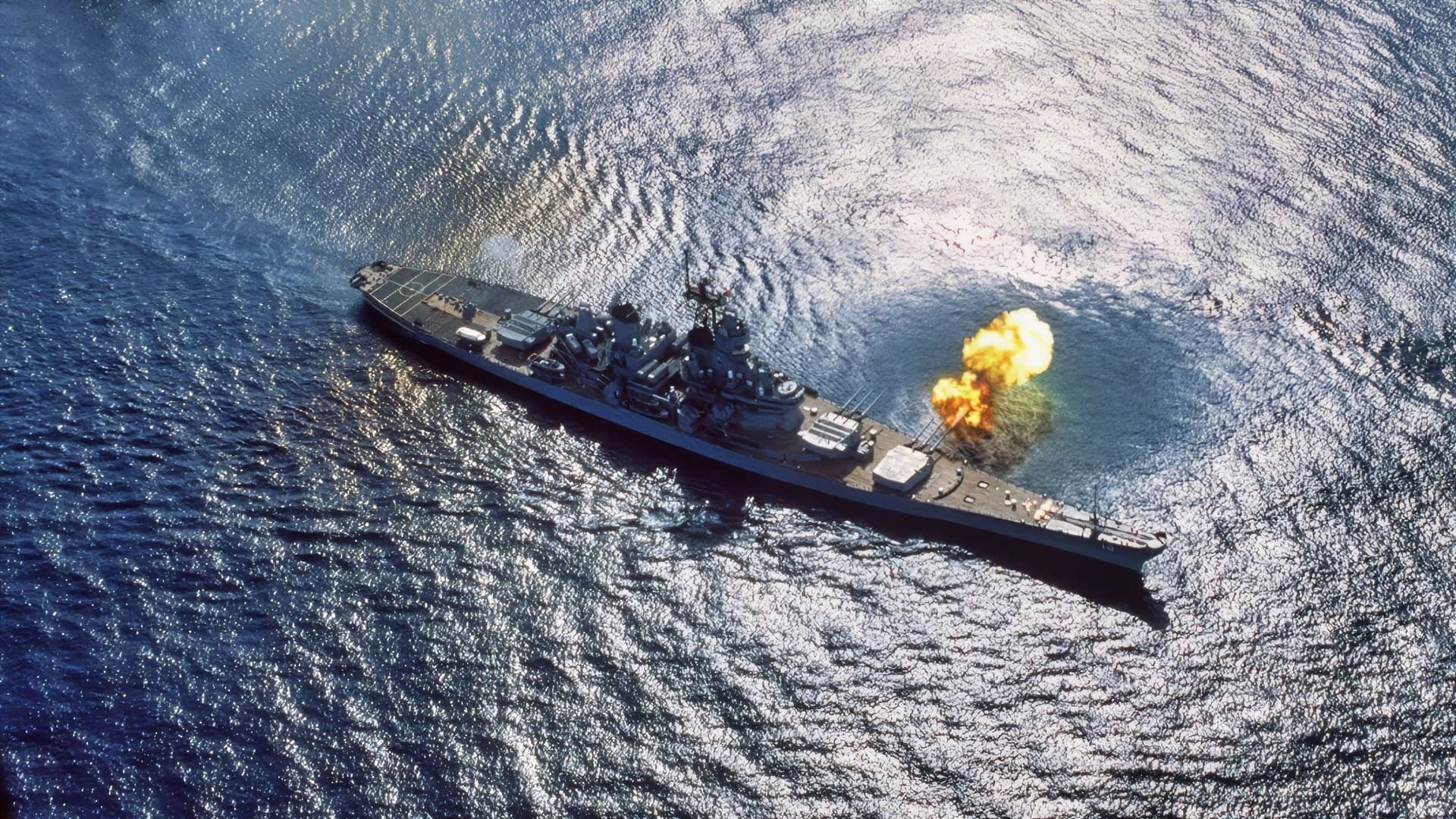
USS Illinois Was 22 Percent Complete When the Navy Canceled Its Fifth Iowa-Class Battleship – The Philadelphia Navy Yard finally laid the keel for Illinois on January 15, 1945. The construction contract was awarded in September 1940, but higher-priority naval work delayed the start, and engineers increased the use of welding and adjusted underwater protection. A later Naval History clarification resolves conflicting accounts that place the keel several years earlier.
Seven months later, the Navy canceled BB-65 with the ship about 22 percent complete. Illinois had never left the building ways, received no commission, and spent zero days at sea. No completed section ever entered the water. The partially assembled hull remained in Philadelphia until workers began dismantling it in September 1958.
Had construction continued, Illinois would have measured 887 feet 3 inches long and 108 feet 2 inches across the beam. The design was rated at 45,000 long tons standard displacement. Because BB-65 never reached completion, no trial displacement exists; a completed sister such as USS Wisconsin reached 57,271 tons at full load. Eight boilers and four geared turbines would have produced 212,000 shaft horsepower and a speed near 33 knots.
The planned battery contained 158 gun barrels: nine 16-inch guns, twenty 5-inch guns, eighty 40 mm Bofors barrels, and forty-nine 20 mm Oerlikons. Three floatplanes would have supported reconnaissance and gunfire spotting. The primary weapons were the 16-inch/50-caliber Mark 7 guns, each able to fire a 2,700-pound armor-piercing shell more than 24 miles.
Illinois Was Ordered as the Fifth Iowa-Class Battleship
Congress authorized Illinois under the Two-Ocean Navy Act of July 1940. The Navy wanted another fast battleship able to keep pace with carrier formations, chase Japanese surface forces, and deliver heavy shore bombardment. The class combined 33-knot speed with nine 16-inch guns, a combination no earlier American battleship matched.
The contract called for completion by May 1, 1946. Accumulated armor, boilers, and prefabricated sections let the yard move quickly after the keel went down, but the late start left no path to wartime service. The cancellation came during the final days before Japan announced its surrender.
BB-65 occupied an important point between two designs. The Iowa class emphasized speed and Panama Canal access. The planned Montana class traded speed for heavier armor and twelve 16-inch guns. Illinois remained an Iowa rather than becoming the first Montana, despite later claims that the hull changed classes.
Nine 16-Inch Guns Would Have Fired a 24,300-Pound Broadside
The main battery would have placed six guns forward and three aft in three triple turrets. One armor-piercing salvo totaled 24,300 pounds, or 12.15 short tons. At a rate of two rounds per minute, the complete battery could theoretically have sent 48,600 pounds of projectiles downrange in 60 seconds.
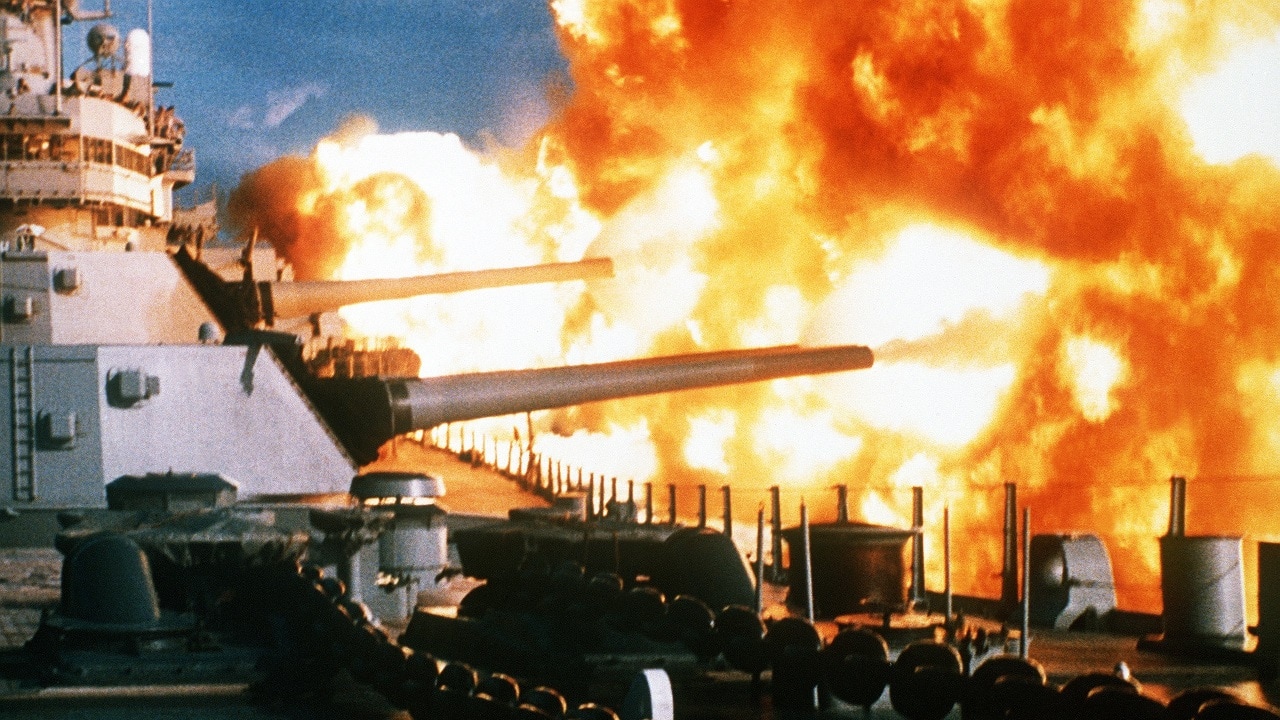
The Iowa-class battleship USS New Jersey fires at positions near Beirut on 9 January 1984 during the Lebanese Civil War.
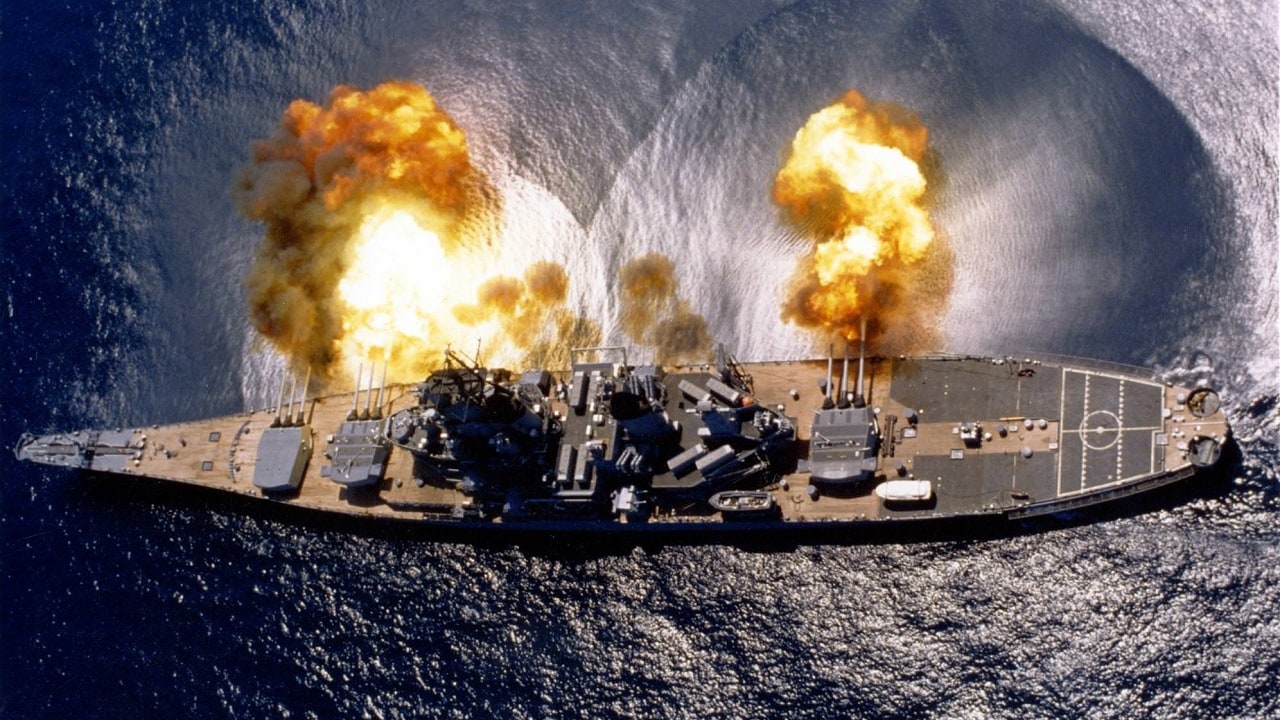
Iowa-class battleship firing a broadside. Image Credit: Creative Commons.
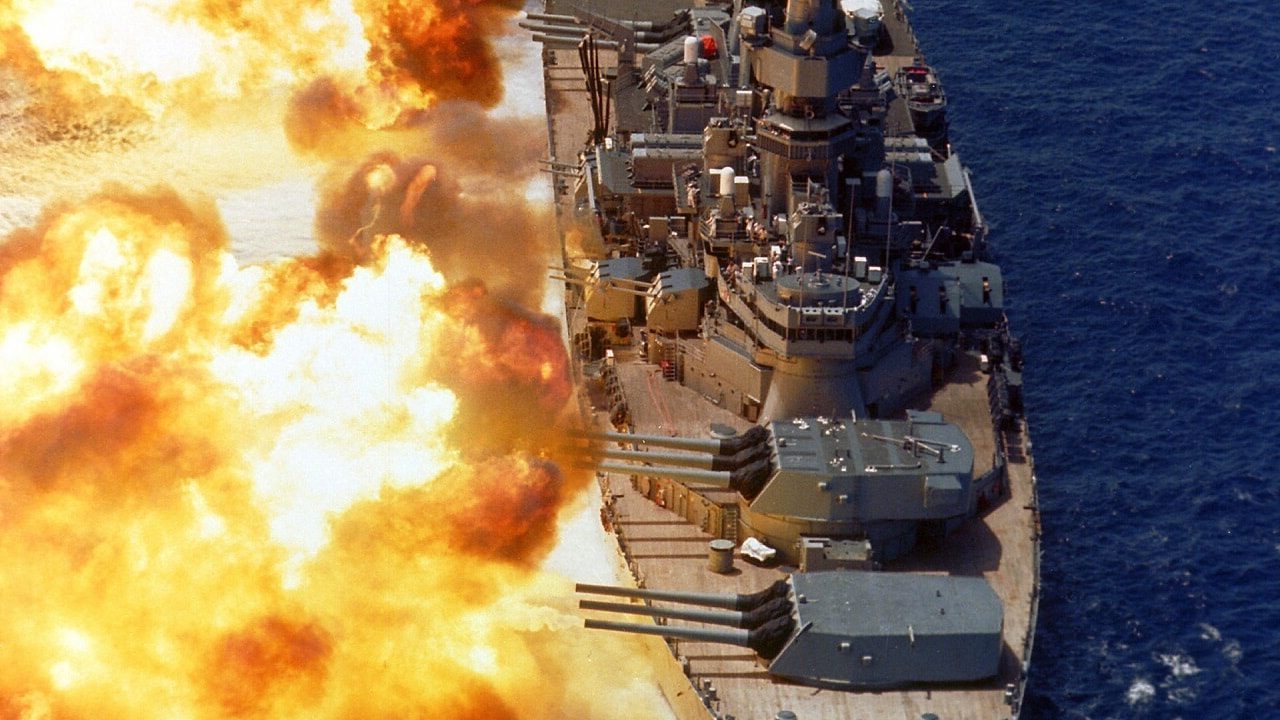
Iowa-class battleship firing off a broadside.
Ten twin 5-inch/38 mounts supplied dual-purpose fire against aircraft and surface targets. The Bofors and Oerlikon batteries reflected the late-war air threat, giving the unfinished ship the same dense anti-aircraft layout associated with the final Iowa-class design. A projected crew of roughly 1,900 would have operated the ship before wartime additions.
All-Welded Construction Was Illinois’s Main Difference
Illinois and Kentucky were planned with all-welded hull construction, rather than the mixture of welding and riveting used in the four completed Iowas. Welding reduced structural weight and improved strength, leaving designers room to refine underwater protection.
The Navy studied giving the final pair a torpedo-defense arrangement closer to the Montana design. That larger change was rejected, and Illinois retained the basic Iowa hull form. She therefore would not have gained the Montana’s fourth main turret, heavier belt, or slower 28-knot operating profile. Her unfinished sister, USS Kentucky, advanced much farther before meeting the same postwar problem.
An Aircraft Carrier Conversion Could Not Save the Hull
The Navy examined turning Iowa-class hulls into aircraft carriers when the Pacific War created an urgent demand for flight decks. A June 1942 Bureau of Ships plan showed an 864-foot flight deck on a converted battleship hull.
The compromise offered less aviation capacity than a purpose-built Essex-class carrier and required extensive redesign. Building another Essex was faster and produced a better carrier, so Illinois stayed on the battleship path. The proposal remains one of the more unusual Iowa-class conversion studies.
Japan’s Defeat Removed the Case for Finishing Illinois
By August 1945, four Iowa-class battleships were already in service. Carrier aircraft had become the Navy’s principal long-range striking force, and the completed Iowas supplied enough fast-battleship capacity for the shrinking postwar fleet. Finishing a fifth ship would have required years of additional spending for a role the Navy already covered.
The four completed Iowas later served in Korea, Vietnam, and the Persian Gulf. Illinois presented a different calculation. Its marginal value no longer justified completing a hull that was only one-fifth built, while the Navy demobilized and canceled the larger Montana program.
The Navy formally recorded Illinois as canceled on August 12, 1945. A bell already cast for the ship survived, as did King Neptune, the Illinois pig whose wartime appearances sold more than $19 million in war bonds. The bell stands at the University of Illinois Memorial Stadium, where Naval ROTC midshipmen ring it when Illinois scores.
MORE – The US Military Is Running Out of Missiles
About the Author: Harry J. Kazianis
Harry J. Kazianis (@Grecianformula) was the former Senior Director of National Security Affairs at the Center for the National Interest (CFTNI), a foreign policy think tank founded by Richard Nixon based in Washington, DC. Harry has over a decade of experience in think tanks and national security publishing. His ideas have been published in the NY Times, The Washington Post, The Wall Street Journal, CNN, and many other outlets worldwide. He has held positions at CSIS, the Heritage Foundation, the University of Nottingham, and several other institutions related to national security research and studies. He is the former Executive Editor of the National Interest and the Diplomat. He holds a Master’s degree focusing on international affairs from Harvard University.