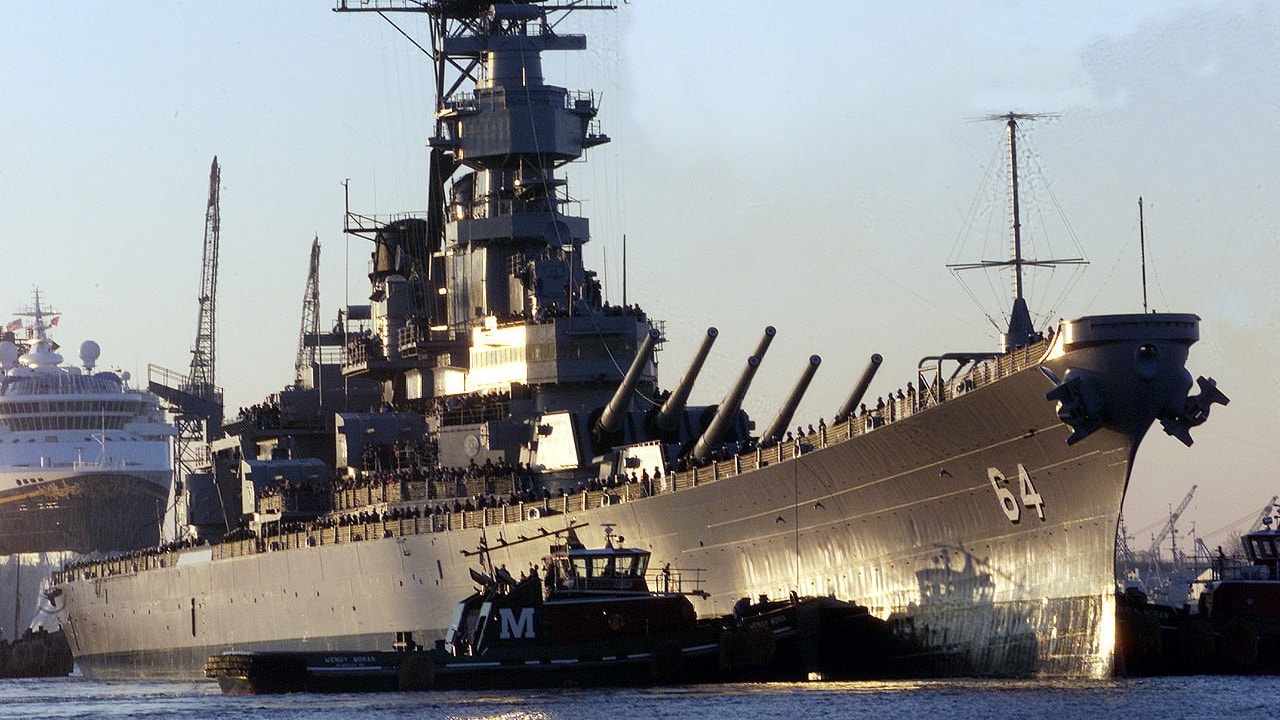
Summary and Key Points: The USS Illinois (BB-65) was authorized as the fifth Iowa-class battleship, but unlike its predecessors, it utilized an all-welded construction method that reduced weight and increased structural strength.
-Construction was halted in 1945 at approximately 20% completion as World War II ended and naval doctrine shifted toward aircraft carriers.
-Post-war, the Navy considered radical conversions for the hull, including transforming it into a guided-missile battleship armed with Terrier or Talos missiles, or even a hybrid carrier.
-However, these retrofits proved too expensive compared to building new ships.
-Unlike the USS Kentucky, which was cannibalized for parts, the Illinois remained unused and was ultimately scrapped in 1958, serving as a silent marker of the transition from the gunship era to the missile age.
The “All-Welded” Battleship: Why the Iowa-Class Battleship USS Illinois Was Special
The USS Illinois was to join the four Iowa-class fast battleships of World War II fame.
Still, only the ship’s hull was ever built, a consequence of changing naval priorities in light of new, emerging technologies.
The Illinois was authorized by the US Navy as the fifth Iowa-class battleship and was laid down at the Philadelphia Naval Shipyard early in 1945.
Although the Illinois was technically part of the Iowa class, that hull’s role had shifted away from the first four Iowa-class ships almost as soon as construction began.
Along with the USS Kentucky, the sixth and final Iowa-class battleship—which, like the USS Illinois, was never finished—the Illinois was built entirely with welded construction instead of the then-usual mix of both welding and riveting used to build other warships.
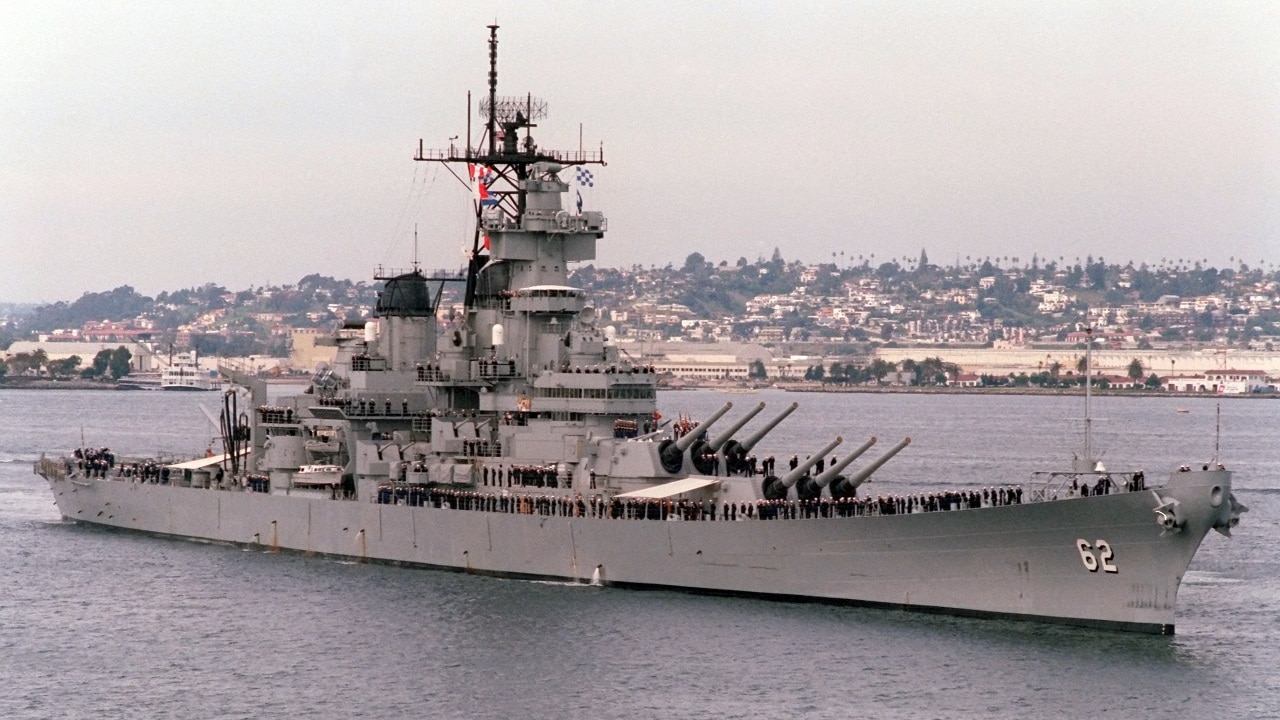
Iowa-class battleship.
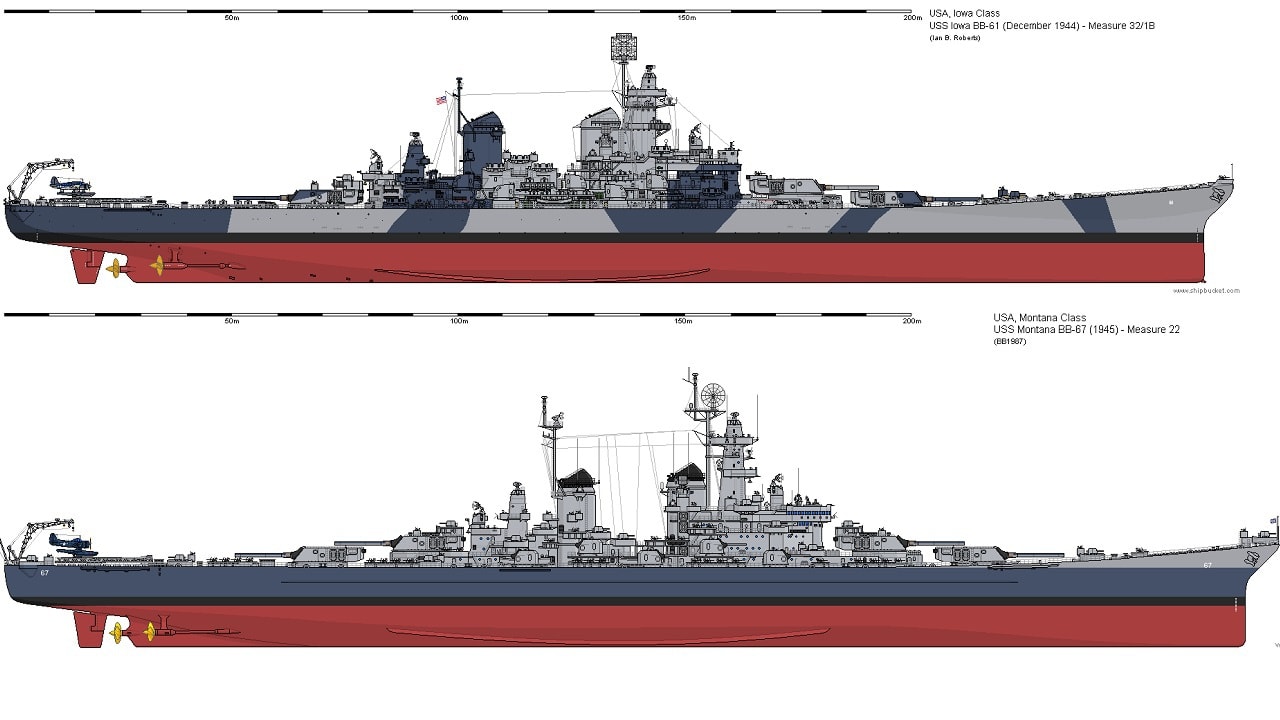
Image of Iowa-class battleship compared to Montana-class battleship that was never built. Image Credit: Creative Commons.
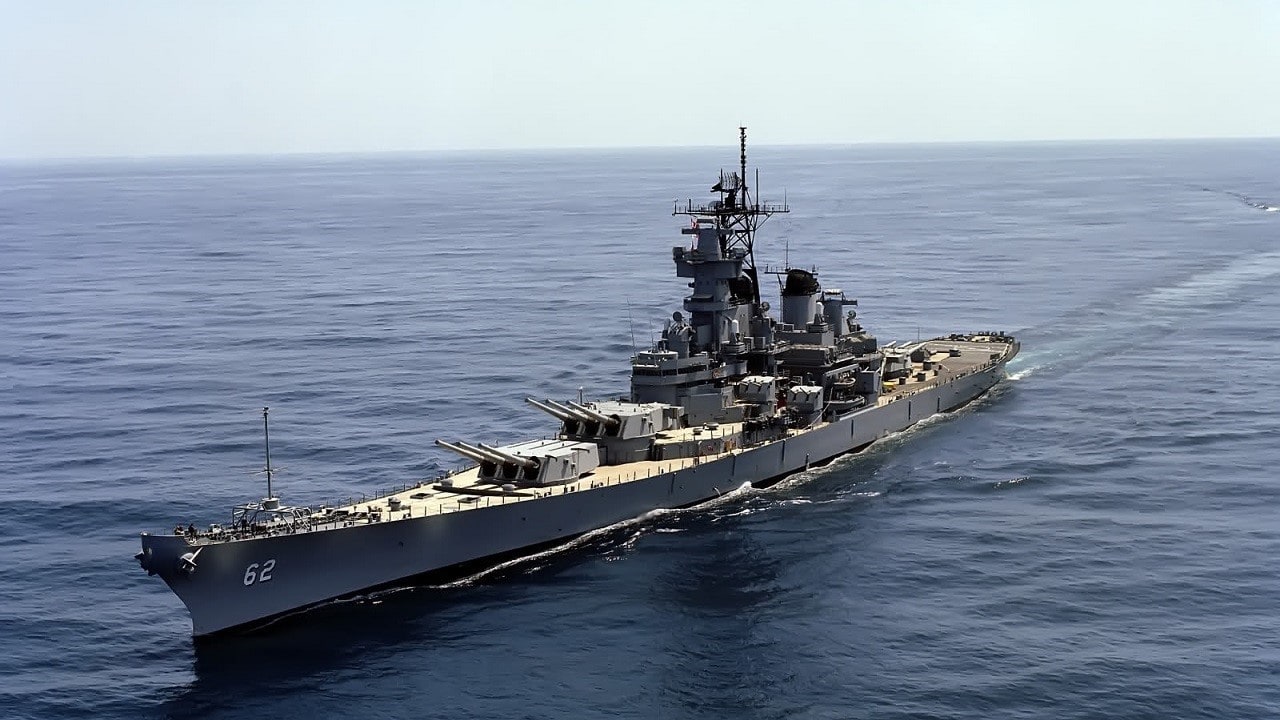
Image is of an Iowa-class battleship. Image Credit: Creative Commons.
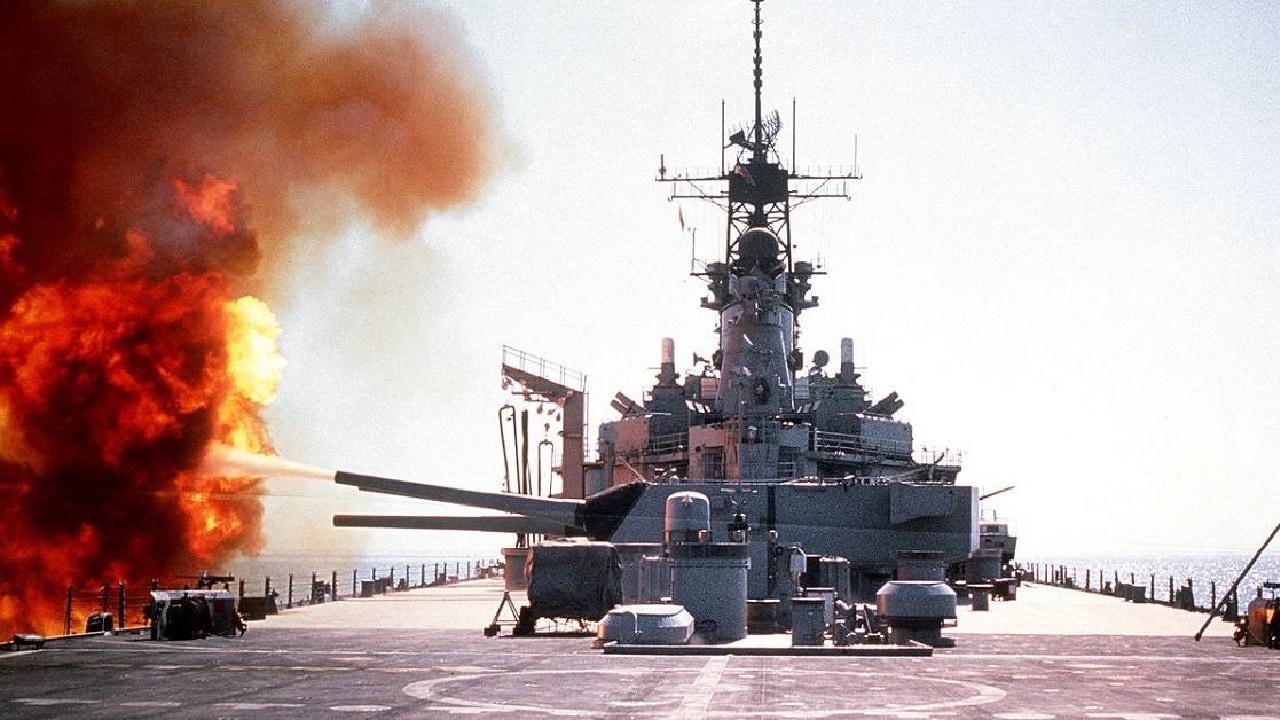
Image of Iowa-class battleships firing her 16-inch guns. Image Credit: Creative Commons.
This all-welded construction saved eight, increased the ship’s structure’s strength, and simplified production. In fact, the weight savings were significant enough to prompt the Navy to study improvements to the class’s underwater protection.
The USS Illinois and USS Kentucky would have been, in essence, modernized Iowa-class battleships.
The Design
But the USS Illinois’ baseline design was similar to the rest of the Iowa-class and would retain the 9 16-inch main guns arranged in triple turrets, a nearly 33-knot top speed, and a fully loaded displacement of 57,000 tons.
Like the other Iowa-class battleships, the USS Illinois would have escorted fast carrier task forces, bombarded shore targets, and provided overmatch in engagements with enemy ships.
However, by 1945, when the ship’s hull was laid down, those missions were in flux, and aircraft carriers had usurped battleships’ traditional importance.
By the time Imperial Japan surrendered, construction on the USS Illinois was around 20 percent completed. But no armor, main guns, or significant machinery had been installed on the ship, and construction was stopped before completion.
A Redesign?
Following the end of the war and the decommissioning of the USS Illinois as a battleship, the Navy was given a blank slate for its post-war Navy and considered several conversions for the USS Illinois.
Highly important was the integration of early guided missiles onto a ship originally intended to carry naval guns.
One proposal considered removing some of the ship’s 16-inch guns and replacing them with missile launchers for the Terrier or Talos missiles, along with improved radar arrays. Another, more radical proposal was to remove all of Illinois’ gun turrets and transform the ship into a missile-heavy warship with long-range strike and air defense capabilities. Had that design proposal been realized, the USS Illinois would have been, in essence, a guided missile battleship.
Another retrofit envisioned converting the USS Illinois into an aircraft carrier or a hybrid aircraft-carrier missile ship.
However, the plan encountered the same problems as previous conversion proposals: a retrofit would be more expensive than building a carrier or guided-missile ship from scratch, and purpose-built carriers would perform more efficiently than a converted battleship.
Ultimately, none of the conversions progressed beyond a theoretical stage, and no conversion work was ever carried out.
Unlike her sister ship, the USS Kentucky, the Illinois did not contribute any of her parts to the rest of the Iowa-class or to other warships at all. The machinery that would have been placed in the Illinois’ hull was never built, and the hull, as it was, was not used for training or evaluation. In 1958, the ship was stricken from the Naval Vessel Register and scrapped.
But along with the USS Kentucky, the Illinois represented an important shift in the US Navy: a transition from the battleship as the principal capital ship to the aircraft carrier as the centerpiece of US Navy doctrine and planning.
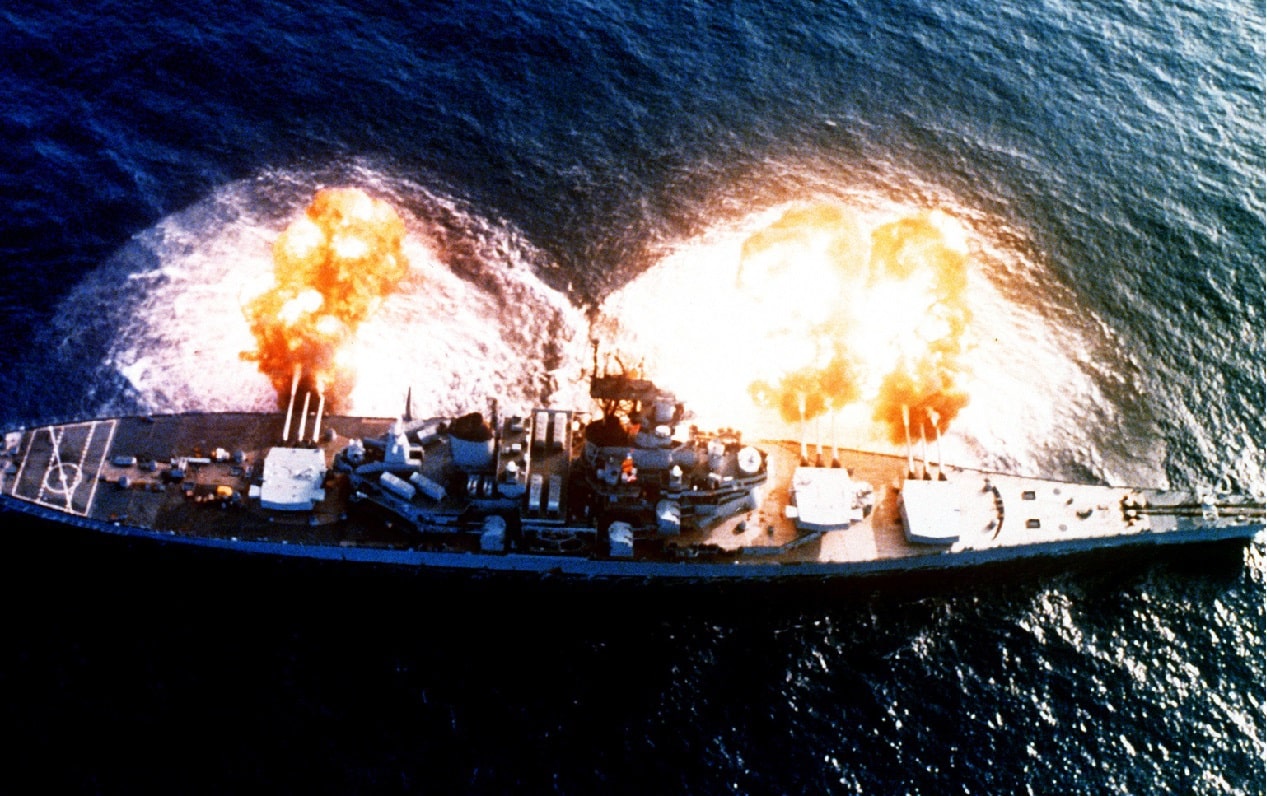
An overhead view of the battleship USS NEW JERSEY (BB-62) firing a full broadside to starboard during a main battery firing exercise.
The emphasis on aircraft carriers was so great that the US Navy didn’t even bother finishing the Illinois in a truncated form, highlighting how advances in missile technology quickly made the naval gun obsolete.
Ironically, the US Navy did reactivate the four Iowa-class battleships that had been built as a part of the Reagan administration’s goal of building a 600-ship navy. As a part of their reactivation, the Iowas were outfitted with modern anti-ship and strike missiles as well as modernized radar arrays.
Had the USS Illinois or her sister, the USS Kentucky, been built by the Navy, they would likely have undergone a similar modernization. But following the end of Cold War hostilities after the collapse of the Soviet Union, those ships, too, were retired as part of wide-ranging cost-saving measures within the Department of Defense.
The USS Illinois is a brief episode in the history of the United States Navy, marking a transition from the naval gun to the guided-missile era and a shift in naval doctrine in which battleships gave way to aircraft carriers.
About the Author: Caleb Larson
Caleb Larson is an American multiformat journalist based in Berlin, Germany. His work covers the intersection of conflict and society, focusing on American foreign policy and European security. He has reported from Germany, Russia, and the United States. Most recently, he covered the war in Ukraine, reporting extensively on the war’s shifting battle lines from Donbas and writing on the war’s civilian and humanitarian toll. Previously, he worked as a Defense Reporter for POLITICO Europe. You can follow his latest work on X.