
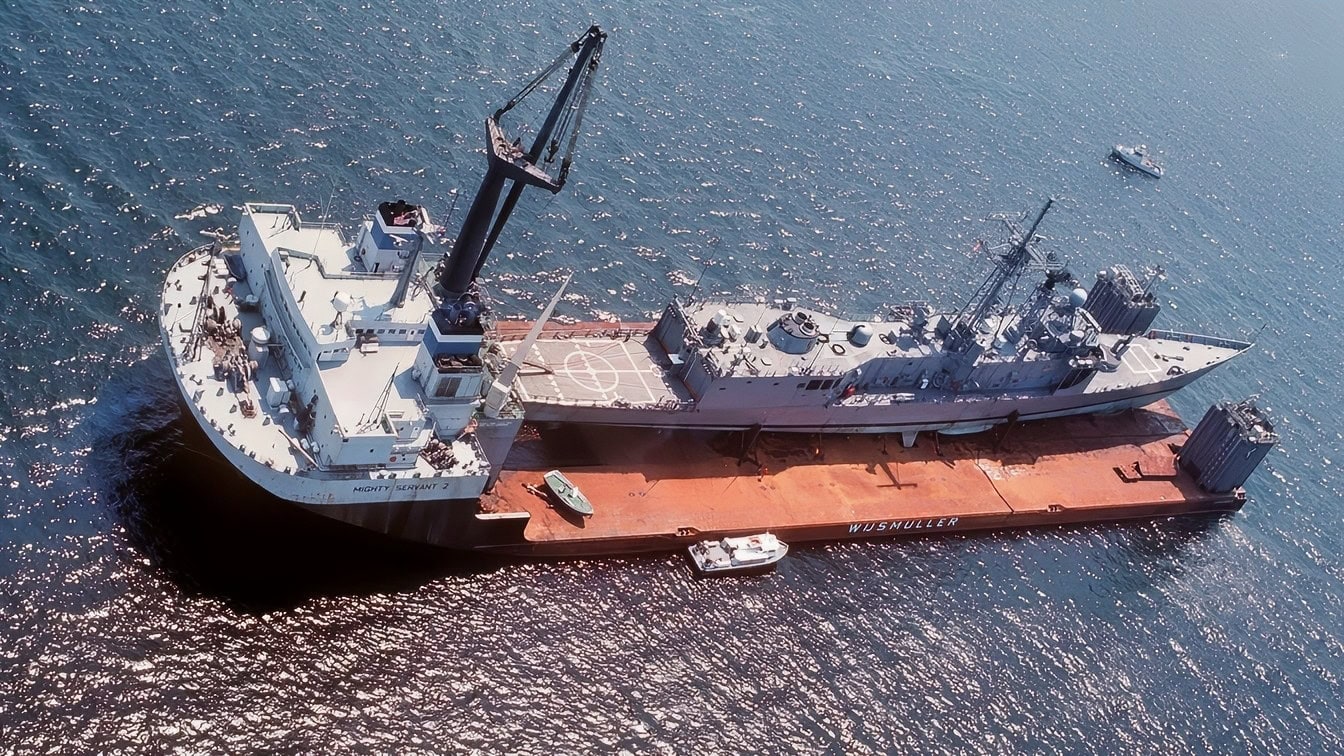
The USS Samuel B. Roberts (FFG-58) was one of the final ships in the United States Navy’s Oliver Hazard Perry-class of guided-missile frigates (FFG).
She was commissioned in 1986, but just two years later, the ship was severely damaged by an Iranian M-08 contact naval mine in 1988, leading U.S. forces to respond with Operation Praying Mantis.
Repaired and returned to duty, the ship served until its decommissioning in 2015.
That World War I-era sea mine cost about $ 1,500- $ 2,000 but did about $90 to $93 million of damage to the Roberts, coming close to sinking the modern frigate.
Background On The USS Samuel B. Roberts Disaster
The frigate was named for Samuel B. Roberts, a Navy coxswain who was killed while evacuating the U.S. Marines during the battle of Guadalcanal in 1942. Roberts was posthumously awarded the Navy Cross.
The USS Samuel B. Roberts was the third U.S. ship to bear the coxswain’s name, after Samuel B. Roberts (DE-413), a John C. Butler-class destroyer escort, commissioned in 1944 and sunk in the Battle off Samar later that year; remembered as a destroyer escort that “fought like a battleship,” and Samuel B. Roberts (DD-823), a Gearing-class destroyer, commissioned in 1946 and decommissioned in 1970.
On April 14, 1988, the Roberts was in the Persian Gulf and was heading for a refueling rendezvous with USS San Jose. She had the mission of escorting reflagged Kuwaiti tankers during the Iran-Iraq War.
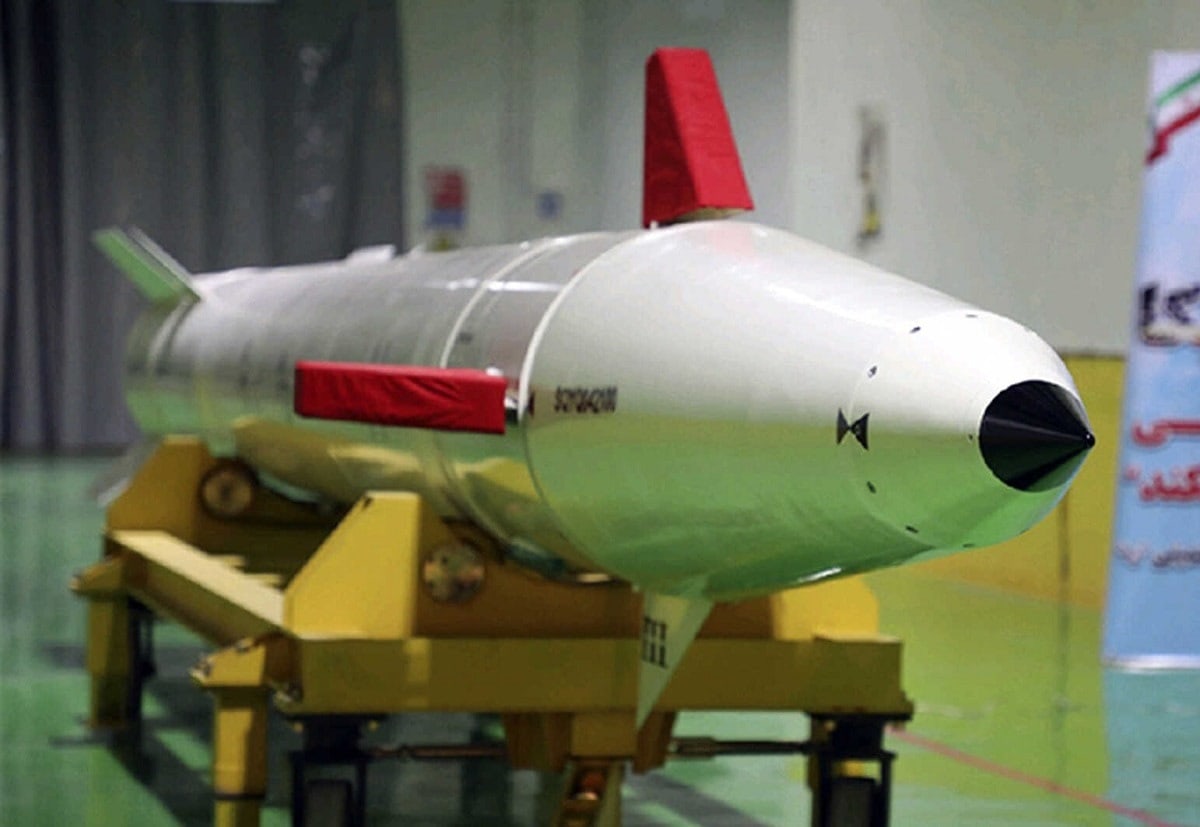
Iranian ballistic missiles. Image: Creative Commons.
The Roberts was considered the top ship of all of the Perry-class of frigates, and its skipper, Commander Paul Rinn, was a rising star in the Navy. Rinn’s ship was well aware of the dangers present in the Gulf between Iranian warships and Iraqi fighters, but what worried Rinn and the crew more than those were mines.
He was also well aware that since WWII, the most damage done to US warships came from mines. On that fateful night, one of the Roberts’ alert lookouts spotted three black spheres in the water. The officer of the deck immediately halted the ship.
Rinn immediately knew he was located in a minefield. He began to creep the Roberts in reverse, trying to extricate himself from it.
In an excellent account of the incident in USNI News, “Rinn thought, We’re going to get out.
“There were those, later, who imagined they heard a scrape of metal on metal—a half-inch-thick hull plate crushing a mine’s foil trigger. Two hundred and fifty pounds of TNT exploded, shaking the Roberts from stem to stern.
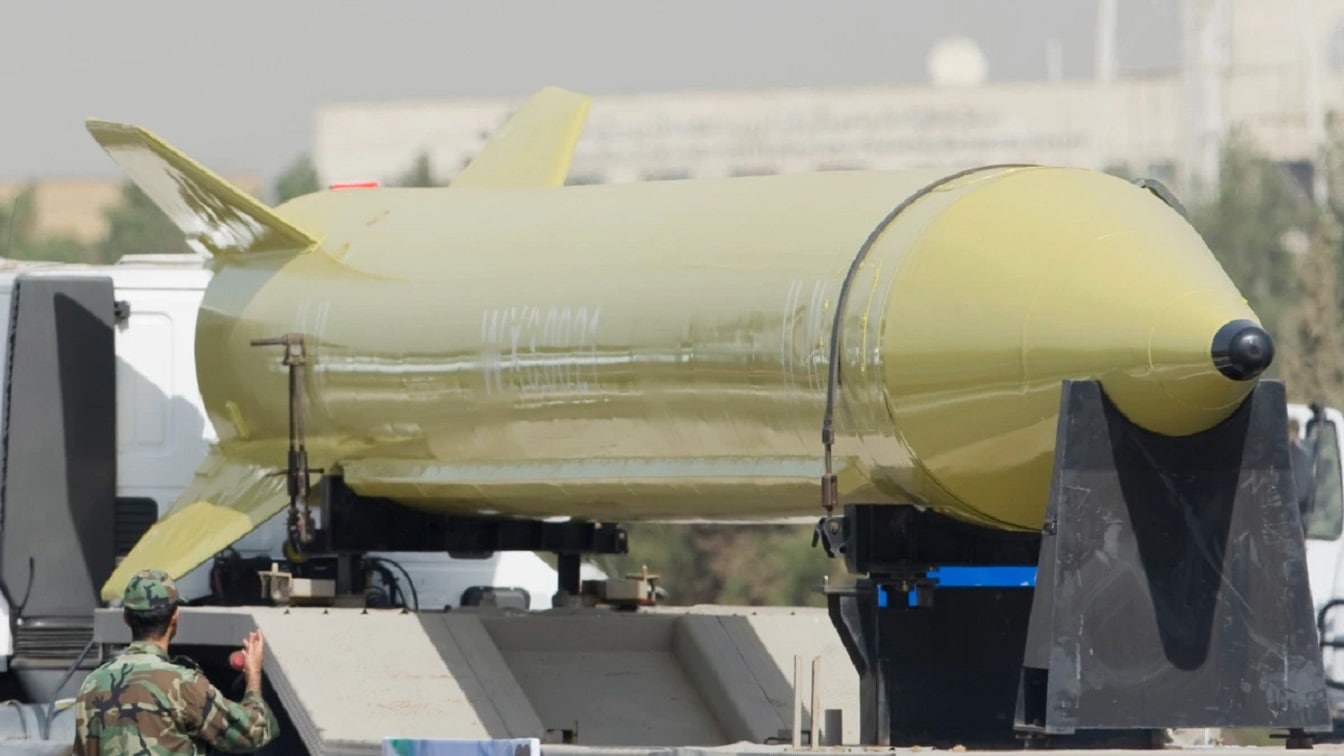
Iranian Ballistic Missile. Image Credit: Creative Commons.
“The keel snapped, HY-80 steel curling away like pipe cleaner. Superhot gases rushed through a truck-size hole in the hull, setting fires at the ship’s core; a wall of seawater soon followed. The gases vented through the exhaust flues, sending a fireball up through the ship’s stack.”
The mine blew a 15-foot hole in the hull, flooded the engine room, and knocked the two gas turbines from their mounts. The halon fire-fighting systems were out. Water for the fire-fighting hoses was only trickling out.
Normally, this would have been a death knell for any warship. But not for the Roberts.
Fireman Mike Tilley, at great personal risk, manually started the large diesel engine that powered a generator, allowing the sailors to begin fighting the fires. The Roberts’ damage control parties stemmed the flow of water into the ship.
Despite all of the damage and the chaos, the US Naval War College later cited that the Roberts never lost combat capability with her radars and Mark 13 missile launcher.
Rinn had trained his ship well, and five hours later the fires were out. The Roberts was later towed to Dubai and then ferried aboard the Mighty Servant 2, a semi-submersible heavy-lift ship, to Portland, Maine, where the massive repairs were conducted.
She continued to serve until 2015, when she retired. In 2022, she was towed to Brownsville, Texas, where she was scrapped.
The M-08 Russian Pre-World War I Era Contact Mine
The M-08 is a traditional moored naval mine designed by the Russian Empire in 1908. It was created for the Imperial Russian Navy before World War I.
It is a spherical metal globe studded with chemical-electric contact horns. When a ship hits a horn, it breaks and triggers the explosive charge. Costing very little, approximately $1,500 to $2,000, it remains a very simple, dangerous, and cheap weapon used in shallow littoral waters.
The mine is attached by an anchor and held in a static position by a cable to remain near the surface. The mines were arrayed in a minefield with a minimum distance of 120 feet between them.
The Iranians still have an indeterminate number of M-08 mines, which could once again be deployed in the Strait of Hormuz.
Even Today, Modern Warships Are Susceptible To Cheap Weapons
The lesson from the Roberts disaster was that a modern warship can fall victim to ancient, cheap weapons such as the mine, whose design is nearly 120 years old.
The Roberts probably would have sunk if not for the outstanding crew and its damage control procedures. An interesting footnote to the incident: American Fleet engineers tried to simulate the damage done to the Roberts; they reportedly could not do it without sending their model frigates to the bottom.
And while the Navy has vastly improved its mine detection by transitioning from relying strictly on crewed surface sweepers to deploying autonomous underwater vehicles (AUVs) and remote minehunting systems, dangers remain.
Because while the technology is faster and smarter, the overall size of the active dedicated mine-countermeasure force has shrunk, creating continuous strategic risks in critical chokepoints like the Middle East.
About the Author: Steve Balestrieri
Steve Balestrieri is a National Security Columnist. He served as a US Army Special Forces NCO and Warrant Officer. In addition to writing on defense, he covers the NFL for PatsFans.com and is a member of the Pro Football Writers of America (PFWA). His work was regularly featured in many military publications