
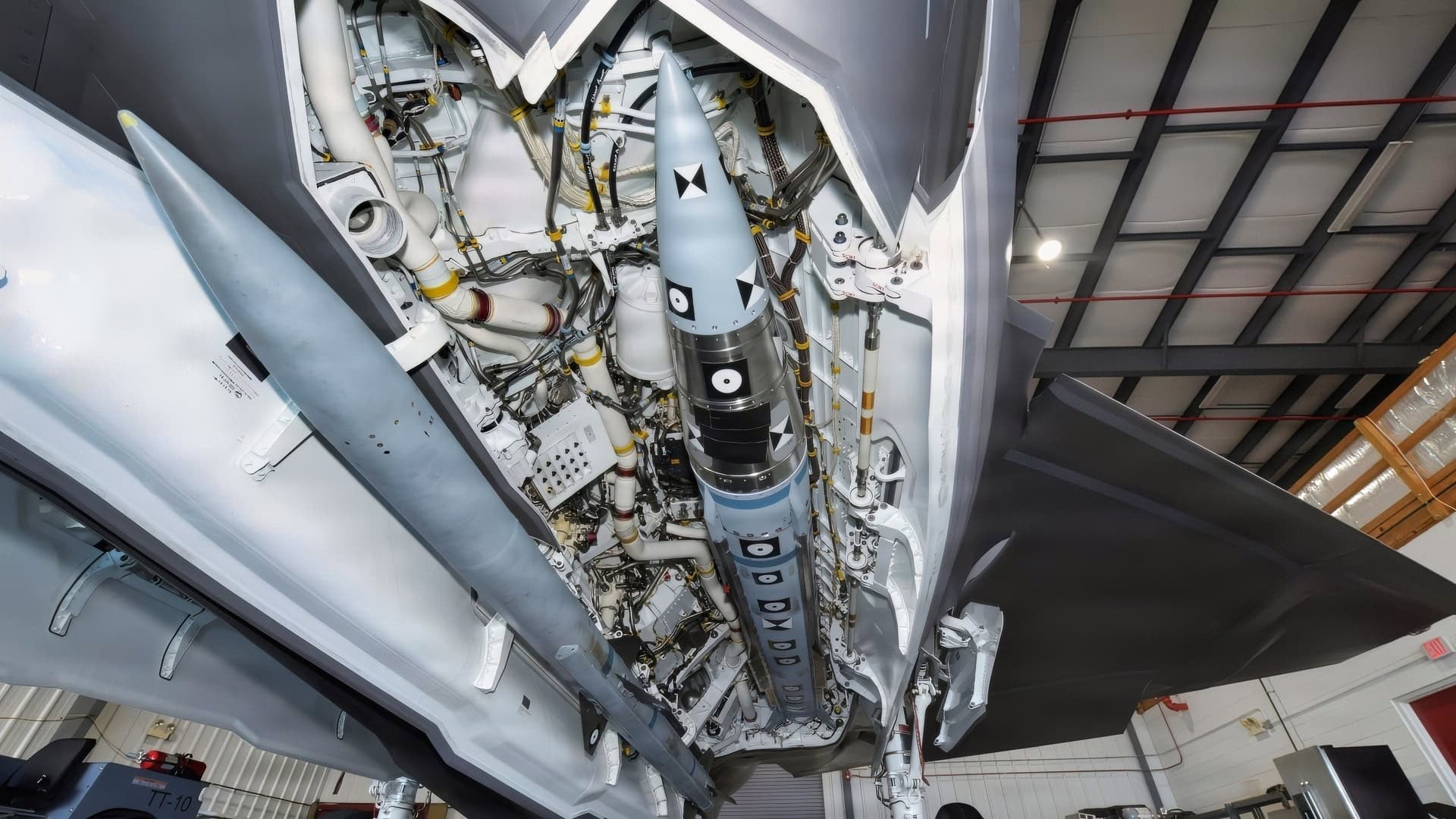
Last weekend, the US Navy revealed at its Tailhook Symposium in Reno that it had begun flight-testing a new very long-range air-to-air missile (VLRAAM) designated the AIM-424 Malice for its carrier-based F/A-18E/F Super Hornet and F-35C Lightning fighters—just two years after the service unveiled another very long-range air-to-air missile, the AIM-174B Gunslinger.
The US Navy’s Missile Upgrade
Malice and Gunslinger follow nearly a decade in which China’s PL-15 missile substantially outranged the U.S.’s own longest-range air-to-air weapon, the AIM-120D. China is also finalizing the PL-16, a miniaturized variant of the PL-15, and debuted the oversized PL-17 VLRAAM in 2022, with a 250+ mile range.
China’s J-20 stealth jets can carry four PL-15s or six PL-16s internally without increasing their radar cross-section through external carriage.
The Navy published specifications detailing the AIM-424 as having two-stage rocket boosters allowing it to engage targets from over 287.7 miles away, further than any air-to-air missile currently in service—though bear in mind official missile range figures are often understated by the Pentagon.
Gunslinger and Malice are both built by Raytheon and measure 135 millimeters in diameter, possibly reflecting that the latter evolved from the former.
However, the Navy has implied Malice outranges Gunslinger despite weighing 330 pounds less at 1,500 pounds, and being shorter at 4.11 meters long.
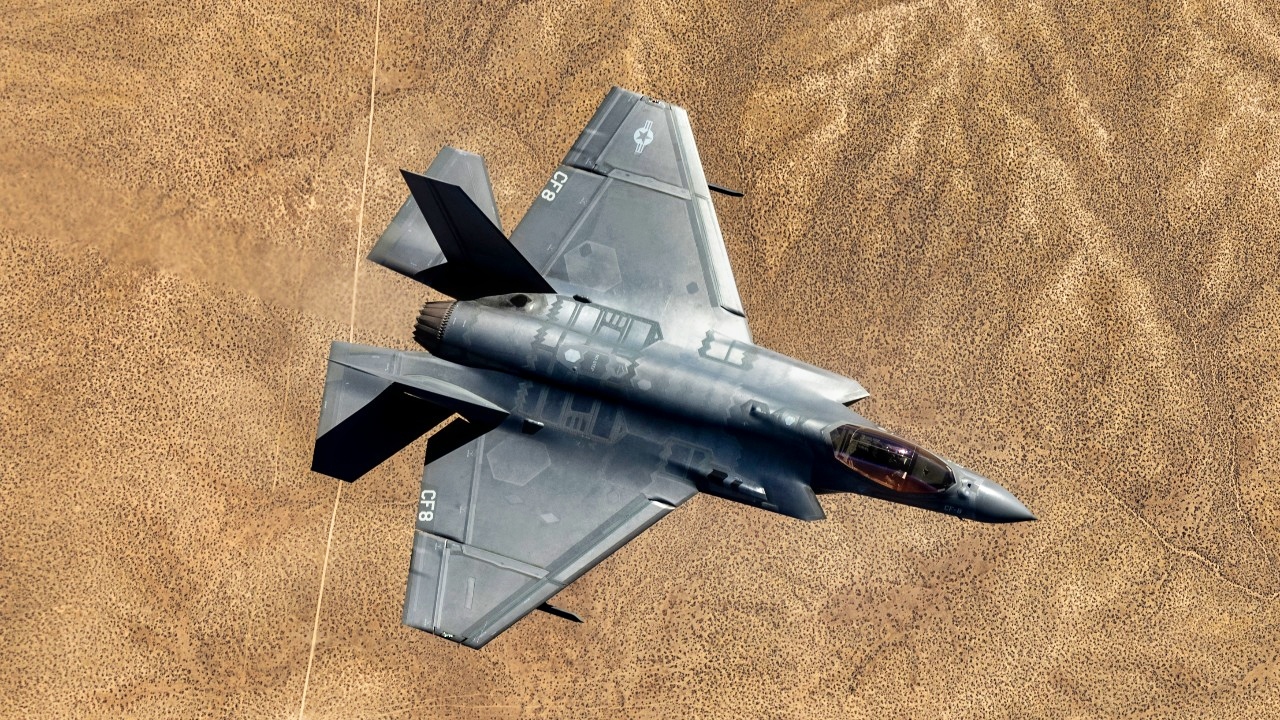
Maj. Nicholas Helmer conducts a mission over the Mojave Desert on October 8, 2024. The F-35C aircraft is assigned to the 461st Flight Test Squadron, F-35 Integrated Test Force at Edwards Air Force Base, California. The aircraft’s dual markings of United States Navy Air Test and Evaluation Squadron Nine (VX-9) and 461st FLTS represents the joint mission of the Integrated Test Force. The F-35 ITF includes people and aircraft from the United States Air Force, United States Navy, United States Marine Corps, foreign partners, Air Force Reserve Command 370th FLTS, and the Air Force Operational Test and Evaluation Center’s 31st TES. (Courtesy Photo, Lockheed Martin Edwards Team)
That last number is important, because it means Malice will fit inside the roughly 4.27-meter-long weapons bay of an F-35C stealth fighter (or an F-35A, but not the F-35B jump jets, which have a 4-meter-long bay).
That contrasts with the 4.7-meter-long Gunslinger confined to underwing carriage by non-stealth Super Hornet jets.
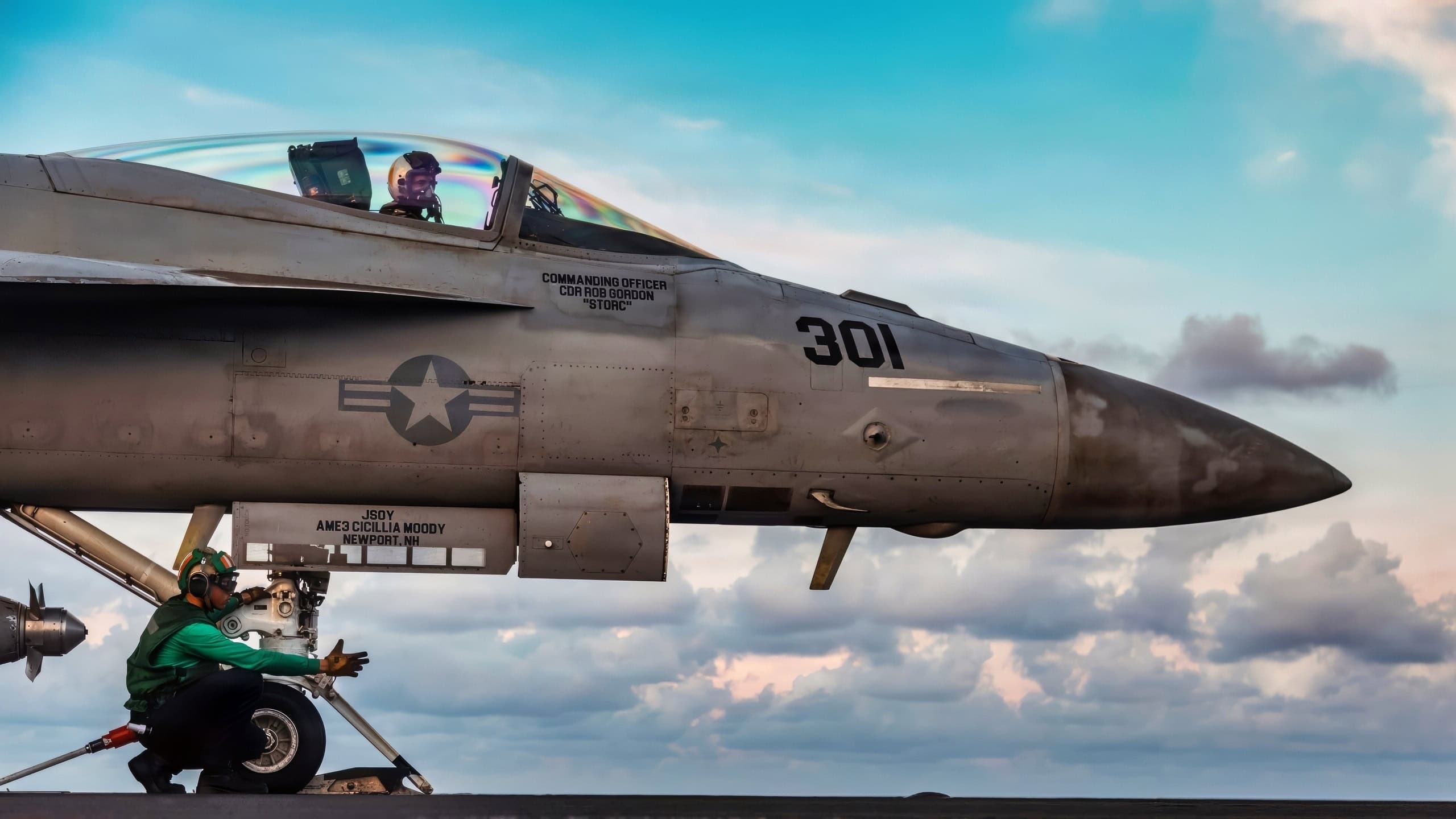
A U.S. Sailor performs a safety scan of the catapult track as an F/A-18E Super Hornet aircraft positions for launch from the flight deck while underway in the Caribbean Sea, Nov. 25, 2025. U.S. military forces are deployed to the Caribbean in support of Operation Southern Spear, the U.S. Southern Command mission, Department of War-directed operations, and the president’s priorities to disrupt illicit drug trafficking and protect the homeland. (U.S. Navy photo)
Indeed, the Navy released photos showing an AIM-424 mounted alongside a door-mounted AIM-120C missile in an F-35C’s weapons bay, and an F/A-18E Super Hornet carrying four AIM-424s.
Malice’s compatibility with F-35s has important tactical implications, because some of the most vulnerable targets to very-long air-to-air missiles—large subsonic early-warning radar, bomber and tanker aircraft—will naturally try to operate far ‘backfield’ outside the range of known enemy anti-aircraft missiles and their carriers.
With such far-reaching weapons, stealth fighters can now stalk and ambush these aircraft from farther away, with less risk to themselves.
That is—if somebody can tell those stealth jets where to shoot! That’s because weapons like Malice and Gunslinger have maximum ranges far exceeding the detection ranges of the radars on the fighters carrying them.
So, maximum-range attacks require leveraging external networked sensors that can detect distant targets and relay targeting data to the missile-carrying fighter—or even directly to the missile itself once launched.
Such sensors could come from powerful radars on Navy warships and E-2D Hawkeye Airborne Early Warning and Control aircraft, forward ‘infiltrated’ stealth fighters and loyal wingman drones, ground-based Over-the-Horizon radars, or even downwards-looking radars on satellites from the future SB-AMTI constellation planned to begin deploying in 2028.
Importantly, long-range sensors may not trigger radar warning receivers (RWRs) on adversary aircraft, yet are sufficient to pass on low-resolution tracking data and course corrections that a VLRAAM can use to navigate most of the way to the target.
Once in proximity, a VLRAAM finally turns on its onboard active radar seeker to more precisely lock onto a target and complete the intercept.
That will finally set off RWR alarms on the targeted aircraft, but leave the victim little time to react unless warned by other means.
Admittedly, the Navy hasn’t shared details on the AIM-424’s integral sensors, communication and propulsion systems, or kinematic performance specifications (speed, G-force tolerance), which are critical to estimating its combat effectiveness.
Gunslinger is also being evaluated as a counter-hypersonic missile interceptor because of its lineage to the ship-based SM-6 missile, and its versatile missile-defense capabilities.
Given the apparently superior energetics of AIM-424 and possible design elements inherited from AIM-174, Malice may also have applications in defeating maneuverable supersonic and hypersonic missiles that threaten carrier task forces.
What have we learned about very long-range missiles from the air war over Ukraine?
For a long time, conventional wisdom held that such VLRAAMs were specialist tools for sniping U.S. tankers, B-52 bombers, and cargo and AWACS aircraft that lacked the agility to easily evade—while lacking effectiveness against agile fighter planes.
Then in 2022 Russia began using its R-37M missile (range 190-250 miles) extensively in its air war over Ukraine to snipe at Ukraine’s tactical jets—launched by Su-35S fighters, Su-57 stealth jets and MiG-31BM interceptors typically using guidance and course corrections transmitted by A-50 Mainstay AWACS jets.
Thanks to the A-50’s powerful downward-looking radar, it could provide R-37Ms with long-distance tracks even of low-flying Ukrainian jets over ‘safe’ airspace, and R-37Ms scored several kills over record-setting distances.

MiG-31 Fighter. Image Credit: Creative Commons.
However, as Ukraine’s air force grew familiar with the threat, ground controllers became adept at warning pilots in time to evade most incoming R-37Ms. While R-37Ms still occasionally score kills, their primary impact is disrupting Ukrainian air operations by forcing pilots to abort engagements and perform evasive maneuvers.
The Ukrainian air war therefore not only affirmed the viability of multi-platform kill chains for VLRAAMs, but demonstrated that such weapons may have a role in combat against tactical aircraft, despite their ability to evade when forewarned.
Russia’s R-37Ms didn’t engage ‘traditional’ VLRAAM targets like tankers and AWACS aircraft because Ukraine didn’t have any.
But Ukraine did shoot down two Russian A-50 AWACS jets over ‘safe’ airspace using a combination of forward-positioned ground-launched missiles and guidance relaying—demonstrating the vulnerability of such aircraft to long-distance attacks from unexpected advantages.
Of course, stealthy F-35s armed with AIM-424s could execute ambushes more sustainably and flexibly than ground-based systems.
Why is the Navy fielding very long air-to-air missiles before the Air Force?
The Air Force and Navy are concurrently adopting the AIM-260 JATM as their future mainstay, boosting maximum engagement ranges to 150-180 miles. Meanwhile, the Navy has publicly unveiled two even longer-range weapons, while the Air Force hasn’t. What’s happening?
For one, we don’t know what capabilities the Air Force is keeping classified. The service is currently developing a 1,150-mile-range air-to-air/air-to-surface missile called the Air Force Long Range Weapon (AFLRW), which evolved from the earlier Long Range Engagement Weapon (LREW) program started in 2017. The Air Force could also integrate the AIM-424 for F-35As and, presumably, other fighters if it wants to.
But consider that the Air Force also has a sixth-generation F-47 stealth fighter along the way, plus two types of drone ‘loyal wingman’ fighters with missile-carrying duties entering service; so the Air Force may prioritize introducing these platforms and relying on them to close range gaps, rather than missiles.
Meanwhile, the Navy’s F/A-XX jet (explicitly planned to carry the AIM-424) and its nascent Loyal Wingman program, by contrast, are far from leaving the ground.
And with a 3:1 ratio of Super Hornet to F-35Cs typical in current carrier air wings, the Navy’s Super Hornets can’t avoid shouldering considerable air-to-air combat duties in the event of a major Pacific war facing more and more Chinese fighters like the J-20 that, in theory, outclass them one-on-one.
The Navy furthermore has a strong imperative to rapidly intercept and destroy missiles and missile-carrying bombers at maximal range, because even a few missiles ‘leaking’ through to strike carriers are more likely to inflict crippling damage than those striking airbases on land.
During the Cold War, the threat of massed Soviet bomber regiments armed with anti-ship missiles drove the Navy’s interest in ‘fleet interceptors’ like the legendary F-14 Tomcat and its long-range AWG-9 radar and AIM-54 Phoenix missiles.
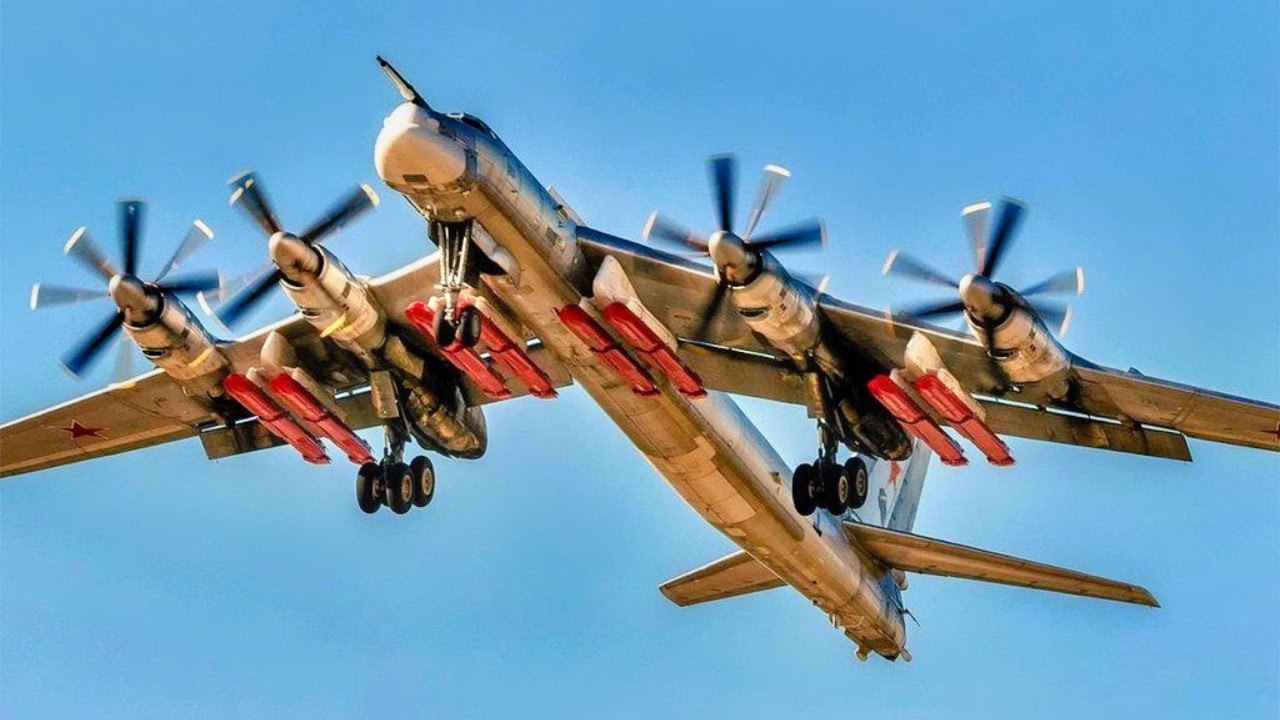
Tu-95 Bomber from Russia. Image Credit: Creative Commons.
Today, China operates roughly 230 H-6 bombers variously armed with cruise and ballistic anti-ship missiles, as well as shorter-range JH-7 supersonic fighter-bombers.
China’s land- and carrier-based fighters also pose a long-range strike threat when supported by China’s growing fleet of AWACS aircraft (also both land- and carrier-based) and tankers, notably now including large Y-20 tankers carrying considerably more fuel over greater ranges. Attempting to disable these critical support sinews might be more profitable than direct attrition.
Still, establishing timely sensor-to-shooter kill chains at very long distances against aerial targets is tricky.
Especially for offensive counter-air operations, the AIM-424’s maximum range combined with the F-35’s stealth infiltration capabilities will likely exceed the range of long-range sensors on an E-2D early-warning plane—and thus require tracks furnished by forthcoming space-based radars.
About the Author: Defense Expert Sebastien Roblin
Sebastien Roblin writes on the technical, historical, and political aspects of international security and conflict for publications including The National Interest, NBC News, Forbes.com, and War is Boring. He holds a Master’s degree from Georgetown University and served with the Peace Corps in China. Roblin is also a 19FortyFive.com Contributing Editor.