
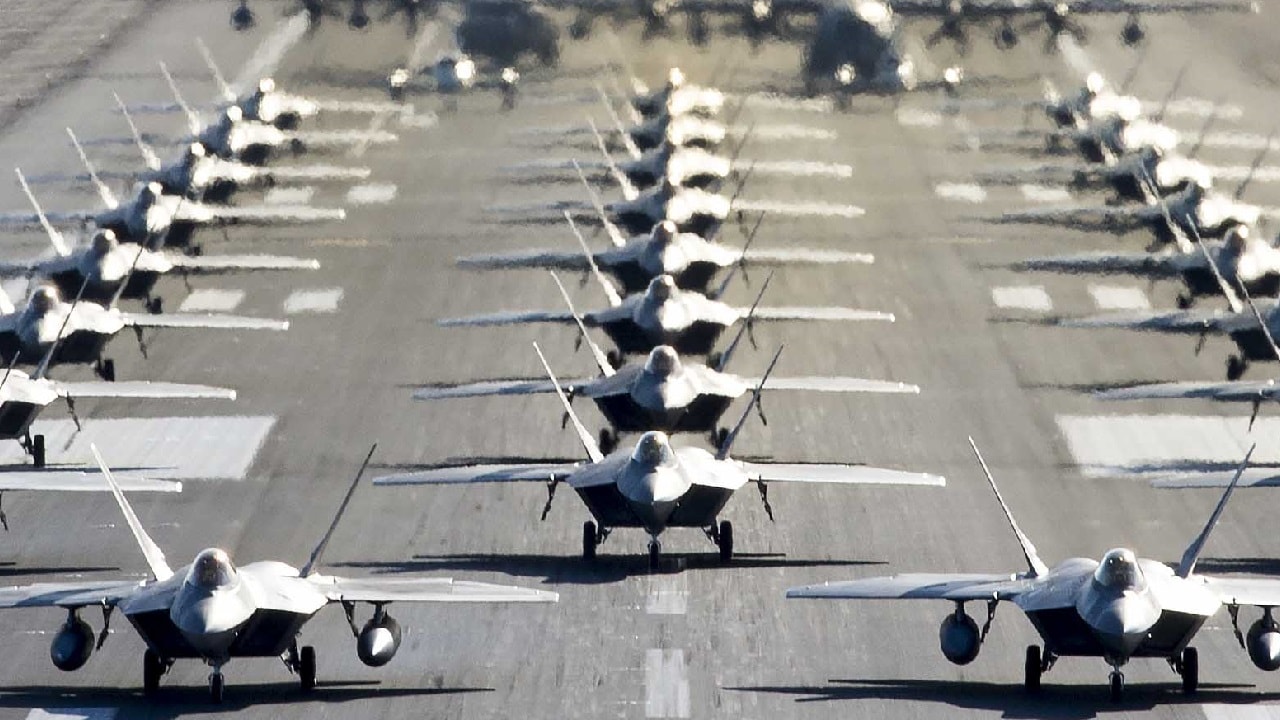
Beyond the Shadow: What Makes the F-22 Raptor Stealth Fighter a Lethal Weapon System for the US Air Force – When discussing the F-22 Raptor, the conversation almost always starts and ends with stealth. And for good reason, its radar cross-section (about the size of a marble), shaping, and radar-absorbent coatings are genuinely revolutionary.
But stealth alone doesn’t win a fight. What makes the Raptor one of the most dominant air superiority fighters ever built is the combination of weapons, sensors, and systems working together behind that low-observable airframe. Strip away the invisibility of its outstanding stealth for a moment, and the F-22 is still the standard against which all other fighters are judged.
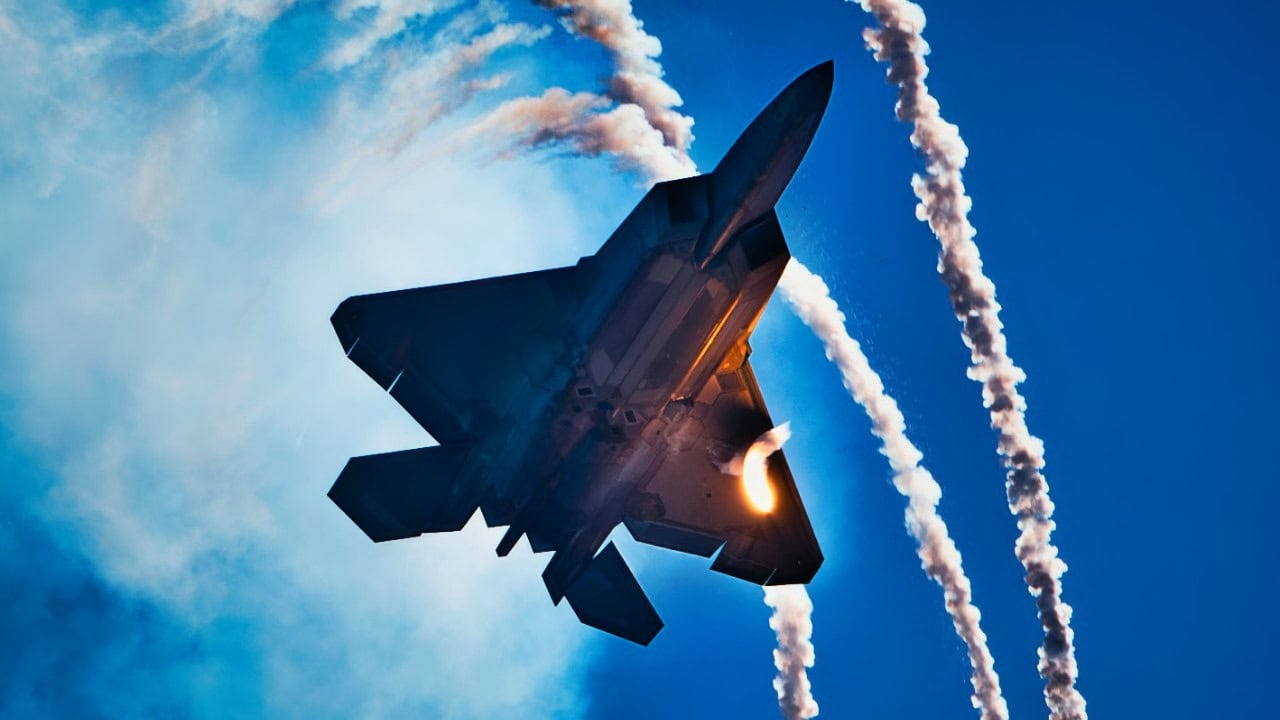
A U.S. Air Force F-22 Raptor, flown by Capt. Samuel “Razz” Larson, F-22 Raptor Demonstration Team pilot, deploys flares over the Gulf of Mexico during the 2024 Gulf Coast Salute Air Show at Panama City Beach, Florida, May 4. The F-22’s unique combination of stealth, speed, agility and situational awareness, combined with lethal long-range air-to-air and air-to-ground weaponry, makes it one of the most advanced fighters in the world. (U.S. Air Force photo by Staff Sgt. Stefan Alvarez)
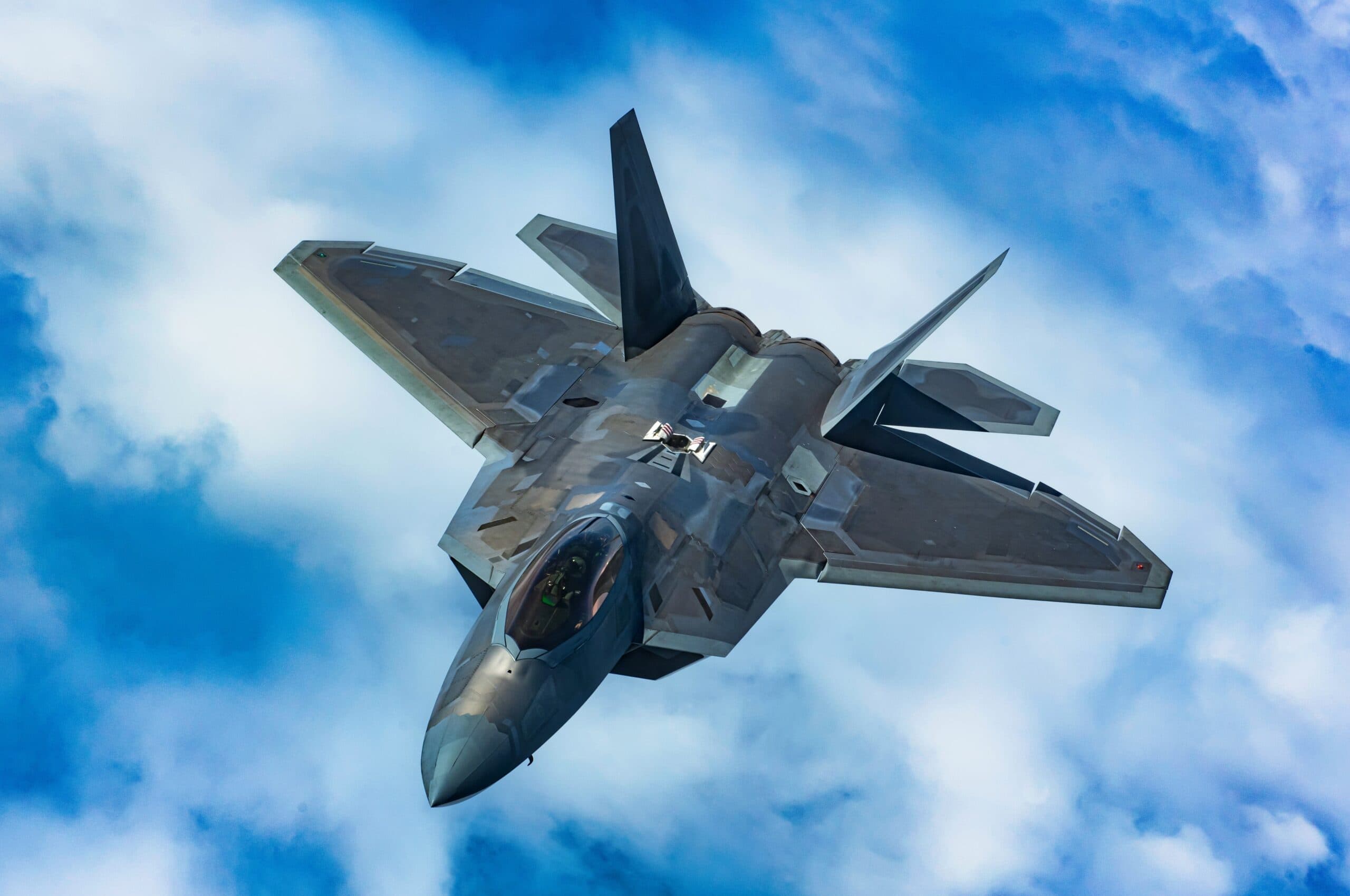
A Hawaii Air National Guard F-22 Raptor pulls away from a KC-135 Stratotanker after receiving fuel April 21, 2021, near Oahu, Hawaii. The fifth-generation aircraft, operated by Airmen from the 199th and 19th Fighter Squadrons, integrated with a Royal Australian Air Force command-and-control aircraft during exercise Pacific Edge 21. The exercise was held to enhance air-combat proficiencies through the integration of allied units and further the interoperability between the two countries’ aircraft. (U.S. Air National Guard photo by Staff Sgt. John Linzmeier)
The F-22’s Weapons Are Battle-Tested
The Raptor’s primary air-to-air weapons are the AIM-120 AMRAAM (Advanced Medium-Range Air-to-Air Missile) and the AIM-9X Sidewinder, along with an internal M61A2 Vulcan 20mm rotary cannon for close-range engagements.
The AIM-120 is an active radar-guided missile, meaning that its “fire-and-forget” capability lets the F-22 launch a missile and immediately turn away or engage another target, rather than staying exposed while guiding the weapon home. The F-22 typically carries up to six AIM-120s in its main internal weapons bay.
The AMRAAM is a dual-role missile, offering operational flexibility in air-to-air and air-to-surface engagements. In the air-to-air role, the weapon’s advanced active guidance section and mature seeker design allow it to quickly find targets in the most challenging environments.
The AIM-9X Sidewinder, carried in the Raptor’s side weapons bays, is a high-off-boresight, infrared-guided missile.
Modern versions can be cued not just by radar but also by the pilot’s helmet-mounted sight, allowing a pilot to look at a target, even one far off the aircraft’s nose, and fire without physically pointing the jet at it. This dramatically shrinks the reaction time an adversary has to react in a dogfight.
The Sidewinder is used by the US Navy, US Air Force, and over 30 other Allied nations.
The internal cannon is a lightweight, 20mm, six-barrel rotary Gatling gun weighing 202 pounds. It fires up to 6,600 rounds per minute and is used primarily on modern tactical fighter jets such as the Raptor and the F-18E/F Super Hornet.
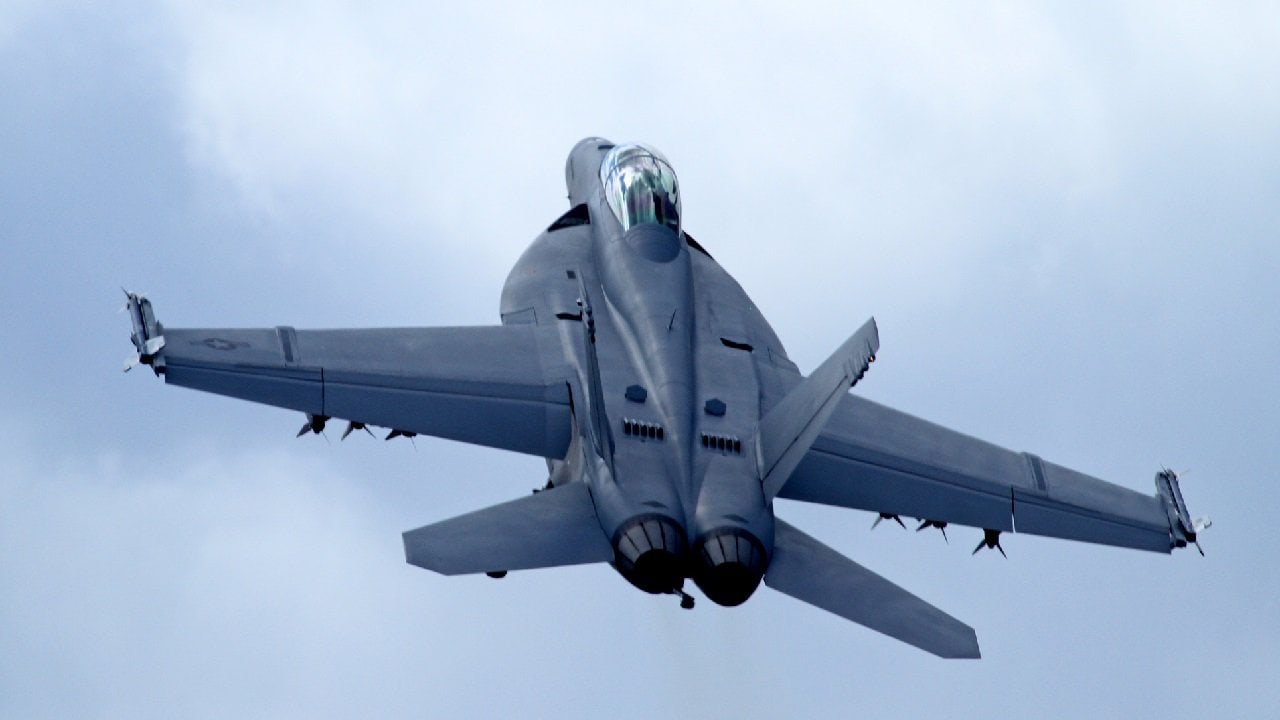
Block III F/A-18 Super Hornet. US Navy Photo.
Internal Weapons Storage: Why Where the Weapons Are Matters
While it is tempting to separate “stealth” from “weapons, the two are deeply intertwined in a way that’s still worth discussing on its own merits: internal weapons bays.
Every missile the Raptor carries in its standard air-to-air loadout rides inside the fuselage rather than on external pylons.
This reduces the Raptor’s radar signature; however, it also means the jet retains its full aerodynamic performance. External stores create drag and turbulence that degrade speed, range, and maneuverability.
By keeping weapons located internally, the F-22 flies like a clean fighter even when it’s fully armed, which matters enormously for a jet built around speed and energy management.
Sensor Fusion: The Quiet Superpower
The F-22’s sensor fusion system combines data from its AN/APG-77 radar, AN/ALR-94 electronic warfare suite, and external data links into a single, unified tactical picture for the pilot. =
The Raptor’s AN/APG-77 AESA (Active Electronically Scanned Array) radar can track multiple targets simultaneously while remaining difficult for enemy systems to detect, since AESA radars can spread their emissions across frequencies in ways that resist traditional radar warning receivers.
The Raptor fuses radar data with other onboard sensors, including electronic support measures that passively detect and characterize enemy radar emissions, into a single, unified tactical picture displayed to the pilot.
Instead of juggling separate readouts, the pilot sees one coherent picture of the airspace: where threats are, what they are, and how they’re behaving. This allows a single pilot to maintain a level of situational awareness that would otherwise require a second crew member.
The Raptor’s Supercruise Speed Is Also A Weapon
The F-22 can sustain supersonic flight ( greater than Mach 1.5, 1,000 mph) without using afterburner, a capability known as supercruise, powered by two Pratt & Whitney F119-PW-100 turbofan engines providing massive dry thrust. It can hit Mach 2.25 as a top speed.
This matters for weapons employment in a very concrete way: missile range and launch energy are heavily influenced by the launching aircraft’s speed and altitude.
A missile fired from a jet already cruising at high supersonic speed carries more kinetic energy into the fight, extending its effective range and reducing the time a target has to react or evade.
Supercruise also means the Raptor can loiter in contested airspace at high speed for extended periods without burning through fuel the way afterburner-dependent aircraft would, giving it more time on station to find and engage targets.
Networking And Information Dominance
The F-22 was also designed with data sharing in mind, using an intra-flight data link that allows Raptors to silently share targeting data with one another without emitting radar signals that would reveal their positions.
A four-ship formation of F-22s can effectively act as a single distributed sensor-and-weapons platform, cross-cueing targets and dividing engagement responsibilities without a single radio call. This networked approach means the aircraft’s lethality scales with the formation, not just the individual jet.
Putting It All Together Makes The Raptor A Tough Customer
None of these systems function in isolation. The sensor fusion feeds targeting data to the weapons; supercruise extends the effective range of those weapons; internal carriage preserves the aircraft’s performance so it can get into a favorable firing position in the first place; and the data link lets a flight of Raptors act with a shared understanding of the battlespace.
Stealth allows the F-22 the opportunity to get close without being detected; however, the Raptor’s deeply integrated package of sensors, weapons, and networking turns that opportunity into a decisive advantage in air-to-air combat.
An F-22 pilot often knows where the enemy is well before the enemy knows the Raptor is there at all, and by the time weapons are in the air, the target frequently has little chance to respond.
The F-47 NGAD Will Soon Replace The Raptor
The NGAD sixth-generation stealth fighter will soon begin replacing the F-22. President Trump confirmed the long-held rumors that the NGAD stealth fighter has been flying for the past five years. The new F-47, as it has been named, is slated to replace the F-22 within the next decade.

Shown is a graphical artist rendering of the Next Generation Air Dominance (NGAD) Platform. The rendering highlights the Air Force’s sixth generation fighter, the F-47. The NGAD Platform will bring lethal, next-generation technologies to ensure air superiority for the Joint Force in any conflict. (U.S. Air Force graphic)
“The F-47 will be the most advanced, most capable, most lethal aircraft ever built,” Trump told reporters. “America’s enemies will never see it coming,” he added.
The new aircraft will feature state-of-the-art stealth capabilities, engines capable of powering it past Mach 2, and the ability to operate as a quarterback for stealth drone fighters, thereby maintaining American air dominance.
The F-47 Is Even More Stealthy Than The Raptor:
The F-22 Raptor is the oldest stealth fighter in the world; it was designed in the 1990s and has been flying for more than 20 years. Despite this, it is still the stealthiest fighter bar none. With a radar cross-section that’s generally estimated to be as much as 15 times smaller than the F-35 and maybe 100 times smaller than China’s J-20.
The F-22 remains the standard against which every other stealth fighter is measured. Even after 20 years of service, it is still the best stealth fighter in the world. But the rest of the world is slowly catching up. And it’s time, as #1 will soon end and be replaced by the F-47.
The F-47 will have a 70 percent longer combat radius than the Raptor and possess stealth++.
In the meantime, the F-47 and the F-35 are capable of operating the Air Force’s Collaborative Combat Aircraft (CCA) program, a multi-pronged initiative to test, develop, and implement new autonomous and manned-unmanned aircraft teaming concepts.
It is also known as the Loyal Wingman concept, capable of flying independently or in small groups, and will be used to counter China’s anti-access/area-denial (A2/AD) capabilities. The F-22 will also be able to deploy with these.
The Raptor is still the King of the dogfighters, an aging one to be sure, but still a very dangerous one.
About the Author: Steve Balestrieri
Steve Balestrieri is a National Security Columnist. He served as a US Army Special Forces NCO and Warrant Officer. In addition to writing on defense, he covers the NFL for PatsFans.com and is a member of the Pro Football Writers of America (PFWA). His work was regularly featured in many military publications.