
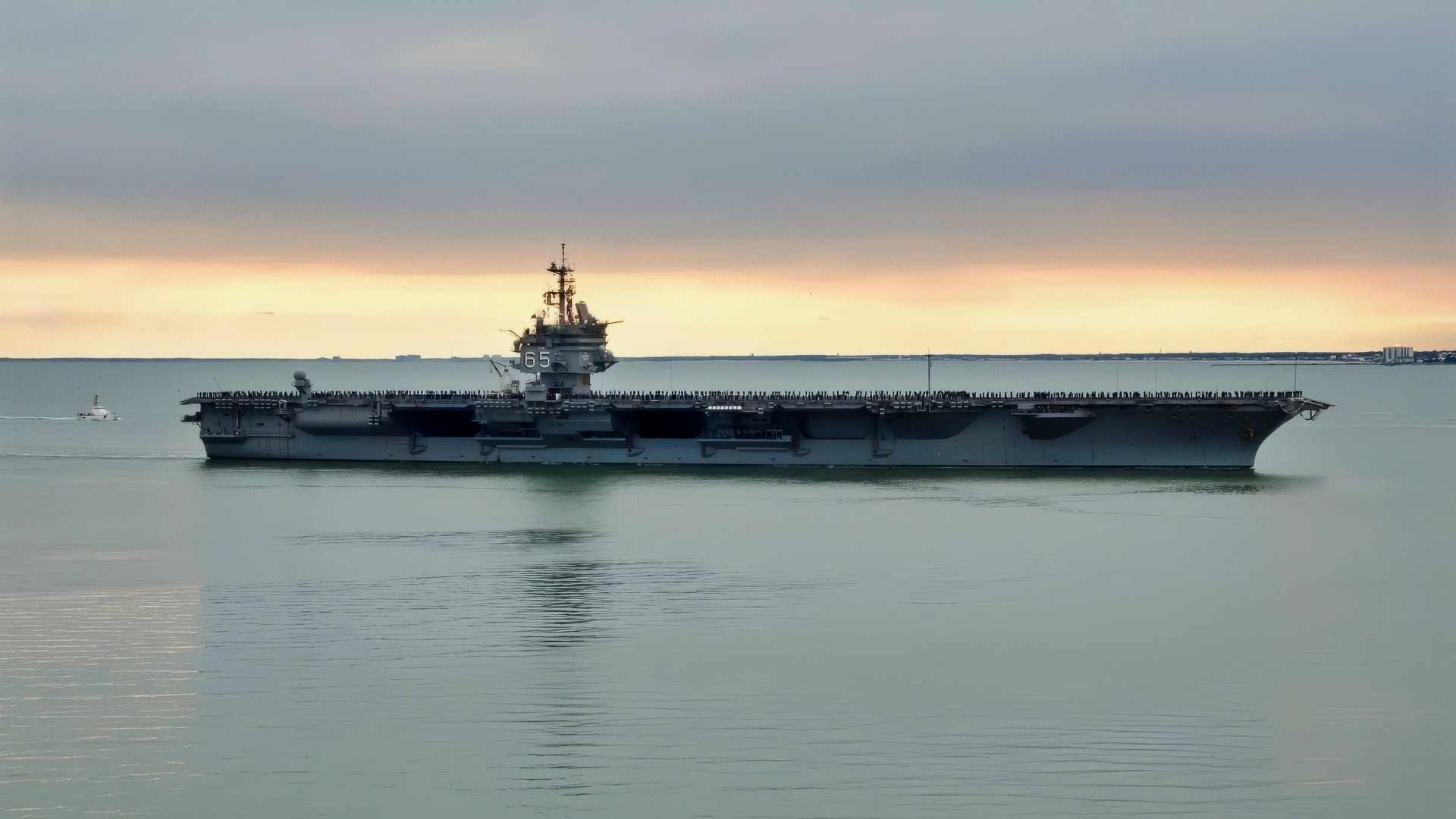
When the USS Enterprise (CVN-65) was commissioned in November 1961, it was the most radical warship on the planet.
Rather than the two-reactor plants that would become standard on every American carrier that followed, Enterprise was built with eight Westinghouse A2W pressurized-water reactors, arranged in four independent propulsion units that together produced roughly 280,000 shaft horsepower across four propellers.
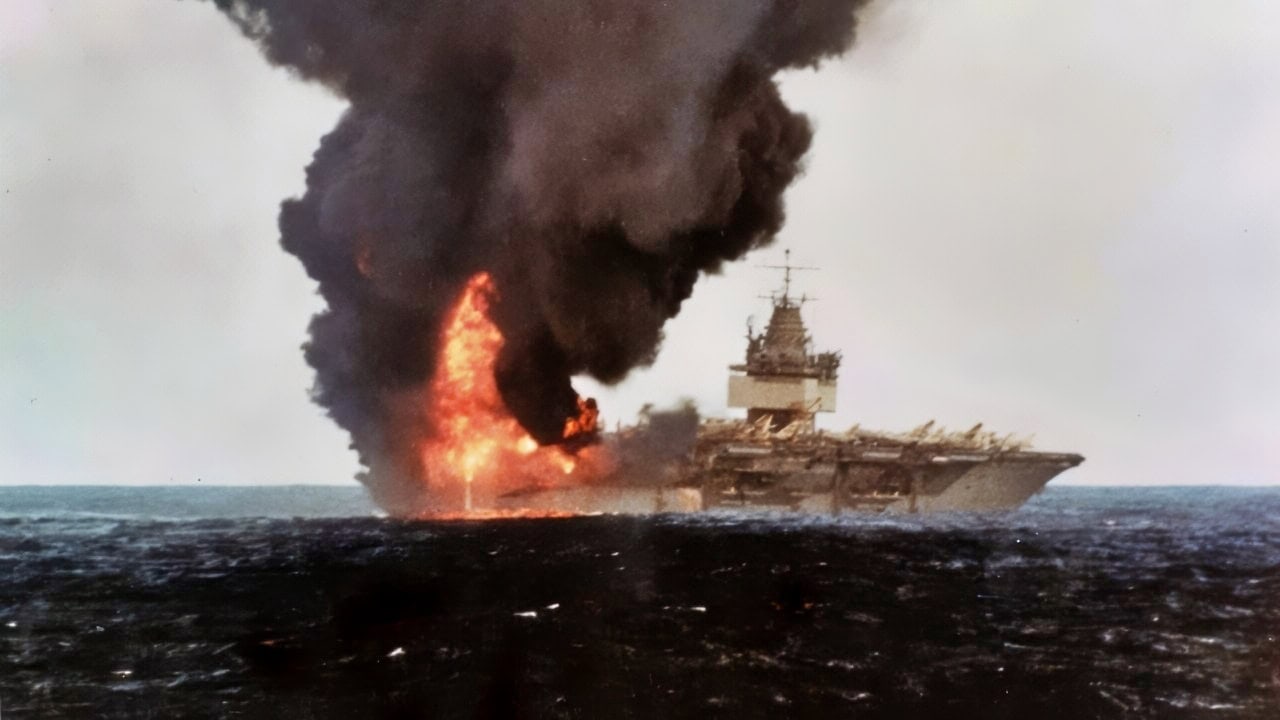
USS Enterprise (CVN-65) Aircraft Carrier on Fire.
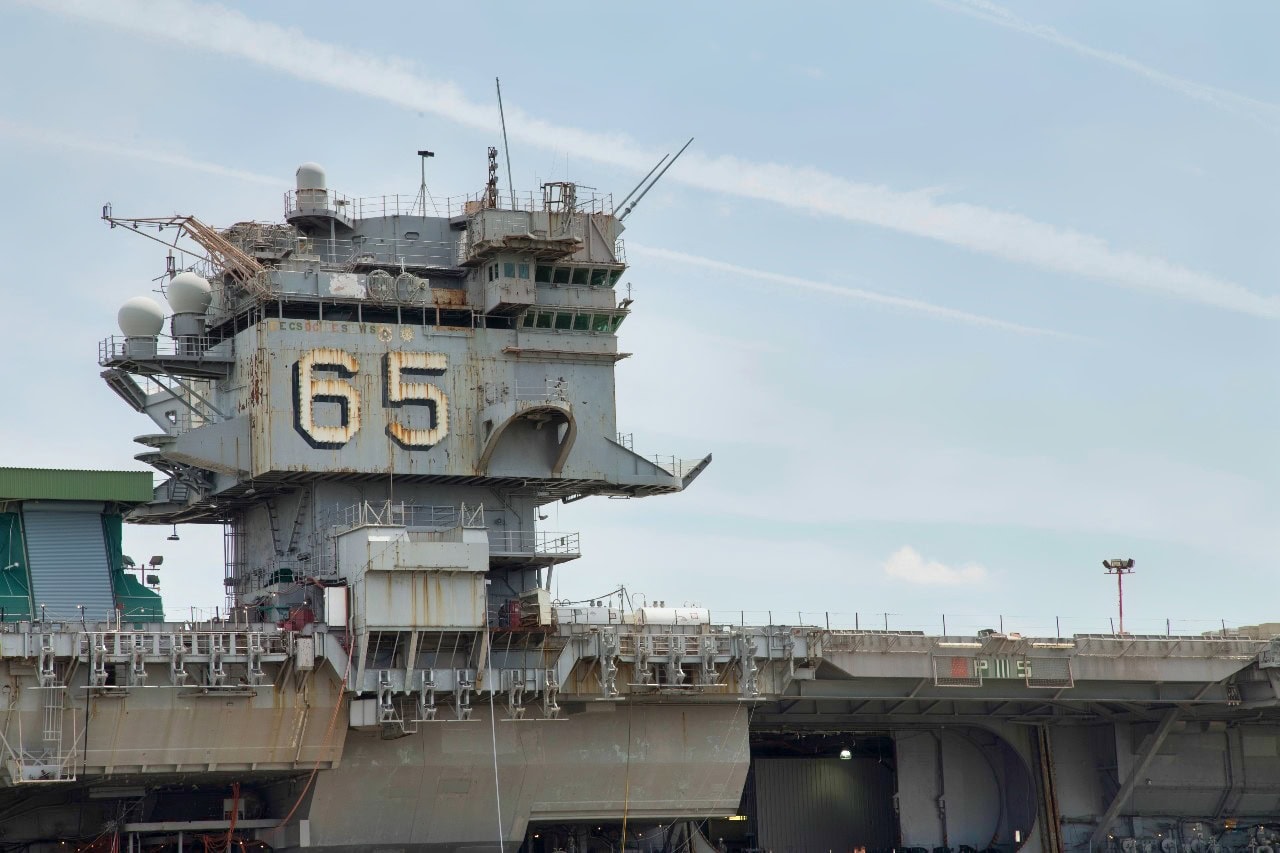
NEWPORT NEWS, Va. (July 15, 2018) — USS Enterprise (CVN 65) sits pierside at Newport News Shipbuilding following its decommissioning in February 2017. (U.S. Navy photo by Mass Communication Specialist 2nd Class Cat Campbell/RELEASED)
No carrier before or since has used anything like it, a fact commemorated in the ship’s own unofficial motto, “Eight Reactors, None Faster.”
Given the scale of the nuclear machinery and the ship’s 51 years of continuous service, it is reasonable to ask how safe that plant actually was in practice. The historical record is unusually clean on the nuclear side.
Enterprise never suffered a core meltdown, an uncontrolled criticality event, or a confirmed radiological release to the public or the sea.
Its most serious accidents, the ones that killed sailors and made headlines, were conventional fires and munitions explosions on the flight deck, not failures of the reactor plants themselves.
The one incident that did directly involve the reactors was not a meltdown but an automatic safety shutdown, triggered by an ordinary ship-handling mishap.
Understanding Enterprise’s accident history means keeping those two categories separate.
The Enterprise’s Deadly 1969 Flight Deck Fire
The single worst disaster in the ship’s history occurred on January 14, 1969, while Enterprise was steaming roughly 70 miles off Pearl Harbor ahead of a scheduled deployment.
During a routine pre-launch sequence, exhaust heat from a nearby “huffer” starter cart overheated a Zuni rocket warhead mounted on a parked F-4 Phantom.
The rocket cooked off, and its blast ruptured fuel lines and detonated ordnance on nearby aircraft, setting off a chain reaction of explosions across the flight deck.
Fires burned for hours, fed by jet fuel and bombs; eighteen aircraft were destroyed or badly damaged, and holes were torn through the armored flight deck.
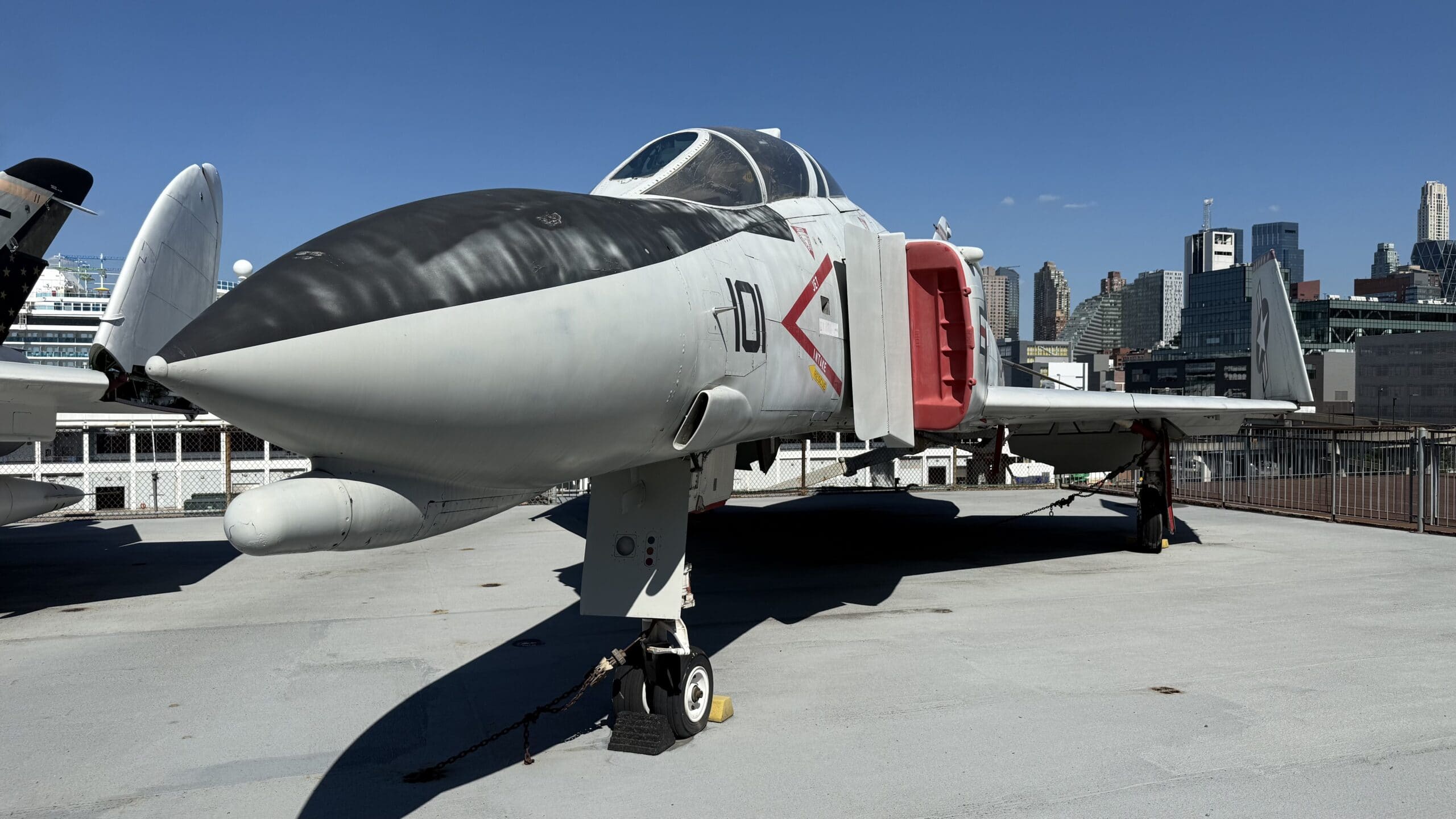
F-4 Phantom. 19FortyFive.com Photo.
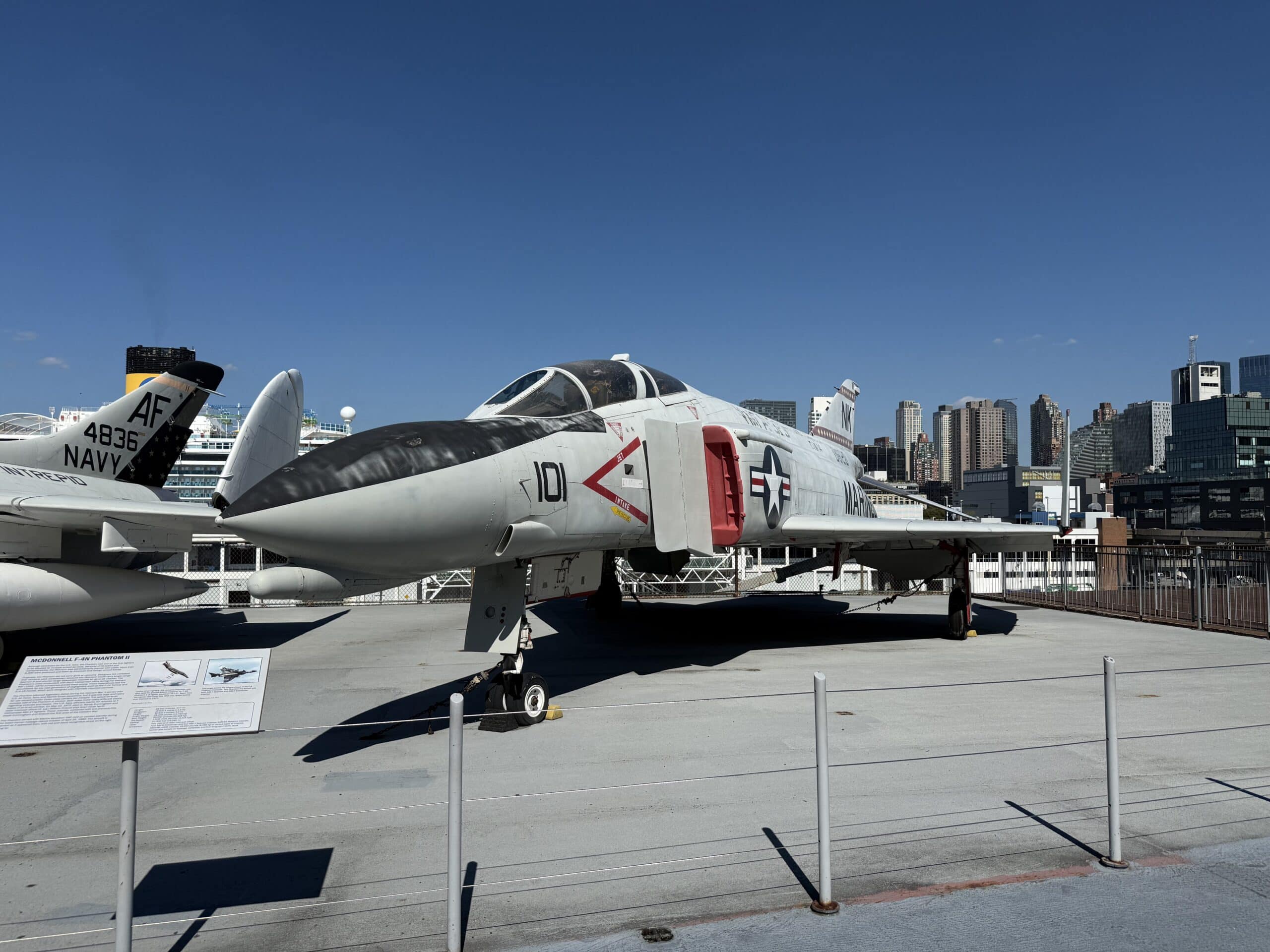
F-4 Phantom. 19FortyFive.com Photo.
Twenty-seven sailors were killed and 314 injured, making it one of the deadliest peacetime accidents in the history of American naval aviation.
It is worth stressing what this accident was not: it had nothing to do with the reactors.
Enterprise’s eight A2W reactors sit deep within the hull, behind dedicated armor and multiple deck levels of separation from the flight deck, precisely so that a fire or explosion topside cannot easily reach the propulsion spaces.
The ship’s own official history and the Navy’s damage reports treat the 1969 fire purely as an aviation-ordnance casualty.
The crew’s ability to fight the fire, restore power, and get the ship back underway within a day is often cited as evidence that the reactor plant’s isolation and the crew’s training worked as intended, even under the worst conditions the ship ever faced.
This was not an isolated type of incident for Enterprise or her era.
A broadly similar accident, also triggered by an accidental rocket firing, had struck the carrier USS Forrestal in 1967, killing 134 sailors, and Enterprise’s own crew reportedly drew directly on lessons from that disaster when fighting their fire two years later.
Neither event involved a nuclear reactor casualty; both were failures of ordnance-handling procedure and flight deck safety culture, which the Navy subsequently overhauled fleet-wide.
The 2005 Grounding And Reactor Shutdown
The one accident in Enterprise’s career that directly involved the nuclear plant occurred in October 2005, and it illustrates how conservative and automatic these reactors’ safety systems are.
After completing a shipyard overhaul at Newport News, Virginia, the carrier was getting underway when she ran aground on a sandbar in the James River.
The grounding stirred up river mud that was drawn into the ship’s seawater intakes, which feed the condensers used to cool the reactor plants’ steam cycle.
With the cooling water fouled, all eight reactors automatically scrammed, shutting down as designed rather than risking operation without adequate heat removal.
For nearly three hours, Enterprise sat dead in the water on emergency diesel power while tugs worked to free her and pull her back to the pier at Naval Station Norfolk.
It then took the ship’s nuclear machinists roughly three days to clear mud out of the condensers before the plant could be restarted.
It was an embarrassing and operationally disruptive event, but not a dangerous one in the sense of endangering the crew or public: the automatic scram is exactly the response the reactor safety systems are designed to produce whenever cooling is degraded, and no radiological hazard resulted.
If anything, naval historians and nuclear engineers have pointed to the 2005 grounding as a demonstration that the safety interlocks did their job correctly under an unplanned and somewhat embarrassing set of circumstances; a sandbar, not a nuclear malfunction, was the root cause.
Other Accidents In The Ship’s History
Enterprise’s long service life included a number of lesser mishaps common to any large warship; a 1998 deck collision of an EA-6 Prowler and an S-3B Viking resulted in four deaths, minor collisions during close maneuvering, and the routine hazards of flight deck operations across 25 deployments.
In 1983, she also ran aground near her homeport of Alameda, California after a steering failure.
On November 2, 1985, the Enterprise struck the submerged Bishop Rock at Cortes Bank while conducting readiness exercises off Southern California.
None of these involved the reactor plants in any significant way.
Refueling overhauls, which replace the uranium cores that power each reactor, took place across the ship’s career, in the mid-1960s, early 1970s, and again from 1979 to 1982, and required years of shipyard work each time, but none is documented as having produced a radiological accident or exposure incident affecting the crew or the public.
This is notable given the sheer number of reactors involved and the ship’s more than five decades in commission.
It reflects both the inherent conservatism of naval reactor design, which the Navy has maintained an unusually strict safety culture around since Admiral Hyman Rickover established the modern nuclear navy in the 1950s, and a degree of good fortune in how the ship’s few serious accidents happened to unfold, always in the aviation or ship-handling domain, never in the reactor spaces themselves.
The Enterprise Had Few Accidents Over A 51-Year Career
The USS Enterprise’s accident record is really two separate stories.
On the flight deck, the ship suffered a genuinely catastrophic disaster in 1969 that killed 27 sailors and injured hundreds more, a stark reminder of how dangerous carrier aviation was in that era.
In the reactor spaces, by contrast, the worst recorded event was a 2005 grounding that triggered a routine, by-design shutdown of all eight reactors with no injuries and no radiological consequences.
After 51 years, eight reactors and 25 deployments, Enterprise was decommissioned in 2017 and is considered by many analysts to be the best aircraft carrier in US history.
About the Author: Steve Balestrieri
Steve Balestrieri is a National Security Columnist. He served as a US Army Special Forces NCO and Warrant Officer. In addition to writing on defense, he covers the NFL for PatsFans.com and is a member of the Pro Football Writers of America (PFWA). His work was regularly featured in many military publications.