
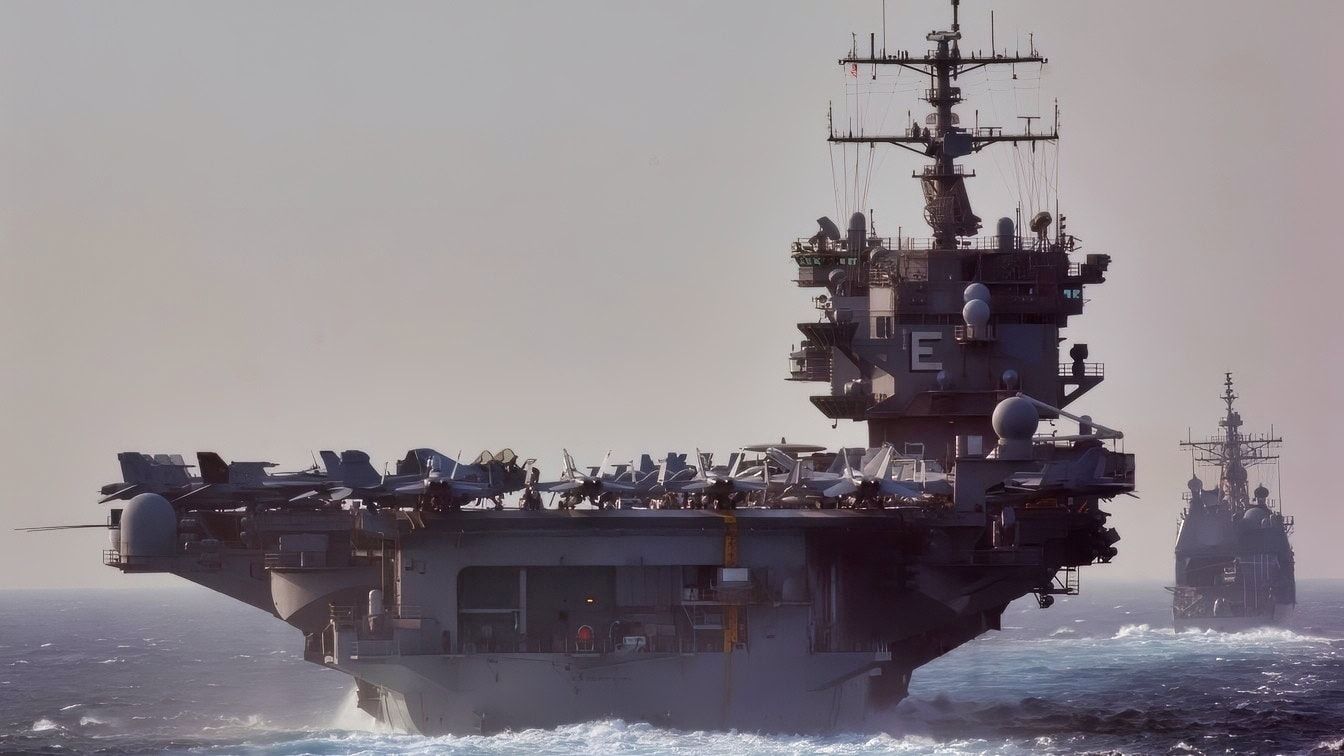
A Submerged Rock Ripped Open USS Enterprise Off California: USS Enterprise was conducting a major readiness exercise off Southern California on November 2, 1985, when the world’s first nuclear-powered aircraft carrier struck Bishop Rock at Cortes Bank. The Navy’s official history records flooding, hull damage, a damaged No. 1 screw and the temporary loss of 24 aviation-fuel tanks.
Contemporary reporting described a 40-foot gash in the outer hull and a bent port bilge keel. The collision injured no one, but it caused $17 million in damage and required about six weeks of repairs. Later accounts often put the opening at 60 feet or longer. The Navy’s public history does not assign a length, making the 1986 figure the safest contemporary estimate.

Aviation Museum of Kentucky F-14 Tomcat. Image Taken on March 1, 2026 by Christian D. Orr.
Cortes Bank is an underwater mountain range roughly 100 miles from San Diego. Bishop Rock rises almost to the surface. The NOAA Coast Pilot identifies it as an awash, buoy-marked hazard where seas break even in moderate weather. Enterprise had not found an unknown obstacle. She had entered the shallowest part of a known danger area.
Enterprise entered service in 1961, displaced about 85,600 tons at full load and carried thousands of sailors and aviators. Eight reactors drove four shafts. The ship represented the height of Cold War naval engineering, yet her immediate danger came from navigation rather than an enemy weapon.
USS Enterprise Was Flying Aircraft Near a Known Hazard
The carrier was taking part in ReadiEx 86-1, an exercise involving the battle group, simulated terrorist-aircraft threats and an evaluation of combat readiness. The Bishop Rock grounding occurred during a demanding period at sea, not during a quiet harbor transit.
Flight operations increase a bridge team’s workload because a carrier repeatedly changes course to generate suitable wind over the deck. Aviation requirements do not cancel navigational limits. The public Navy history does not provide enough detail to reconstruct every bridge order before impact.
The available record does not identify one bridge error or provide enough evidence to reduce the accident to a momentary distraction. What it establishes is that the hazard was charted, Enterprise entered it and the commanding officer retained responsibility. The Navy applied the same command-accountability principle after the later USS Connecticut collision with an undersea mountain.
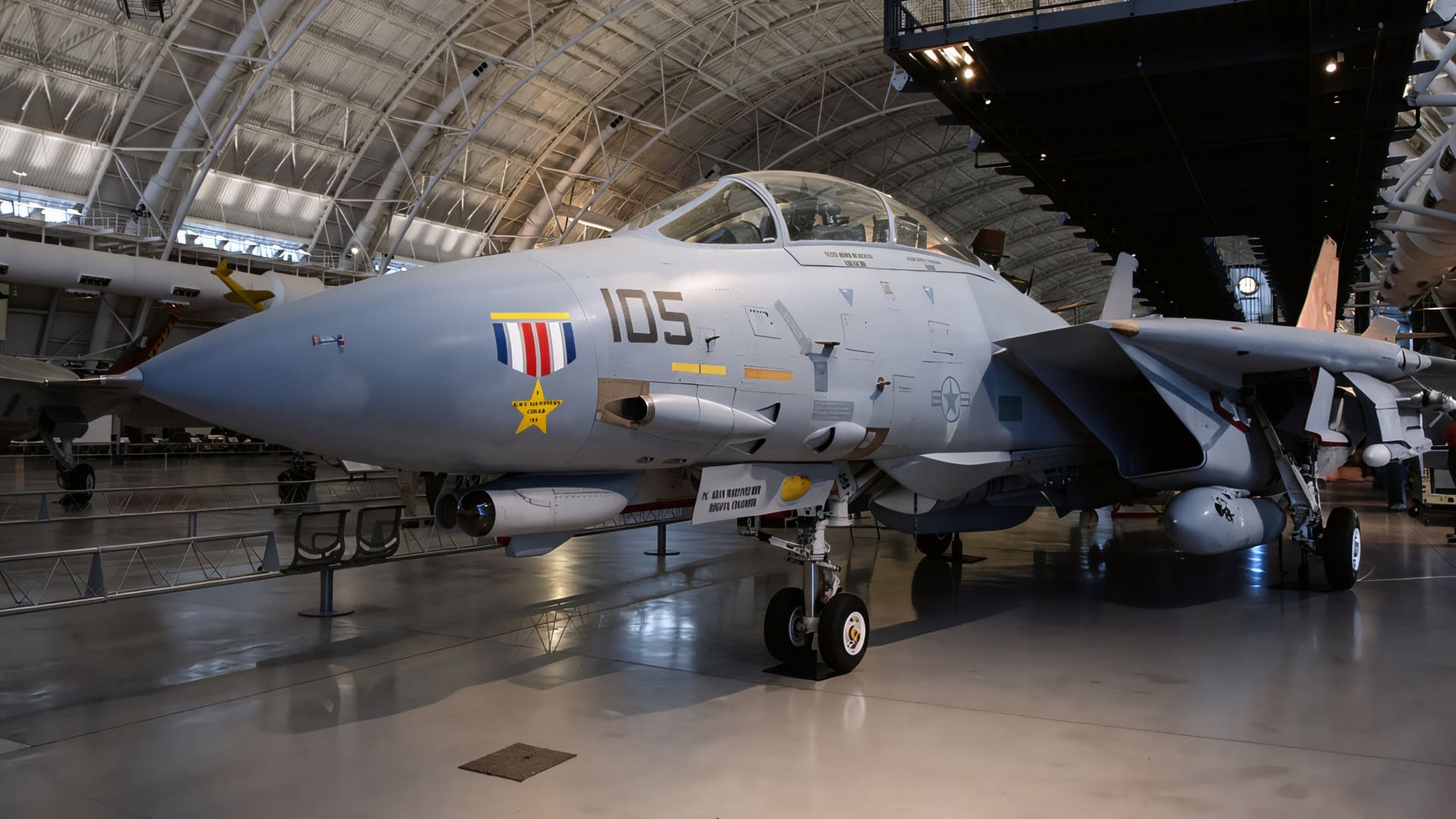
19FortyFive F-14 Tomcat Photo From Smithsonian Personal Visit
The Outer Hull Took the Blow
The damage extended beyond torn steel. The port bilge keel, a fin-like structure used to reduce rolling, was bent or torn, and the official account identifies damage to the No. 1 screw. Twenty-four JP-5 tanks became temporarily unusable, reducing aviation-fuel storage during an exercise built around sustained flight operations.
Later descriptions of the damage to Enterprise’s port side disagree over the number of propellers affected. The official Navy history singles out No. 1. The consistent facts are serious enough: seawater entered, propulsion hardware suffered damage and part of the aviation-fuel system had to be isolated.
The reactors were not reported damaged, and Enterprise retained propulsion. The crew counter-flooded selected spaces to control the ship’s list and stopped the flooding from becoming unmanageable. Counter-flooding deliberately adds water on the opposite side, sacrificing some reserve buoyancy to restore stability.
Enterprise Continued Training Before Entering Dry Dock
The collision did not immediately send the carrier home. After a one-day pause to inspect the damage, Enterprise resumed scheduled training and returned to Alameda on November 23. The flooding had been contained, although the carrier still needed a dry dock before its next deployment.
The incident came only two and a half years after Enterprise ran aground in San Francisco Bay during an April 1983 homecoming. That earlier grounding trapped the carrier for hours but caused far less damage. Two groundings involving the same ship within three years guaranteed close scrutiny.
Enterprise also carried a hard history of shipboard survival. In 1969, a flight-deck fire and repeated explosions killed 28 sailors. The 1985 accident was different, but the response again depended on sailors controlling damage below decks.
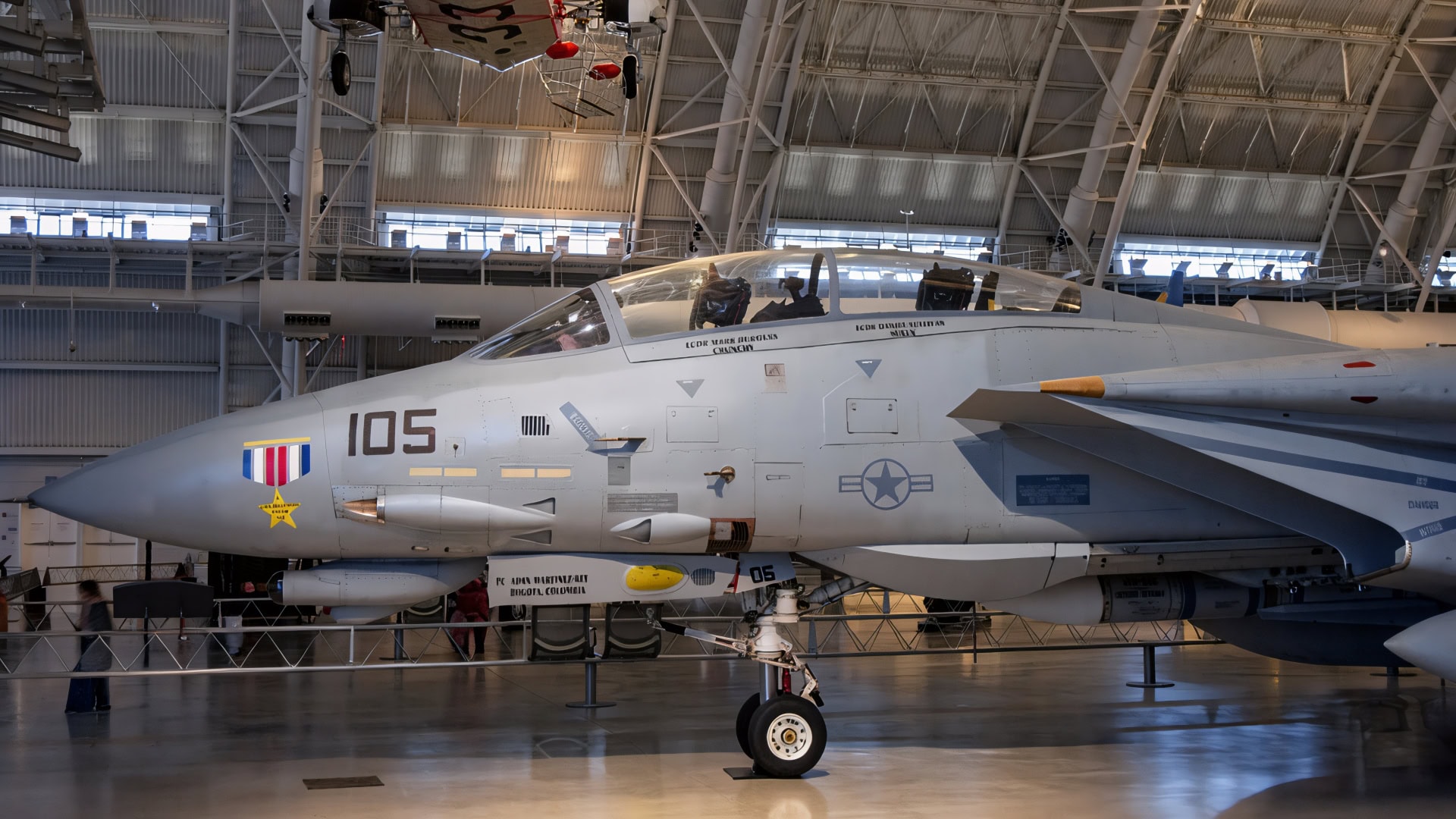
F-14D Tomcat 19FortyFive Photoshoot Back in 2025
Enterprise entered Hunter’s Point Naval Shipyard on November 28 for emergency work. An explosive-ordnance-disposal detachment helped inspect the submerged damage. Navy divers completed 25 dives totaling 400 man-hours before the carrier left dry dock in early January.
The Ship Returned to Sea Before the Captain Lost Command
Enterprise floated free on January 6 and 7, returned to Alameda, and began bringing Carrier Air Wing 11 aboard. The eight-reactor carrier departed for the Western Pacific on January 12, just over ten weeks after striking Bishop Rock.
The Navy did not treat a fast repair as an answer to the navigation failure. A 1986 Los Angeles Times examination of carrier command placed Captain Robert L. Leuschner Jr. among seven carrier commanding officers disciplined over a three-and-a-half-year period. A captain remained accountable for the safety of the ship even when another officer held the conn.
Captain Robert J. Spane relieved Leuschner on January 27, 1986, two weeks after Enterprise departed Alameda.
About the Author: Harry J. Kazianis
Harry J. Kazianis (@Grecianformula) was the former Senior Director of National Security Affairs at the Center for the National Interest (CFTNI), a foreign policy think tank founded by Richard Nixon based in Washington, DC. Harry has over a decade of experience in think tanks and national security publishing. His ideas have been published in the NY Times, The Washington Post, The Wall Street Journal, CNN, and many other outlets worldwide. He has held positions at CSIS, the Heritage Foundation, the University of Nottingham, and several other institutions related to national security research and studies. He is the former Executive Editor of the National Interest and the Diplomat. He holds a Master’s degree focusing on international affairs from Harvard University.

