
Fifty-four years ago today, on August 28, 1972, an F-4D Phantom call-signed Buick 01 took a head-on radar lock on a MiG-21 over North Vietnam, converted to its tail, and fired four Sparrow missiles; the fourth one connected. In the front seat, Captain Steve Ritchie became, in that instant, the only United States Air Force pilot ace of the Vietnam War. In the back seat, running the radar that made the shot possible, Captain Charles B. DeBellevue logged his fourth kill, and he was not finished. Twelve days later, he would take two more, passing every pilot in the American war, and the top American ace of Vietnam would be, permanently and officially, a man who never flew the airplane. This is the straight explanation of how that happened and why it made sense.
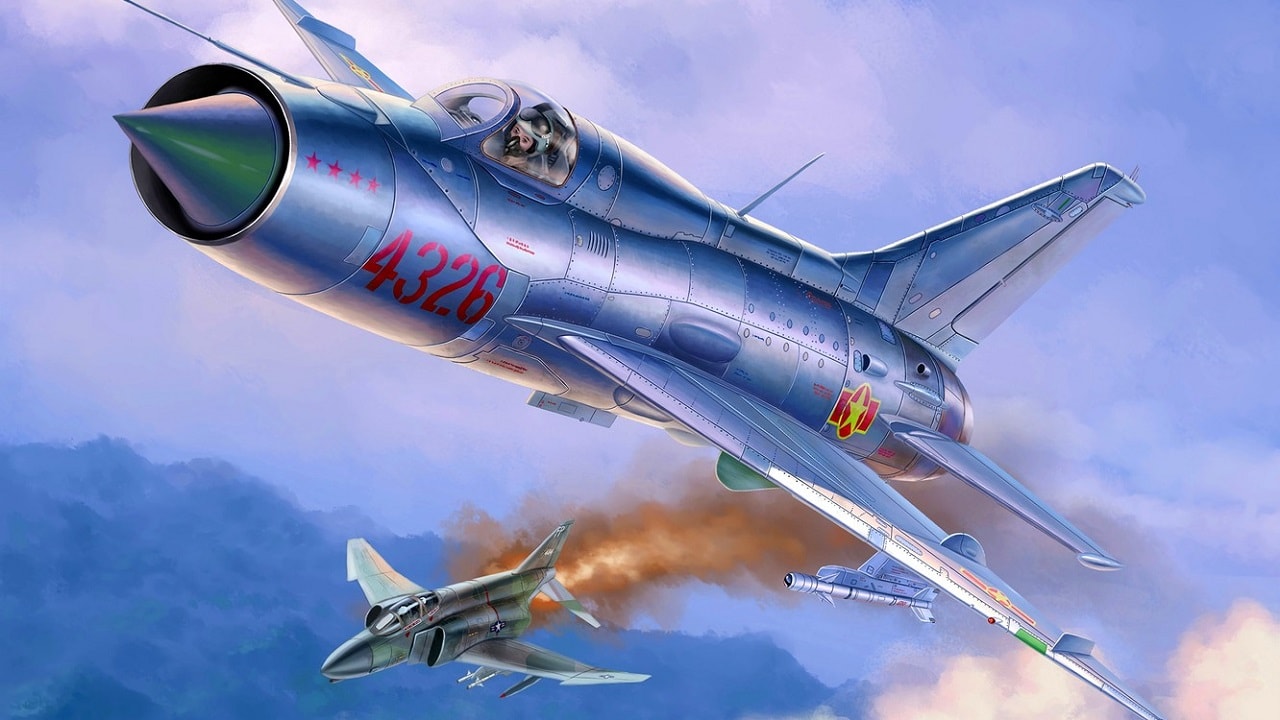
MiG-21 fighter. Image Credit: Creative Commons.
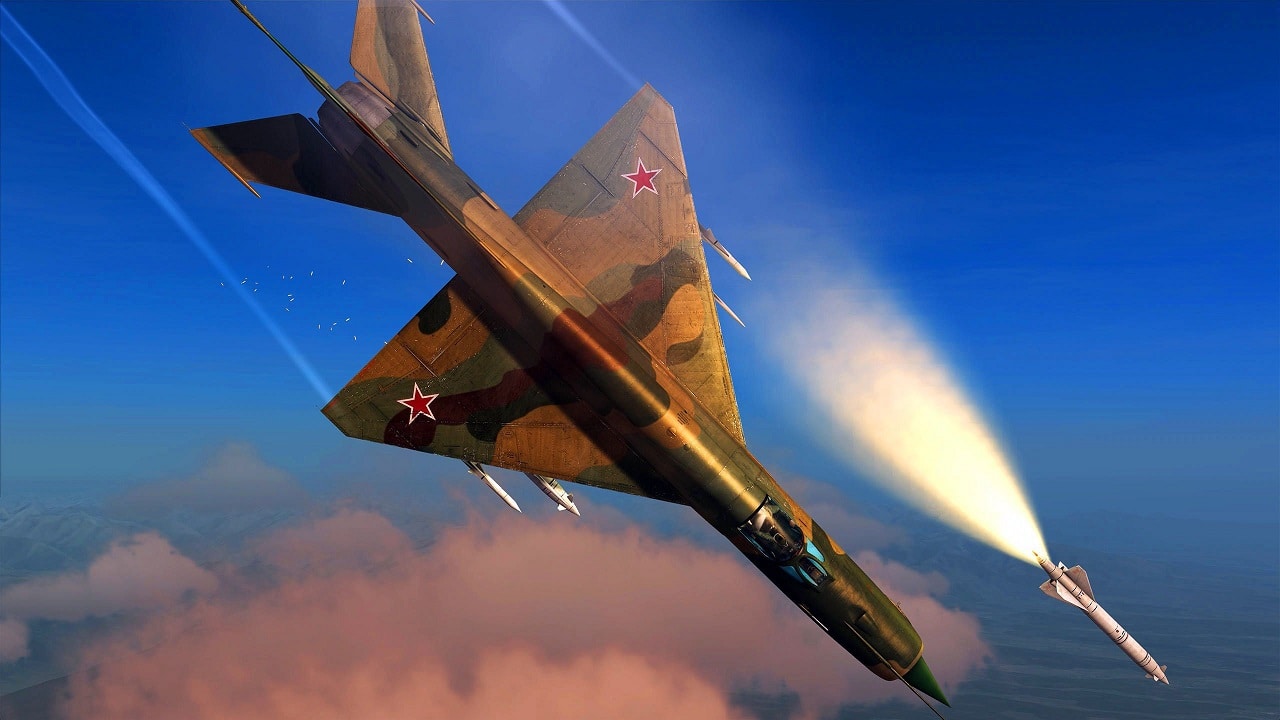
MiG-21. Image Credit: Creative Commons.
The Man in the Back Seat
DeBellevue came to the cockpit through the navigator’s door.
Born in New Orleans in 1945 and commissioned through ROTC at the University of Southwestern Louisiana in 1968, he finished navigator training and was selected for the first all-navigator class trained as weapons systems officers in the F-4 Phantom.
The Phantom was built for two: a pilot in front and, in Air Force service, a WSO in back, pronounced Wizzo, who ran the radar, the navigation, and the weapons employment that a Mach 2 fighter demanded at closing speeds beyond a thousand miles an hour, a workload no single crewman could carry in combat.
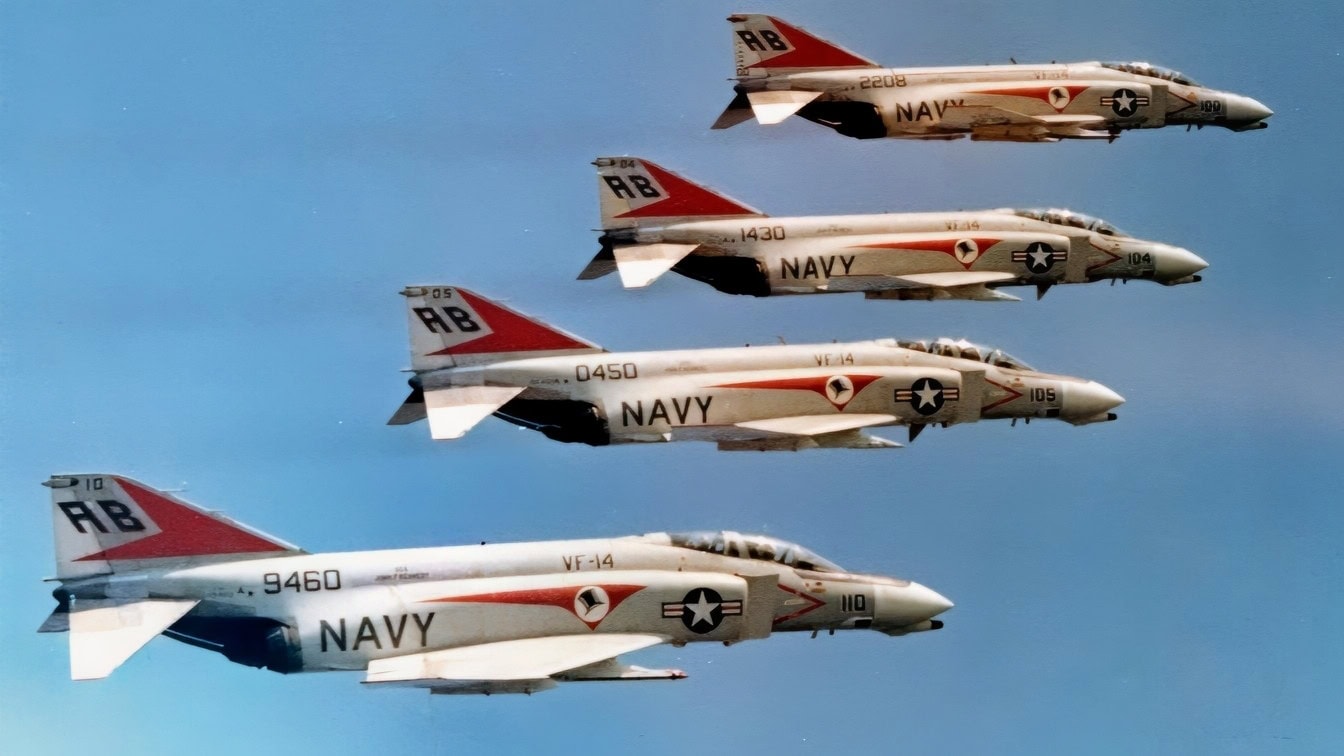
F-4 Phantoms in 1970 Creative Commons Image.
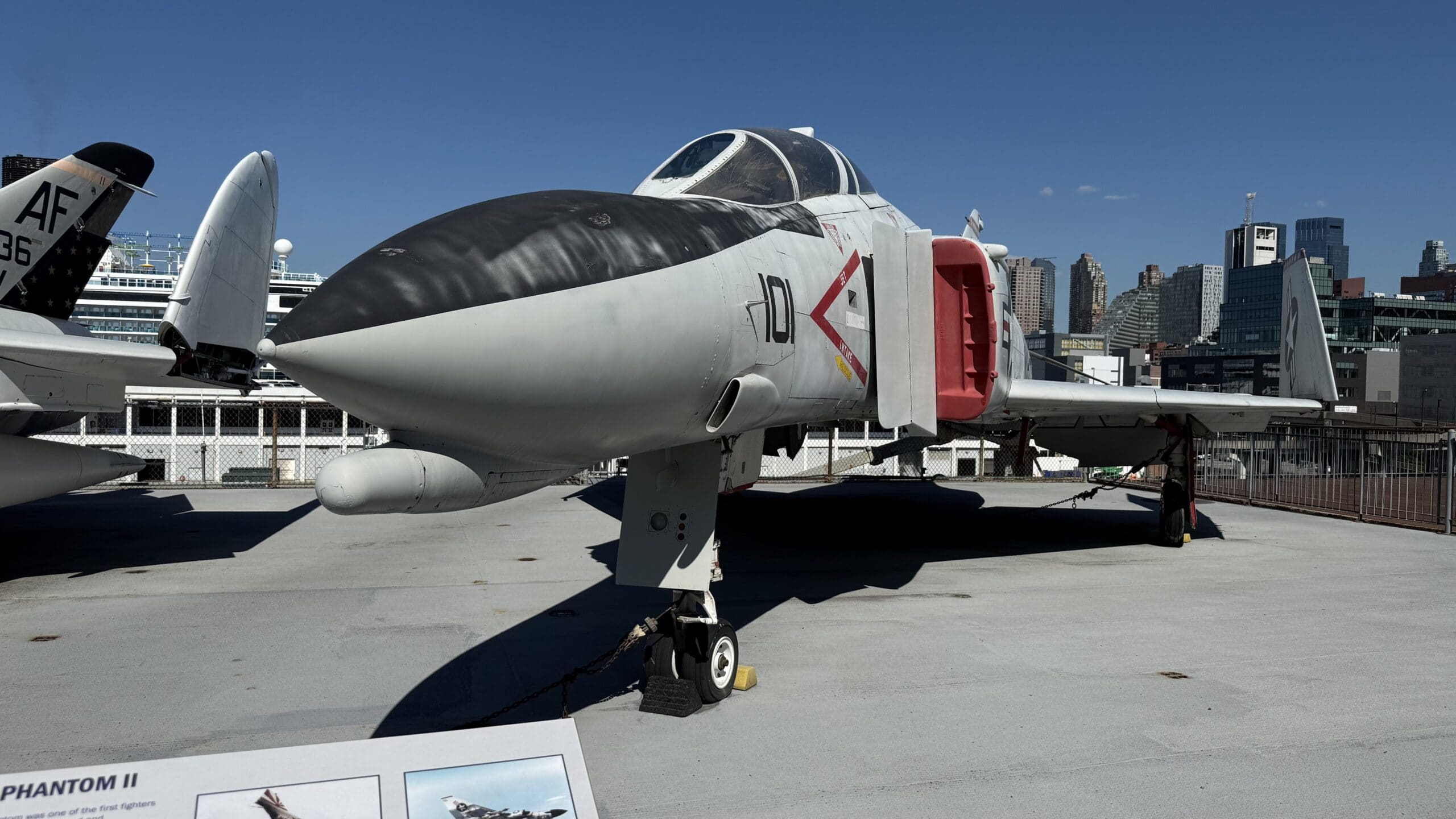
F-4 on USS Intrepid. 19FortyFive Image. We took this picture last year.
In October 1971 DeBellevue joined the 555th Tactical Fighter Squadron, the Triple Nickel, at Udorn in Thailand, and when Operation Linebacker opened the air war over North Vietnam in the spring of 1972, the Triple Nickel’s Phantoms carried an advantage called Combat Tree, a device that could interrogate the MiGs’ own transponders and paint them on the F-4’s radar beyond visual range, before the MiGs knew anyone was looking.
Combat Tree lived in the back seat. So did the work of turning its first look into a firing solution, which is the plain answer to how a navigator became the deadliest American aviator of the war: in the Phantom, the kill chain ran through the rear cockpit, and the Air Force, recognizing it, awarded full and equal credit for every MiG to both men in the airplane.
The Ladder
The scoring began on May 10, 1972, the fiercest air-combat day of the entire war, dozens of engagements from the Red River to the coast, when DeBellevue and Ritchie downed a MiG-21 in the same hours that the Navy’s Randy Cunningham and Willie Driscoll, pilot and radar intercept officer, ran their score to five and became the war’s first aces.
Ritchie took his second at the end of May with another back-seater; the partnership resumed on July 8, when Ritchie and DeBellevue killed two MiG-21s in a single low-altitude engagement lasting barely two minutes, tying a Southeast Asia record set by Robin Olds five years before.
Then came 51 days of nothing, missions flown and no MiGs caught, until August 28, when Buick flight found its head-on MiG-21 near Hanoi.
The official Air Force account preserves the mechanics: the radar lock-on, the conversion to the stern, two Sparrows fired out of parameters to force the MiG’s turn, two more from astern, the fourth one fatal. It was Ritchie’s fifth, the ace-maker, and DeBellevue’s fourth, and the kill was witnessed from the number-three Phantom by Captain John Madden, a detail the story would soon repay.
On September 9, flying with Madden as his pilot near Phuc Yen, DeBellevue’s flight was jumped by four MiG-19s; in the fight that followed, the crew destroyed two of them with heat-seeking Sidewinders — DeBellevue’s fifth and sixth victories, the action that made him an ace, earned him the Air Force Cross, and put him past every American aviator of the war.
He was the first Air Force weapons systems officer to make ace; the Navy’s Driscoll had reached five from a Phantom back seat in May, and a third back-seater, Captain Jeffrey Feinstein, would follow in October, which meant that of the five American aces of Vietnam, only two were pilots.
Why the Back Seat Won the War’s Scoreboard
The scoreboard was the era’s talking. Vietnam’s air war was fought at missile ranges with radar eyes, against ground-controlled MiGs that ambushed and ran, under rules that put protecting the strike force above running up scores, and in that war the decisive skills were detection, identification, and missile employment, the back-seater’s trade.
Every American ace of the conflict flew the two-seat F-4 Phantom, and the aircraft DeBellevue scored most of his kills in tells the same story in miniature: F-4D serial 66-7463 destroyed six MiGs in 1972 while flown by five different crews, a killing machine whose lethality belonged to the system and the men operating it rather than to any single stick hand, and it stands today on display at the Air Force Academy.
DeBellevue’s own arc completed the argument. After the war, the war’s top ace went to pilot training, spent the rest of a long career flying from the front seat, and retired as a colonel in 1998, the last American ace still on active duty.
In 2015, he received the Congressional Gold Medal. Fifty-four years ago today, he was a captain with a radar scope, four kills, and twelve days to go. Feinstein’s fifth that October closed the roster, and no American has become an ace in the half-century since that autumn, which leaves the man at the top of the last scoreboard exactly where the era put him: the one who ran the radar, called the geometry, and proved that in modern air combat the question is not who holds the stick. It is who sees first.
About the Author: Harry J. Kazianis
Harry J. Kazianis (@Grecianformula) was the former Senior Director of National Security Affairs at the Center for the National Interest (CFTNI), a foreign policy think tank founded by Richard Nixon based in Washington, DC. Harry has over a decade of experience in think tanks and national security publishing. His ideas have been published in the NY Times, The Washington Post, The Wall Street Journal, CNN, and many other outlets. He has held positions at CSIS, the Heritage Foundation, the University of Nottingham, and several other institutions related to national security research and studies. He is the former Executive Editor of the National Interest and the Diplomat. He holds a Master’s degree focusing on international affairs from Harvard University.

