
The Timex brand of watches is known for its slogan “Takes A Licking And Keeps on Ticking.” If there is one brand of double-action (DA) revolvers that could also qualify for that slogan, it would have to be Sturm, Ruger & Co.
Breaking that claim down by specific caliber, in .44 Magnum there’s the Ruger Redhawk and Super Redhawk, whilst in .357 Magnum, there’s our current subject, the GP100.

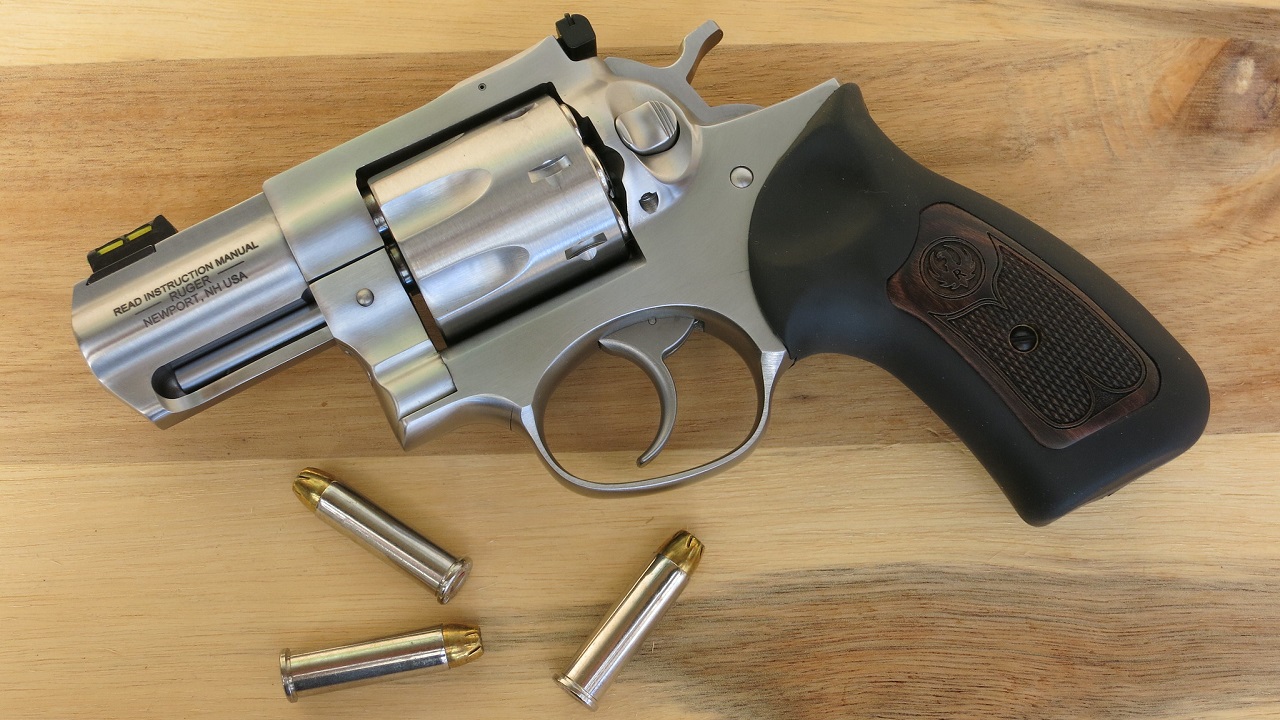
Ruger GP-100. Image: Creative Commons.

Ruger GP-100. Image: Ruger.
As an impressionable teenager, I took a liking to the GP100’s shooting and handling characteristics even before I learned of its Timex-like traits, so eventually, when I became an adult and old enough to purchase firearms, I had to get my own.
Accordingly, I shall cover the general history of the Ruger GP100 gun in brief, as well as my own personal experiences owning one.
Ruger Roots: A Brief History of the GP-100
Sturm, Ruger & Co. was founded in 1949 by the late great William Batterman “Bill” Ruger Sr. (1916 – 2002) and Alexander McCormick “Alex” Sturm (1923 – 1951).
For the longest time, the company was headquartered in Southport, Connecticut, but recently relocated to Mayodan, North Carolina, which is not surprising given the fact that the South is far more business-friendly and 2nd Amendment-friendly.
The GP-100 debuted in 1985 as the successor to the company’s popular Security-Six DA revolver, and while the older product line was certainly no slouch in the durability department, the then-new kid on the block was beefed up to the handgun equivalent of a steroid freak.
A major factor behind this freakish extra strength is the investment casting construction.
Moreover, as noted by the official company website, “Triple-locking cylinder is locked into the frame at the front, rear and bottom for more positive alignment and dependable operation shot after shot, and “Transfer bar mechanism provides an unparalleled measure of security against accidental discharge.”
Just how tough are the GP100s? Well, to give you a better idea, they’ve been run over by pickup trucks and beaten against brick walls … and the guns just keep right on perking along like Superman after having just bounced bullets off of his chest or the late great Hulk Hogan “hulking up” after sustaining a seemingly unsustainable beatdown from an in-ring opponent.
They’ll keep on plugging away after being subjected to loads that would literally blow up a Smith & Wesson (S&W) or a Colt wheelgun. When you see reloading manuals with sections that state “For Ruger Guns Only,” that oughta tell you something.
NOTE: If there’s a semiauto pistol equivalent of the Timex and Ruger revolvers, it would have to be the 9mm Glock 17. The Austrian Army subjected it to brutal field tests that included freezing the gun in a solid block of ice as well as the opposite extreme of subjecting it to temperatures over 212 degrees Fahrenheit.
Meanwhile, the Miami (Florida) Police Department’s then-armorer, Sgt. Paul Palank, did his own torture tests on the G17, which included dropping the pistol from a helicopter at an altitude of 400 feet.
Rockin’ the Ruger AKA Ain’t Nothin’ But a GP Thang, Baby: Personal Experiences with the M29
I first discovered the joys of firing the GP100 as a 9th grader in May 1990, courtesy of the now-defunct Santa Anita Firing Range in Monrovia, California.
I told the delightfully friendly range staff that I wanted to rent a .357 Maggie but didn’t bother to specify a brand—hey, I only had seven months’ shooting experience under my belt at that point in my life—and, as luck and Divine Providence would have it, they hooked me up with a GP-100.
And I quickly became enamored of how easy the gun was to fire accurately.
The factory rubber grips went a long way in tamping down recoil and making the six-gun very comfortable to shoot, even with the full-house Magnum loads; this is a sharp contrast to wood grips, which many old-school traditionalists prefer for aesthetic purposes, never mind that they’re slippery and don’t absorb recoil worth a damn, making revolvers downright painful to shoot.
However, as a compromise gesture to placate those woody wonks, the manufacturer puts wood inserts in the middle of the GP-100’s rubber grips.
Fast-forward to 2003, and I finally bought one of my own from Belleville Shooting Range, now known as Metro Shooting Supplies.
I chose a stainless steel finish—which I prefer to a blued finish both aesthetically and for superior rust resistance—and a 6-inch barrel—which I prefer to a 4-inch barrel for both recoil control and sight radius.
Since then, I’ve probably shot out somewhere in the neighborhood of 25,000 rounds through the goshdarn thing, and I have nothing but good things to say about it.
25-yard head shots and 50-yard torso shots are a breeze, in DA and single-action (SA) trigger mode alike.
The gun enabled me to win multiple gold and silver medals during the Revolver Events at the Nevada Police & Fire Games (NPAF) from 2007 to 2010, back when I was a CBP Officer and ICE Special Agent.
Mind you, I was the only schmoe there competing with a Ruger wheelie—and totally factory stock, to boot—while everybody else was using fancy, tricked-out Smiths.
The GP-100 is my favorite revolver, hands down.
Want Your Own?
Well, of course you do, duh! I mean, who wouldn’t want that Timex-like strength and durability?
Ruger’s online catalog currently lists them at an MSRP range of $1,029 to $1,149. Ouch; they’ve definitely gotten more expensive in the past 23 years, even when you factor in inflation!
But if you’re willing & able to turn to the used/surplus firearm market, Gunbroker.Com has some very good deals for less than half the MSRP dollar amounts going right now, so act fast!
According to True Gun Value, “A RUGER GP100 pistol is currently worth an average price of $876.04 new and $611.62 used. The 12-month average price is $827.57 new and $621.96 used.”
About the Author: Christian D. Orr
Christian D. Orr is a Senior Defense Editor. He is a former Air Force Security Forces officer, Federal law enforcement officer, and private military contractor (with assignments worked in Iraq, the United Arab Emirates, Kosovo, Japan, Germany, and the Pentagon). Chris holds a B.A. in International Relations from the University of Southern California (USC) and an M.A. in Intelligence Studies (with a concentration in Terrorism Studies) from American Military University (AMU). He is also the author of the book “Five Decades of a Fabulous Firearm: Celebrating the 50th Anniversary of the Beretta 92 Pistol Series,” the second edition of which was recently published.


bgdavis
October 28, 2026 at 3:37 pm
Had no idea that iCE was firing that many rounds and doing those cool head shots at relatively close range! Who did you hit? Or was it just random firing into a crowd?