
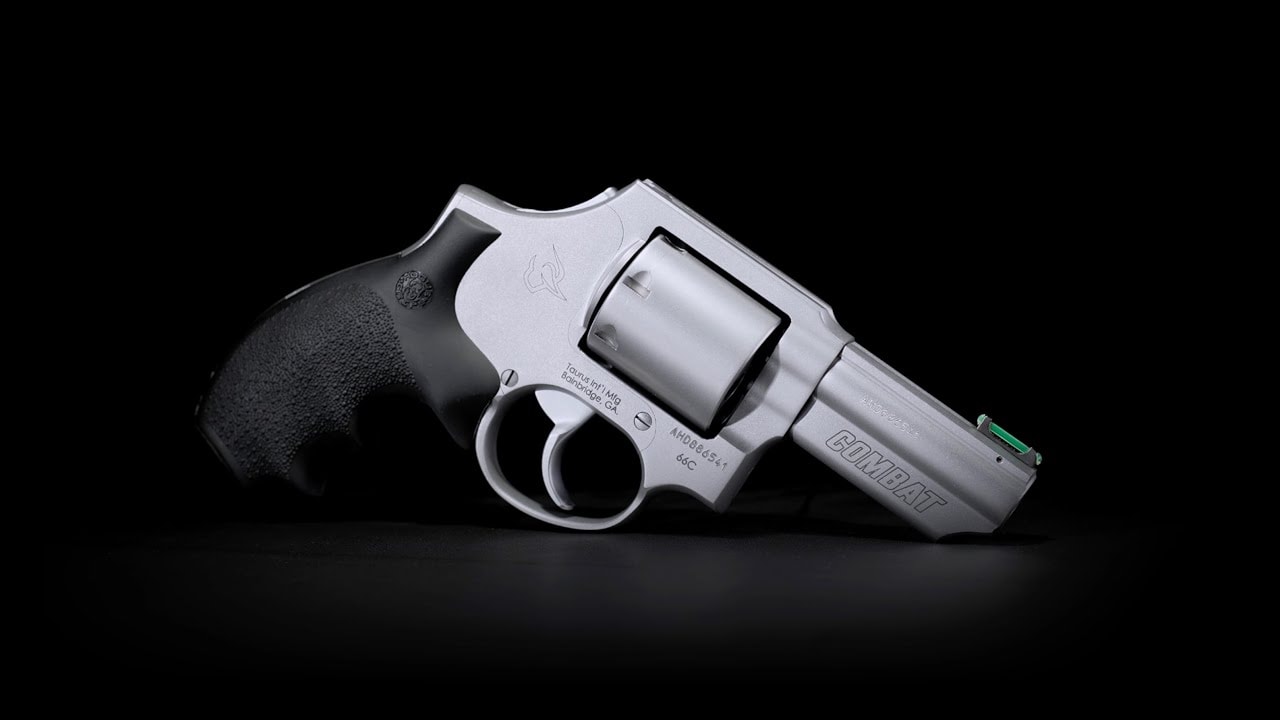
Summary and Key Points: Taurus built the 66 Combat for carry rather than marketing it that way afterward. Bobbed hammer so nothing snags a cover garment, a double-action-only trigger reviewers rate among the best on the market, stainless steel instead of polymer, and a three-inch barrel that still produces more muzzle energy than a lot of 9mm defensive loads out of a full-size pistol. The honest cost is weight and capacity: 36.5 ounces and seven rounds, against fifteen and a spare magazine.
Meet the Taurus 66 Combat Revolver
Revolvers have been having a moment.
Between the ammo shortages of the last few years pushing people toward guns that “just work” and a renewed appreciation for wheelguns as backup and pocket carry pieces, Taurus picked a good time to roll out the 66 Combat.
The question here is simple: can this thing actually carry every day, or is it better suited to the range bag?
The short answer, in my opinion, is that it is certainly an option, but it’s not for everybody, and who you are as a shooter matters more here than with most guns.
And it depends on what you’re comparing it to.
If the question is “does this beat a compact 9mm for daily carry,” the answer is no, not on paper.
If the question is “is this a well-built revolver that can genuinely do the job, with plenty of power,” the answer is yes, and it’s worth taking seriously.
Taurus rolled out the 66 Combat at a good moment: wheelguns have been getting a second look lately, partly for reliability reasons, partly because people are tired of treating magazine capacity as the only metric that matters.
This one was clearly built with carry in mind, not just built and then marketed that way after the fact.
Buying a. 66 Combat Is About Power, Reliability
Seven rounds of .357 Magnum (or .38 Special if you want softer practice sessions), a 3-inch barrel, a tuned double-action-only trigger, a fiber-optic front sight, and a stainless-steel frame drilled and tapped for a Shield RMSC-pattern optic.
The MSRP ranges from $970 to $1,050, depending on the retailer.
It’s not cheap, but you’re paying for steel, not polymer with a steel price tag stapled to it.
36.5 ounces unloaded. 8.4 inches overall.
That’s the number to sit with before anything else, because it is not a small handgun, and it decides a lot of what comes next.
The Trigger Is One Of The Best
Every reviewer who’s put meaningful rounds through one comes back saying the same thing: this is one of the better DAO triggers on the market.
American Rifleman ranked it among the finest they’ve tested.
Guns.com put over 340 rounds through theirs with zero malfunctions and shot one-inch groups at seven yards. That’s the kind of reliability and shootability you want in something you trust with your life.
For a DAO gun, that’s not a small thing.
A bad trigger will make an otherwise good defensive gun useless under stress; this one apparently doesn’t have that problem.
Built For Concealment, Not Just Chambered For It
The hammer is bobbed.
No spur to snag a cover garment, no spur to hang up inside a pocket holster. Hook & Barrel calls it “well designed for a concealed-carry defensive revolver,” and they’re right about the detail people forget: a revolver can be fired from inside a coat pocket in an emergency.
No slide to rack, no safety to think about.
For winter carry, gloved hands, cold fingers, that simplicity matters more than it gets credit for.
And you’re not giving up much on the ballistics end to get it. A 140-grain full-power .357 load out of that 3-inch barrel generated 448 foot-pounds of muzzle energy in testing, with 14.5 inches of gel penetration.
That’s more energy than many common 9mm defensive loads produce from a full-size pistol, from a barrel two inches shorter.
Say what you want about revolvers being outdated. That’s beside the point when the numbers hold up.
The Capacity Question Isn’t Going Away
Seven rounds is seven rounds.
A compact 9mm gives you fifteen or more plus a spare mag in your pocket, and reloading a revolver under stress is a skill most people never practice enough to trust.
The pistol has plenty of knockdown power but not many rounds to fire.
Guns and Ammo and The Firearm Blog both frame this the same way: it’s not a flaw unique to this gun; it’s the trade-off you accept the moment you pick a revolver over a striker-fired pistol. You get the idea.
The Weight Is The Honest Trade-Off
At 36.5 ounces, this isn’t a J-frame you forget you’re carrying. It carries more like a compact 1911 than a pocket .38.
Carrying it concealed under a jacket in November is an easy sell.
Appendix carry under a T-shirt in July is harder.
The Hogue grip that tames .357 recoil so well is also bulkier than a boot grip, and more than one reviewer noted it can print.
However, I’ve always had a soft spot for guns that do their job with the fewest moving parts possible, and a well-built revolver is about as close to that ideal as a defensive handgun gets.
That’s a personal bias, not an argument that capacity doesn’t matter.
The Verdict: It Is Best For An Experienced Shooter
Buy the 66 Combat because you want a revolver.
Buy it because you shoot a wheelgun better than you shoot a striker-fired pistol, or because you like knowing exactly what a double-action trigger pull will feel like every single time.
But don’t buy it because you’ve convinced yourself it beats a 9mm on paper. It doesn’t, and it was never meant to.
Price is the last honest knock. At right around $1,000, you’re paying a real premium over a comparable polymer 9mm, and you’re doing it for a handgun that holds fewer rounds.
You’re buying steel construction, that trigger, and the optics-ready cut.
This isn’t a gun I’d tell a first-time CCW buyer to default to. It’s a handgun I’d tell a revolver person to go to.
About the Author: Steve Balestrieri
Steve Balestrieri is a National Security Columnist. He served as a US Army Special Forces NCO and Warrant Officer. In addition to writing on defense, he covers the NFL for PatsFans.com and is a member of the Pro Football Writers of America (PFWA). His work was regularly featured in many military publications.