
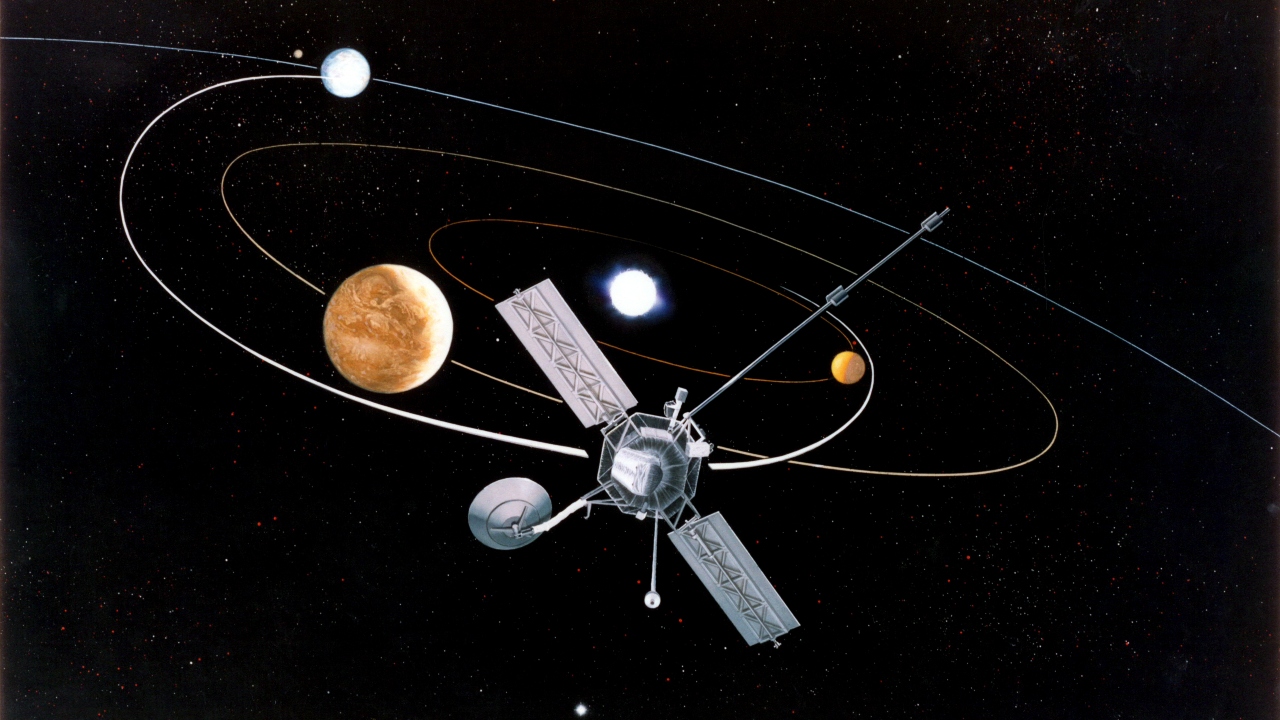
Mercury has proven exceptionally difficult to study. Small and distant—only 3,032 miles in diameter and orbiting just 36 million miles from the Sun on average—Mercury never appears far from the Sun in the sky, which complicates telescopic observation.
NASA’s Mariner 10 changed that, however, providing humanity’s first informed glances at the mysterious planet.
NASA logo at the Kennedy Space Center. Image by Harry J. Kazianis for 19FortyFive.
Launched November 3, 1973, from Cape Canaveral aboard an Atlas-Centaur, Mariner 10 flew past Venus and then made three encounters with Mercury in March 1974, September 1974, and March 1975—becoming the first spacecraft ever to visit Mercury.
Mariner 10 succeeded, returning thousands of photographs and mapping roughly 40 to 45 percent of Mercury’s surface.
The mission also discovered something unexpected: Mercury had its own magnetic field.
A Relatively Cheap Mission
Mariner 10 belonged to NASA’s comparatively lean Mariner planetary probe program.
The mission cost commonly associated with Mariner 10 is about $100 million in 1970s dollars, which equates to roughly 700–$ 800 million in today’s money.
This sounds like a lot, but it’s still modest compared to modern flagship planetary missions, which cost several billion dollars apiece.
The Mariner 10 spacecraft itself weighed only about 1,100 pounds at launch.
It was a compact octagonal spacecraft bus with solar panels, a high-gain antenna, cameras, spectrometers, magnetometers, and charged-particle/plasma instruments.
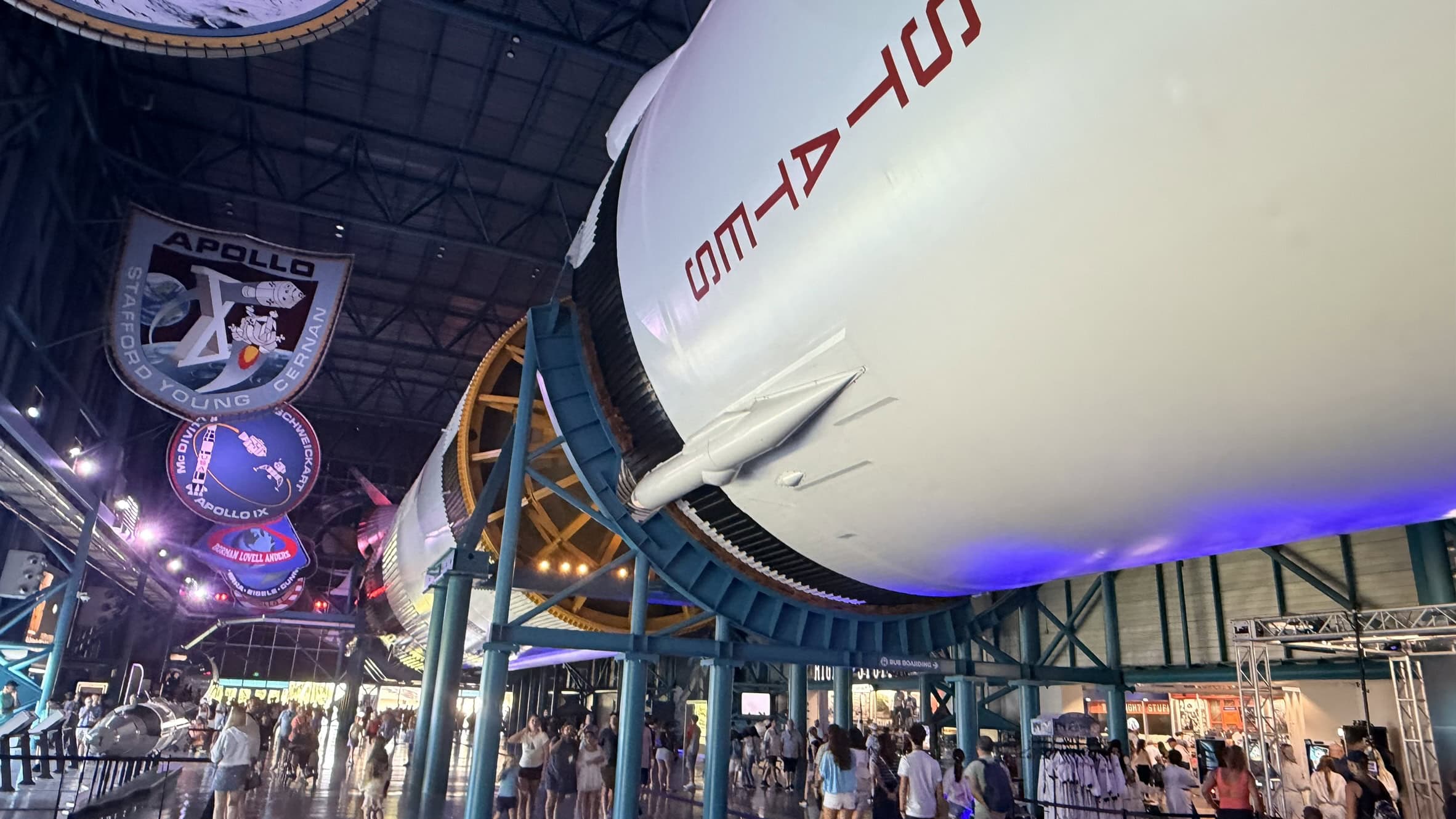
Saturn 5 Rocket. Image from NASA Kennedy Space Center Taken on 6/28/2026. Taken by Harry J. Kazianis for 19FortyFive.com
The mission showed how much planetary science NASA could extract from a relatively small spacecraft using clever orbital mechanics.
Flying Towards the Sun
Flying towards the Sun is difficult.
Mercury is closer to Earth than many outer planets, but distance isn’t the main obstacle in exploring the rocky planet.
Earth already travels around the Sun at roughly 67,000 mph.
A spacecraft launched from Earth inherits much of that sideways orbital velocity, so to fall substantially inward toward Mercury, a spacecraft must shed a large amount of heliocentric orbital energy/angular momentum.
That means NASA couldn’t just point a rocket at Mercury and fire away. Mercury orbits the Sun at 107,000 miles per hour.
Like passing a hockey puck, you don’t pass it to where your teammate is; you pass it to where your teammate will be.
Essentially, the spacecraft has to arrive where the planet will be—at the right place, at the right time, with a trajectory that allows a useful encounter.
This is easier said than done when crossing millions of miles and accounting for such extreme orbital rotation speeds.
Flying toward the Sun also increases sunlight, thermal load, and radiation exposure.
Using Venus as a Brake
Mission planners got creative, using celestial mechanics to reach Mercury effectively. Mariner 10 flew past Venus on February 5, 1974, passing roughly 3,600 miles above the planet.
Venus’s gravity bent the spacecraft’s trajectory and altered its heliocentric orbit.
This allowed NASA to change Mariner’s path—without carrying all of the propellant needed to accomplish the trajectory-changing maneuver independently.
In using Venus to reach Mercury, Mariner 10 became the first planetary spacecraft to use a gravity assist to reach another planet.
The technique would later become foundational to deep-space exploration, used repeatedly on missions like Voyager, Galileo, Cassini, and New Horizons.
Surviving Near the Sun
Operating so close to the Sun, at Mercury’s distance, meant exposure to sunlight roughly six times as intense as Earth.
Thermal control therefore became a major engineering issue for Mariner’s builders.
Accordingly, Mariner 10 used reflective thermal blankets, sunshades, careful spacecraft orientation, and solar panels managed relative to incoming sunlight.
The solar panels in particular presented an interesting problem.
The panels needed sunlight to generate electricity—obviously.
But pointing them too directly at the Sun could cause too much heat.
So mission controllers had to adjust the panels’ angle to balance electrical generation with protection from the Sun’s intensity.
Mission Success
Mariner 10 produced humanity’s first close views of Mercury.
The surface looked Moon-like—at least superficially—with craters and a rocky texture.
But the mission’s biggest shock was discovering Mercury’s magnetic field, which was weak compared to Earth’s (roughly 1% as strong at the surface) but global.
This implied that Mercury had a more complicated and active internal structure than expected.
After making three passes, Mariner’s nitrogen supply was nearly exhausted.
NASA turned the transmitter off on March 24, 1975, ending an important chapter in planetary exploration. Mariner 10 remains in heliocentric orbit today.
About the Author: Harrison Kass
Harrison Kass is a writer and attorney focused on national security, technology, and political culture. His work has appeared in Tablet, City Journal, The Hill, The Spectator, and The Cipher Brief. He holds a JD from the University of Oregon and a master’s in Global & Joint Program Studies from NYU. More at harrisonkass.com.