
No handgun in the .44 Magnum world owes less to a movie script and more to a mountain full of elk than the Ruger Super Blackhawk. Smith & Wesson had the fame. Ruger had the customer base. That’s the appeal and the business case in one sentence. The story starts in 1955, when Bill Ruger introduced his first centerfire single-action revolver, the .357 Magnum Blackhawk, priced at $87.50.
A year later, Smith & Wesson and Remington cooked up something considerably angrier, the .44 Magnum, and Ruger wasn’t about to sit that one out.
Company lore has it that a Ruger employee found spent .44 Magnum brass in a scrapyard before the cartridge was even officially announced.
However, it actually happened: Ruger reinforced the Blackhawk’s cylinder and frame and had its own .44 Magnum revolver on dealer shelves by the end of 1956, practically alongside the Smith & Wesson Model 29.
The Honest Trade-Off
The standard Blackhawk in .44 Magnum was punishing to shoot, and shooters said so.
Ruger listened.
So, in 1959, with input from Elmer Keith and Herb Glass, the company rolled out the Super Blackhawk: a heavier steel grip frame, a squared Dragoon-style trigger guard, a non-fluted cylinder, and a wide spur hammer built to tame the recoil rather than just survive it.
The Super weighed 48 ounces, compared to 40 for the standard gun.
Eight extra ounces doesn’t sound like much until you’ve fired hot .44 Magnum loads through both guns back-to-back.
Keith, no stranger to hyperbole, called it the finest single-action six-gun he’d ever owned.
In my opinion, that’s about as strong an endorsement as a 1950s rancher and firearms enthusiast could give a factory gun.
Why It Never Had To Chase The Model 29
The Model 29 got the Hollywood treatment and the price tag to match. The Super Blackhawk stayed affordable, stayed in stock, and quietly became the working man’s .44 Magnum.
Ruger made a smart play.
A gun doesn’t need a movie deal if it’s already sitting in every gun shop in the country for a few hundred dollars less.
Ruger kept refining it. In 1962, the top strap was reshaped to shield the rear sight, creating the now-collectible Flattop guns, and the lineup grew to include .41 Magnum, .45 Colt, and even .30 caliber Carbine variants.
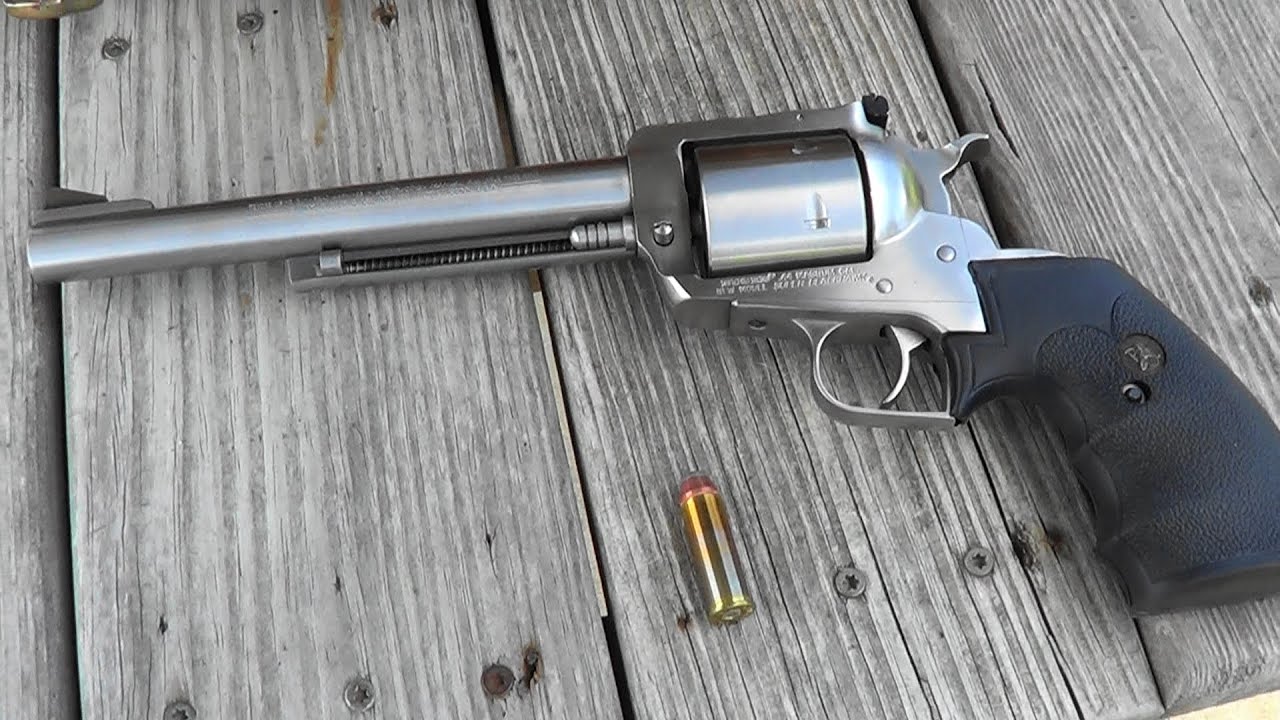
Ruger Super Blackhawk YouTube Screenshot
Then, in 1973, came the real leap: the New Model action, with a transfer-bar safety that let owners carry all six chambers loaded without worrying that a dropped hammer would fire a round. No prototypes needed. It just worked, and it’s still the action every current Super Blackhawk uses.
The Numbers That Actually Matter
Today’s New Model Super Blackhawk ships in 4.62-, 5.5-, 7.5-, and 10.5-inch barrel lengths, blued or stainless, with a cold-hammer-forged barrel, an adjustable rear sight paired with a fixed ramp front, and a six-shot cylinder.
MSRP runs from roughly $1,099 to $1,139 depending on configuration. Factory .44 Magnum loads generate around 800 foot-pounds of muzzle energy out of that barrel.
However, handloaders working up to the Super’s higher-pressure ceiling routinely push past 1,200 foot-pounds, more energy than a 300-grain .45-70 rifle load delivers at the muzzle. Which is a big punch out of a handgun.
The Super Blackhawk Can Fire .44 Special At The Range
Every Super Blackhawk chambered in .44 Magnum will also run .44 Special ammunition without any modification, which matters more than it gets credit for.
A new shooter can spend an afternoon on milder .44 Special loads before working up to full-house Magnum rounds, and the same gun does both jobs without complaint.
Ruger also still offers the Bisley grip option, with its raked-back angle borrowed from the old Colt target guns of the 1890s, for shooters who find the standard Dragoon grip rolls too much in recoil.
That capacity is why the Hunter model exists: built with a scope-ready rib for guides and backcountry hunters who use the Super Blackhawk as a finishing gun for elk, moose, and grizzly, or as a primary sidearm for cape buffalo.
It’s also why the gun still appears in the accuracy tables.
A well-tuned Super Blackhawk will put five rounds into one ragged hole from a rest at 25 yards.
That’s not a gimmick.
That’s a single-action built by people who actually hunted with it.
A Reputation Built By Hunters And Guides
Personally, I’d opt for the 7.5-inch barrel over the shorter carry guns every time.
It balances best for a two-handed hold, and it’s the one that shows up most in the hunting camps that built this revolver’s reputation.
John Gardner’s continuation of the Ian Fleming book series put a Ruger single-action in the 1981 James Bond novel “License Renewed,” and the video game crowd got their own version of it years later in GoldenEye 007.
However, neither one built the gun’s name. Elk hunters and handloaders did that decades earlier.
Smith & Wesson got the fame.
Ruger got sixty-plus years of customers who never cared much.
Although I have a strong affinity for Single-Action Army pistols, the Western style of the Super Blackhawk isn’t my first choice.
Regardless, it is an excellent pistol, with a track record of being exceptionally strong, accurate, and rugged.
About the Author: Steve Balestrieri
Steve Balestrieri is a National Security Columnist. He served as a US Army Special Forces NCO and Warrant Officer. In addition to writing on defense, he covers the NFL for PatsFans.com and is a member of the Pro Football Writers of America (PFWA). His work was regularly featured in many military publications.