
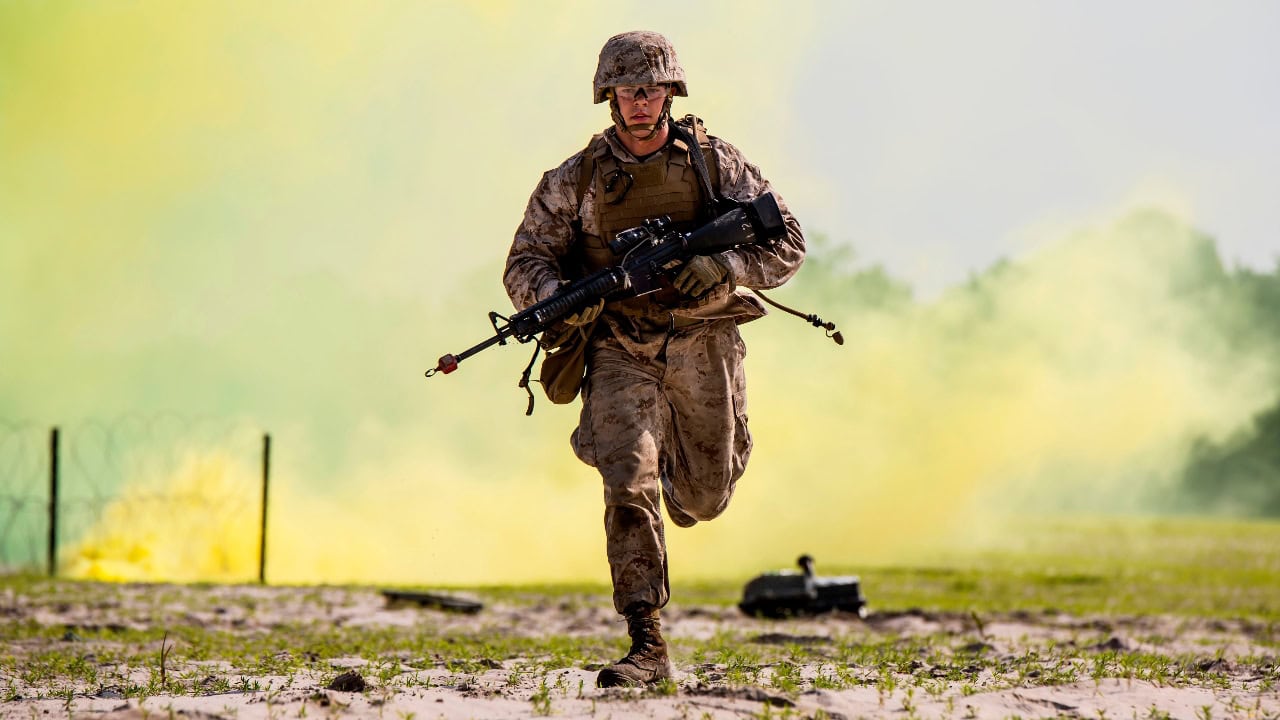
Summary and Key Points: The argument took place over a radio, above a burning city, and it lasted only minutes. On October 3, 1993, two Delta Force sniper sergeants orbiting Mogadishu in a Black Hawk helicopter looked down at a crashed American aircraft, a wounded crew, and a crowd of armed fighters closing from every direction, and asked their commanders to put them on the ground. The answer was no. They asked again. The answer was no again, for the soundest of reasons: two men could not hold that ground, and everyone giving the orders knew it. On the third request, the answer changed. Master Sergeant Gary Gordon and Sergeant First Class Randall Shughart went down a rope into a city that was coming to kill the men below, and everything that followed, including the first Medals of Honor awarded since Vietnam, flows from the fact that they would not stop asking.
The Mission That Was Supposed to Take an Hour
The raid that became the Battle of Mogadishu began as a snatch mission with a planned duration shorter than a football game.
Task Force Ranger, the assembly of Delta Force operators, Army Rangers, and Night Stalker aviators sent to Somalia to hunt the warlord Mohamed Farrah Aidid, launched into central Mogadishu that afternoon to seize two of Aidid’s lieutenants, an operation built on helicopters, speed, and surprise. The seizure itself worked. The extraction did not, because Somali fighters with rocket-propelled grenades began shooting at the low, slow helicopters overhead, and one of them, the Black Hawk Super Six-One, went down in the city.
A rescue force converged on the crash site. Then a second Black Hawk, Super Six-Four, flown by Chief Warrant Officer Michael Durant, took a grenade hit and crashed about a mile away, and there the plan ran out. Every American ground element was already moving toward the first site, and, as President Bill Clinton would later describe at the White House, the forces on the ground could not reach the second helicopter quickly by land.
The first crash had absorbed the rescue force; a ground convoy trying to reach the fight was being shot apart in the streets, and the battle had consumed every reserve the task force owned.
Four injured crewmen lay in the wreckage of Super Six-Four. The only Americans close enough to matter were circling above it.
Three Requests
Gordon and Shughart were the Delta sniper element aboard Super Six-Two, working the battle from the air alongside a third sniper, Sergeant First Class Brad Halling, and from that orbit they could see what was coming better than anyone on the net.
Armed Somalis were converging on the wreck from across the district; the crew inside was alive and helpless, and no rescue was en route or possible. Gordon radioed a request to be inserted at the crash site to defend the crew.
Mission commanders denied it, judging the situation far too dangerous for two men on the ground and holding that the snipers were worth more where they were, providing fire from above. Gordon asked a second time and was refused again on the same logic, and the logic was correct, which is the terrible center of this story. A sniper team on that ground changed the arithmetic of the fight by almost nothing. It only changed who would be standing next to the wounded when the crowd arrived. On the third request, permission came.
Gordon made the requests as the team leader, and his Medal of Honor citation records the sequence in the document’s own flat language: “After his third request to be inserted,” it reads, Gordon received permission to perform his volunteer mission.
Halling stayed aboard to man a minigun in place of a wounded crew chief, and the helicopter that put Gordon and Shughart onto the ground was itself struck by a rocket-propelled grenade minutes later, a hit that took Halling’s leg.
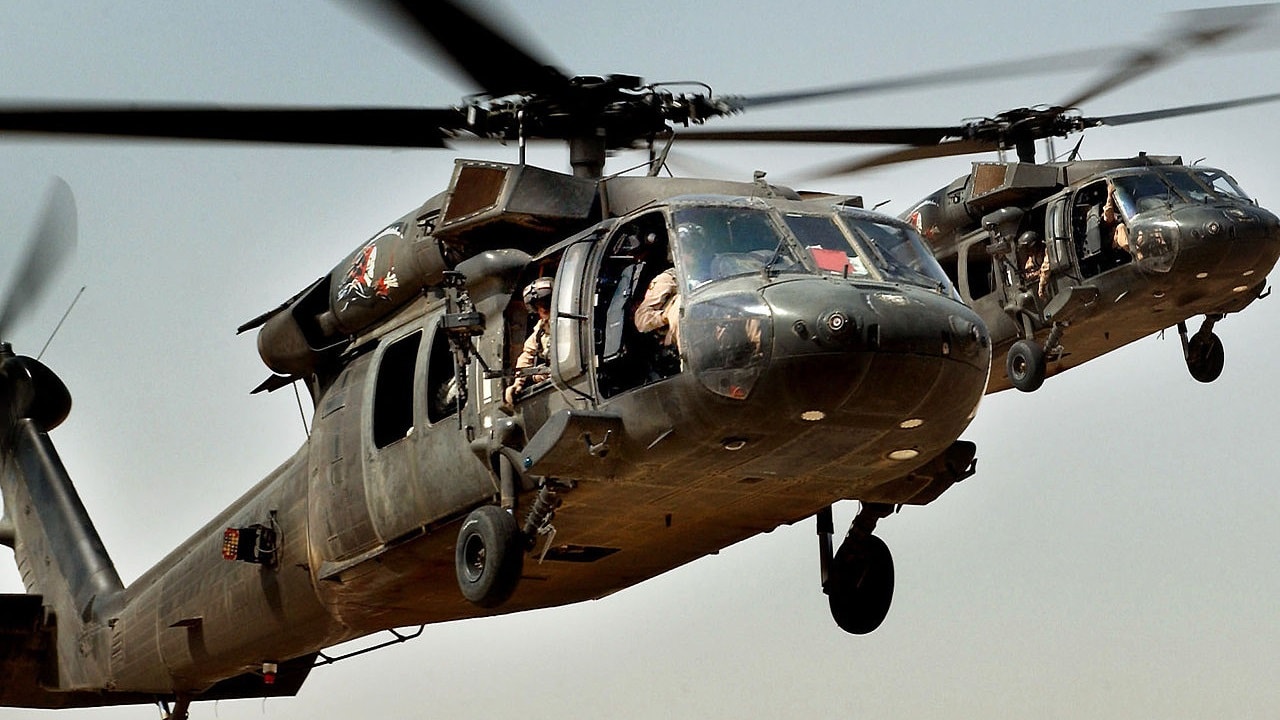
Soldiers from the 101st Airborne Division fly to Forward Operating Base Dagger near Tikrit, Iraq, aboard UH-60 Black Hawk helicopters. This photo appeared on www.army.mil.
There was never going to be a safe way to do any of it, and everyone involved had known that from the first no.
Two Men on the Ground
Debris and ground fire forced the two sergeants to abort their first insertion attempt, and they went down a rope one hundred meters south of the crash site, equipped, as the citations record, with only their sniper rifles and pistols, and fought through a maze of shanties and gunfire to Super Six-Four.
Durant was alive in his seat, defending himself with a submachine gun, unable to move with a crushed vertebra and a broken leg; the fast-rope insertion from Super Six-Two and the fight to the wreck are preserved in the accounts of the battle and in both Medal of Honor citations.
Gordon and Shughart pulled Durant and the injured crew from the airframe, set them in cover, and began defending a perimeter consisting of two riflemen against a district. They fired with the precision their profession is built on, and precision was never going to be enough against the numbers coming at them. One of the two fell. The survivor went back to the wreckage, recovered a rifle with five rounds remaining, handed it to Durant with the words “good luck,” and kept fighting with a pistol until he was killed.
The official citations record Shughart falling first and Gordon fighting last; accounts assembled by Mark Bowden for Black Hawk Down, drawing on a teammate who heard the radio calls, suggest the order may have been reversed, and Durant himself has said he could not be certain, and the record was left to stand because no one could be certain.
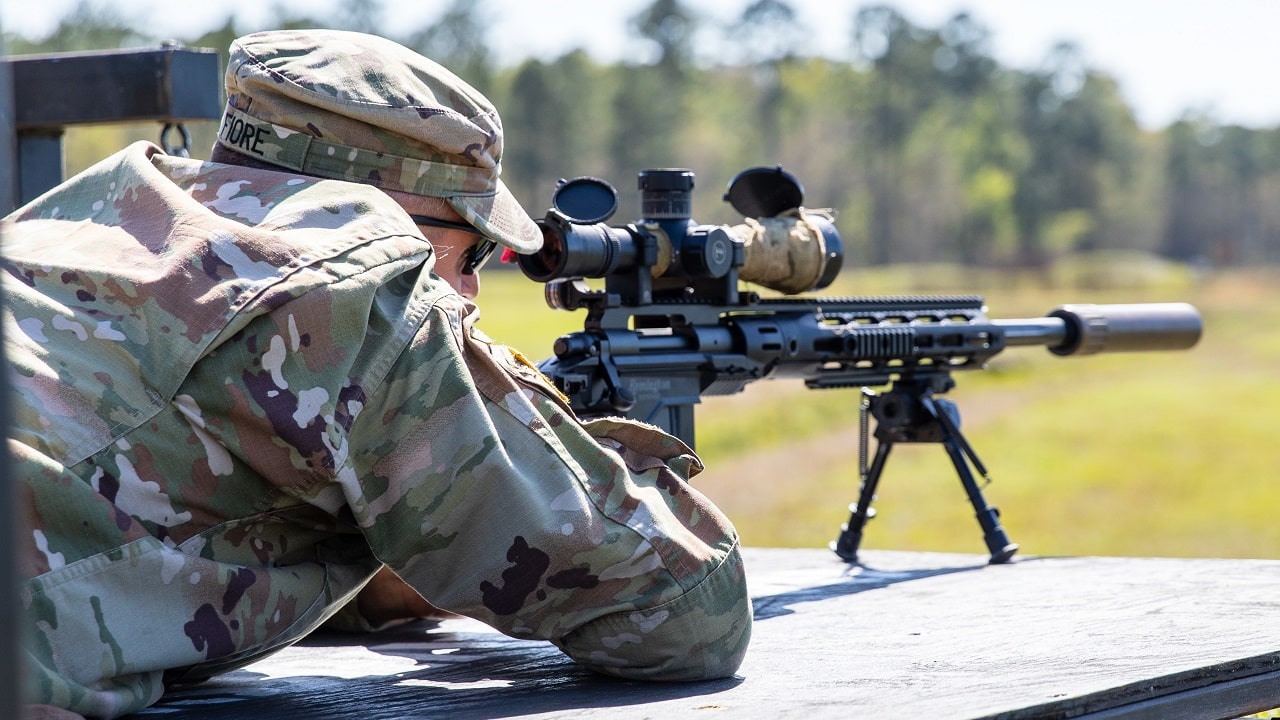
U.S Army Sgt. Matthew Fiore, a UH-60 Black Hawk crew chief representing the Marietta-based 78th Aviation Troop Command, Georgia National Guard, engages targets with the M2010 Enhanced Sniper Rifle at the sniper event during the 2022 Georgia National Guard Best Warrior Competition at Fort Stewart, Ga., March 21, 2022. The Best Warrior Competition tests the readiness and adaptiveness of our forces, preparing our Georgia Guardsmen to meet today’s unpredictable challenges. (U.S. Army photo by Sgt. 1st Class R.J. Lannom Jr.)
What no account disputes is that both men spent everything they had, to the last round, between the crowd and the crew.
What the Medal Was For
The position fell, as every professional watching had known it would. Durant, the only man alive at the site, was taken captive, and the crewmen the two snipers had pulled from the wreck and defended, copilot Ray Frank and crew chiefs Bill Cleveland and Tommy Field, died there.
The wider battle raged on through the night in the most intense combat American forces had seen since Vietnam before the task force fought its way out. Seven months later, on May 23, 1994, the families of both men stood in the East Room of the White House as President Clinton presented the Medal of Honor for Gordon and for Shughart, telling the room that the two sergeants gave their lives to save others and that their actions were clearly above and beyond the call of duty.
The medals were placed in the hands of Carmen Gordon and the Shughart family, the country’s highest decoration, in place of the two men who earned them. They were the first Medals of Honor awarded since the Vietnam War, and they remain, by the accounting of the special operations community, the only ones ever given to snipers.
The citations themselves, published by the Army, read less like decorations than like depositions, a minute-by-minute record of two men methodically doing an impossible job, and they are among the few citations in the medal’s history that document the recipients requesting, in the text itself, the mission that killed them.
The Man They Went In For
Michael Durant lived. He was held for eleven days and released, carried home with a broken back and a shattered leg and the knowledge of exactly what had been spent to make his survival possible, and in his memoir, In the Company of Heroes, and across three decades of interviews, he has said plainly that he owed his life to the two men who came in knowing it was a losing battle with nobody left to back them up.
He recovered, returned to fly with the 160th Special Operations Aviation Regiment, and, for decades since, told the story of the men who came down the rope.
Gordon, from a small town in Maine that later raised a bronze statue of him, and Shughart, off a Pennsylvania dairy farm by way of the Ranger Regiment, were career noncommissioned officers at the absolute peak of their profession, and the record of their lives is now kept by the units, towns, and families who carry it.
The Third Request
The part of this story that separates it from nearly every other act of battlefield valor is the argument.
Gordon and Shughart were not ordered onto that ground, nor were they swept onto it by chaos.
They watched the situation develop from above with the clearest eyes in the battle, understood the tactical mathematics better than anyone, heard the refusals of commanders whose reasoning was sound, and asked again anyway, because the calculation they were running was not the one the command net was running. The command question was whether the position could be held.
Their question was whether wounded Americans would face what was coming alone. Those are different questions with different right answers, and the Medal of Honor exists for the men who choose the second one with full knowledge of the first.
Thirty-three years later, the two names are taught to every sniper, every Night Stalker, and every soldier who studies what the profession of arms asks, and the lesson is not that the position could have been held. It could not; they knew it could not, and they asked three times anyway.
The answer that finally came back was yes, and they went.
About the Author: Harry J. Kazianis
Harry J. Kazianis (@Grecianformula) was the former Senior Director of National Security Affairs at the Center for the National Interest (CFTNI), a foreign policy think tank founded by Richard Nixon based in Washington, DC. Harry has over a decade of experience in think tanks and national security publishing. His ideas have been published in the NY Times, The Washington Post, The Wall Street Journal, CNN, and many other outlets. He has held positions at CSIS, the Heritage Foundation, the University of Nottingham, and several other institutions related to national security research and studies. He is the former Executive Editor of the National Interest and the Diplomat. He holds a Master’s degree focusing on international affairs from Harvard University.

