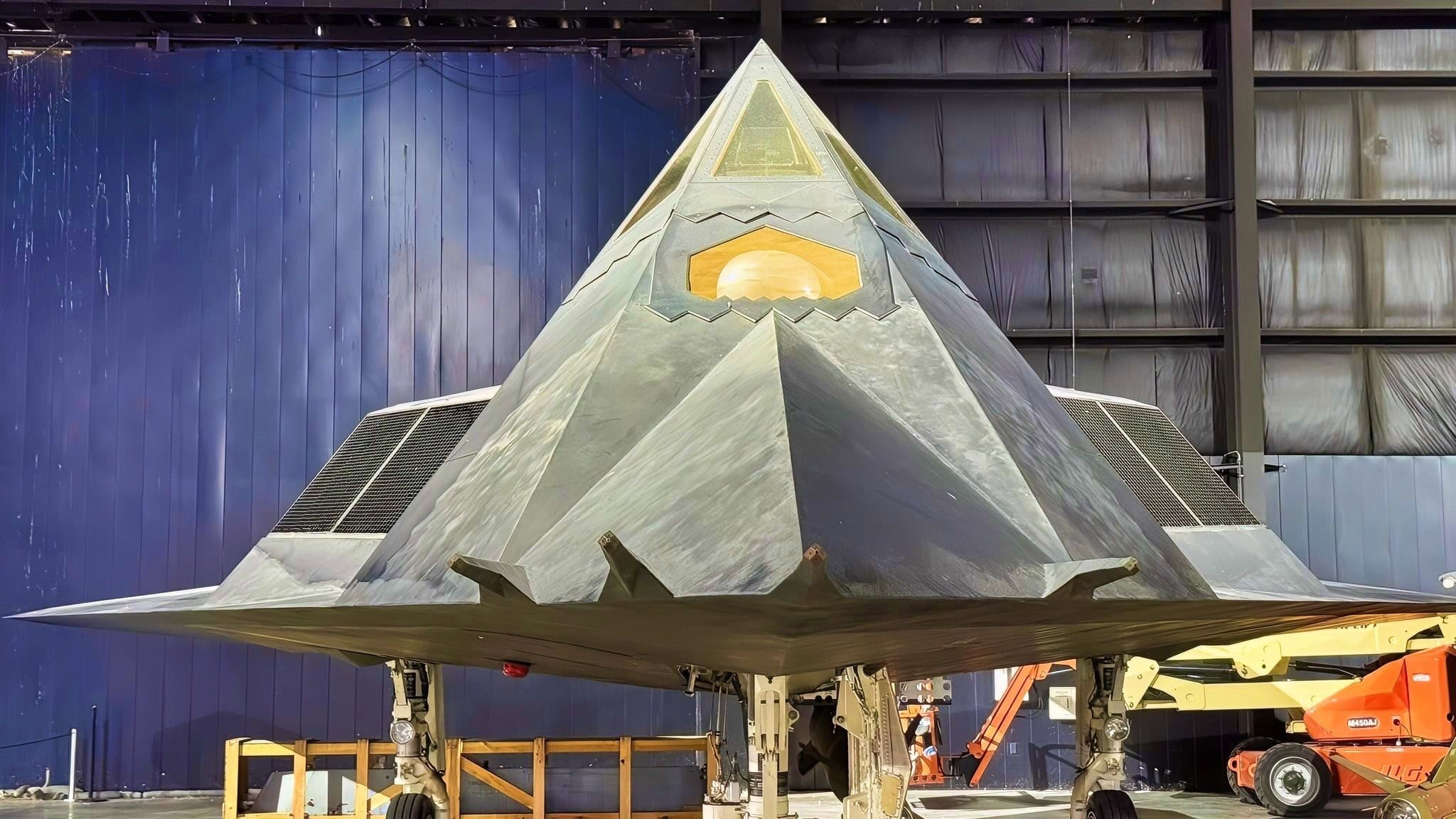
One particular F-117 Nighthawk has been to Panama, Iraq, Yugoslavia, and back to Iraq again. Now, instead of penetrating defended airspace, it is preparing for a trip inside a C-5 Galaxy. The Smithsonian’s National Air and Space Museum is adding F-117A tail number 85-0818, nicknamed “The Overachiever,” to its collection. The aircraft will be partially disassembled and moved to Dulles International Airport by the Air Force Reserve’s 512th Airlift Wing.
It will then be reassembled at Chantilly’s Steven F. Udvar-Hazy Center.

F-117 Nighthawk at National Museum of Air Force 19FortyFive Photo
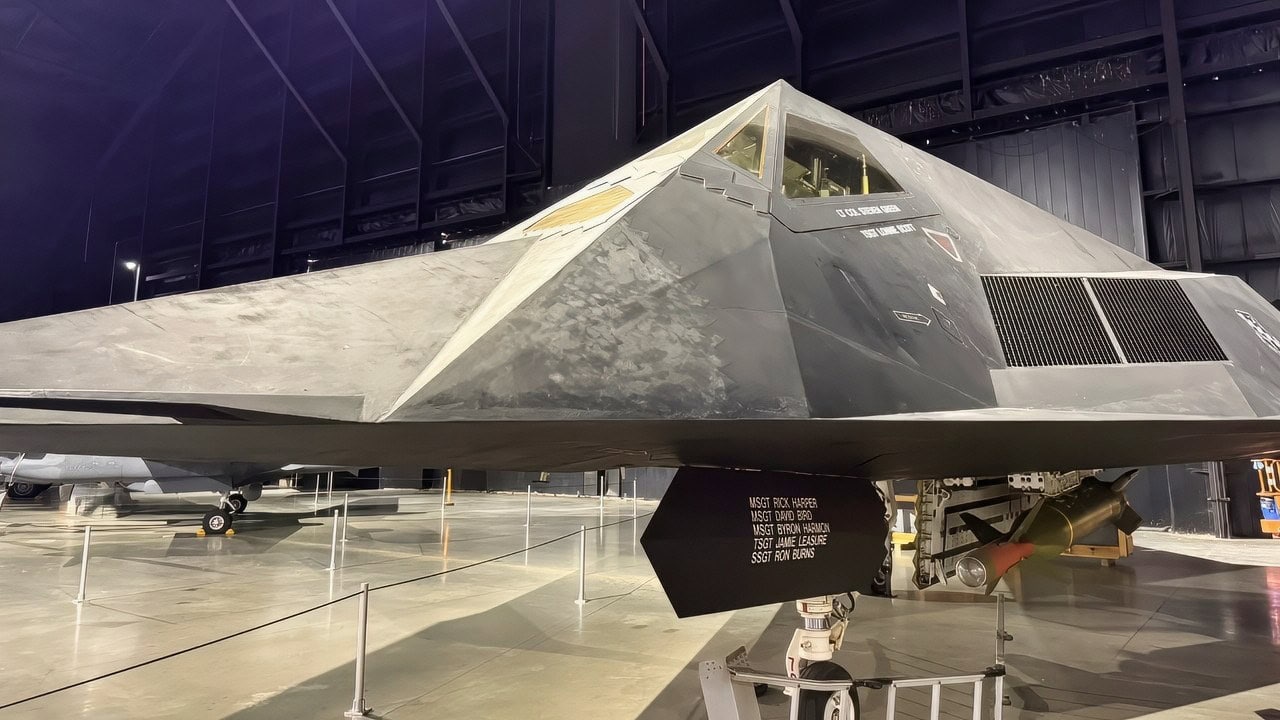
F-117A Nighthawk at USAF Museum. Image taken by 19FortyFive Owner, Harry J. Kazianis.
Jeremy Kinney, assistant director for research, collections and curatorial affairs at the museum, said the Nighthawk has “earned its place in the national collection” because it “revolutionized modern airspace and military technology.” He added that the acquisition was “only possible through the support and collaboration of partners,” including the Air Force and Lockheed Martin.
What Is Different About ‘The Overachiever’?
The Smithsonian describes 85-0818 as the only F-117 to have flown combat missions in all four major conflicts in which the type fought: Operation Just Cause over Panama in 1989, Operation Desert Storm in 1991, Operation Allied Force over Yugoslavia in 1999, and the 2003 Iraq War.
In the museum’s announcement, the 2003 Iraq campaign is referred to as “Operation Enduring Freedom.”
However, the Air Force’s own record described the March 2003 operation in Iraq as Operation Iraqi Freedom, during which F-117s opened the air attack by striking the Dora Farms complex southwest of Baghdad on March 19.
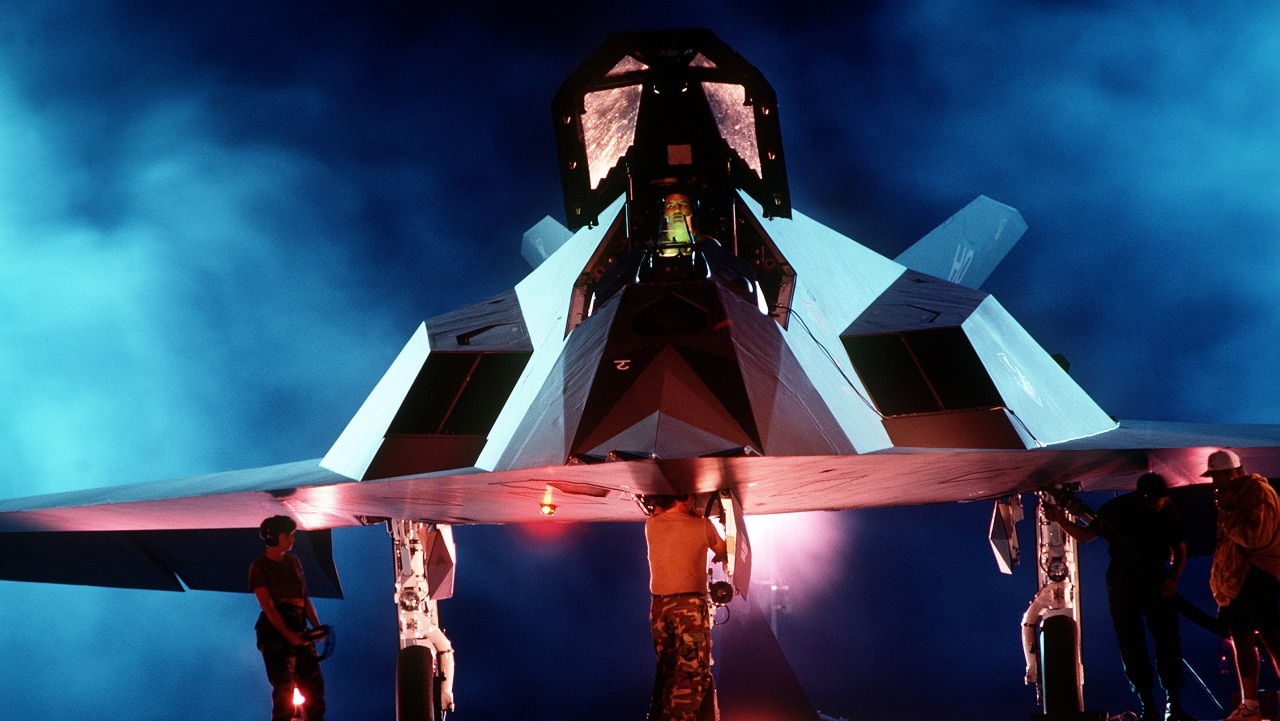
A back lit front view of a F-117A Stealth Fighter aircraft. From Airman Magazine’s February 1995 issue article “Streamlining Acquisition 101”.

Four F-117 Nighthawks fly in formation during a sortie over the Antelope Valley recently. After 25 years of history, the aircraft is set to retire soon. As the Air Force’s first stealth fighter, the F-117 is capable of performing reconnaissance missions and bombing critical targets, all without the enemy’s knowledge. (Photo by Bobbi Zapka)
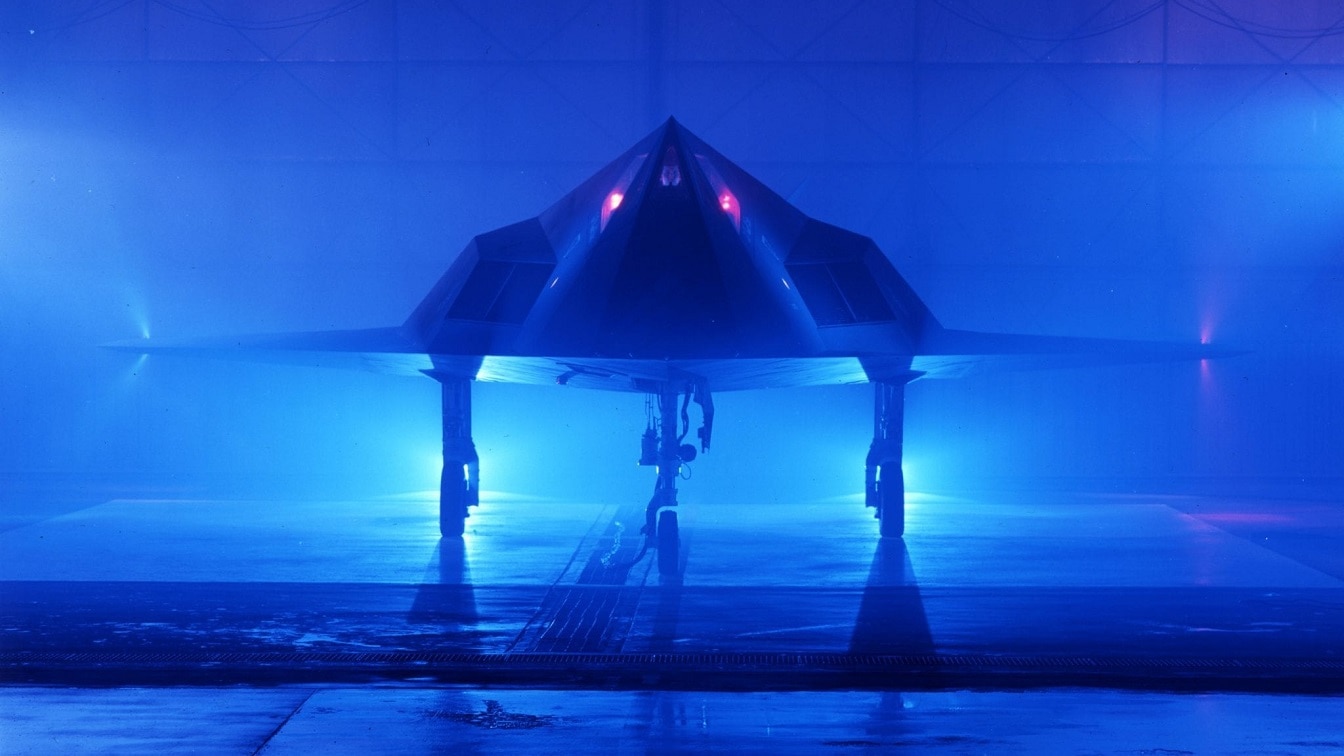
F-117. Image Credit: Lockheed Martin.
The F-117 was “developed rapidly and in complete secrecy,” Lockheed Martin has said.
The aircraft’s radar-absorbent material and faceted surfaces meant that it was “nearly invisible to radar.” The inaugural F-117 flew in June 1981.
Its initial operational capability followed in 1983, years before the Pentagon openly acknowledged the initiative.
Operation Desert Storm
One of the jet’s major tests took place in 1991 over Iraq. Brig. Gen. Greg Feest, who flew the lead F-117 on the opening night of Desert Storm, later recalled that after several missions, crews realized “this stealth technology really worked” and were “begging to get back up into the air.”
During the operation, more than 1,270 F-117 sorties were flown without one of the jets receiving battle damage.
The Nighthawk flew roughly 2 percent of combat sorties during Desert Storm but struck about 40 percent of the strategic targets.
Gen. Bruce Carlson later called its performance a “remarkable contribution” and described the airplane as the “foundation for low-observable technology” in the United States.
Stealth alone was only part of the equation. Air Force historian Yancy Mailes said it was the “marriage of the GBU-27 to the F-117” that turned the aircraft into such a “precise, deadly platform.”
Keeping that capability working required equally unusual maintenance.
Col. John Forsythe, an F-117 operations group commander, noted that the aircraft had no radar or defensive systems, saying: “We depend exclusively on the stealth provided by our maintainers.”
Back to Baghdad
Twelve years after Desert Storm, the Nighthawk was back over Iraq.
During Operation Iraqi Freedom, F-117s attacked Baghdad command bunkers and communications nodes with EGBU-27 precision-guided bombs.
Maj. Clint Hinote, then an F-117 pilot working at the Combined Air Operations Center, said the aircraft had received “some very tough assignments” and that its crews had “performed superbly.”
The Air Force officially retired the F-117 in 2008, but retirement did not mean the type disappeared. Surviving aircraft have continued to support limited research, testing, and training work.
Current Air & Space Forces reference data says the service has contracted to support F-117 test and training operations through at least 2034.
Window to the Past
During one training deployment with California Air National Guard F-15s, Lt. Col. David Allamandola called flying with the Nighthawks a “unique opportunity” that offered “incredible value for everyone involved.”
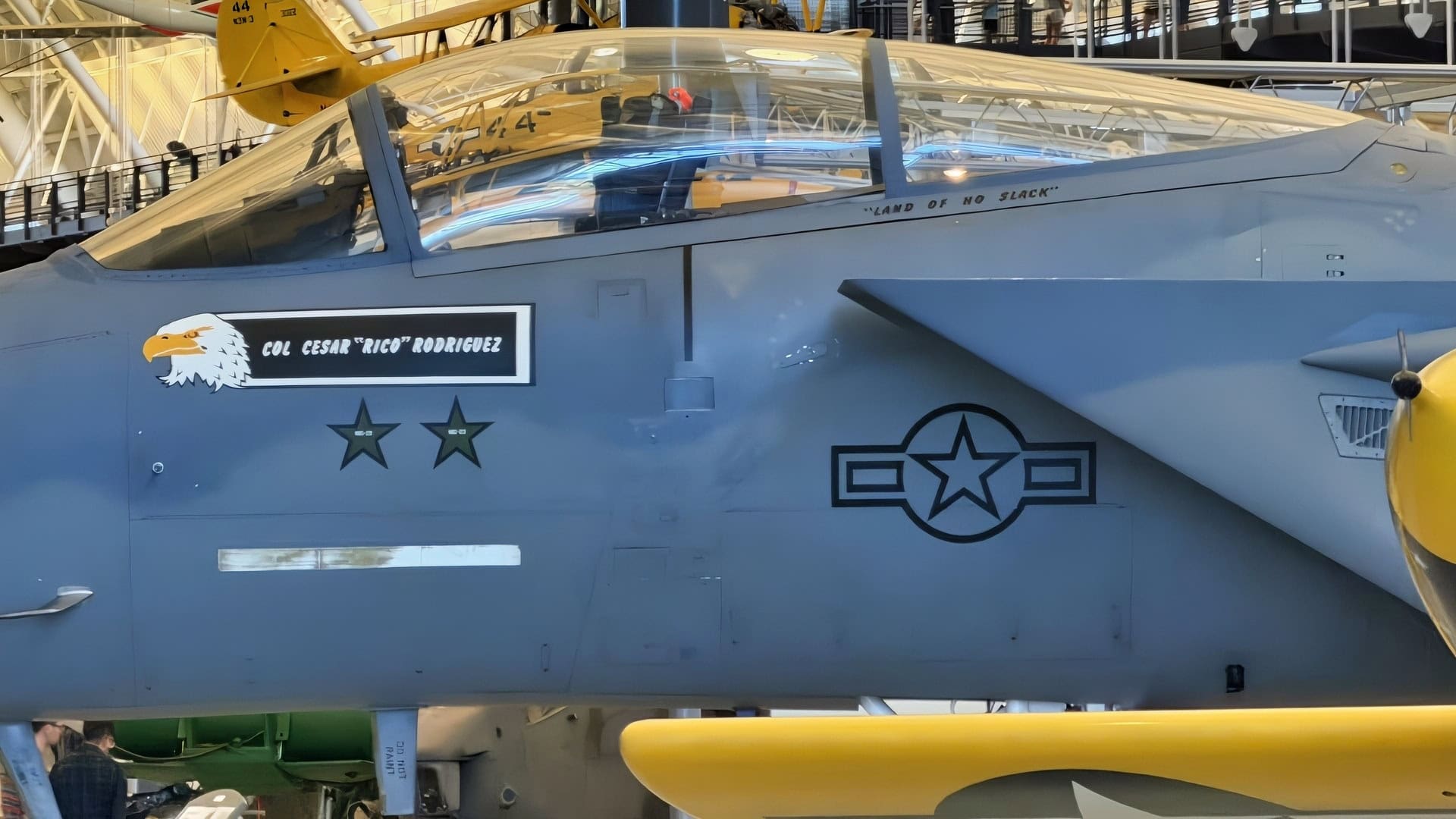
F-15C Smithsonian 19FortyFive Photo
The Overachiever, however, is headed in the opposite direction: preserving history.
National Air and Space Museum director Chris Browne said the F-117 gave commanders “options they never had before.” It could operate as the “tip of the spear,” he said, while attacking crucial targets with “unmatched precision.”
Soon, one of the aircraft that demonstrated those capabilities in four wars will sit where the public can examine it up close.
About the Author: Georgia Gilholy
Georgia Gilholy is a journalist based in the United Kingdom who has been published in Newsweek, The Times of Israel, and the Spectator. Gilholy writes about international politics, culture, and education.