
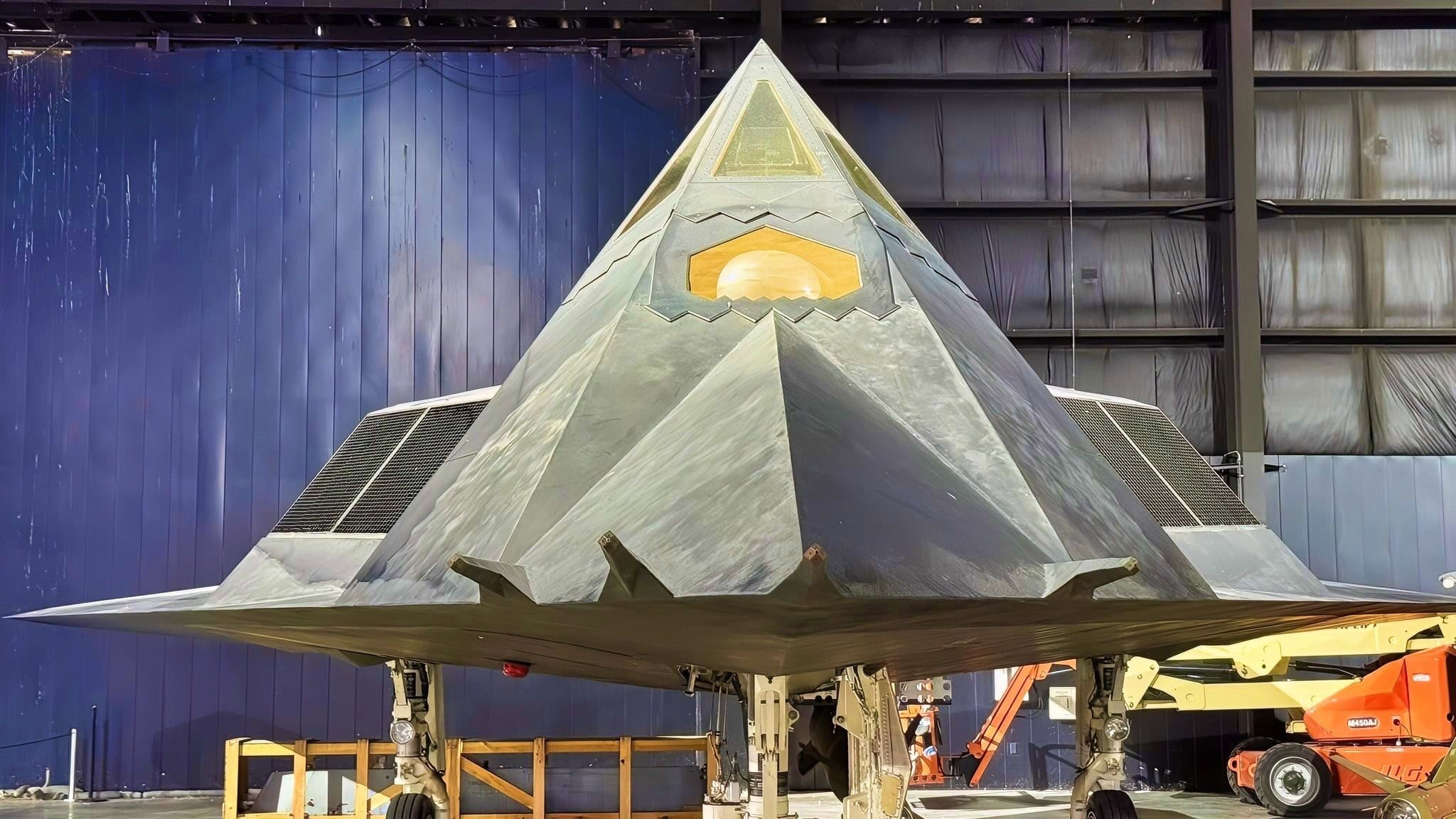
The Lockheed F-117 Nighthawk was the first stealth aircraft in the world to enter active service, and no analog existed in any other nation until the 2000s. Today, the aircraft is remembered as a Cold War icon thanks to its unique design and stealth capabilities. After the end of the Cold War, the aircraft was retired from combat service and presumed mothballed.
The Air Force, however, maintained a few aircraft and continues to operate them to this day as training aircraft and to mimic stealth fighters from Russia and China. In fact, many experts argue the plane was never really retired at all.
The F-117 is Still Being Flown
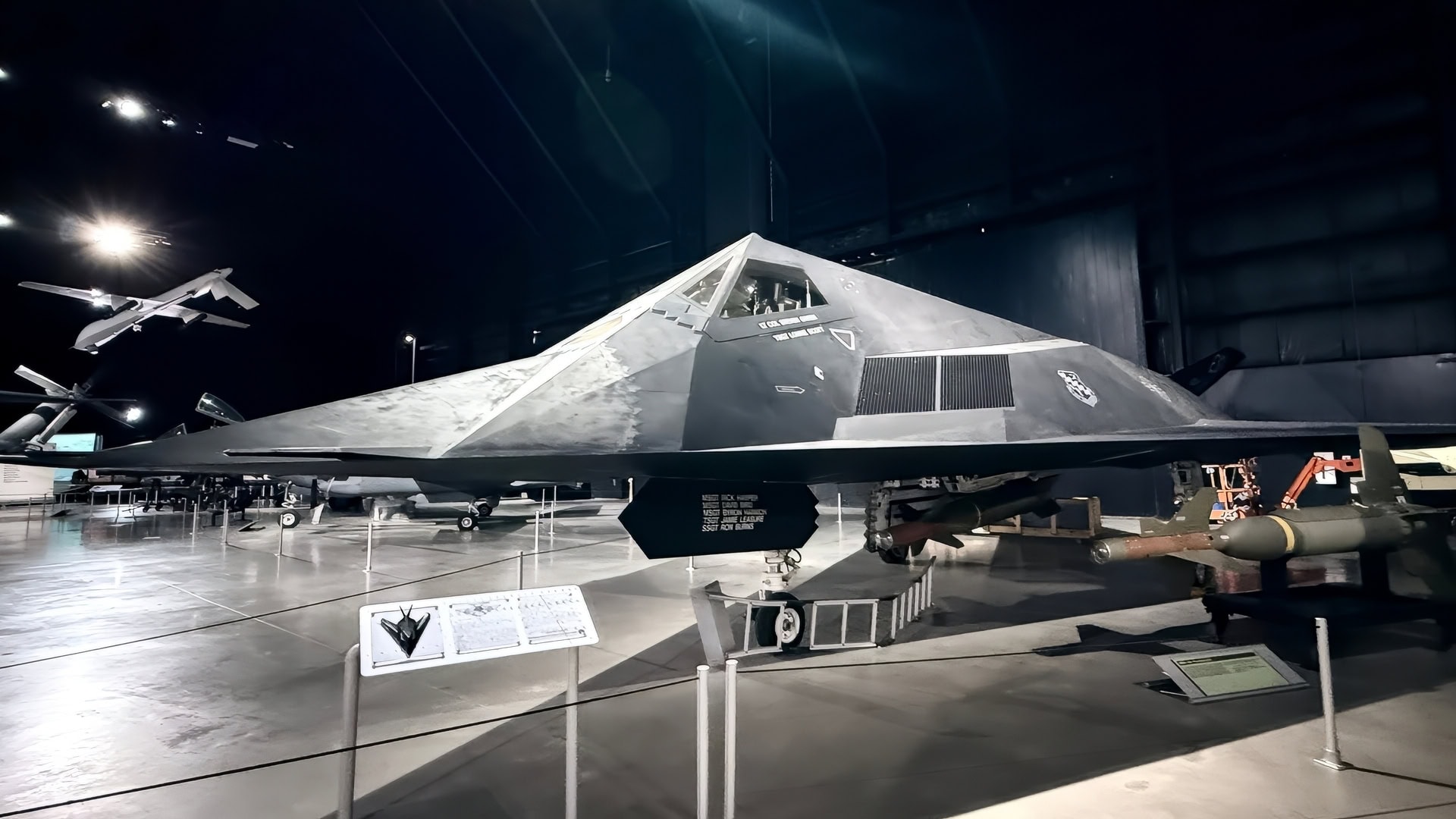
F-117A Nighthawk 19FortyFive.com Image. Taken in July 2025 at the National Museum of the U.S. Air Force by Harry J. Kazianis.
Despite being withdrawn from combat service almost twenty years ago, the Air Force deliberately preserved a subset of F‑117s in flyable condition. Sometime in the 2010s, the Air Force decided to revive around 45 aircraft for various training and testing purposes.
The aircraft is slated to remain in service until 2034. The first public sighting in the U.S. was reported in 2021, when a pair of Nighthawks landed at Yosemite International Airport to train with National Guard Air Units.
Its most recent sighting was in 2025, when a pair were spotted above Los Angeles refueling from a KC-135 Stratotanker.
Why the U.S. Still Maintains a Few Nighthawks
One of the primary uses for the F-117 today is as a relatively cost-effective stealth test platform. Unlike digital simulations or unmanned targets, the Nighthawk is a crewed aircraft with well‑documented radar and infrared signatures.

F-117 Nighthawk at National Museum of Air Force 19FortyFive Photo
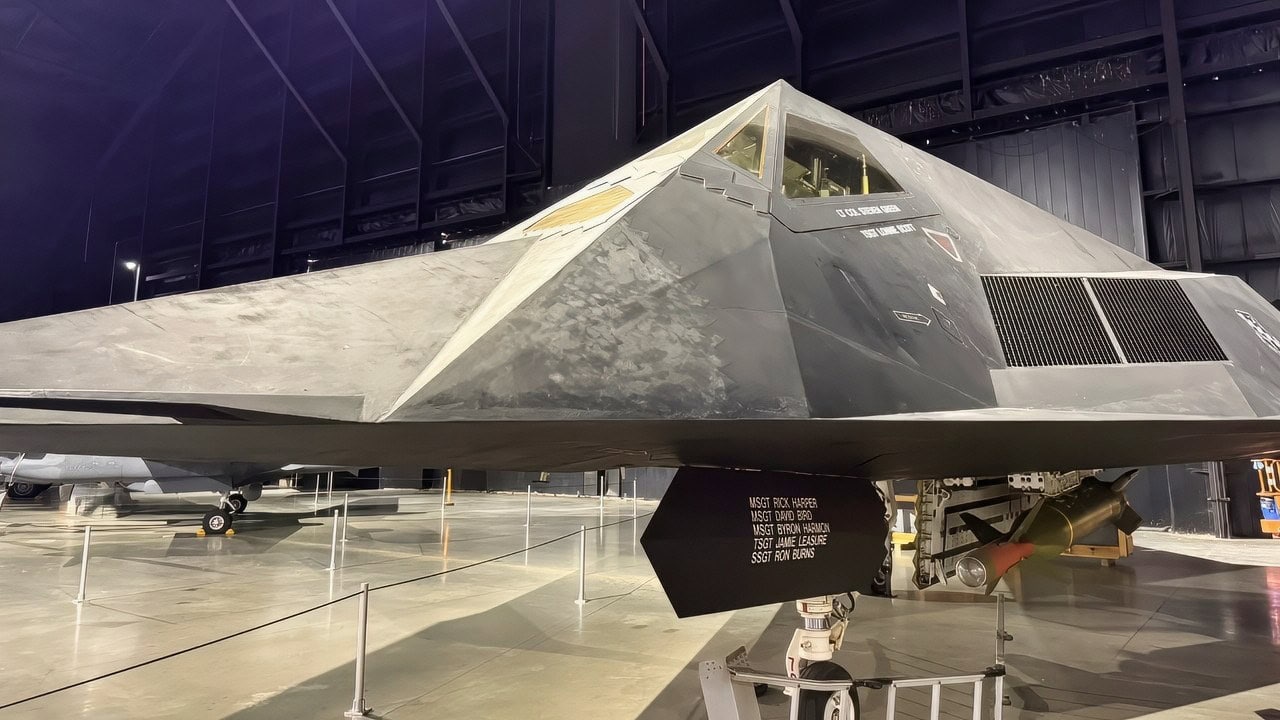
F-117A Nighthawk at USAF Museum. Image taken by 19FortyFive Owner, Harry J. Kazianis.
Engineers and operators know precisely how it should appear to sensors, which makes it ideal for testing new radar systems, infrared tracking technologies, and detection algorithms. Flying an actual low‑observable aircraft against experimental sensors yields valuable information and accounts for conditions that digital models cannot fully replicate.
Equally important is the role the F‑117 plays in training. Since the Air Force does not have any J-20s or Su-57s, the Nighthawk serves as a low-observable adversary for pilots to train against.
By flying the Nighthawk as an aggressor squadron during major exercises, the Air Force gives pilots and air defense crews exposure to a real stealth aircraft behaving unpredictably in a three‑dimensional space.
While the F‑117 does not perfectly simulate modern Chinese or Russian stealth fighters, it helps refine the skills necessary to detect and combat enemy stealth aircraft in real-world conditions.
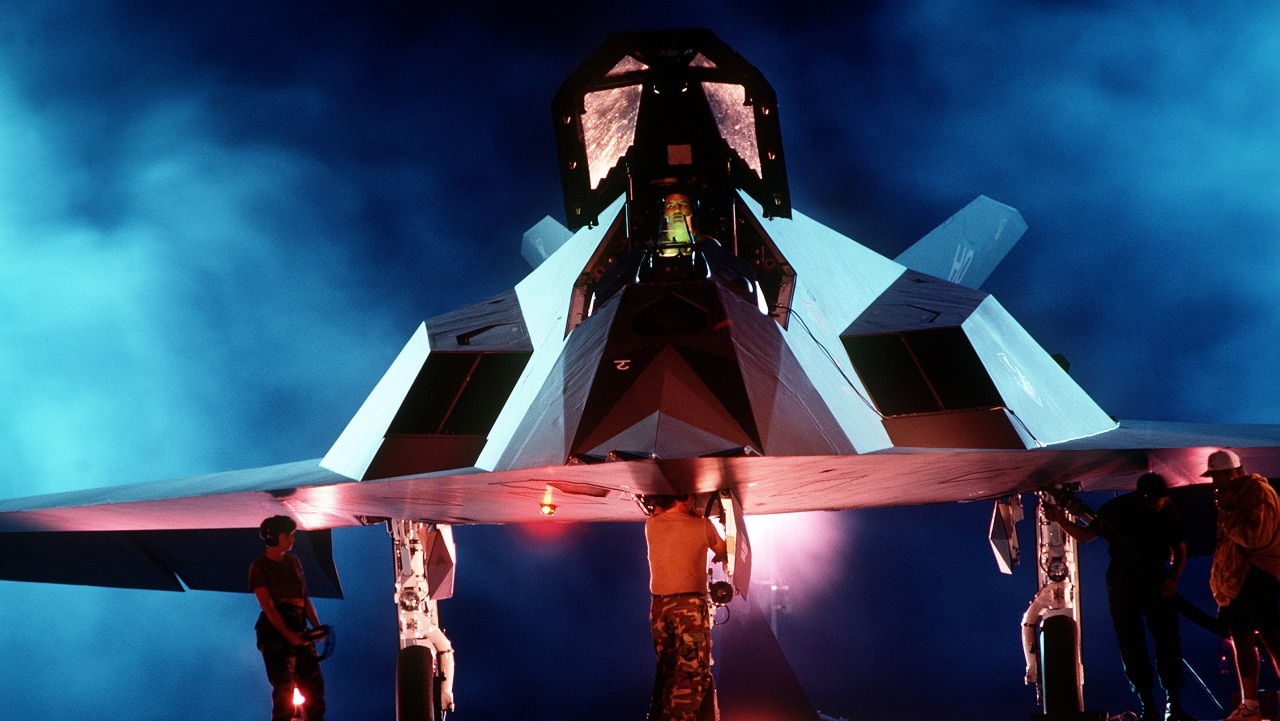
A back lit front view of a F-117A Stealth Fighter aircraft. From Airman Magazine’s February 1995 issue article “Streamlining Acquisition 101”.
A Head of Its Time: Preserving the Knowledge of the F-117
Despite being designed and manufactured during the Cold War, the F-117 was ahead of its time, and keeping the aircraft operational helps to preserve institutional knowledge about stealth aircraft. Low observability depends not only on design but on maintenance, materials, and operational discipline.
Radar‑absorbent coatings, edge alignment, and signature control procedures require specialized skills that can fade if not practiced. Maintaining a small fleet of Nighthawks allows the Air Force to train engineers and maintainers in these processes, ensuring that expertise is carried forward to newer platforms.
Keeping the F-117 for training is also more cost-effective than using F-35s or F-22s in the long run. Because the aircraft are already paid for and no longer needed for combat, they can be flown aggressively in test and training roles without jeopardizing frontline readiness.
Using an older stealth aircraft for sensor development or adversary simulation avoids consuming flight hours on extraordinarily expensive and operationally in‑demand assets like the F‑35.
Development of the Nighthawk
The F-117 Nighthawk was developed in response to the growing sophistication of Soviet air defenses. By the late 1960s and early 1970s, it was increasingly clear that traditional approaches to penetrating enemy airspace were yielding diminishing results.
As a result, the U.S. Air Force and DARPA explored a radically different approach.
They experimented with geometrical shaping so that radar energy would scatter away from the emitter rather than reflect back. Lockheed’s Skunk Works, drawing on radar theory developed decades earlier by Soviet physicist Pyotr Ufimtsev, discovered that radar reflectivity could be predicted mathematically and controlled through geometry. From this insight emerged the faceted, angular configuration that would define the Nighthawk.
The resulting aircraft was unlike anything that had flown before. Its sharp edges and flat panels were dictated almost entirely by radar physics rather than aerodynamic efficiency.
This made the F‑117 inherently unstable, incapable of sustained flight without constant computer correction. The solution was an early and sophisticated fly‑by‑wire system that continuously adjusted control surfaces to keep the aircraft controllable.
Because of the technology at the time, the Nighthawk had to make deliberate sacrifices in other areas as well. It was subsonic, relatively short‑ranged by fighter standards, and entirely dependent on night operations and precision guidance rather than speed or maneuverability.
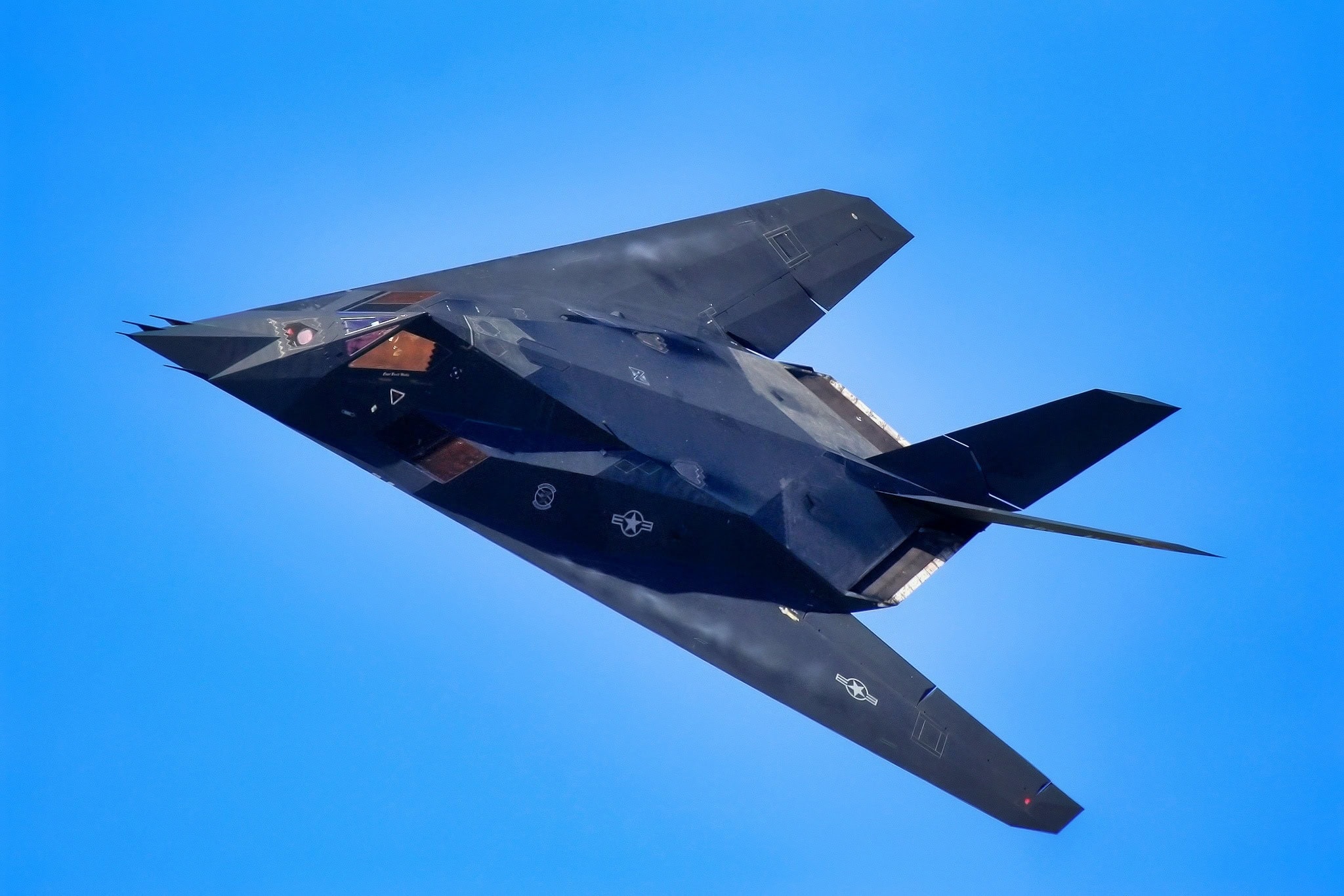
F-117. Image Credit: Creative Commons.
Why the F-117 Was Originally Retired
For some unknown reason, the Nighthawk was designated “F-117.” The F designation is typically reserved for fighters, but the F-117 is not a fighter in the traditional sense. It carried no air‑to‑air weapons and had no onboard radar.
Its mission was to deliver precision strikes against heavily defended, high‑value targets. To preserve stealth, all weapons were carried internally, typically laser‑guided bombs delivered with extreme accuracy.
This narrow specialization was necessary to allow the aircraft to fulfill its true mission: to penetrate air defenses rather than contesting air superiority.
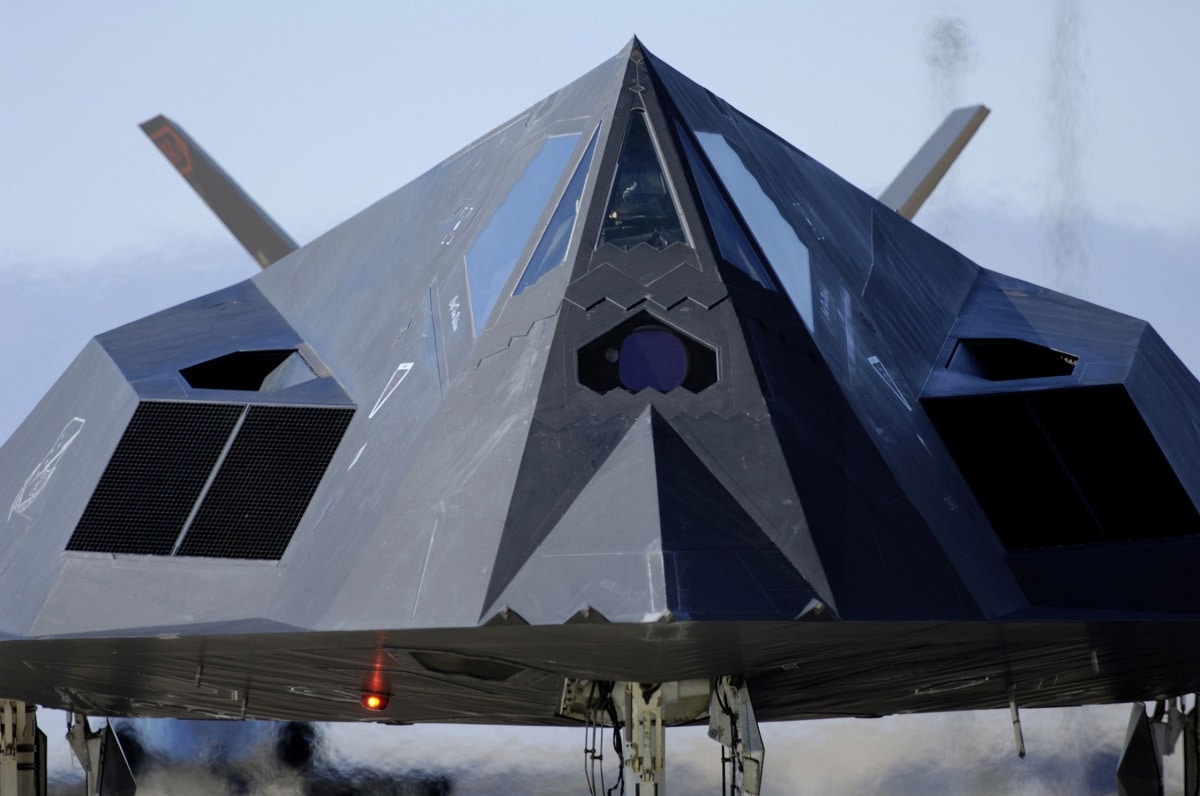
F-117 Stealth Fighter.
By the early 2000s, the strategic environment and technological landscape had changed. Newer stealth platforms such as the F‑22 and F‑35 offered vastly broader capabilities, combining low observability with air‑to‑air combat, advanced sensors, and networked warfare. Compared to these multirole aircraft, the F‑117 was somewhat redundant.
As a result, the U.S. Air Force formally retired the type in 2008, placing most of the fleet into storage at the remote Tonopah Test Range in Nevada and transferring a small number to museums. This marked its first official retirement, though plans were already underway to return the aircraft to limited service.
About the Author: Isaac Seitz
Isaac Seitz, a Defense Columnist, graduated from Patrick Henry College’s Strategic Intelligence and National Security program. He has also studied Russian at Middlebury Language Schools and has worked as an intelligence Analyst in the private sector.