
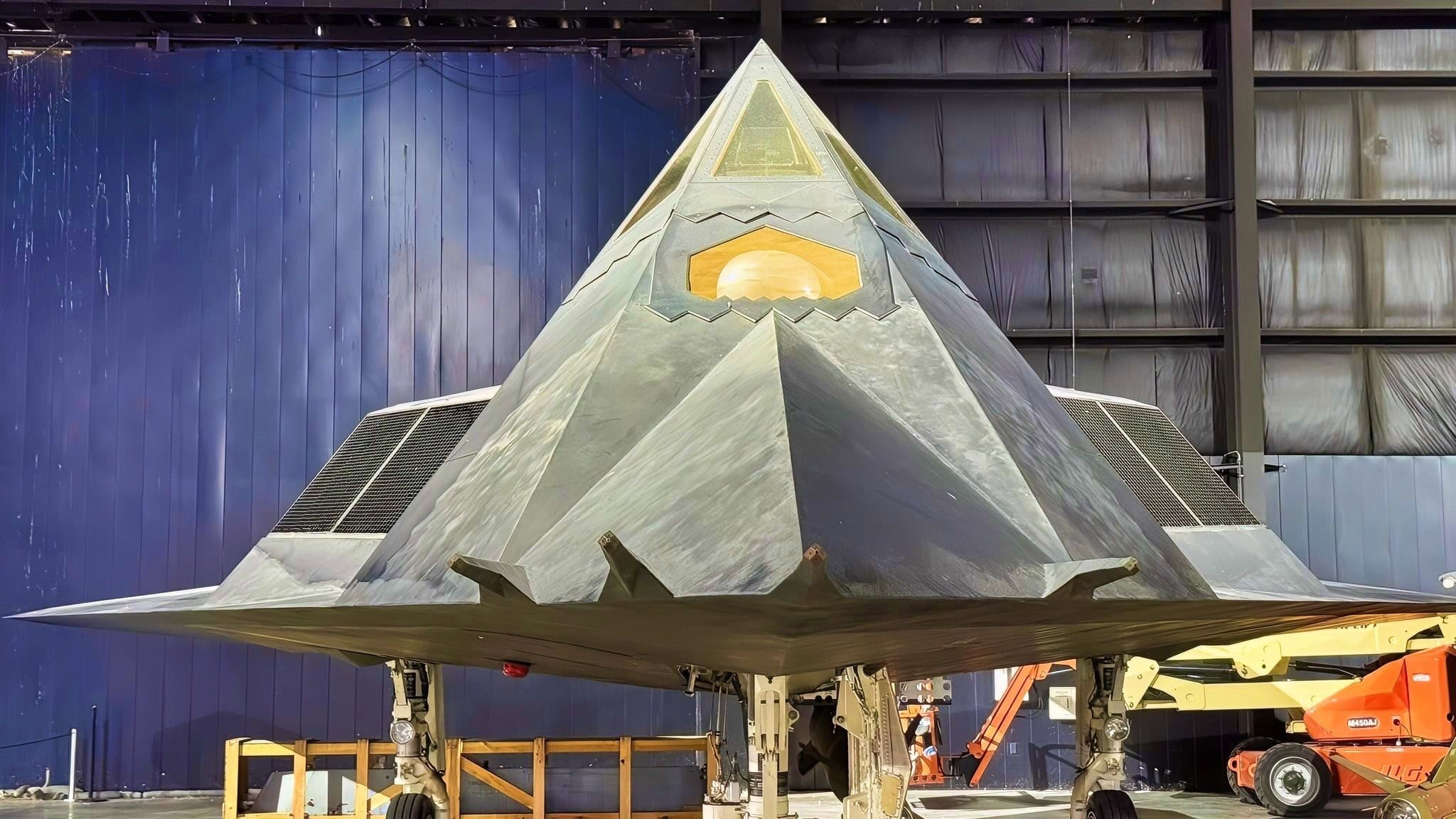
The F-117 Nighthawk was the first stealth aircraft produced by the United States.
Although development began in the 1970s, the Nighthawk was a foray into stealth technology and paved the way for the eventual F-22 and F-35 fifth-generation stealth fighters.
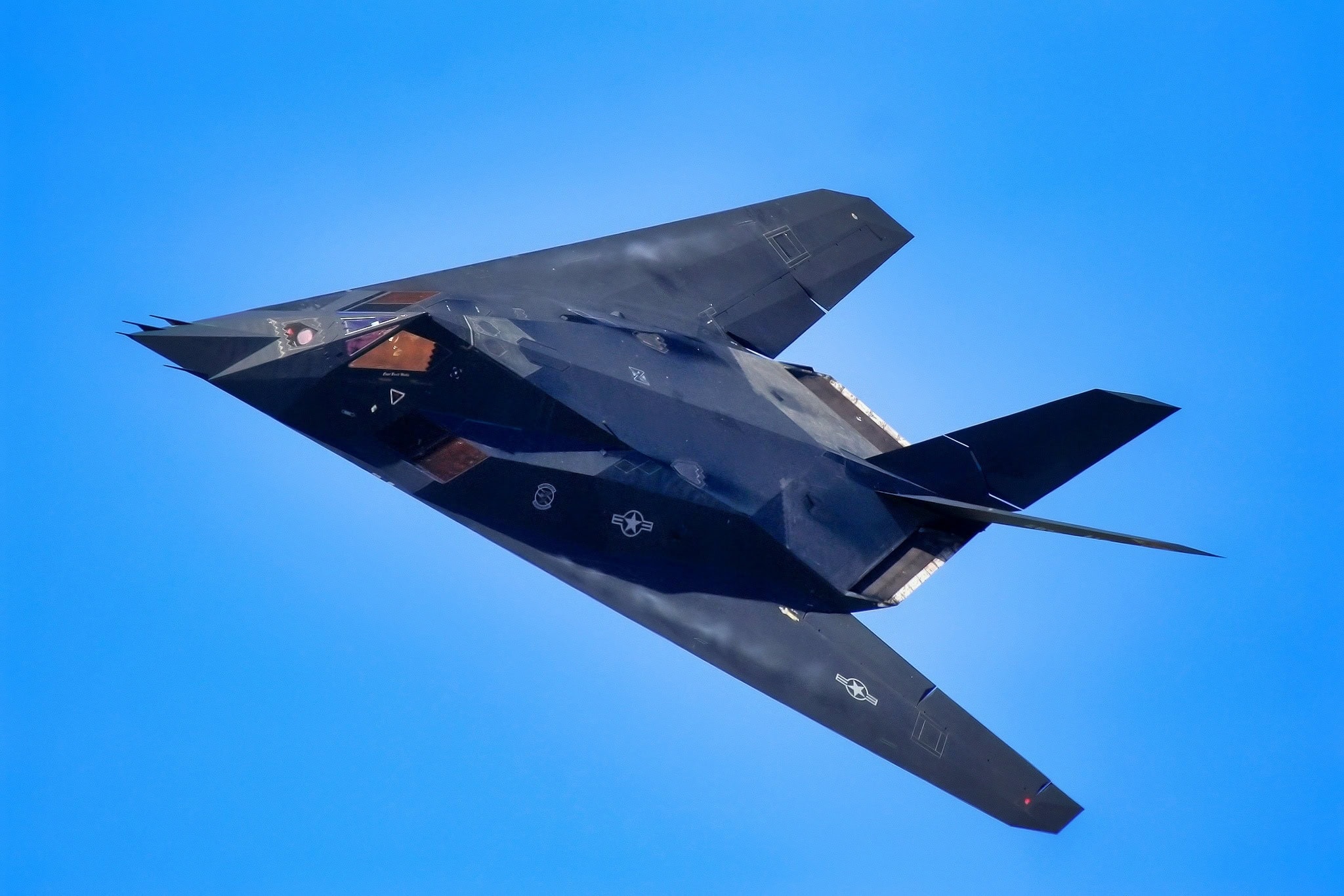
F-117. Image Credit: Creative Commons.
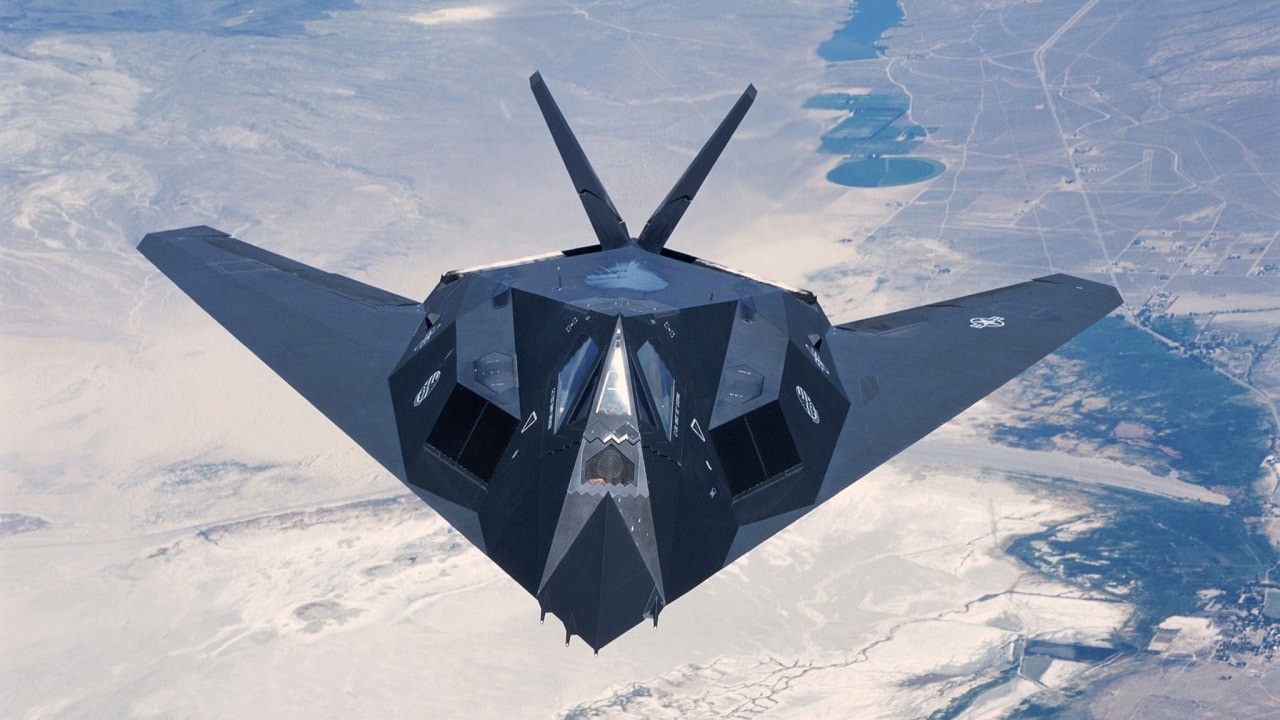
F-117. Image Credit: Creative Commons
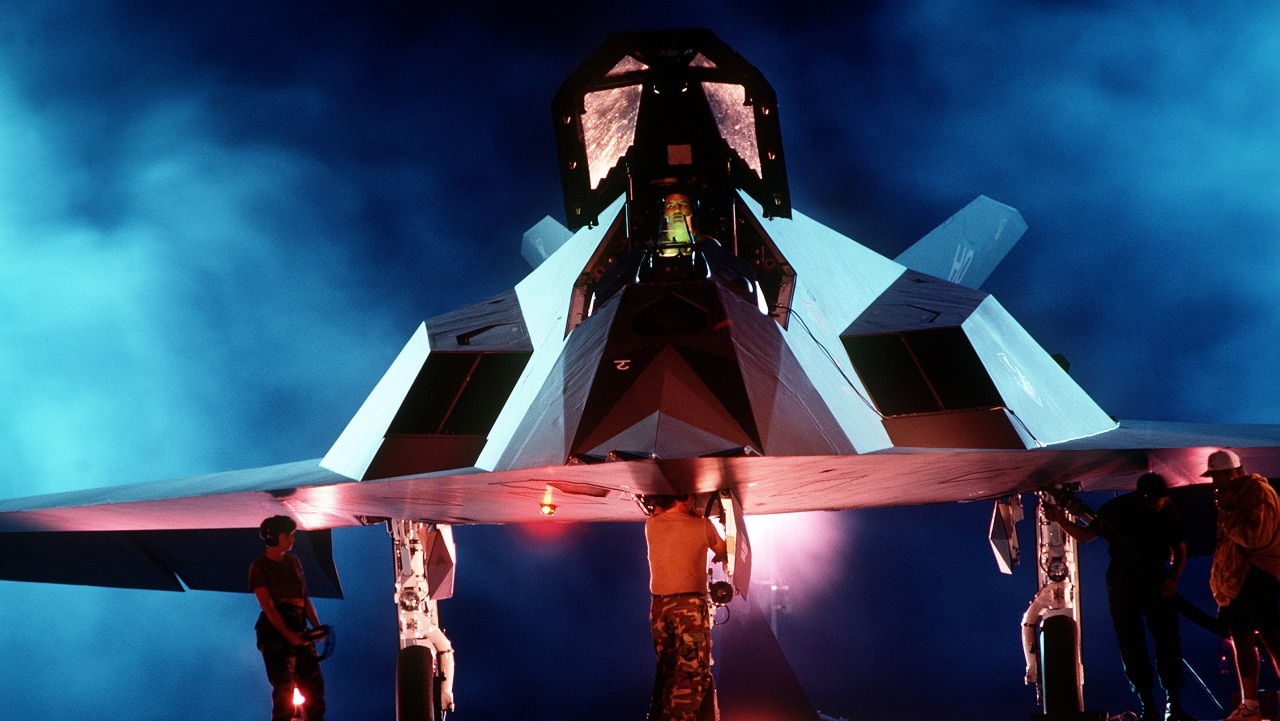
A back lit front view of a F-117A Stealth Fighter aircraft. From Airman Magazine’s February 1995 issue article “Streamlining Acquisition 101”.
Even today, most nations are incapable of replicating the insane engineering behind the F-117.
During its time in service, the F-117 flew with the U.S. Air Force. For a brief period, however, the Navy considered acquiring a navalized version of the Nighthawk, dubbed the F-117N Seahawk, for its carrier fleet.
The idea was a plane that would have cost $70 million per airframe, with a production run of around 255 total, for a total program cost of over $17 billion.
This would have required a near-complete redesign of the aircraft, which Lockheed was more than willing to provide. The Department of Defense ultimately rejected the proposal.
F-117s For the Navy?
In 1984, the Navy tested the F-117 to evaluate its suitability for carrier operations, but ultimately deemed it unfit. Previously, the Navy sought out a high-end, low-observable, long-range aircraft under the recently canceled A/F-X program.
Unsatisfied with the results, Lockheed Martin proposed navalizing the F-117 for carrier operations.
The proposed F-117N, dubbed the “Seahawk,” differed significantly from the base Nighthawk.
The aircraft used a bubble canopy, a more angular cockpit, and a less sharply swept wing/tail configuration.
The original GE F404 engines would have been replaced with GE 414 engines, and the aircraft could have accommodated external hardpoints, allowing it to carry 8,000 additional lbs of munitions.
While Lockheed Martin and a few aviation enthusiasts never produced the F-117N, they created a couple of illustrations to show what the Seahawk could have looked like.
Beauty is in the eye of the beholder, so I encourage readers to take a look and judge for themselves how the aircraft looks aesthetically.
Unfortunately for Lockheed Martin, the DoD was completely uninterested in a navalized version of the F-117. For starters, the Navy wanted a multi-role aircraft, and the Seahawk wasn’t versatile enough.
Additionally, the DoD feared that developing a naval F-117 would be too expensive and would divert funding from other projects, such as the Joint Advanced Strike Technology program (which later evolved into the Joint Strike Fighter Program).
Lockheed Tries Again
After the initial rebuff, Lockheed was shaken, but undeterred.
If the U.S. Navy wanted a multi-mission aircraft, it would get one.
The company later returned to the Navy with an updated proposal, this time with greater emphasis placed on multi-role capabilities.
The aircraft was also designed with afterburning capabilities to improve its speed and versatility.
To boost interest even further, Lockheed even made a ground version of the F-117N, dubbed the F-117B.
The F-117B was proposed not only to the U.S. Air Force, but also to the British Royal Air Force.
From 1986 to 1987, the RAF evaluated the aircraft and even performed several test flights on a base F-117, but ultimately decided against it.
Neither the Seahawk nor the F-117B received any formal orders and were thus scrapped.
With the Seahawk written off, the Navy would have to wait before it would get its hands on a navalized stealth aircraft.
It had originally pursued a navalized version of the F-22 Raptor under the Navy Advanced Tactical Fighter program (NATF), but as the Cold War drew to a close, the defense budget slowly shrank, and the NATF program was canceled.
It was not until 2019 that the carrier-capable F-35C finally entered service with the Navy.
From the beginning, the Joint Strike Fighter program was designed to provide a much-needed carrier-capable stealth fighter. Although the program faced its own controversies, the wait for a naval stealth fighter was finally over.
The First Stealth Aircraft
Although the F-117 never flew with the Navy, the Nighthawk still had a rich operational history.
The aircraft began as a top-secret black project. Under the “Have Blue” project, designers at Lockheed Martin’s Skunk Works designed a plane that incorporated brand-new stealth techniques (ironically, they were inspired by the work of Soviet scientist Pyotr Ufmitsev).
A couple of demonstrator aircraft were cobbled together from parts of other aircraft and new fly-by-wire systems that allowed the aerodynamically unstable aircraft to stay in the air using computerized flight-control systems.

F-117 Nighthawk at National Museum of Air Force 19FortyFive Photo
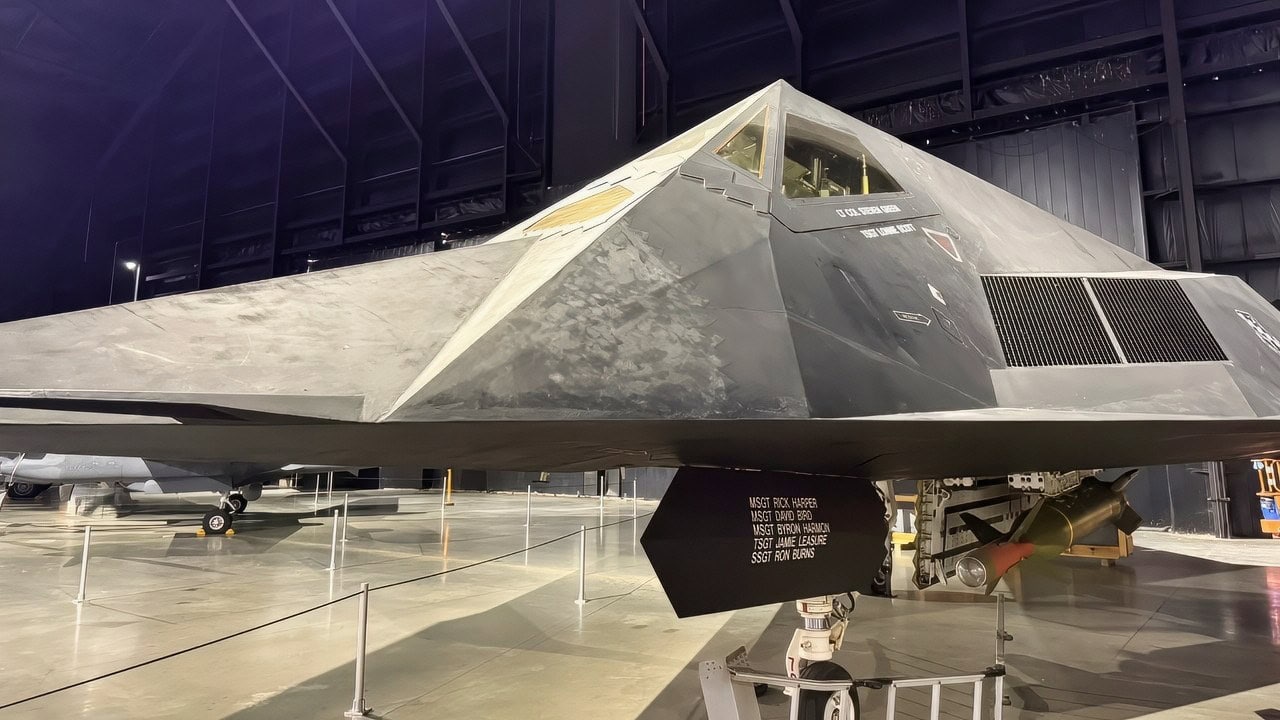
F-117A Nighthawk at USAF Museum. Image taken by 19FortyFive Owner, Harry J. Kazianis.
Although a few demonstrator aircraft crashed during testing, the flight data was invaluable, and development continued under the project codename “Senior Trend.”
The aircraft officially entered service in 1983, and the USAF did not officially confirm it until 1988.
The Nighthawk saw extensive use during the Gulf War, where it was able to successfully penetrate Iraqi air defenses and perform bombing raids.
According to some claims, F-117s flew 1,300 sorties during the war and recorded over 6,900 flight hours.
In 1999, the F-117 was used against Yugoslavia during the Kosovo War, during which a Nighthawk was shot down for the first and last time.
The program officially closed in 2006, although the USAF retained a small number of F-117s for testing and training.
About the Author: Isaac Seitz
Isaac Seitz, a Defense Columnist, graduated from Patrick Henry College’s Strategic Intelligence and National Security program. He has also studied Russian at Middlebury Language Schools and has worked as an intelligence Analyst in the private sector.