
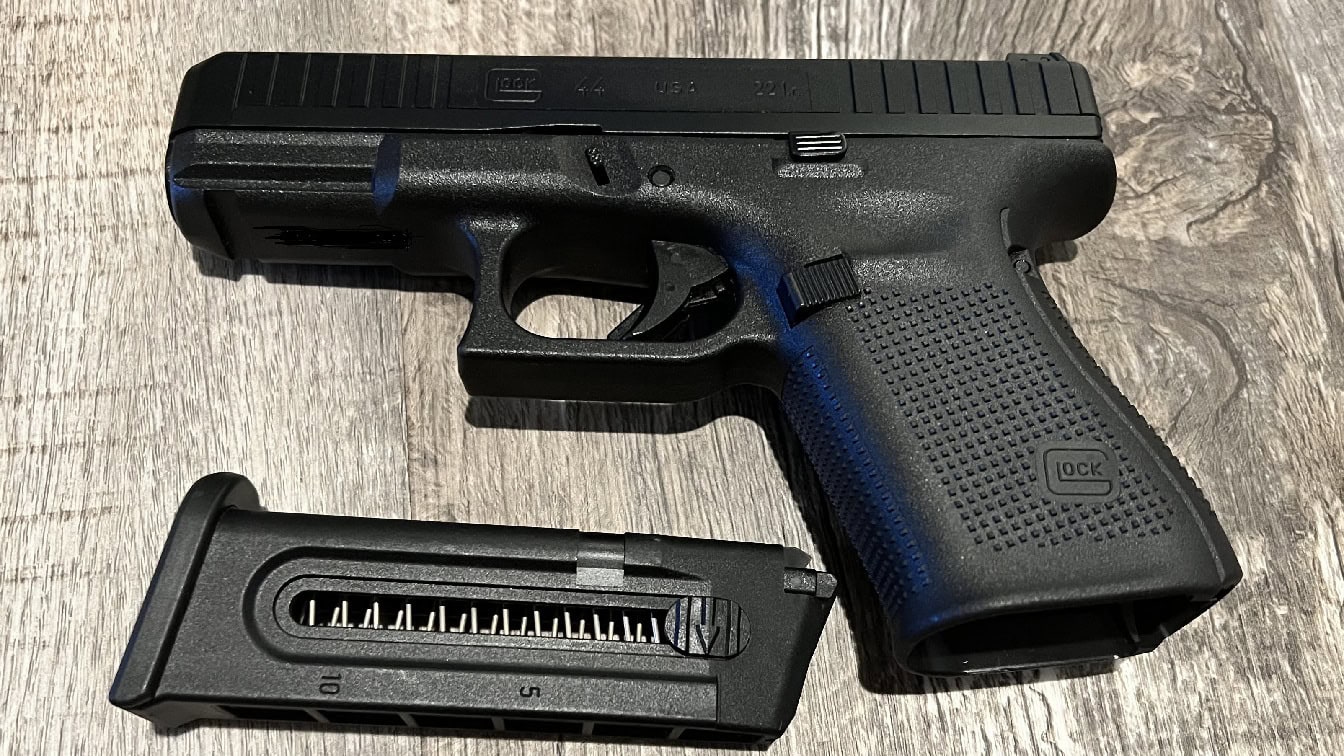
Some pistols are built for the holster. The Glock 44 is built for the range. Its job is to make you a better shooter with the Glock you already carry. Glock put off making a rimfire pistol for decades. When it was finally unveiled in January 2020, the G44 had an MSRP of $430 and looked almost identical to the Glock 19.
That was deliberate, and a brilliant idea. The G44 is a .22 LR trainer in the frame of America’s most popular carry pistol. Six years later, it’s still one of the most useful handguns Glock sells, provided you understand what it is.
What You’re Getting With The Current Glock 44
The current model is the G44 V, which was part of the V Series lineup Glock announced in October 2025 when it retired most of its Gen 4 and Gen 5 models.
The specifications are familiar.
It has a 4.02-inch barrel, a 7.28-inch overall length, and a 1.26-inch width.
The trigger pull is listed at about 5.8 pounds, and the gun comes with adjustable rear sights and interchangeable backstraps.
The weight is what sets it apart. Glock lists the G44 at 12.63 ounces without a magazine and 16.40 ounces fully loaded.
The trick is the hybrid slide: a steel frame wrapped in polymer.
A .22 LR doesn’t have enough energy to cycle a heavy, all-steel slide, so Glock had to lighten the slide.
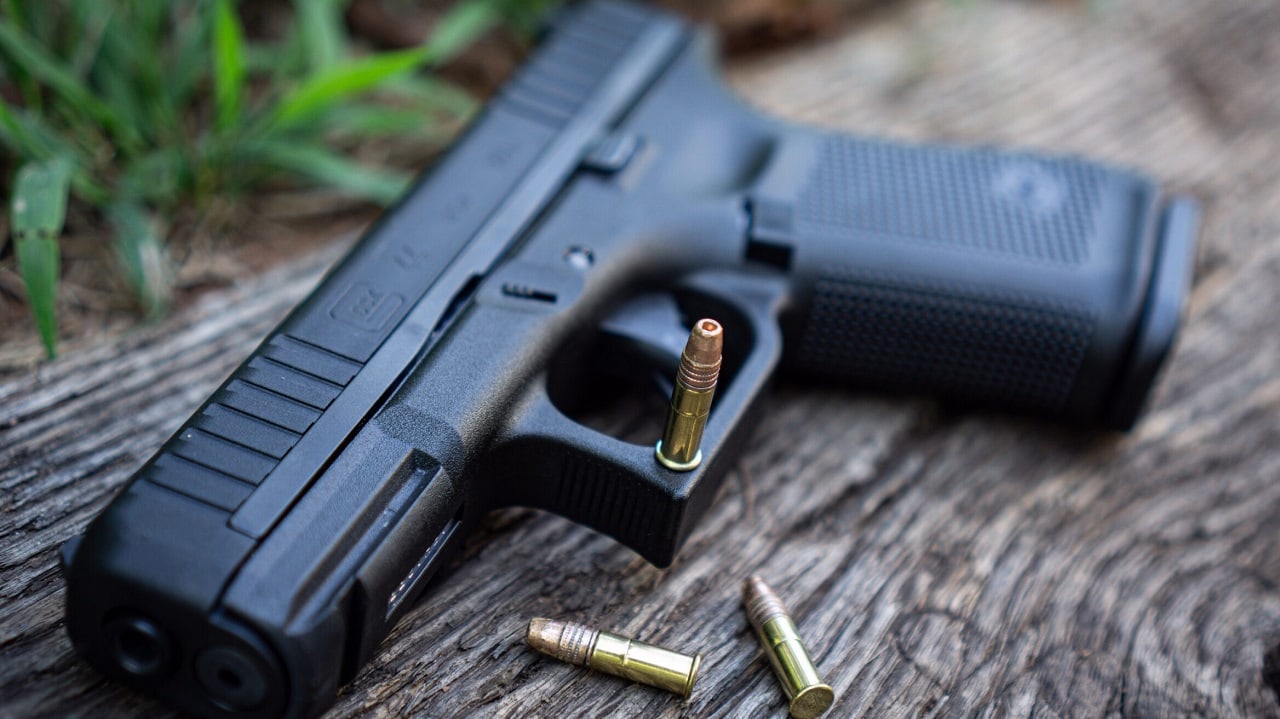
Glock 44 .22LR. Image Credit: Creative Commons.

Glock G44. Image Credit: Creative Commons.
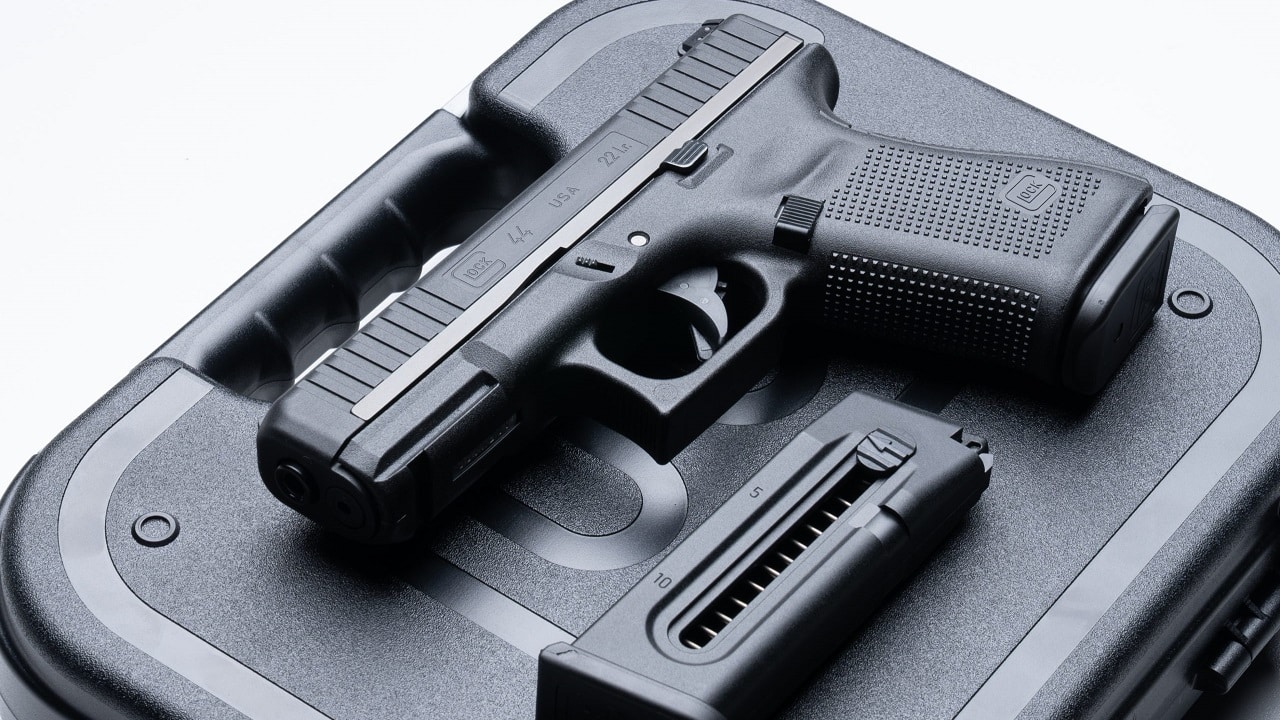
Glock 44. Image Credit: Creative Commons.
The Case For The G44
Cost is the biggest selling point. A .22 LR costs a fraction of what 9mm does, and a trainer only works if you shoot it.
You can run a few hundred rounds of drills in an afternoon without draining your wallet.
That lets you work on grip, trigger control, sight picture, and draws with a gun that feels and handles like your G19.
It also fits most holsters built for the G19, according to Pew Pew Tactical’s testing, so you can practice from the same rig you carry.
The controls sit in the same places. What you learn with the G44 carries over directly.
For new shooters, it may be the best introduction to a striker-fired pistol on the market.
There’s almost no recoil and much less noise compared to a centerfire. Nobody develops a flinch in the first ten minutes.
In my opinion, that alone makes it worth the money for anyone teaching a spouse, a kid, or a first-time buyer.
It’s also a perfect handgun to go plinking all afternoon with a family member.
It’s also accurate.
Pew Pew Tactical reported consistent hits at distances over 100 yards, which is impressive for a pistol of this size.
Capacity used to be a common complaint.
For years, the G44 shipped with 10-round magazines, and people wondered why a G19-sized gun held five fewer rounds.
Glock fixed that at the 2026 NRA Annual Meeting, announcing a factory 15-round polymer magazine for the G44 that started shipping in May.
Glock now lists 15 rounds as standard capacity.
The Ammo Sensitivity Is The Honest Trade-Off
However, rimfire is rimfire, and the G44 doesn’t change that. Glock’s launch materials said the pistol ran “to near perfection” with a range of ammunition.
Owners and reviewers have been less sure. Pew Pew Tactical said the gun “ran flawlessly” with CCI Mini-Mag and Blazer.
However, cheaper bulk loads and older ammo caused stovepipes, misfeeds, and failures to lock back.
Carbon buildup on the feed ramp led to more stoppages after long-range sessions.
That’s the pattern with most .22 semi-autos.
The G44 simply punishes cheap ammo more than people expect from a Glock.
Feed it high-velocity, quality rounds and clean it more often than your 9mm. Think of that as part of the price.
The Weight Cuts Both Ways
Being light makes the G44 pleasant to shoot.
It also makes it a less-than-perfect copy of the G19.
A loaded G19 weighs about twice as much.
The balance is different, and the recoil is much lighter.
You can build good habits with it.
However, you can’t learn recoil management with a gun that barely moves.
The G44 supplements centerfire practice, not a replacement.
Factory optics are another gap. Glock’s specifications don’t list a MOS cut for the G44 V.
If your carry gun has a red dot, you lose some of the one-to-one training benefit that makes the G44 attractive in the first place.
What About Self-Defense?
This question comes up every time, so let’s get it out of the way.
Can you use a G44 for self-defense?
Yes, the same way you can use any gun.
Should it be your first choice?
No. Relying on a .22 for a primary self-defense weapon is …taking an unnecessary risk.
The .22 LR doesn’t penetrate reliably, and rimfire ignition isn’t as dependable as centerfire.
That’s a bad combination when your life is on the line.
I’d take a 9mm every time. And the G44 is meant to make you better with that 9mm.
So Who Should Buy One?
If you carry a G19 or a G17 and want to shoot more often for less money, the G44 is an easy call.
If you’re bringing someone new into the sport, it’s even easier.
Everything about the G44 works the same as its big-brother Glocks.
However, if you’re looking for a cheap plinker and don’t care about the Glock family of weapons, there are less expensive .22 pistols that do the job just as well.
Say what you want about Glock taking 40 years to make a .22.
That’s beside the point.
The G44 isn’t trying to replace your carry gun.
It’s trying to make you better with it, especially if it is a Glock.
And it does that job well.
About the Author: Steve Balestrieri
Steve Balestrieri is a 19FortyFive National Security Columnist. He served as a US Army Special Forces NCO and Warrant Officer. In addition to writing for 19FortyFive, he covers the NFL for PatsFans.com and is a member of the Pro Football Writers of America (PFWA). His work was regularly featured in many military publications