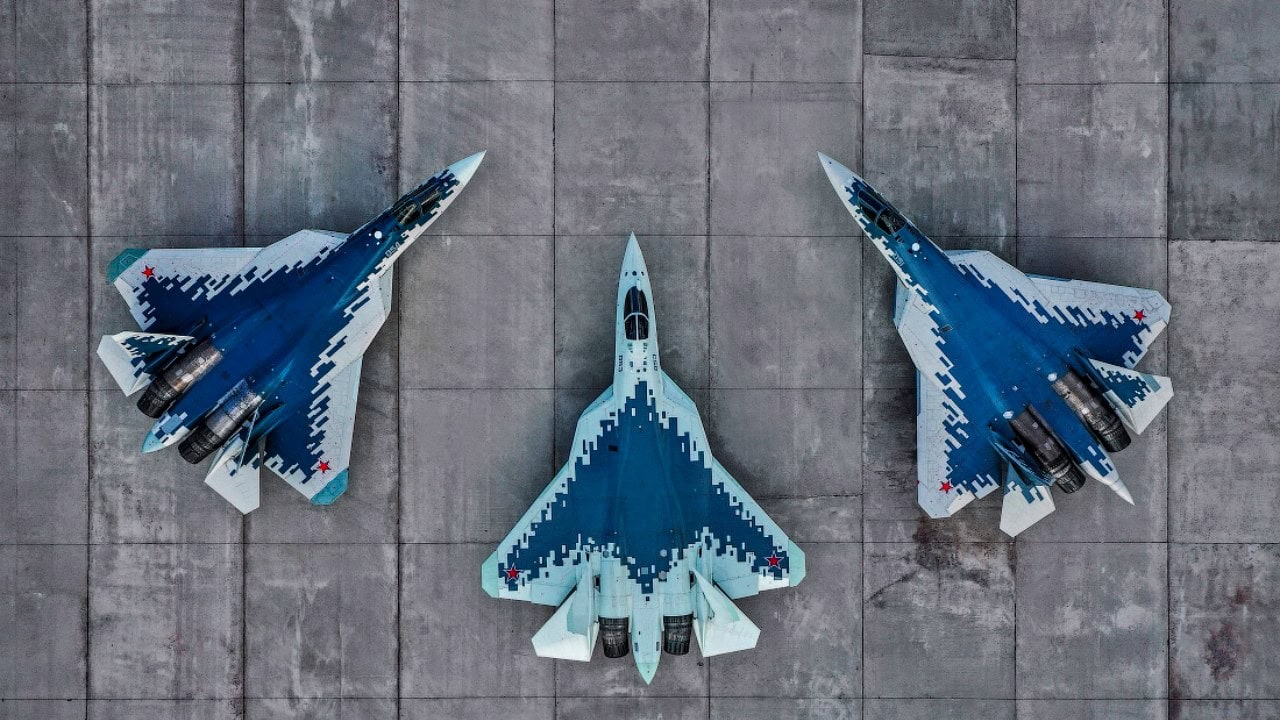
Aviation Geek Club, a well-regarded online trade publication, ran a story critical of Russia’s alleged fifth-generation warplane, the Su-57 “Felon.”
In that story, former United States Air Force avionics technician Damien Leimbach argued that the Su-57 would have been a revolutionary plane…in 1985.
Today, according to the former Air Force avionics technician, the Su-57 is much less impressive. But is that the case?
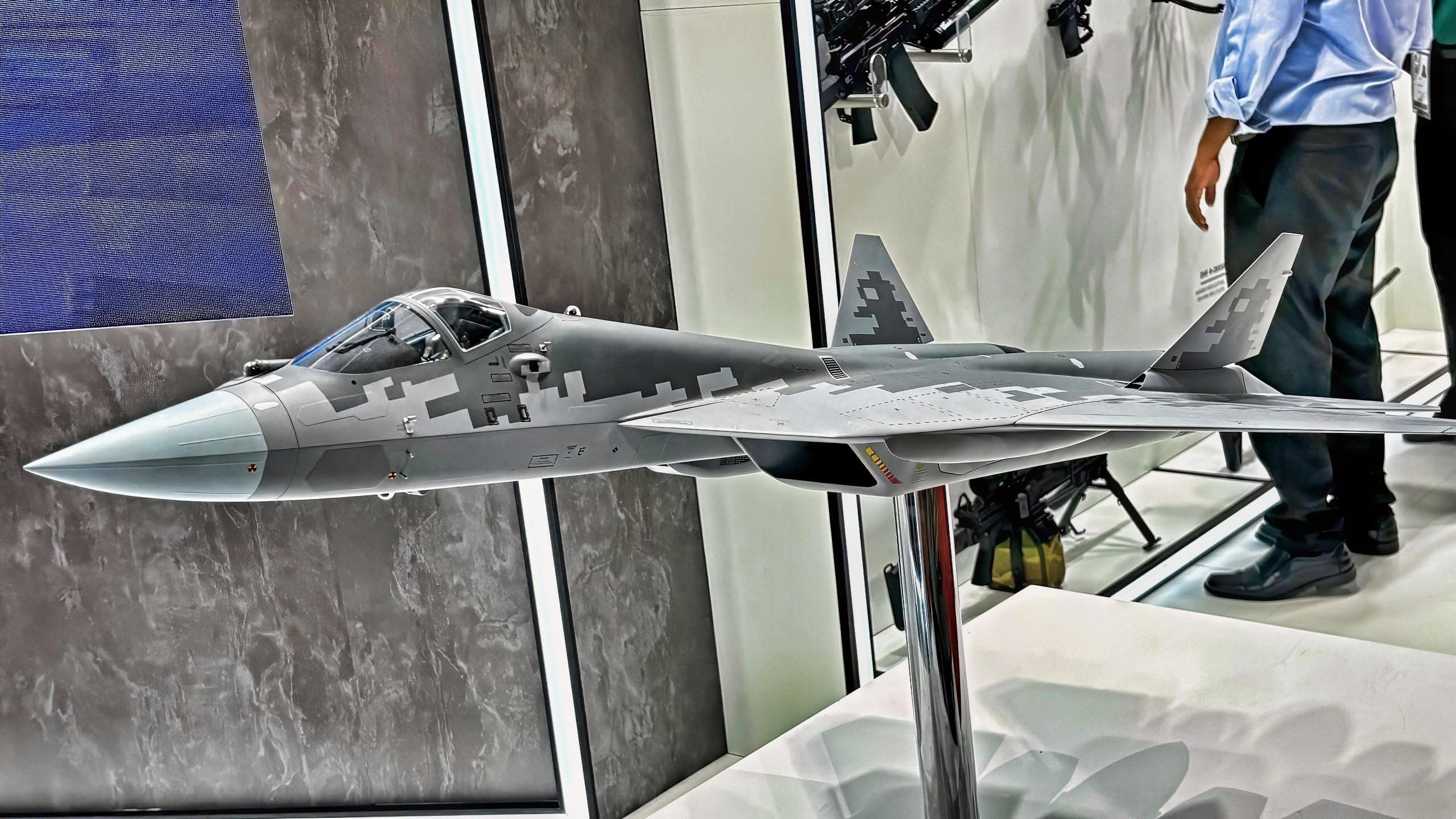
Model Su-57 Felon Fighter. Image taken by Reuben F. Johnson for 19FortyFive.com on 4/20/2026.
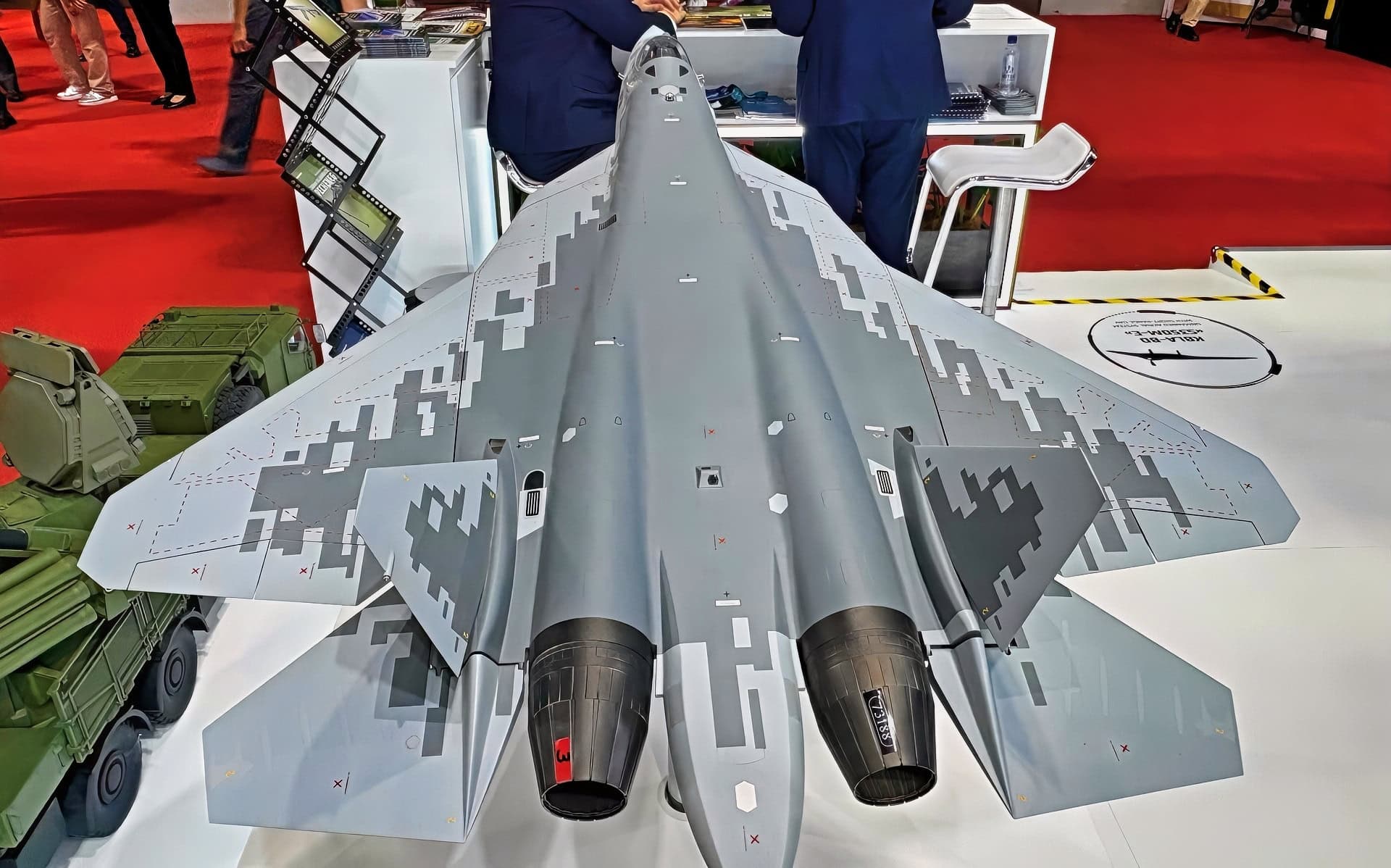
Su-57 Felon Model Aircraft. Image taken on 4/20/2026 by Reuben F. Johnson.
Missing the Mark on the Su-57
Many American avionics specialists say the Su-57 does not hold a candle to either fifth-generation stealth warplane, the F-22 Raptor or the F-35 Lightning II.
Some believe the Su-57 is no better than the fifth-generation warplanes China is producing, such as the Chengdu J-20 “Mighty Dragon” and the Shenyang J-35.
But this misses the point. In fact, the Su-57 seems built not to go to war with the F-22 or F-35.
If the Ukraine War has demonstrated anything, it is that Russian technology doesn’t have to be more exquisite than the sophisticated platforms of their NATO rivals.
Russian military gear, technology, and tactics have to be good enough–and have greater durability–than the more sophisticated (and fewer) NATO systems they are facing in combat.
And the Russians have passed that test repeatedly.
Indeed, this is a common story throughout Russia’s wartime history.
The Soviets didn’t necessarily have superior technology over the Germans in the Second World War.
They had mass and simpler technology that made it easier to advance, replace systems, and maintain them in the throes of combat. The same is true of modern Russian technology.
Consider this: the Russian defense industrial base can produce in three months what the entire NATO defense industrial base takes a year to produce.
Russia’s Su-57 emerged from Russia’s PAK FA program, launched in 1999 to develop a successor to the legendary Soviet-era MiG-29 and Su-27 fourth-generation warplanes.
The Su-57 first flew in 2010 and entered Russian Air Force service in 2020. Unlike the single-engine F-35, the Su-57 employs two Saturn AL-41F1 afterburning turbofan engines.
The Su-57 also possesses thrust-vectoring technology, internal weapons bays for enhanced stealth, advanced radar systems, and an overall stealth-friendly design.
According to its specs, the Su-57 Felon has a maximum speed of around Mach 2 and a service ceiling nearing 66,000 feet.
It also possesses a maximum takeoff weight of around 77,000 pounds.
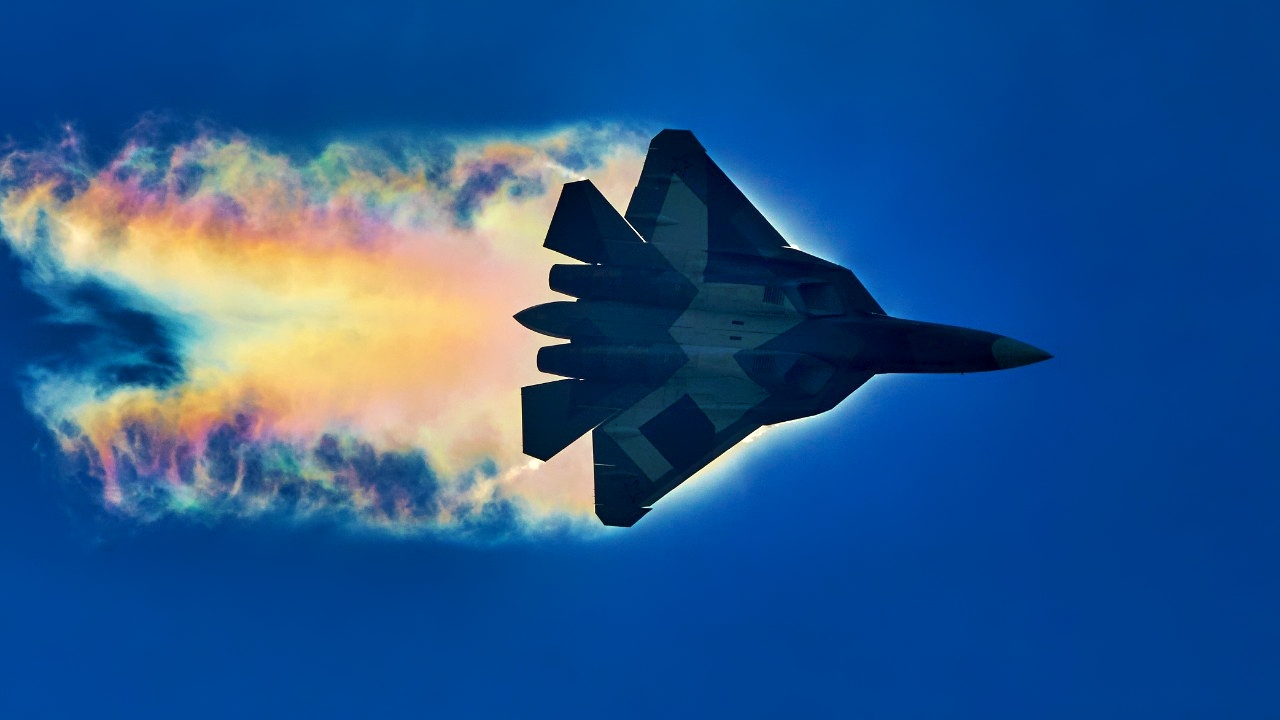
Russia’s Su-57 Felon Fighter

Su-57 Felon Fighter from Russian Air Force.

Su-57 and Su-75 Checkmate Russian Air Force.
Its weapons include a 30mm cannon, air-to-air missiles, and precision-guided air-to-ground munitions.
To be clear, the Su-57’s stealth capabilities fall short of the comparable US systems.
In fact, the biggest criticisms of the Su-57, including those from people like Damien Leimbach, focus on the aircraft’s radar cross-section.
Critics highlight that the Su-57 retains far too many design characteristics associated with the older Su-27 family.
Its engine arrangement, exposed rear components, and overall configuration make it harder to achieve extremely low observability.
The F-22 and F-35 have better stealth features than does the Su-57 Felon.
One of the biggest problems is the Su-57’s exposed engine nozzles.
By comparison, the F-22 uses rectangular thrust-vectoring nozzles (to reduce its infrared and radar signatures). The Su-57 uses conventional round nozzles.
Still, Western critics are wrong to dismiss this plane as just an augmented Su-35. It’s not.
Precise radar cross-section figures for these aircraft remain classified or otherwise unverified publicly.
Unbiased observers should treat claims that one fighter is definitively detectable at a specific distance with caution.
If it were such a bad plane, multiple nations wouldn’t have shown interest in procuring it over more advanced (albeit expensive) US and Western alternatives.
A Significant System for Russia
One such system the Su-57 has at its disposal is the advanced N036 Byelka radar system, which employs multiple active electronically scanned array antennas, including side-facing arrays intended to improve coverage beyond the aircraft’s forward sector.
The fighter features sophisticated infrared search-and-track technology along with an advanced electronic warfare (EW) suite designed to identify, track, and disrupt enemy aircraft and missiles.
There’s also the prospect that the Russians incorporated the advanced R-37M family of long-range air-to-air missiles into the Su-57.
The R-37M has a maximum range exceeding 300 kilometers (in favorable conditions).
So, the Su-57 is better primed than its critics give it credit for in beyond-visual-range (BVR) warfare.
As the war in Ukraine has shown with other systems, BVR will remain the primary advantage most platforms prioritize going forward, even over stealth if necessary.
Plus, the Su-57 fits in well with Russia’s overall strategic doctrine.
It is not necessarily designed to defeat an American F-22 or F-35 in a dogfight.
Instead, the Su-57 is meant to threaten the support systems that enable American air operations.
Attacking American (or NATO) airborne tankers and early-warning aircraft remains a likely wartime scenario. The Su-57 seems well suited to that task.
By the way, both China and Iran are preparing for that very circumstance in conflict with the Americans, where the key is to destroy key enablers of US air operations rather than the aerial combatants, which can defend themselves.
The Su-57 Felon Is No Joke
Another thing the Americans fixate on is that more than 1,300 F-35s have been produced, whereas there are nowhere near that many Su-57s.
But the F-35s have been in service for years. The Su-57s just went operational in 2020.
What’s more, the War in Ukraine has redirected Russia’s production focus to more expendable systems (like the Su-35) that are cheaper and easier to produce en masse than the Su-57.
That doesn’t mean that the Su-57 should just be written off as a throwback to the 1980s.
These capabilities are significant, and they fit well within Russia’s strategic air warfare doctrine.
The Su-57 does not have to build an F-22 or an F-35.
It just needs systems that fit within the overarching military ecosystem and strategic doctrine it already possesses.
About the Author: Brandon J. Weichert
Brandon J. Weichert is the Senior National Security Editor at 19FortyFive.com. He also manages The Weichert Brief on Substack. Weichert also hosts “National Security Talk” on Rumble. He is the author of four bestselling national security books, most recently A Disaster of Our Own Making: How the West Lost Ukraine (Encounter Books). Follow him via Twitter/X @WeTheBrandon.