
Summary and Key Points: Stephen Silver traces George Patton’s maxim “A pint of sweat will save a gallon of blood,” delivered to the Third Army before D-Day, 1944; one June 5 transcript says ‘ounce.’ Citing James Holland and Alex Kershaw, Silver argues Patton’s methodical operational planning, not Hollywood’s blowhard image, won Metz, the Rhine crossing and the Battle of the Bulge, where the 4th Armored Division relieved Bastogne and he alone among senior Allied generals emerged with reputation enhanced.
US Army General George Patton Made History His Way
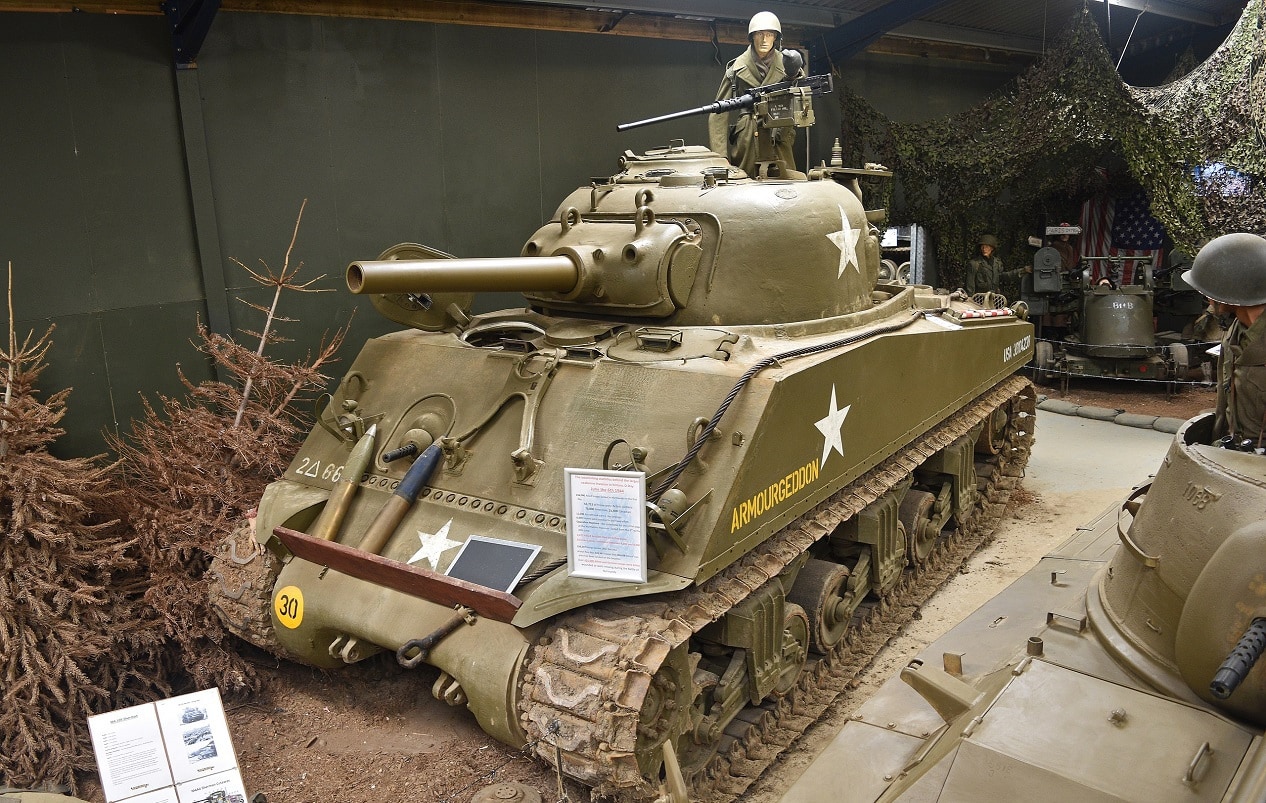
M4 Sherman Tank.

M4 Sherman Tank from WWII Image: Creative Commons.
“A pint of sweat will save a gallon of blood” was one of Gen. George Patton’s most famous quotations, reflecting the general’s relentless focus on preparation.
In a 2022 HistoryNet article titled “Rethinking How We View General Patton,” James Holland pored over Patton’s diaries to argue that the general’s “tactical genius” was made possible, at least in part, by his “operational skill,” especially during World War II.
Holland points to an example in September 1944. After the Allied armies had “ made similarly large strides through France and into Belgium,” the advance slowed.
Patton was overruled when he asked that the Third Army get priority for supplies, so he decided to “focus on preparation.”
“This was not tactical chutzpah, but methodical and painstaking operational planning,” Holland wrote. “And the subsequent capture of the northeastern French city of Metz, the help his forces provided in the Ardennes, and the later crossing of the mighty Rhine were as much to do with planning and preparation—the operational art—as with tactical dash.”
Preparing for the Battle of the Bulge
Another example of General Patton benefiting from preparedness came in the Battle of the Bulge, the crucial, epic World War II battle that lasted six weeks, from December 1944 to January 1945, claiming the lives of 19,000 Americans.
In a 2023 article for the Friends of the National World War II Memorial website, Alex Kershaw reminisced about visiting the sites of that battle and Patton’s grave.
Indeed, the battle was such a part of Patton’s legend that he asked to be buried there, at Luxembourg American Cemetery, alongside the thousands of men he lost there, when he died in late 1945.
It reminded him that Patton was smarter, and a better-prepared tactician, than popular memory sometimes suggests.
Kershaw noted that Hollywood’s 1971 movie Patton had somewhat flattened Patton’s legend.
“It turned Patton into a cliché – a foul-mouthed, impetuous blowhard,” Kershaw wrote of the movie. “Patton was very much a hot-head, impolitic, and hilariously foul-mouthed. But he was also the only senior Allied general to emerge from the Battle of the Bulge with his reputation enhanced.”
That’s because of Patton’s preparation, which saw a major German strike coming, which led Patton to send the 4th Armored Division to break the German siege of Bastogne.
The author also noted that while Patton spent the long battle living in a hotel in Luxembourg, the general “was often to be found in his jeep, red-faced from the cold, famous ivory-handled pistol strapped to his waist, braving the elements and enemy fire.”
The author also noted that Patton’s grave is the most-visited one of the thousands located in that cemetery.

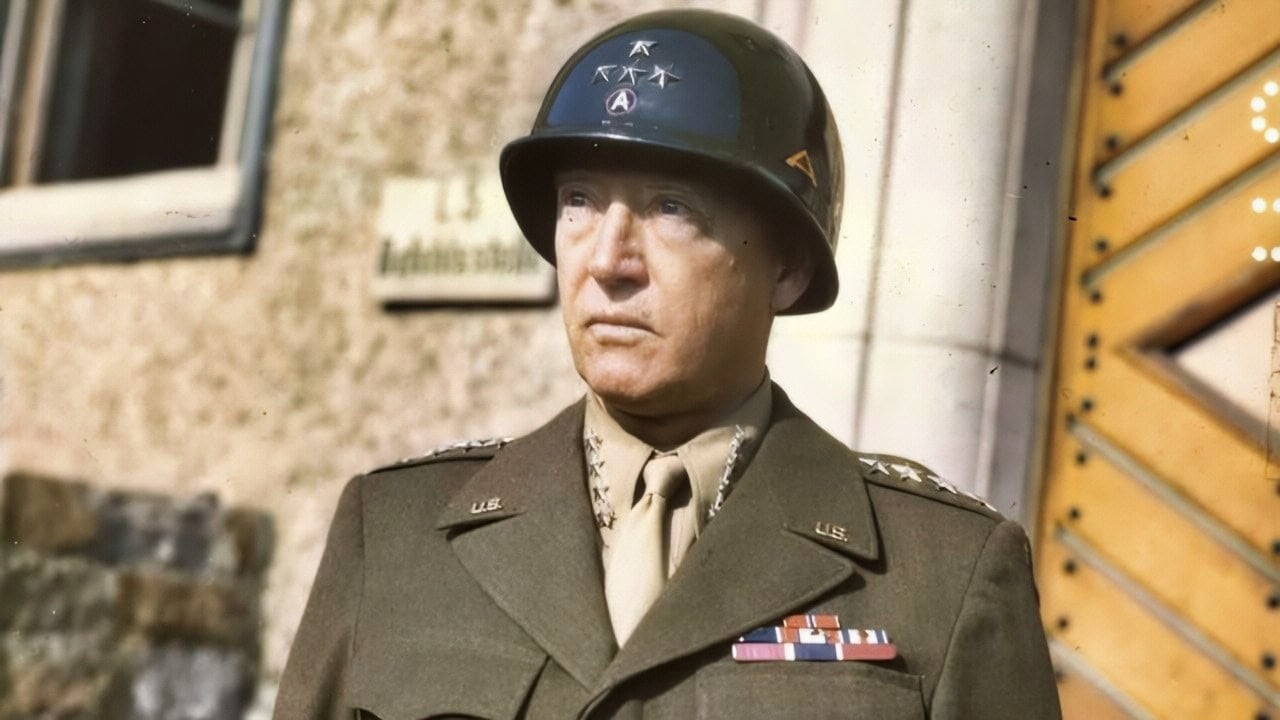
U.S. Army General George Patton. Image Credit: Creative Commons.
“Many of those who carried out his strict orders may have cursed him in the cauldron of conflict, but those who survived and came home were inordinately proud to have served under him,” Kershaw wrote.
A D-Day Pep Talk
Patton delivered “A pint of sweat will save a gallon of blood” in speeches to the Third Army in 1944, shortly before D-Day. There were multiple speeches and multiple transcriptions, so the wording isn’t always the same across versions.
It’s a piece with Patton’s quotations, and he often used variations of the same phrases in different speeches that weren’t always fully transcribed.
In one transcript, Patton said an “ounce” of sweat, rather than a pint.
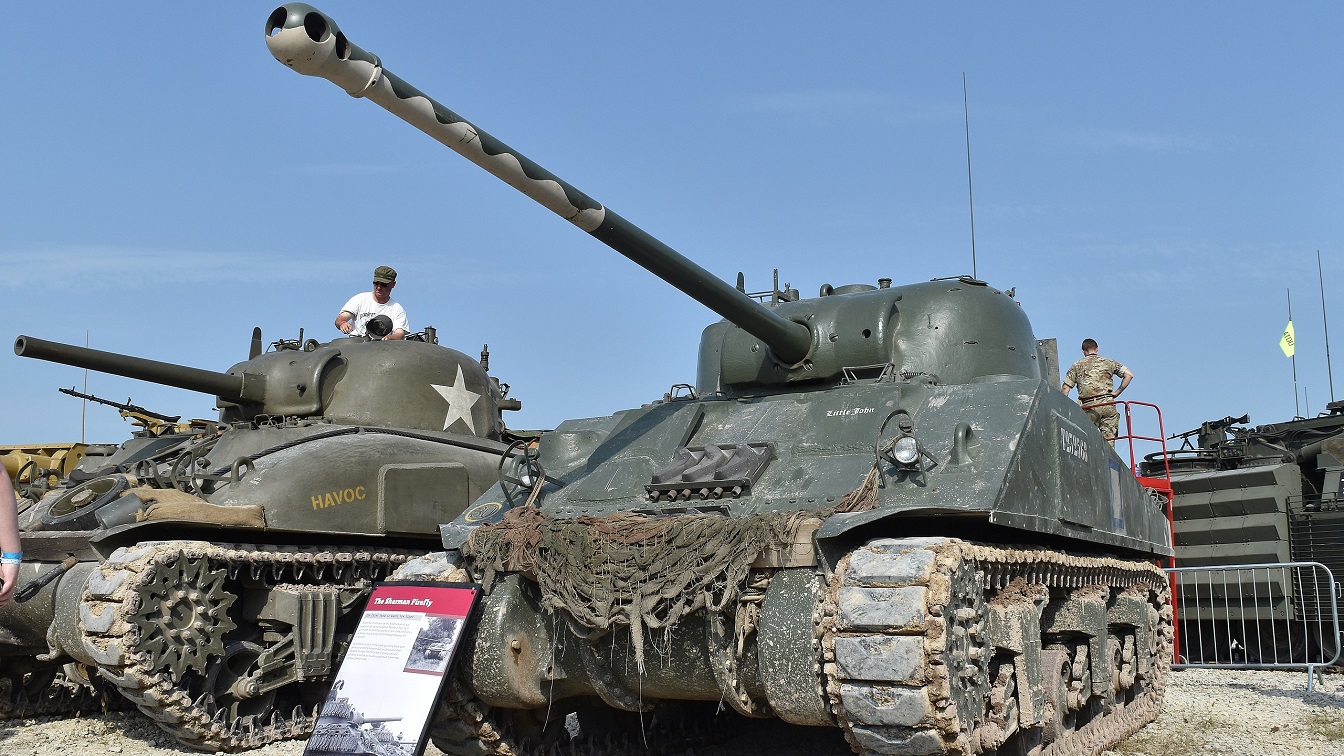
Serial No:- 16912 Official designation:- M4A4 Tank Medium 17Pdr. Total production:- 2,100-2,200 Main armament:- QF 17-pounder Anti-tank Gun The Firefly was a British modification of the M4 Sherman, with a 17 pounder gun replacing the usual 75mm. This gun was able to puncture the armour of a Tiger I or Panther, making the Firefly one of the few Allied tanks genuinely feared by Axis forces. This example comes from the Bastogne Barracks in Belgium, part of the Belgian Royal Military Museum. It was manufactured in the USA in 1942 and delivered to Europe in 1943 carrying the running number ‘USA 3017218’. It was converted to a Firefly in early 1944 and saw British service as ‘T232568’. She is fully operational and is seen in the ‘Tank Park’ after making a guest appearance at TankFest 2019. The Tank Museum, Bovington Camp, Dorset, UK.
“I believe in the old and sound rule that an ounce of sweat will save a gallon of blood,” Patton said in a speech dated June 5, 1944, the day before D-Day. “The harder WE push, the more Germans we will kill. The more Germans we kill, the fewer of our men will be killed. Pushing means fewer casualties. I want you all to remember that.”
The “pint of sweat” quote, however, has been applied in many places, from medicine to business.
“Whether it’s a soldier, a civilian wanting to run a marathon, or a CEO running a company, being successful at what you do requires focus, effort, and learning,” military.com said in an analysis of Patton’s maxim.
About the Author: Stephen Silver
Stephen Silver is an award-winning journalist, essayist, and film critic, and contributor to the Philadelphia Inquirer, the Jewish Telegraphic Agency, Broad Street Review, and Splice Today. The co-founder of the Philadelphia Film Critics Circle, Stephen lives in suburban Philadelphia with his wife and two sons. For over a decade, Stephen has authored thousands of articles that focus on politics, national security, technology, and the economy. Follow him on X (formerly Twitter) at @StephenSilver, and subscribe to his Substack newsletter.