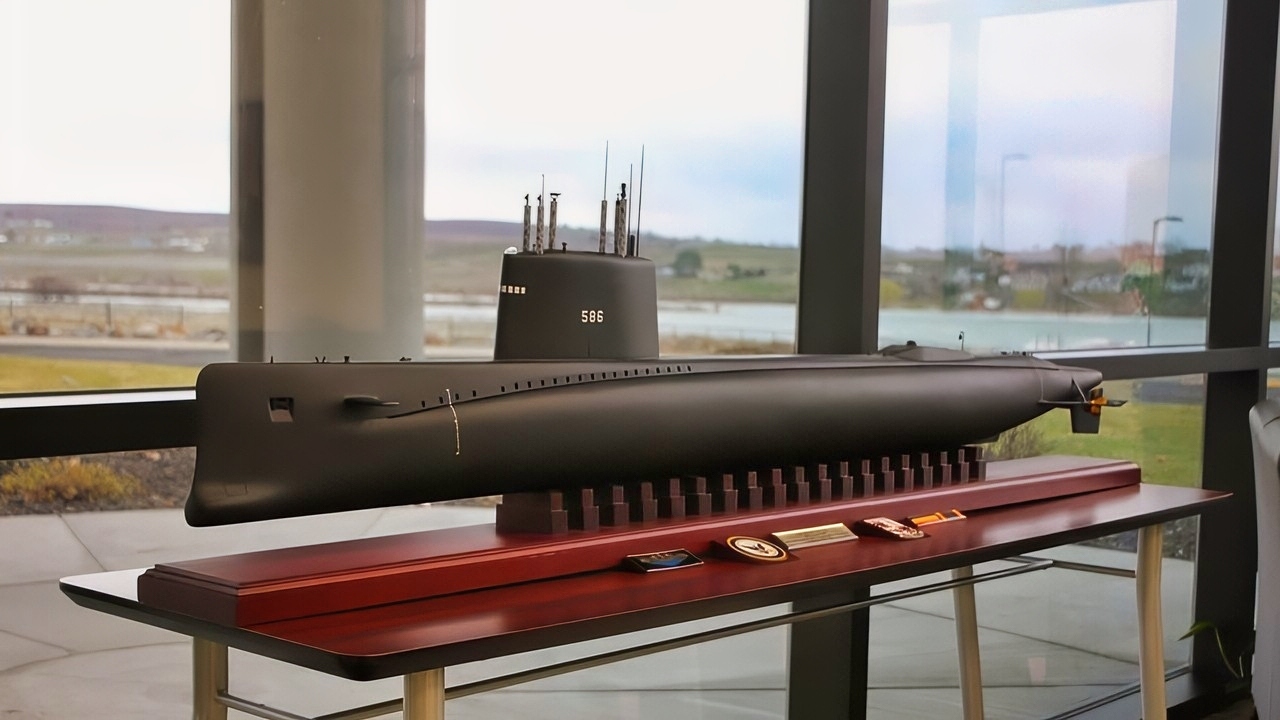
Summary and Key Points: Brandon J. Weichert profiles USS Triton (SSRN-586), the 447-foot, 8,000-ton radar-picket submarine powered by two Westinghouse S4G reactors driving twin shafts at 34,000 shaft horsepower and more than 30 knots, with AN/SPS-26 air-search radar and six 21-inch torpedo tubes. In February 1960, under Capt. Edward L. Beach Jr., Operation Sandblast made it the first submarine to circumnavigate the globe submerged. Redesignated SSN-586 in 1961 and decommissioned May 3, 1969, it remains America’s only two-reactor sub.
USS Triton Was a US Navy Nuclear Submarine Legend That Made Clear Military History
America loved experimenting with submarine designs throughout the Cold War.
One such experiment was the USS Triton (SSRN-586).
Triton became one of the largest and most powerful submarines of its day.
She measured about 447 feet long and displaced nearly 8,000 tons submerged; she was significantly larger than most American attack submarines in service at the time.
One of its most distinctive features was that, unlike other attack submarines in America’s fleet, it had two Westinghouse S4G nuclear reactors powering two propeller shafts.
Those two reactors generated enough power to propel the submarine underwater at speeds over 30 knots.
A Unique Submarine
It became one of the fastest submarines in its generation that America ever produced.
Triton also became the first submarine to circumnavigate the globe underwater completely.
In 1960, it became the first submarine to completely circumnavigate the globe underwater, demonstrating the extraordinary endurance of nuclear propulsion.
The Triton emerged as the Navy experimented with different missions for nuclear-powered submarines. The Navy originally intended this sub as a radar-picket submarine, a specialized platform designed to provide early warning of approaching enemy aircraft and missiles to American carrier battle groups.
During the 1950s, radar-picket submarines were considered useful because they could operate ahead of naval formations, detect incoming aircraft, and relay warnings to surface ships.
But conventional diesel-electric submarines lacked the speed (and endurance) to keep pace with US carriers.
Nuclear propulsion was the Navy’s solution for overcoming that problem.
Triton traveled at high speeds for extended periods without surfacing or refueling. Its twin-reactor configuration provided greater propulsion than the single-reactor arrangements used aboard other American subs.
The submarine’s two reactors drove separate propulsion shafts, producing a combined output of about 34,000 shaft horsepower.
That power ensured Triton could operate continuously underwater at speeds above 30 knots.
The submarine also carried other advanced systems for its day, like the AN/SPS-26 air-search radar, to help fulfill its early-warning mission.
Triton had six 21-inch torpedo tubes, four forward and two aft.
Circumnavigating the Globe
In February 1960, just three months after the United States Navy commissioned her, Captain Edward L. Beach, Jr. commanded the submarine as it departed Groton, Jr. Under Operation Sandblast, the Triton completed the world’s first submerged circumnavigation.
The voyage aimed to demonstrate US naval technological supremacy during the Cold War while testing the endurance of nuclear-powered submarines.
The circumnavigation began around St. Peter and St. Paul Rocks in the Atlantic Ocean.
The submarine followed a route similar to the one Ferdinand Magellan took when he successfully circumnavigated the globe.
Despite its advances and record-breaking achievements, the Triton quickly became obsolete.
Advances in carrier-based airborne early-warning aircraft gave the Navy a more flexible way to detect approaching Soviet bombers.
The Navy redesignated Triton as SSN-586, a nuclear-powered attack submarine, on March 1, 1961.
Between 1962 and 1964, the submarine underwent conversion at Portsmouth Naval Shipyard.
Triton went on to operate with the Atlantic Fleet and served as the flagship of Submarine Force, Atlantic Fleet, from 1964 until 1967.
Scrapping It
The submarine was too big and too specialized to maintain cost-effectively.
Then came massive Navy cost cuts, leading the Pentagon to cancel the planned overhaul of the USS Triton.
The submarine was ultimately decommissioned on May 3, 1969, less than a decade after entering service.
Its nuclear propulsion plant was eventually dismantled, and the submarine was scrapped.
No US submarine ever duplicated its two-reactor configuration again.
Still, the Triton will go down in history as a successful program because it broke records in its relatively short lifespan.
About the Author: Brandon J. Weichert
Brandon J. Weichert is the Senior National Security Editor at 19FortyFive.com. He also manages The Weichert Brief on Substack. Weichert also hosts “National Security Talk” on Rumble. He is the author of four bestselling national security books, most recently A Disaster of Our Own Making: How the West Lost Ukraine (Encounter Books). His next book, Fortress Americas: A New Monroe Doctrine (Tucker Carlson Books), is due out November 24. Follow him via Twitter/X @WeTheBrandon.