
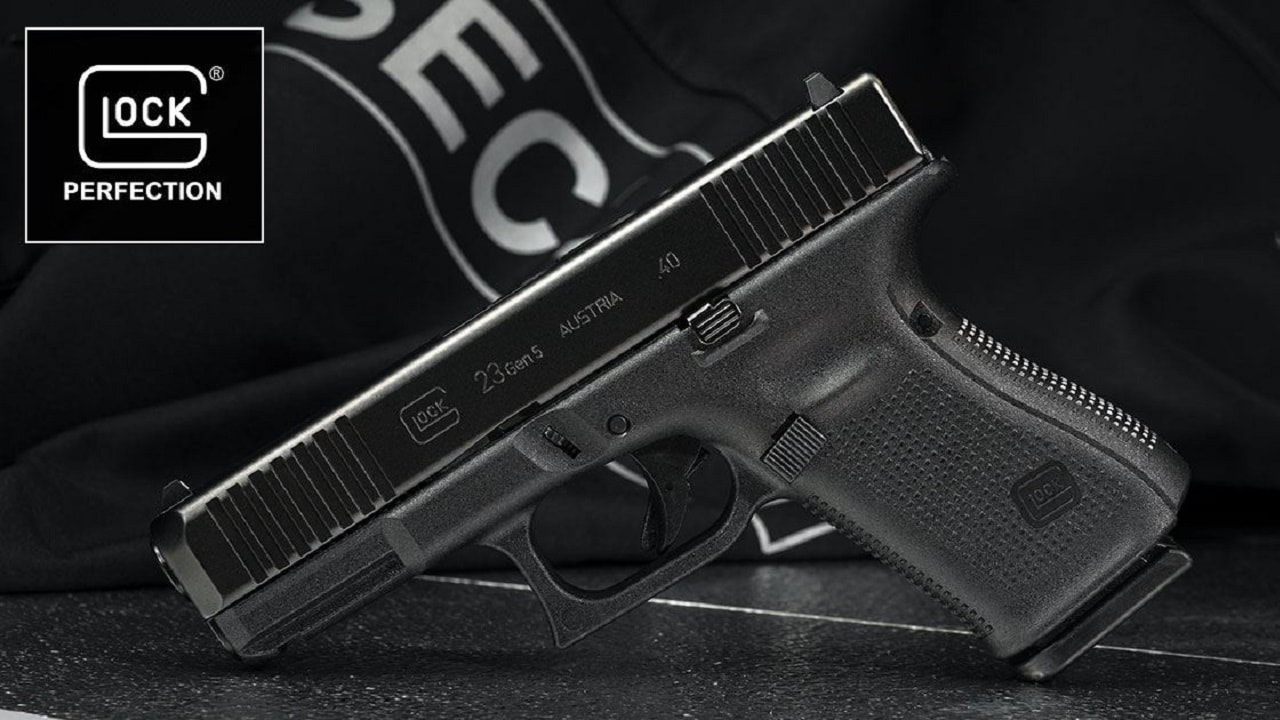
Summary and Key Points: Glock’s V series replaced its Gen 3, 4, and 5 pistols after shipments ended November 30, 2025, a redesign tied to lawsuits over illegal auto “switches” and California’s AB 1127. The Glock 23 V MOS still looks like something that will be in demand for years to come.
Glock 23 V MOS Review: The .40 S&W Isn’t Dead Yet
Some pistols get redesigned because the engineers wanted to. The Glock 23 V MOS got redesigned because the lawyers needed it.
Last fall, Glock pulled the plug on most of its Gen 3, Gen 4, and Gen 5 commercial lineup, with shipments of the outgoing models ending November 30, 2025, Pew Pew Tactical reported.
The V Series replaced them, marked with a “V” on the slide and frame and on shelves by December, per Shoot On. The G23 V MOS is the .40 S&W compact of that family, and the only optics-ready .40 in the launch lineup.
Why the change? Switches. • Numerous state and local lawsuits (as well as regulatory bills, like California Assembly Bill 1127) alleged that standard Glock designs were easily convertible into automatic-fire machine guns using aftermarket “switches” or auto sears. These illegal switches were turning up at numerous crime scenes.
Soldier Systems tied the V redesign directly to that legal pressure, and California’s AB 1127 barred dealers from selling the older designs, according to Gun Tests.
Say what you will about the politics behind it. That’s beside the point here. The real question is whether the G23 V MOS is still a good pistol.
It’s Still A Glock 23, And Shoots The Same
On paper, very little changed. Glock’s spec sheet lists the G23 V MOS with a 4.02-inch Glock Marksman Barrel, standard 13+1 capacity, and optional 15-round magazines, with a 10-round version for restrictive states.
It weighs 26.67 ounces empty and 34.36 ounces loaded. It runs 7.28 inches long, 5.08 inches tall, and 1.34 inches wide, per Handgun Hero.
The Gen 5 creature comforts carried over. You get the nDLC finish, front slide serrations, an ambidextrous slide stop, a flared magwell, and a grip without finger grooves, which was the right call when Glock made it and still is.

Glock 42. 19FortyFive Image.

Glock 32 gun. Creative Commons Image.

Glock 19X image. Image Credit: Author, Corey Ritter.
The trigger is where people will argue. Glock lists the pull at 26 Newtons, which works out to about 5.8 pounds. However, Lenny Magill’s early hands-on with the G19 V, written up by AmmoLand, found it felt identical to a Gen 5, breaking around 4.25 to 4.5 pounds with the same reset. If you like a Gen 5 trigger, you’ll like this one. Buy a trigger gauge and find out for yourself.
Holsters, lights, and magazines built for the Gen 5 carry over. And the aftermarket for all things Glock is enormous. However, the internal parts are not interchangeable from the original G23. The firing pin assembly and slide cover plate are V-specific, and Glock’s own Performance Trigger won’t function in a V gun. That’s the anti-switch architecture at work.
The .40 S&W Is The Real Debate
The G23 and its full-size sibling, the G22, were the first pistols chambered for .40 S&W when the round arrived in 1990. The FBI’s post-Miami search for more stopping power than 9mm, without the recoil and size of the 10mm, gave birth to the cartridge.
For most of two decades, the G22 and G23 rode in more police holsters than anything else in America.
Then the Bureau went back to 9mm in the mid-2010s, citing better modern ballistics, and much of law enforcement followed. That flood of trade-ins is why you’ll still find police-marked G23s at the local gun shop for a song.
So who’s the G23 V MOS for? In my opinion, three groups. Shooters with a stockpile of .40 ammunition. Agencies that never left the caliber. And folks who simply prefer a heavier 165- or 180-grain bullet in a G19-sized package.
You give up two rounds against a G19 V, 13 versus 15. You also take on a bit snappier recoil. That’s where the optic cut earns its keep. A red dot lets you watch the dot lift and settle back into the A-zone, and with the .40’s sharper muzzle flip, that feedback is worth more than it is on a 9mm.
However, with a simple barrel swap, the .40 S&W becomes a 9mm or a .357 SIG handgun. That versatility goes a long way with many shooters
The Trade-Off With Aftermarket Parts
Pricing held steady with the Gen 5 lineup. MSRP is $745, per Academy’s listing, but street prices sit right around $620. The fixed-sight G23 V without the optics cut runs closer to $539. For those keeping score at home, that’s an $80 premium to skip the trip to a slide milling shop.
The higher cost is the aftermarket reset. Every Gen 5 trigger upgrade, connector, and internal part that made the Glock the most customizable pistol on earth has to be re-engineered for the V. That will happen. Glock owners buy aftermarket parts the way Patriots fans buy Drake Maye jerseys. It just won’t happen overnight.
However, if you run your Glocks stock, and most people who carry one for a living do, none of that matters. The G23 V MOS is a Gen 5 G23 MOS with new guts and a “V” stamped on the side. It shoots when you pull the trigger, it holds a dot, and it fits your existing holster.
Some pistols get redesigned because the engineers wanted to. This one got redesigned because the lawyers needed it to change. Lucky for us, it still shoots like a Glock 23.
About the Author: Steve Balestrieri
Steve Balestrieri is a National Security Columnist. He served as a US Army Special Forces NCO and Warrant Officer. In addition to writing on defense, he covers the NFL for PatsFans.com and is a member of the Pro Football Writers of America (PFWA). His work was regularly featured in many military publications.