
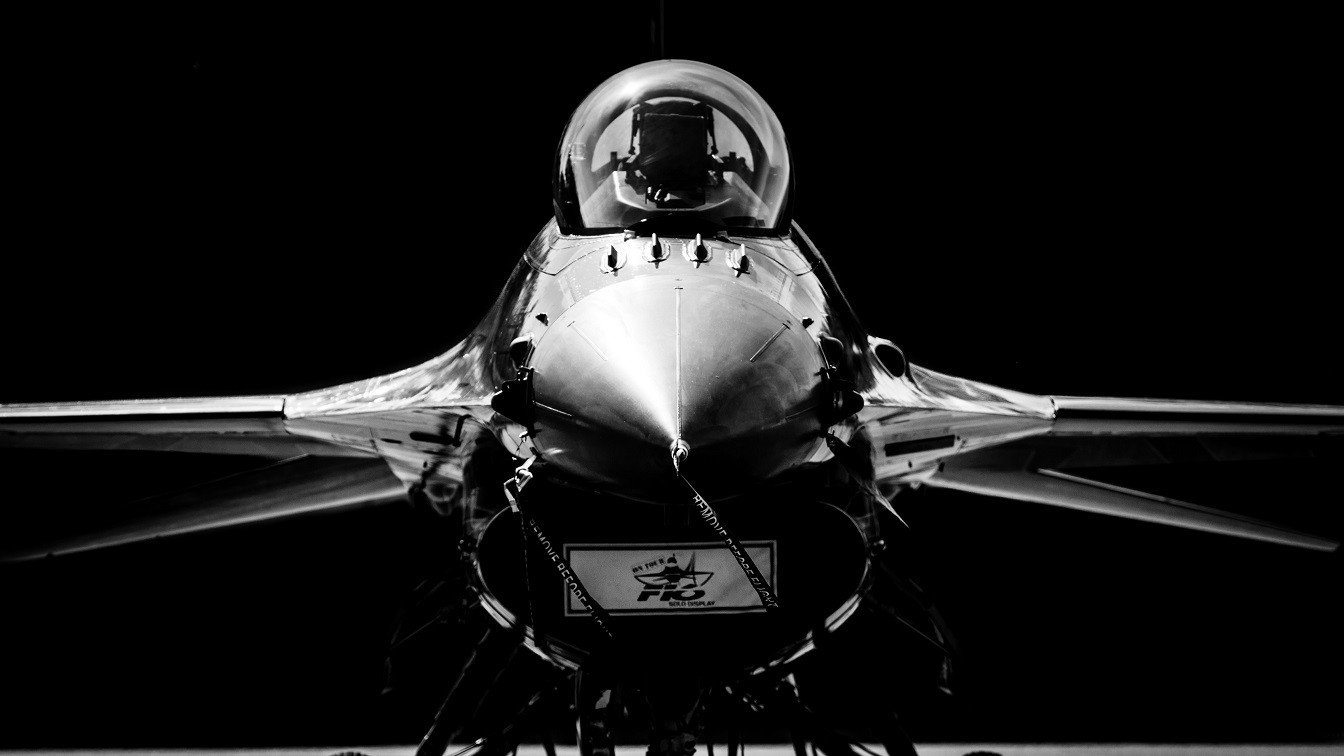
Summary and Key Points: Expert Steve Balestrieri argues the F-16N Viper was the best adversary jet the Navy ever flew: 26 stripped Block 30 F-16Cs with the F110-GE-100, 25,735 pounds of thrust, no M61 cannon, Mach 2, bought in 1985 to play MiG-29s.
The F-16N Fighter Explained
The Navy’s best adversary aircraft lasted less than eight years. The Aviation Geek Club has called the F-16N Viper the best adversary fighter jet the US Navy has ever flown, and I won’t argue. Crews who spent the late 1980s getting worked over by it at Miramar, Fallon, and Key West.
It was a stripped-down, up-engined hot rod built to make Navy fighter crews better by beating them up in training. It did that job too well.
That irony runs through this whole story.
Why The Navy Needed A Newer Hot Rod
By the mid-1980s, the Navy’s adversary stable of A-4 Skyhawks and F-5E Tigers was showing its age. They were fine for playing MiG-17s and MiG-21s.
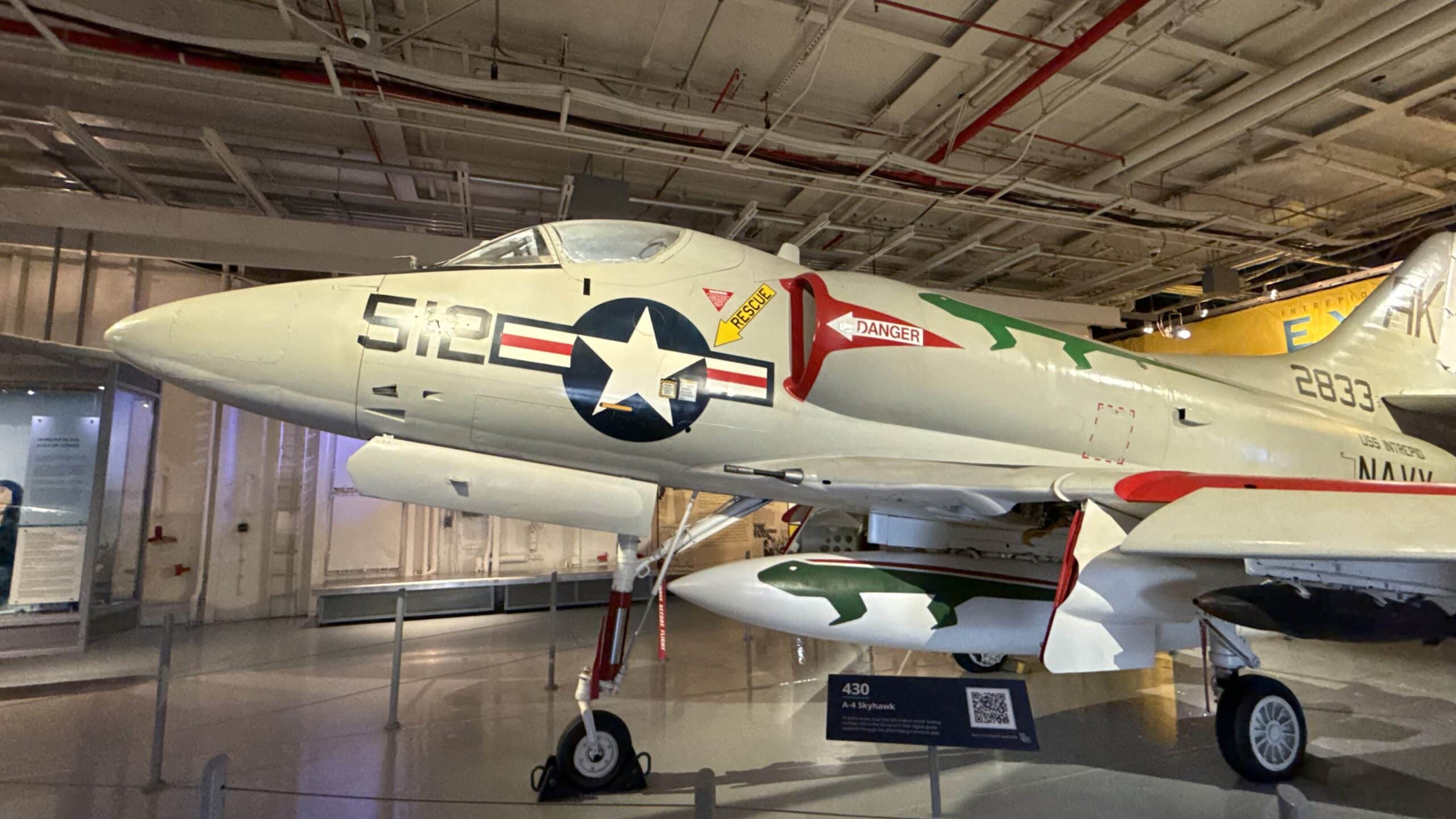
A-4 Skyhawk 19FortyFive Photo from USS Intrepid.
However, the Soviets were fielding the MiG-29 Fulcrum and Su-27 Flanker, and nothing in the Navy’s inventory could fake those.
The Navy owned no Fulcrums or Flankers.
It needed the next best thing, and it needed it cheap.
The realistic candidates were General Dynamics’ F-16/79 and Northrop’s F-20 Tigershark.
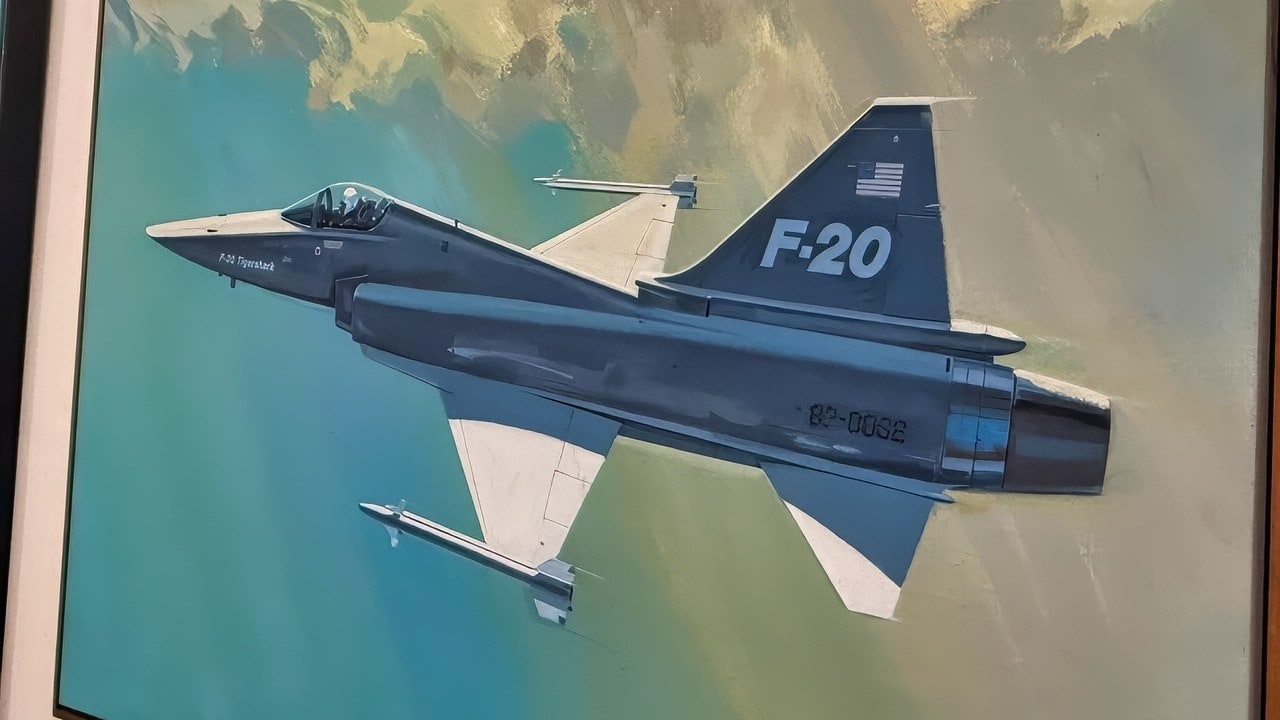
F-20 Tigershark. Image Credit: Harry J. Kazianis/19FortyFive.com

F-20 Tigershark Model at Western Museum of Flight. Image by Harry J. Kazianis/19FortyFive.com Image.
As former Top Gun instructor Paul Nickell explained in his first-hand account for The War Zone, politics touched everything, from export rules to an F-20 crash in October 1984 just before the decision.
The Navy announced its pick in January 1985.
It ordered 22 single-seat F-16Ns and four two-seat TF-16Ns, all built in 1987 and 1988, according to F-16.net.
Top Gun got eight of them.
The first two landed at Miramar on June 17, 1987. The rest went to fleet adversary squadrons, including VF-45 “Blackbirds” at Key West and VF-43 “Challengers” at Oceana.
For those who didn’t know, the Navy’s adversary or aggressor squadrons that play the role of Soviet or Russian pilots in training are also known as “Red Air.” They painted their aircraft in camo patterns that mimicked Soviet or Russian aircraft.
Lighter, Faster, And Built To Pull
On paper, the F-16N was a Block 30 F-16C with the General Electric F110-GE-100.
In practice, it was lighter and meaner.
Nickell rated the engine at 25,735 pounds of thrust in full afterburner, pushing a jet weighing under 25,000 pounds with a full internal fuel load.
That’s better than a one-to-one thrust-to-weight ratio at takeoff.
He personally saw it hit Mach 2, and it would supercruise when slick at altitude.
The Navy also took things out.
They removed the M61 cannon, saving about 250 pounds plus the ammo and feed system, and added nose ballast to keep the center of gravity within limits.
The radar was the older APG-66 from the F-16A/B.
There was no self-protection jammer, since it was never going into a real fight.
Titanium went into the lower wing attachment fittings because everyone knew this jet would live at high G.
It kept a tailhook for runway arrestments, but it was never carrier-capable.
One Jet, Every Threat
Here’s where the N earned its reputation.
It could be whatever bandit the syllabus called for. To play a MiG-17, instructors flew it without afterburner.
For a MiG-21, they held back on how far into the burner range they went. In the MiG-23, they flew fast and kept turns under about 4 G.
In the Fulcrum or Flanker, they flew it full up, full burner, at any speed.
Navy crews felt the difference.
As the Aviation Geek Club put it, Tomcat and Hornet crews were finally fighting a truly different aircraft.
In a turning fight, the F-16N held a significant maneuvering edge over the F-14.
Smart Tomcat crews won the forward-quarter battle before the merge and avoided the close-in knife fight.
A slick Hornet could hang with it at slow speed, since the Hornet had no angle-of-attack limiter.
Some Tomcat drivers figured it out anyway.
The Aviation Geek Club tells the story of a VF-101 pilot known as “Okie” who developed tactics for scoring gun kills on the F-16N.
He used the big F-14’s ability to pitch and hold energy while the Viper bled its own away.
Those lessons went straight into the replacement air group syllabus.
The N-model also gave adversary pilots a recordable radar and HUD.
Forward-quarter shots could finally be validated in the debrief.
For a training force, that was huge.
Done In By Its Own Success
But the very thing that made the F-16N great also killed it. Air Force Vipers split their time between air-to-air and air-to-ground.
The N spent nearly every sortie at the edge of the envelope in air combat maneuvering.
In 1990, Naval Air Systems Command inspectors found cracks in the center fuselage wing carry-through area and called it an emergency safety-of-flight issue, according to Proceedings.
Nickell offered an honest pilot’s take on why.
The G limiter made pilots feel protected, so they pulled harder than they did in the A-4 or F-5. Rapid G onset could still spike past 9 G.
The limiter also only accounted for a symmetrical pull. Roll and pull at the same time, and one wing takes more load than the other.
There was no money in the budget to fix them.
The Navy announced retirement in 1994, and the last F-16N went to the boneyard at Davis-Monthan in January 1995.
The F-5s it was bought to replace outlasted it.
As one instructor put it in the Aviation Geek Club’s look at the retirement, TOPGUN “just was not as credible of an adversary without that plane.”
In One Word: Irreplaceable?
The Navy didn’t stay away from the F-16 for long.
In 2002 and 2003, it picked up 14 F-16A/Bs built for Pakistan and then embargoed.
Now it is absorbing surplus Air Force Vipers too, with 12 F-16Cs going to VFC-13 and 14 more to the Naval Aviation Warfighting Development Center.
The Navy plans to fly the F-5 and F-16 as its primary adversary aircraft through 2035.
It is debatable, but the feeling here is that none of them will quite match the F-16N.
It was purpose-built, light, fast, and flown by some of the best aerial tacticians the Navy ever produced.
It made a generation of Navy fighter crews better by beating them every day. It lived fast and died young.
The best bad guy the Navy ever had.
It still is.
About the Author: Steve Balestrieri
Steve Balestrieri is a National Security Columnist. He served as a US Army Special Forces NCO and Warrant Officer. In addition to writing on defense, he covers the NFL for PatsFans.com and is a member of the Pro Football Writers of America (PFWA). His work was regularly featured in many military publications.