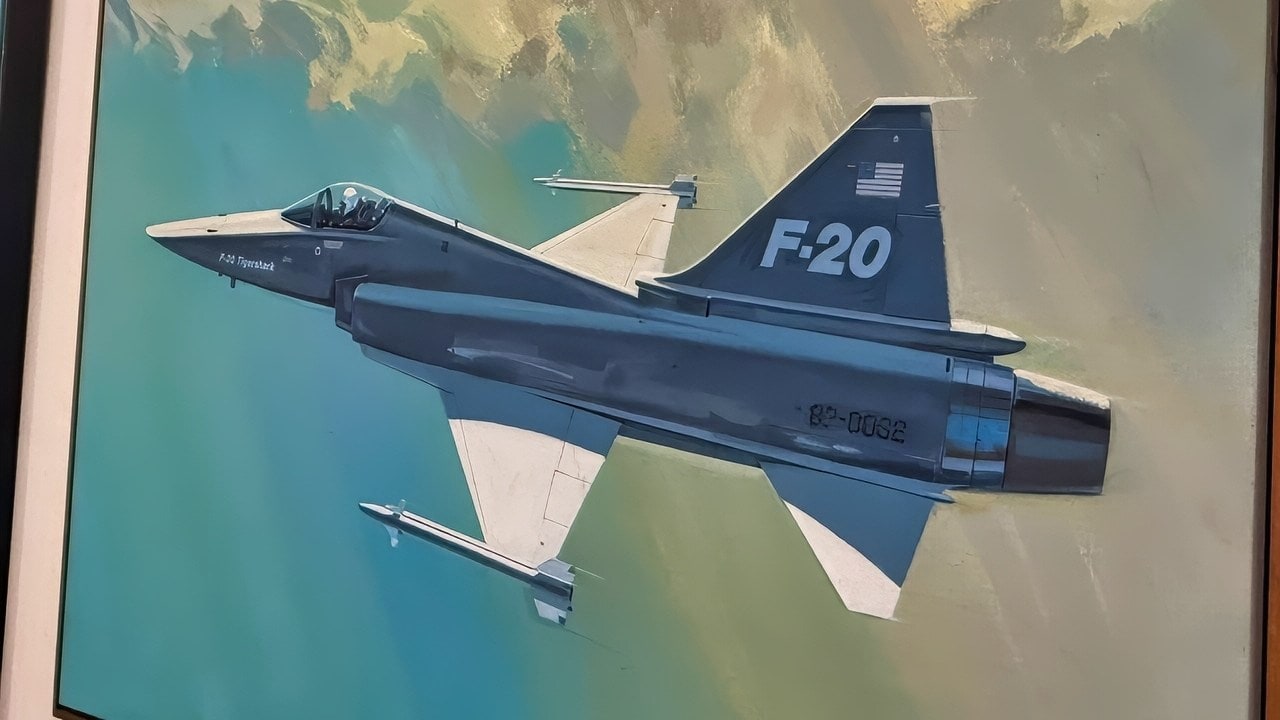
The history of military aviation is filled with aircraft that failed due to flaws. The F-20 Tigershark was not one of those flawed birds.
In fact, the Northrop F-20 may be one of the most misunderstood fighter programs in American history.

F-20 Tigershark Model at Western Museum of Flight. Image by Harry J. Kazianis/19FortyFive.com Image.
It was fast, affordable, easy to maintain, and packed impressive performance into a relatively simple design.
Yet despite all its promise, the aircraft never entered service and never secured a single production order.
For decades, aviation enthusiasts have argued that the F-20 was the fighter that should have been. Others insist it was merely an inferior alternative to the F-16 Fighting Falcon.
The truth lies somewhere in between.
The real lesson of the F-20 Tigershark is not that America rejected a superior fighter. Rather, the aircraft became the victim of changing geopolitical realities and a defense procurement system that often favors institutional momentum over innovation.
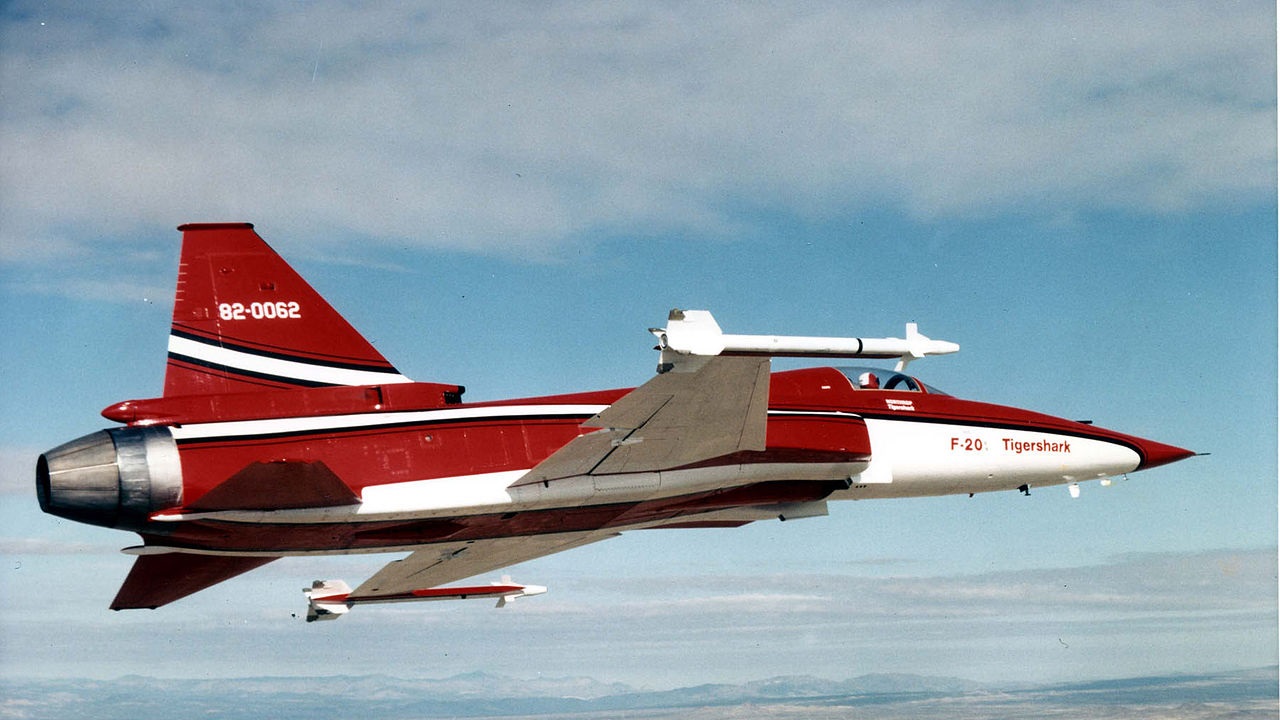
Northrop F-20 (S/N 82-0062) in flight. (U.S. Air Force photo)
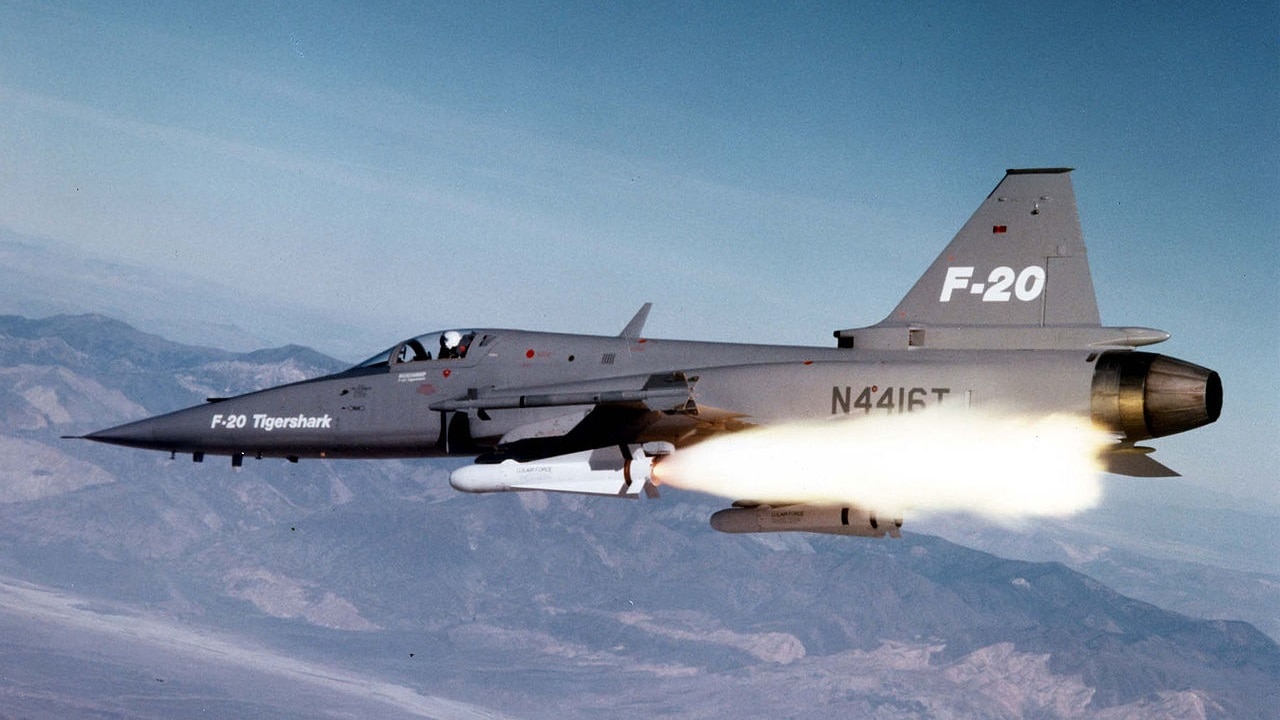
An F-20 launching an AGM-65 Maverick missile.
What Made the F-20 Special?
Beginning its life as an effort to modernize the highly successful F-5 Freedom Fighter, the F-20 was not an entirely new warplane.
It was, instead, a redesign of the F-5. That’s because during the Cold War, the F-5 proved enormously popular with allied nations due to its affordability, ease of operation, and high reliability.
By the late 1970s, though, the aircraft was becoming obsolete.
Air forces around the world wanted modern radar, beyond-visual-radar (BVR) range missile capability, and improved performance. Northrop’s answer was the F-20 Tigershark.
Northrop started with their redesign of the F-5 by putting in a General Electric F404 engine–the same engine that powered the US Navy’s excellent fourth-generation warplane, the F/A-18 Hornet.
The result was a fighter that retained the simplicity of the F-5 while dramatically improving performance.
Indeed, the F-20 could exceed Mach 2.
Northrop gave their new F-20 next-generation avionics, a capable APG-67 radar, compatibility with AIM-9 Sidewinder and AIM-7 Sparrow missiles, and strike capabilities using weapons such as the AGM-65 Maverick.
But the F-20’s operational simplicity was the real selling point of the plane.
The F-20 could reportedly scramble from a cold start to supersonic flight in just a few minutes.
Maintenance requirements were significantly lower than those of many contemporary fighters, making it particularly attractive for smaller air forces.
The F-20 was precisely the kind of aircraft that defense planners today claim they want: affordable, reliable, and combat-capable.
Reagan Accidentally Killed the F-20 Tigershark
Supposedly, the Air Force set about to kill the F-20 to protect the F-16 Fighting Falcon. In reality, the F-20 was killed by President Ronald Reagan.
The F-20 was originally developed under the restrictions of the Carter administration’s arms-export policies.
Back then, Washington was reluctant to sell advanced fighters like the F-15 Eagle and F-16 Fighting Falcon to a wide range of foreign customers.
Northrop believed there would be a substantial market for a capable but less politically sensitive fighter. That assumption by Northrop proved to be catastrophically wrong.
When Reagan entered office in January 1981, his administration loosened export restrictions and aggressively promoted American arms sales abroad. Suddenly, countries that might have purchased the F-20 could instead buy the F-16 itself.
This fundamentally altered the market.
Imagine being a foreign air force commander in 1984. You can buy a fighter that resembles the F-16–or you can buy the actual F-16 flown by the United States Air Force.
The decision was obvious.
The Tigershark found itself trapped in a niche that was no longer needed.
The F-16 Was More Than an Aircraft
Another factor working against the F-20 was that the F-16 had become more than just a fighter. It had become an institution.
Indeed, a cultural icon. The Air Force was purchasing the plane in large quantities. NATO allies were embracing it fully.
Production lines were expanding, too.
Training pipelines were already established. Logistics networks were maturing. Spare parts were becoming widely available.
All these advantages mattered just as much as aerodynamic performance.
Even if the F-20 offered lower operating costs and excellent reliability, foreign customers understood that buying the F-16 meant joining a vast support ecosystem backed by the United States government.
The Tigershark could not compete with that.
Tigershark’s story is a recurring reality in military procurement.
The best platform does not always win. Often, the platform with the strongest political, industrial, and logistical support network emerges victorious.
The F-20 learned that lesson the hard way.
A Victim of Timing
Northrop’s F-20 Tigershark also suffered from terrible luck.
Two prototype aircraft were lost during demonstration flights, killing experienced test pilots.
Investigators ultimately concluded that the crashes resulted from G-induced loss of consciousness rather than fundamental flaws in the aircraft itself.
But perception matters. Potential customers do not carefully study accident reports. They see the headlines.
For a fighter already struggling to find buyers, the accidents further damaged confidence. At roughly the same time, the F-16 continued accumulating customers around the world.
The gap between the two aircraft became insurmountable.
By 1986, after investing approximately $1.2 billion of its own money into the program, Northrop terminated the F-20 effort.
No production orders ever materialized.
The F-20’s Real Legacy
Today, some aviation enthusiasts ask whether America should revive the Tigershark. Of course, that’s not possible.
But the questions surrounding the F-20 and the conditions that initially made its creation possible are again at the forefront of everyone’s minds.
While export controls have not been imposed, necessitating a simpler, cheaper plane as existed in the Carter administration, America’s platforms today are far too exquisite to be worth the investment.
The wars in Ukraine and Iran have proven that mass-producibility, affordability, ease of maintenance, and rapid replacement are preferred over the complex, small number of platforms that today pervade America’s warplane fleet.
Northrop’s F-20 represented a different philosophy–one that dominated the minds of American planners back in the Second World War (the last conflict the United States actually won).
F-20 represented a return–however brief–to operational simplicity, lower production costs, and easier maintenance cycles, all without ever sacrificing effectiveness.
That philosophy has again been lost in the Pentagon today. And the United States risks losing an air war by forgetting this key philosophy.
Not a Revolutionary Fighter. But It Would Have Been
The F-20 Tigershark was not a revolutionary fighter in itself. Nor was it an inferior aircraft that deserved its fate. The F-20 was something more interesting.
It was a potential fork in the road that might very well have created an acquisitions process at the Pentagon that actually rewarded efficiency, simplicity, and mass-producibility.
Something we desperately require today, if we are to win the next big war.
Nevertheless, the F-20’s failure was one of strategy. In military aviation, success depends upon building the right aircraft for the political and strategic environment of the moment.
The F-20 was a capable fighter, and the processes that would have made this program work would be very useful today.
The F-20 was a capable fighter, though. History simply moved on without it.
Yet that decision might ultimately be something we all live to regret, given how desperately the US Air Force needs cheap, mass-produced warplanes today.
About the Author: Brandon J. Weichert
Brandon J. Weichert is the Senior National Security Editor at 19FortyFive.com. He also manages The Weichert Brief on Substack. Weichert also hosts “National Security Talk” on Rumble. He is the author of four bestselling national security books, the most recent of which is A Disaster of Our Own Making: How the West Lost Ukraine (Encounter Books). Follow him via Twitter/X @WeTheBrandon.