
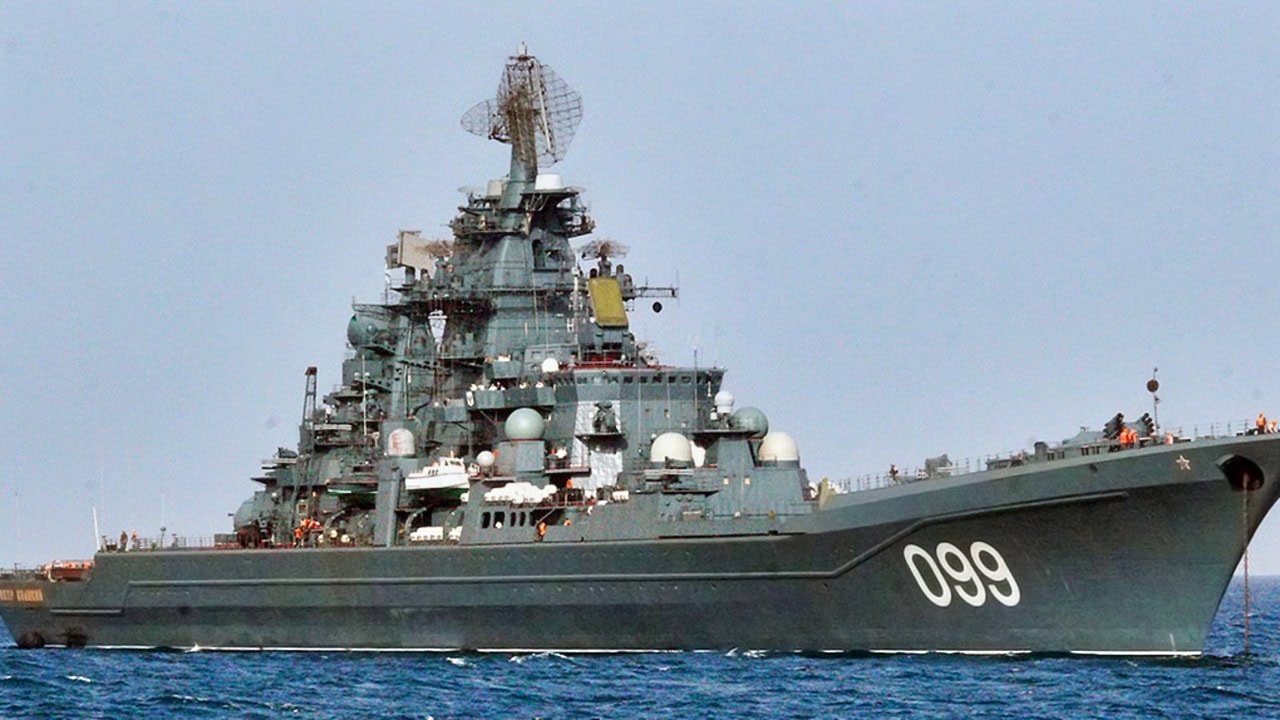
Summary and Key Points: Pyotr Velikiy, the Kirov-class nuclear battlecruiser that leads Russia’s Northern Fleet, has been tied up at Severomorsk since late 2022. TASS and Naval News report that a commission has reached a preliminary decision that she is too worn to modernize, with no final ruling yet. The money went to her sister. Admiral Nakhimov’s overhaul was due to finish in 2018, ran about eight years late, and reportedly doubled in cost to more than 200 billion rubles, or $2.49 billion. She now carries 176 primary launch cells, and a full load is estimated at about $500 million.
Russian Navy Won’t Bring a Kirov-Class Nuclear Battlecruiser Back
Peter the Great isn’t going anywhere. Literally. Russia’s Northern Fleet flagship, the Kirov-class nuclear-powered battlecruiser Pyotr Velikiy, will not get the modernization she has been waiting on since she tied up at Severomorsk in late 2022.
As Naval News reported this week, a special commission decided the ship is too far gone to justify an upgrade, leaving the Russian Navy with only one operational battlecruiser and a shrinking surface fleet.
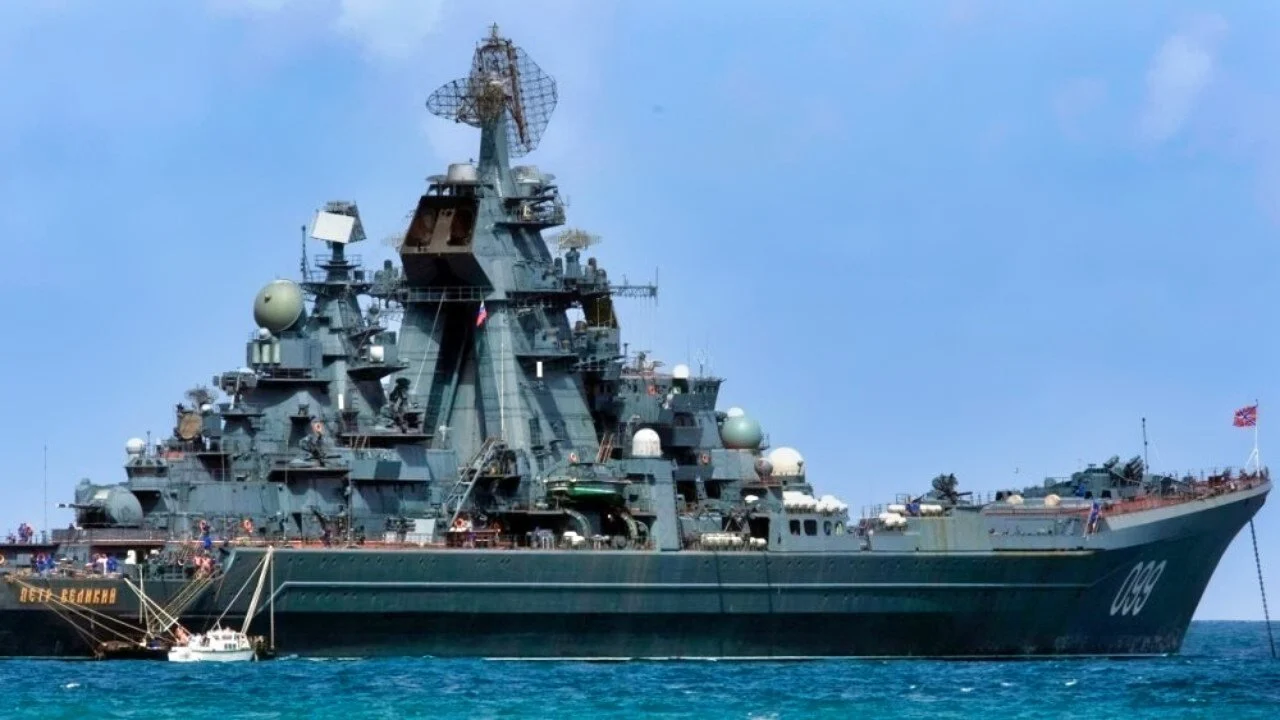
Kirov-Class Battlecruiser. Creative Commons Image.
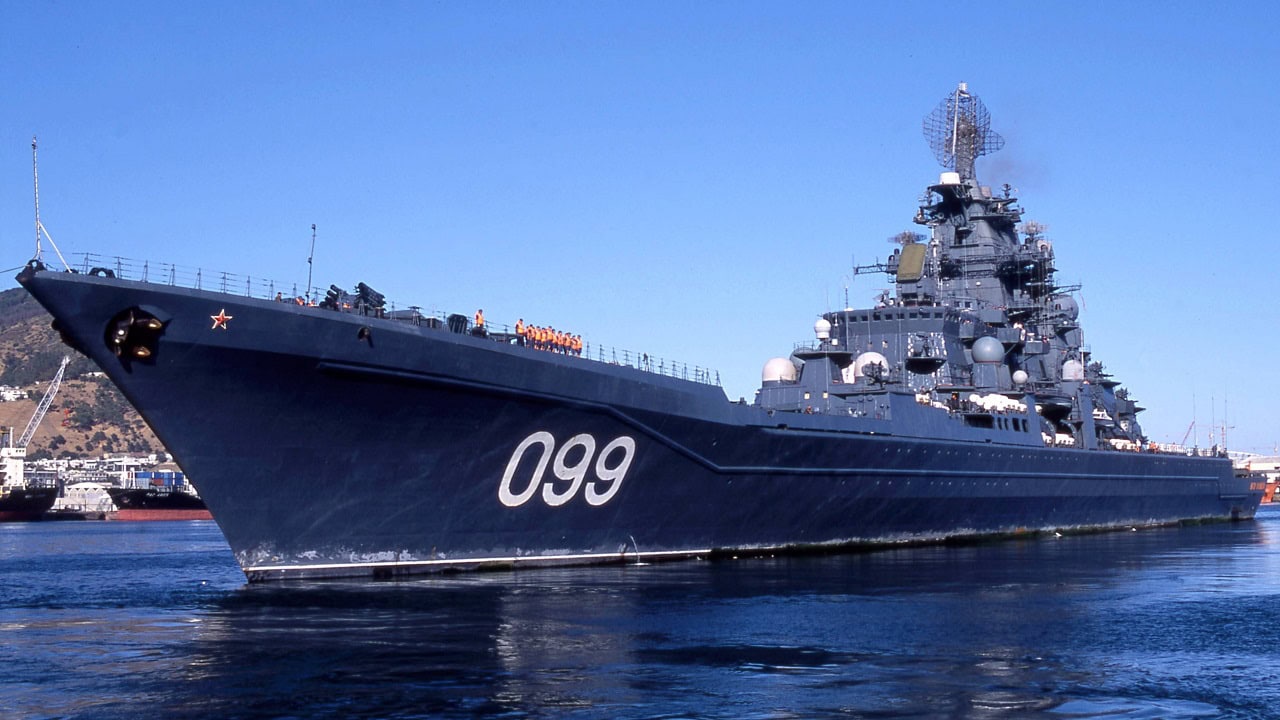
Russian Navy Kirov-Class Battlecruiser. Image Credit: Creative Commons.
The news first surfaced through the Russian state news agency TASS. Vladimir Maltsev, head of the All-Russian Movement in Support of the Fleet, said the commission had reached a preliminary decision that it could not restore the cruiser.
His explanation was short and blunt: “The ship has a certain degree of wear and tear.” Maltsev added, however, that the commission has not yet announced its final decision.
That’s about as close as Moscow gets to admitting a capital ship is a lost cause.
The Admiral Nakhimov Ate The Budget
The modernization budget has been eaten up.
The Admiral Nakhimov went into the Sevmash yard at Severodvinsk for an overhaul that was supposed to wrap up in 2018.
Instead, she finally went back to sea this year after 28 years out of service. Naval News pegged the modernization itself at roughly 12 years, with delivery slipping about eight years past the original date.
The bill grew right along with the schedule. Meduza, citing Russian reporting, says the cost doubled to more than 200 billion rubles ($2.49 billion).
Some estimates put the total as high as $5 billion.
However, the Sevmash shipyard can handle only one ship of the class at a time, and Pyotr Velikiy was slated to enter next once the Nakhimov was finished.
But every year the Nakhimov sat in the yard ate money earmarked for her sister ship. Western sanctions didn’t help either. The Barents Observer reported that Russian builders were forced to produce auxiliary systems at home that they had planned to buy abroad.
The money was gone, and with the war in Ukraine, there’s no more for niche projects. Many analysts believe the Pyotr Velikiy will be retired for good once the Nakhimov finishes its sea trials.
What Russia Is Walking Away From
Originally named the Yuri Andropov and renamed after the Soviet collapse, Pyotr Velikiy served roughly 25 years as Russia’s only active Kirov.
She made long deployments far from Severomorsk and flew the flag in the Mediterranean during Russia’s intervention in Syria.
She was already the best-equipped hull of the class.
Her fit included the S-300FM air-defense system firing the longer-ranged 48N6 missile, a phased-array Tombstone fire-control radar, up to 128 3K95 Kinzhal short-range SAMs, and six Kortik close-in weapon systems.
Her main punch was 20 P-700 Granit (SS-N-19 Shipwreck) supersonic anti-ship missiles, each weighing about 7,000 kg (roughly 15,400 pounds).
The Project 1144.2M upgrade would have gutted all of that.
The Granits come out, and 80 universal vertical launch cells go in, capable of firing the 3M22 Zircon hypersonic missile, the P-800 Oniks, and the Kalibr family.
The S-300FM can carry up to 96 S-400 missiles. On the Nakhimov, that adds up to 176 primary VLS cells, and Naval News estimates a full combat load alone runs about $500 million.
On paper, that’s a frightening ship.
It’s also the whole problem in one sentence.
One hull that costs billions to rebuild and half a billion to fill. But it is also a huge target.
Limbo Is The Cheapest Option
So doesn’t Moscow just scrap her?
Because that costs money too.
The 28,000-ton cruiser has spent the last few years pierside at Severomorsk, used largely as extra berthing for personnel, with much of her crew shifted over to the Nakhimov.
Disposing of two naval reactors is an expensive, slow process, and analysts have noted Moscow is in no hurry to write her off.
The signals out of Russia have been mixed for years.
A TASS source floated retirement back in 2023.
That same year, a source speaking to RIA Novosti insisted there were no such plans.
None of that changed the facts in the shipyard.
The ship hasn’t sailed since 2022, and now she won’t be fixed.
Submarines Are Probably The Answer
Pyotr Velikiy isn’t the only big ship to fall off the budget sheet.
The carrier Admiral Kuznetsov saw her modernization paused in 2025 after a yard period plagued by accidents and missteps.
That leaves Russia with three capital ships: the Nakhimov and two Slava-class cruisers, the Marshal Ustinov and the Pacific Fleet flagship Varyag.
Both Slavas have gone roughly 40 years without a major overhaul.
The lead ship of the class, Moskva, is on the bottom of the Black Sea after Ukrainian missiles sank her in April 2022.
Ukraine has since bottled up much of the Black Sea Fleet’s surface force at Novorossiysk.
Next comes a navy of frigates and corvettes.
The Steregushchiy and Gremyashchiy corvettes and the Admiral Gorshkov-class frigates will carry the surface load.
Moscow’s answer may lie beneath the waves, with Borei-class ballistic missile boats and Yasen-class cruise missile submarines.
So does losing Pyotr Velikiy actually matter?
Militarily, less than the Kremlin would care to admit. A 28,000-ton surface combatant is a huge target, and Moskva proved that the hard way.
And without enough ships for a true battlegroup, it will be very vulnerable.
However, symbolism counts in Moscow, and the Kirovs were the last real examples of Soviet-style blue-water power.
Without her, Russian surface power projection now rests on a single ship that just spent 28 years in the yard.
The Pyotr Velikiy isn’t going anywhere. Neither is Russia’s blue-water navy.
About the Author: Steve Balestrieri
Steve Balestrieri is a National Security Columnist. He served as a US Army Special Forces NCO and Warrant Officer. In addition to writing on defense, he covers the NFL for PatsFans.com and is a member of the Pro Football Writers of America (PFWA). His work was regularly featured in many military publications.