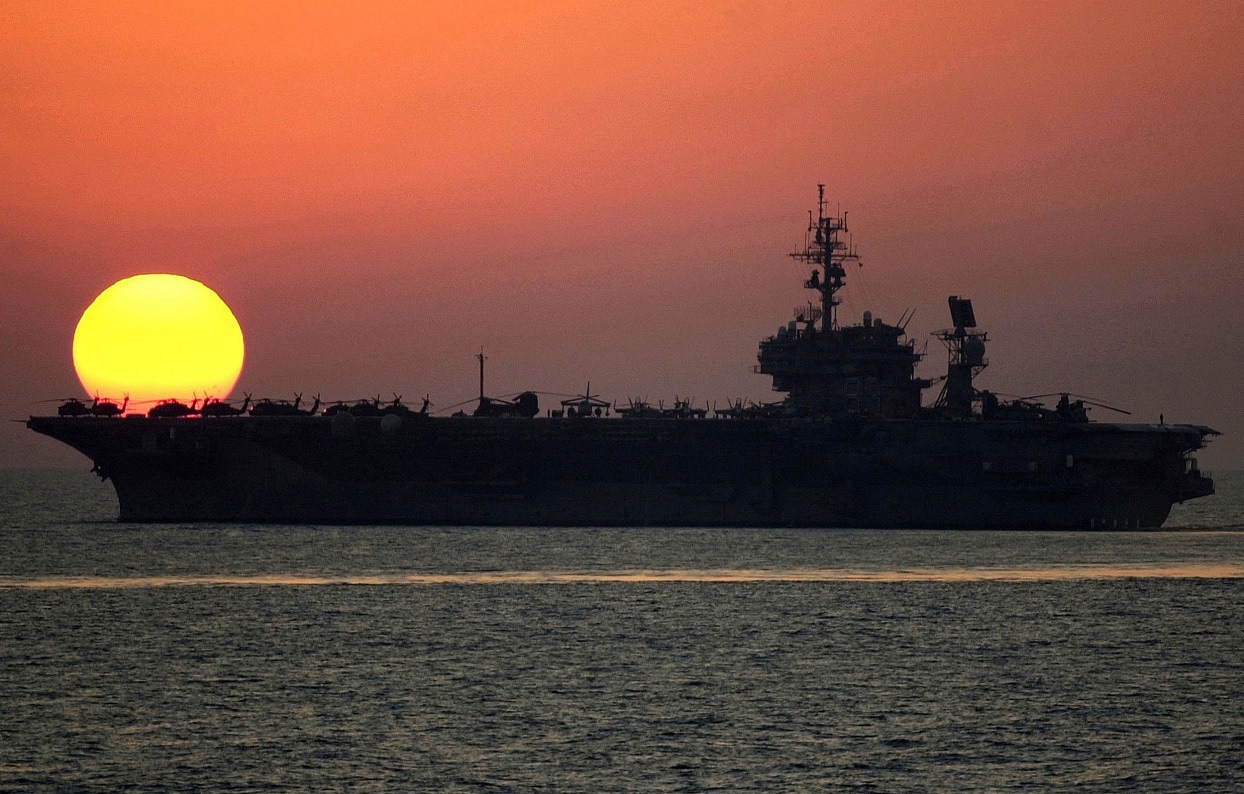
Summary and Key Points: In 1984, a Soviet nuclear-powered submarine collided with the U.S. Navy aircraft carrier USS Kitty Hawk in the Sea of Japan, nearly sparking World War III.
-Recently declassified, this incident revealed how close the Cold War came to nuclear confrontation, raising critical questions about submarine detection technology and naval strategy at that time.
-The Soviet submarine reportedly observed the USS Kitty Hawk from just a few kilometers away, leading to a collision causing significant damage but miraculously avoiding catastrophe.
-This incident highlights the inherent dangers of Cold War naval operations, where the slightest miscalculation could have triggered a global disaster.
Cold War Secrets: The Day a Soviet Sub Collided with an American Carrier
With the possibility of a massive nuclear war or a nuclear exchange appearing more realistic in light of Putin’s continued threats, many are likely inclined to wonder how close the world has ever come to an actual nuclear confrontation.
People are familiar with the Cuban Missile Crisis in the 1960s.
Yet, there is another now declassified incident from the 1980s, which, at the time, arguably could have brought the US and Soviet Union to the very edge of nuclear confrontation.
Cold War Collision: Navy Aircraft Carrier Hit
In 1984, a Soviet Victor-class submarine collided with the US Navy aircraft carrier Kitty Hawk in the Sea of Japan, a scenario which may have started World War III during the height of the Cold War.
Many details of the incident are still unknown, as it was only declassified as recently as 2017, according to an essay in The National Interest, yet both the Soviet and US submarines were at the time armed with an ability to create massive, unparalleled destruction.
This incident occurred at an extremely sensitive time in history between the US and the Soviet Union, as the slightest miscalculation could well have sparked nothing short of a global catastrophe. What caused the near collision may be the result of a number of intersecting variables, including Soviet efforts to secretly track US Navy surface assets near the Korean Peninsula during a US-Korean exercise.
1980s Submarine Detection?
The most significant question emerging from the incident relates to the relative maturity of submarine-detection technologies at this time. Also, why was a Soviet nuclear submarine willing to get that close to a US carrier?
Did the submarine get so close unwittingly, or was it actually intending to mirror and follow the USS Kitty Hawk in close proximity? The latter seems more likely.
In the early days of ship lowered variable towed array sonar, submarine acoustic detection may not have had the range and precision of modern attack subs. However, it is also quite possible that Soviet submarine captains may have knowingly gotten extremely close to the USS Kitty Hawk, particularly if it were able to remain undetected.
Declassified accounts suggest that the Russian submarine captain was able to “see” the aircraft carrier USS Kitty Hawk from four to five kilometers away using a periscope.
It seems much more likely that the Soviet submarine would “see” the USS Kitty Hawk than a circumstance in which the USS Kitty Hawk could “detect” the sub. Ultimately, a crash did occur.
Fortunately, the collision did not “spark” a war or cause irreparable damage to either ship, yet the crash was significant. The Aviation Geek Club in 2023 described the unfolding of events.
“Through the periscope, Captain Vladimir Evseenko discovered that the entire USS Kitty Hawk CSG was only 4 to 5 kilometers away. More alarmingly still, the Americans and K-314 were heading towards each other at full throttle,” the essay states.
This Aviation Geek Club essay’s account of the available information from the collision describes that the small crash was not without consequence.
“K-314’s propeller was heavily damaged as a result of the collision. Kitty Hawk instead had a huge hole in its bow, causing several thousand tons of jet fuel to leak into the sea; by sheer miracle, it did not explode,” the essay states.
Navy Aircraft Carrier Photo Essay
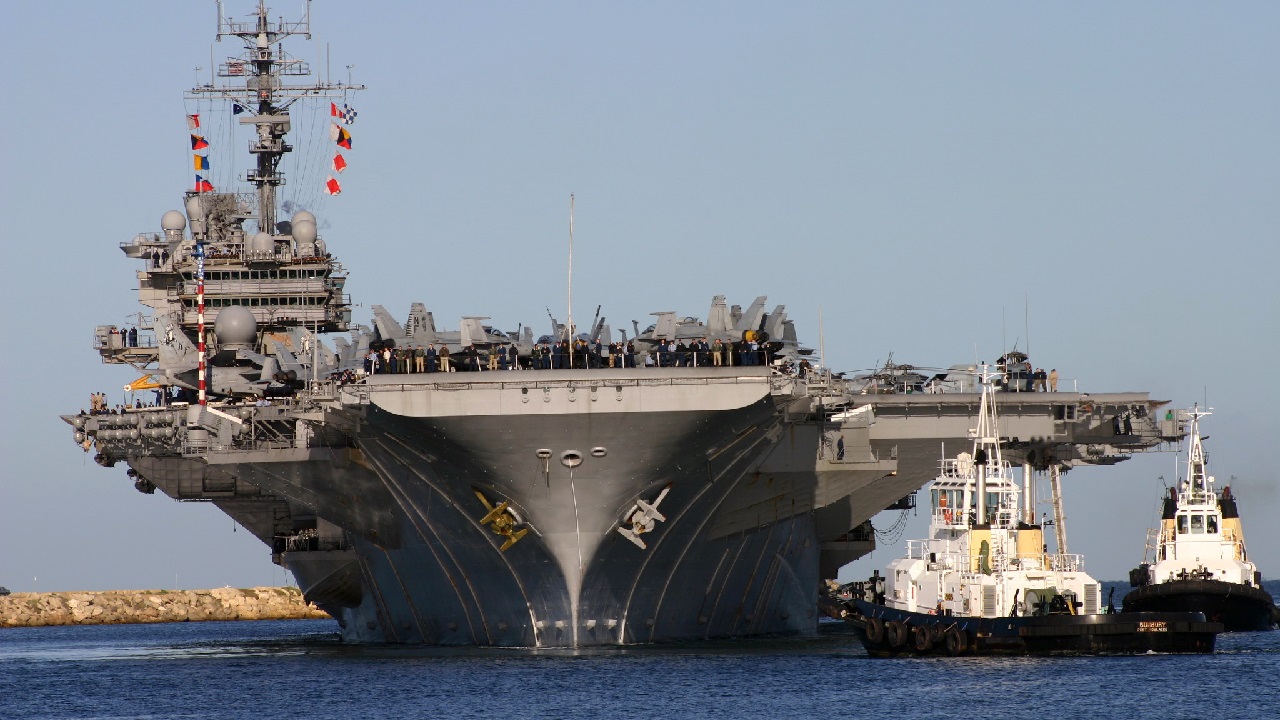
Fremantle Harbour, Australia (Apr. 22, 2004) – Tug boats escort USS Kitty Hawk (CV 63) and embarked Carrier Air Wing Five (CVW-5) into Fremantle Harbour, Australia where the crew will enjoy a five day port call. This was Kitty Hawk’s fifth visit to Fremantle and the ninth for CVW-5. Kitty Hawk is one two remaining conventionally powered aircraft carriers in the U.S. Navy, and is currently homeported in Yokosuka, Japan.
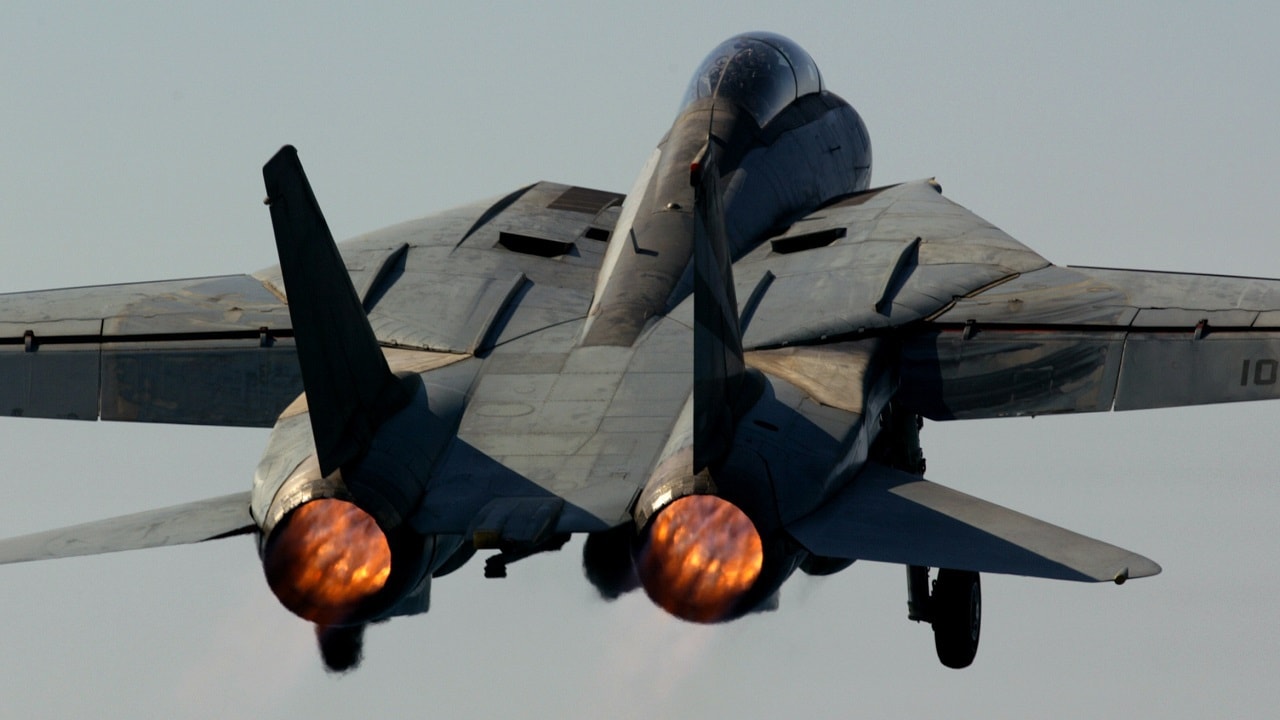
An F-14 Tomcat fighter jet takes off from the USS Kitty Hawk aircraft.
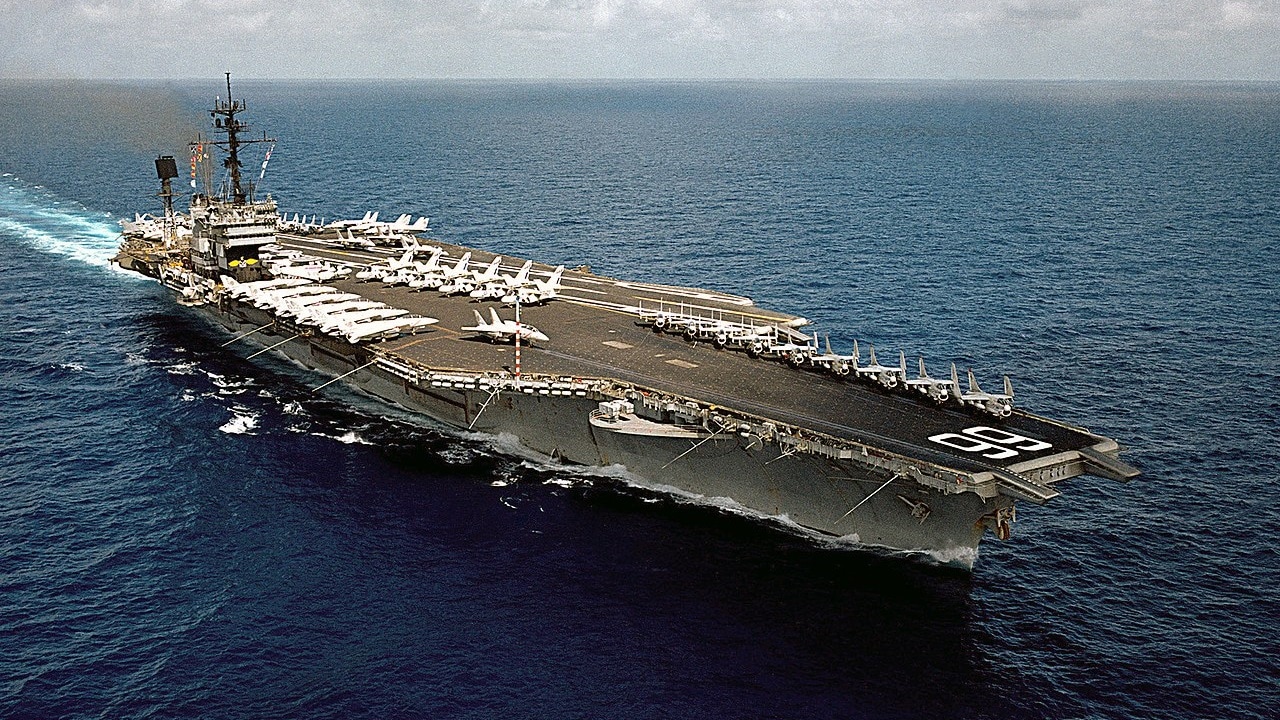
An aerial starboard bow view of the aircraft carrier USS AMERICA (CV-66) underway.

050517-N-0120R-127.USS KITTY HAWK, At Sea (May 17, 2005) – While departing Yokosuka’s harbor, USS Kitty Hawk (CV 63) steams past a small group of Japanese fishing vessels and steams toward Sagami Bay to conduct precision anchor checks. Currently underway in the 7th Fleet area of responsibility, Kitty Hawk demonstrates power, projection and sea control as the U.S. Navy’s only permanently, forward-deployed aircraft carrier, operating from Yokosuka, Japan..U.S. Navy photo by Photographer’s Mate 2ND Class William H. Ramsey.
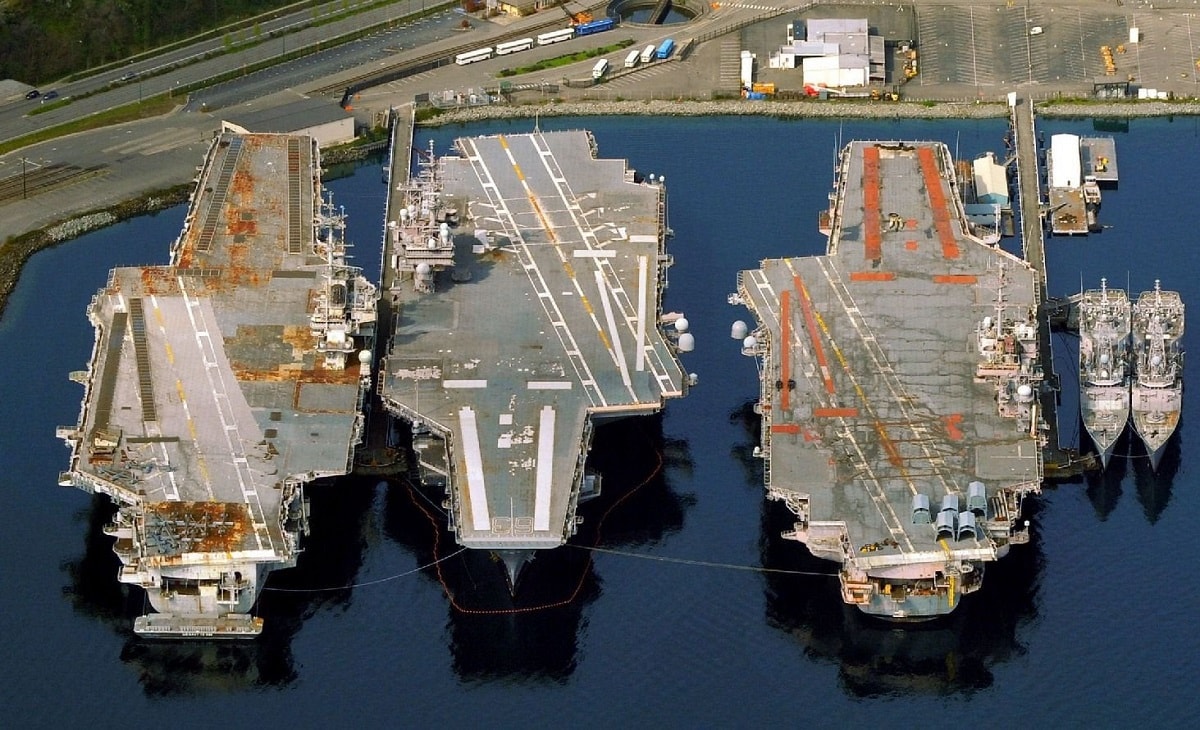
Image of several old carriers headed to scrap yard.
About the Author: Kris Osborn
Kris Osborn is the Military Technology Editor of 19FortyFive and President of Warrior Maven – Center for Military Modernization. Osborn previously served at the Pentagon as a highly qualified expert in the Office of the Assistant Secretary of the Army—Acquisition, Logistics & Technology. Osborn has also worked as an anchor and on-air military specialist at national TV networks. He has appeared as a guest military expert on Fox News, MSNBC, The Military Channel, and The History Channel. He also has a Masters Degree in Comparative Literature from Columbia University.