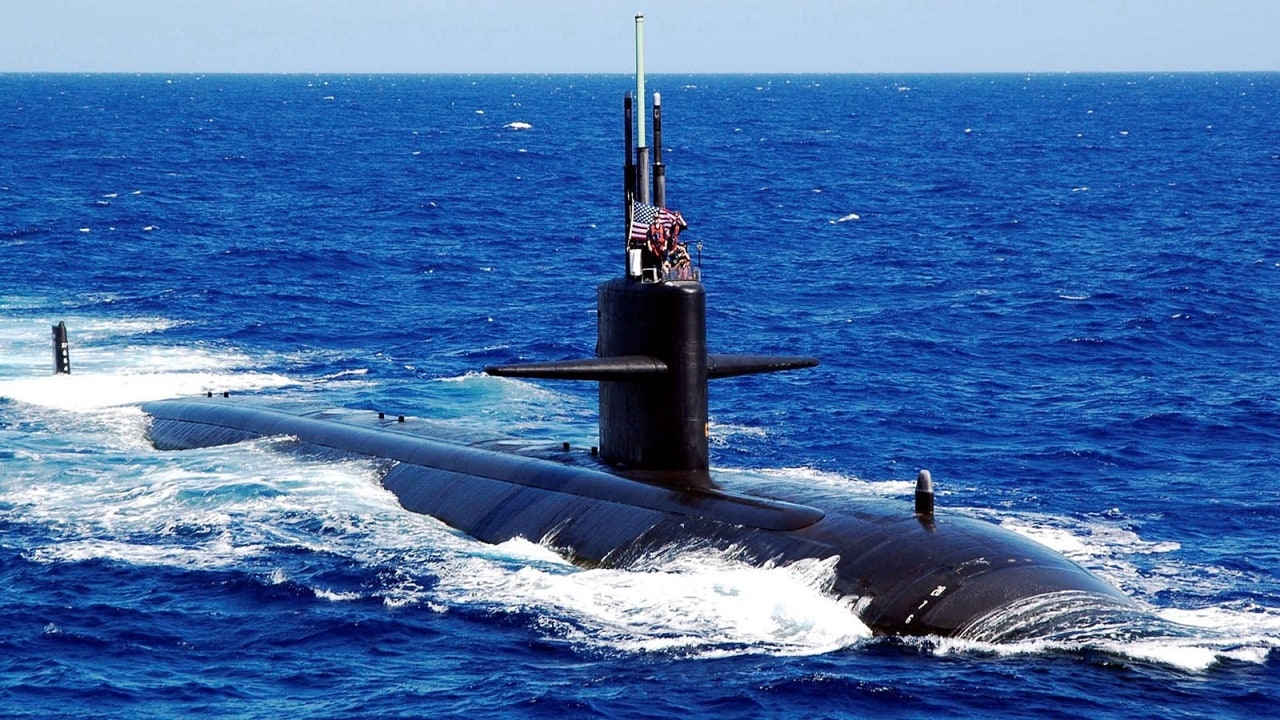
Summary and Key Points: The Los Angeles-class submarines have served as the backbone of the U.S. Navy’s submarine fleet for decades, boasting powerful weapons and upgraded digital systems for rapid threat response.
-With only 20 of the original 62 subs remaining in service, the Navy faces the pressing challenge of quickly transitioning to newer Virginia-class submarines.
-Recent upgrades include advanced digital combat systems and refined sonar-to-weapons interfaces, enhancing combat readiness.
-The lessons learned from these improvements significantly influenced Virginia-class development.
-However, delays in the construction of Virginia-class boats raise concerns about maintaining submarine fleet strength as Los Angeles-class subs approach retirement.
Farewell to Los Angeles-Class Submarines? The Navy’s Replacement Dilemma
The U.S. Navy and its industry partners have built as many as 62 Los Angeles-class submarines, but only 20 remain as the class approaches the end of its service life. And, sadly, the Navy won’t be able to replace those boats easily.
While they are now being replaced by a new generation of high-tech Virginia-class boats, the Los Angeles-class submarines formed the backbone of the Navy’s undersea fleet for decades.
They are still critical.
The submarines are heavily armed for undersea warfare and surface attack. They are built to carry 25 torpedo-tube-launched weapons, as well as Mark 60 CAPTOR mines. Added to this, the last two variants of the submarine are armed with 12 vertical launch tubes for Tomahawk III missiles.
The latest variant, the 688I, can launch Mk 67 Submarine-Launched Mobile Mines, according to an essay in the U.S. Naval Institute Proceedings.
Los Angeles-Class Upgrades
The Los Angeles boats have been in service for nearly four decades, so it’s not surprising they would have been upgraded over the course of many years.
The latest variant’s command-and-control system features an advanced suite of computing, weapons interface technologies, and digital fire control.
The variant’s combat system is referred to as the Mark 1 Combat Control System (CCS)/All Digital Attack Center.
This system builds on an earlier variant, the Mk 117, the first all-digital fire-control system, which replaced legacy analog technology. The newest Mark 1 CCS is networked with the submarine’s sonar systems and with Mk 48 torpedo and Towed Array Motion Analysis operability.
This seems to indicate that signals detected from sonar could more quickly be communicated to weapons systems and fire control to enable a faster response in the event of enemy attack.
The Mk 1 operates with internal tracking, according to an essay from the Federation of American Scientists:
“The CCS internal tracker model provides processing for both towed array and spherical array trackers. Trackers are signal followers which generate bearing, arrival angle and frequency reports based on information received by an acoustic sensor. The CCS tracker model augments the sonar detection processing with corrections to detect SNRs due to the beam pattern shapes and effects. A tracker follows the strongest signal being received by an acoustic sensor. In addition to the effects caused by the array beam pattern, filters are applied to incoming signals to narrow the focus of a tracker,” the FAS paper explains.
This filtering of incoming sensor or acoustic data likely significantly improved targeting efficiency and identification, shortening the sensor-to-shooter loop so critical to prevailing in any undersea warfare engagement.
Los Angeles Influence on the Virginia-Class Submarines?
The upgrades to the Los Angeles-class seem quite significant in terms of internal networking and sensor data analysis, so it would stand to reason that the 688I variants of the Los Angeles-class informed the development of Virginia-class boats.
Virginia-class Block III submarines are not only built with advanced, high-speed computer processing, but are also driven by an automated fly-by-wire joystick-controlled navigational system.
With this technology, a human operator can perform command-and-control functions, while a computerized navigational system automates and sustains key functions such as speed and depth.
The Virginia-class Block III submarines also operate with a new generation of networking capabilities, such as a fiber-optic cable data-transport system that enables commanders to see periscope-like views from anywhere in the boat.
But, of course, the clear challenge is obvious: how will the Navy replace the Los Angeles-class subs quick enough not to harm the services overall lethality?
About the Author: Kris Osborn
Kris Osborn is the Military Technology Editor of 19FortyFive and President of Warrior Maven – Center for Military Modernization. Osborn previously served at the Pentagon as a highly qualified expert in the Office of the Assistant Secretary of the Army—Acquisition, Logistics & Technology. Osborn has also worked as an anchor and on-air military specialist at national TV networks. He has appeared as a guest military expert on Fox News, MSNBC, The Military Channel, and The History Channel. He also has a Masters Degree in Comparative Literature from Columbia University.