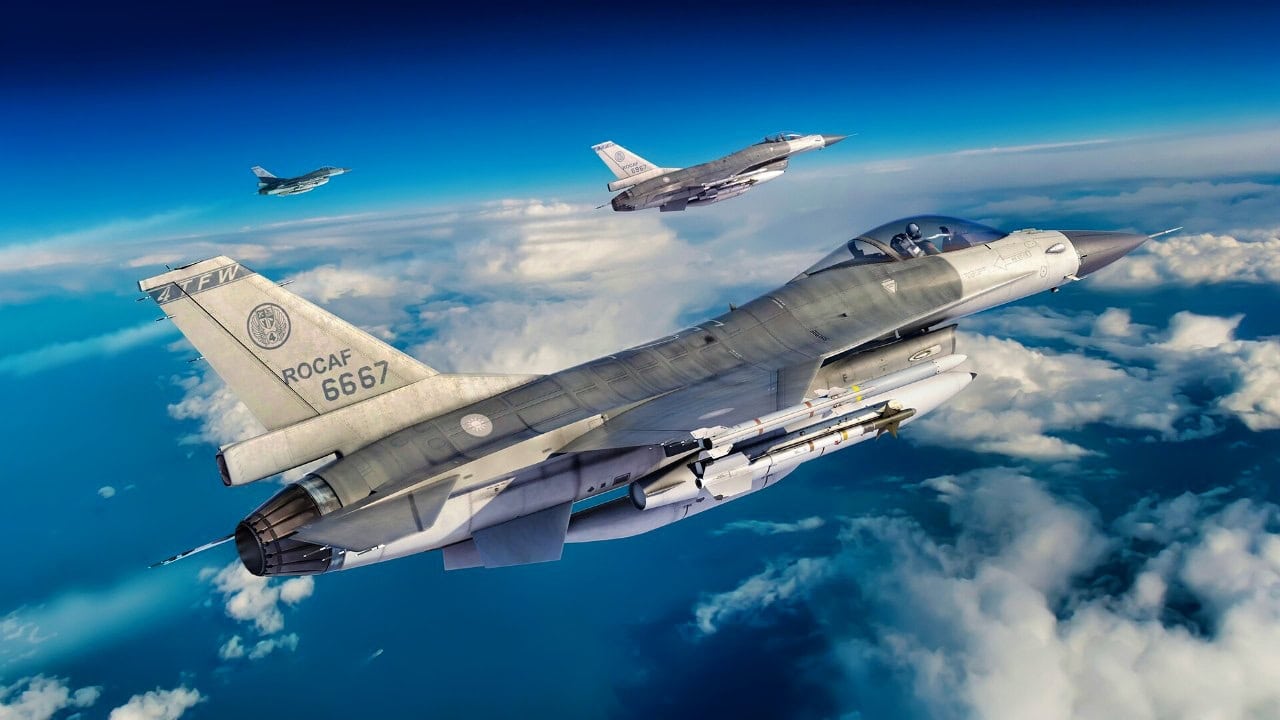
Key Points: As Ukraine integrates F-16 fighters, questions arise about their effectiveness against Russia’s advanced Su-35 jets.
-While proponents highlight the F-16’s agility, durability, and smaller radar signature compared to the large Su-35, a key factor is technology generation.
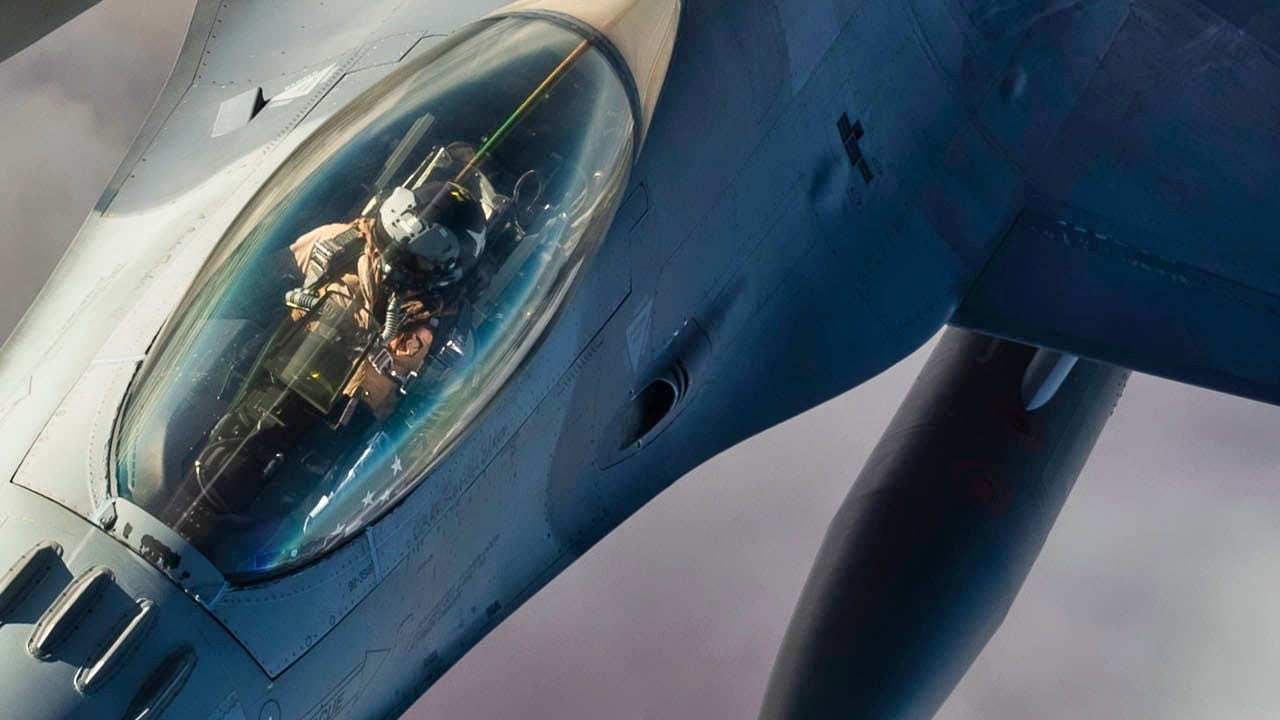
A U.S. Air Force F-16 Fighting Falcon is refueled over the U.S. Central Command area of responsibility Nov. 22, 2024. The F-16 avionics system includes highly accurate enhanced global positioning and inertial navigation systems in which computers provide steering information to the pilot. (U.S. Air Force photo by Staff Sgt. William Rio Rosado)
-The older F-16 models supplied to Ukraine likely feature mechanically scanned radar (AN/APG-66), which is technologically inferior to the Su-35’s electronically scanned PESA radar (N035 Irbis), granting the Russian jet a significant detection range advantage.
-Victory for Ukrainian F-16 pilots may hinge on superior tactics and skill, leveraging agility to close within missile range despite the radar disparity.
Su-35 vs. F-16 in Ukraine
Since the beginning of the Ukraine War in February 2022, the Ukrainian Air Force (PSU) has been begging the United States to supply them with the US F-16 fighter aircraft.
Moscow was using its fleet of advanced Sukhoi Su-35 and Su-30SM fighter jets to launch attacks on Ukraine, and other than donated Western air defense systems, there was no modern weapon system in the PSU arsenal to fight back with.
Ukraine inherited only much older models of Russian-made fighters from the Soviet era.
The PSU now has a cadre of trained F-16 pilots who are expanding the type and number of missions they can fly. The question is how the aircraft will fare against the more powerful Russian jets as it finally takes the fight in the air to the enemy.
At the end of March, Ukraine’s Euromaidan Press addressed the topic, explaining:
“Having more F-16 jets in its arsenal means that Ukraine can improve its operational flexibility in the skies, switching from purely defensive to offensive missions, at a much higher pace with overall bigger efficiency and with less risk. With the continuous degrading of the Russian air defense network, through a massive operation destroying hundreds of Russian launchers, radars, and electronic warfare systems over the past months, the increased quantity of F-16 fighter jets gain the freedom to be used aggressively in offensive roles as well.”
Opposing viewpoints exist on how the F-16 would fare in combat against the modern-day 4+++ generation and larger Su-35.
During a March 2023 interview given to Voice of America (VOA), retired US Air Force (USAF) Lieutenant Colonel Dan “Two Dogs” Hampton described the F-16 as “more durable” and overall gave the edge to the US jet in engagements. “I wouldn’t bet in combat on the Su-35 or any Russian-made aircraft,” he told the US state-funded news service.
David v. Goliath
Hampton elaborated on the David v. Goliath matchup of the Su-35, one of the largest fighters in the world, against the much smaller single-engine F-16. He calls one point in favor of the US-made fighter: the Su-35 lacks the more advanced radar systems that equip the F-16s.
The larger Su-35 also presents a larger radar cross section (RCS) than the American aircraft, which for the F-16 pilot makes it “easy to see, easy to pick up on radar, and easy to shoot at with a long-range missile.”
Hampton’s perspective comes from his personally flying more than 151 combat missions in the F-16 and chalking up 726 hours in the aircraft. Many of those missions were as a “Wild Weasel” pilot, in which he destroyed 21 different surface-to-air (SAM) sites.
The retired USAF officer also noted that the Su-35 has a larger wingspan of nearly 50 feet and is 70 feet long, compared to the F-16’s 33-foot wingspan and slightly less than 50 feet long. The Su-35’s “very large” airframe is one of several factors that Hampton says makes it “not really that good of a plane.”
The F-16 is not only smaller, but a much higher percentage of composites in its airframe design makes it a far lighter aircraft.
The bubble canopy gives the pilot better visibility out of the cockpit, and the side stick controller ergonomically creates a more agile control authority than the Russian twin-engine heavy fighter.
Radar Matchup
Where the Su-35 might have the edge, despite Gen. Hampton’s endorsement of the F-16, is nevertheless with its radar. This is not because today’s US fighter radars are inferior but because the F-16s provided to Ukraine to date are older, used models and not equipped with state-of-the-art radar sets.
Former Naval Aviator Brynn Tannehill told Popular Mechanics that one of the shortcomings of these original-generation F-16A/B models is that they were “designed back in the 1970s.”
“You can use the F-16 for air-to-air, but it’s not as good as an F-15,” he continued. “You can use it for close-air support, but it’s not as good as an A-10. It can do ground attack, but it’s not as good as an F-15E Strike Eagle … It’s a good aircraft at virtually everything, but it’s not the best at anything.”
The matchup on the radars is somewhat uneven. While modern F-16 variants come with the latest radar technology, Ukraine’s older F-16s still use an older, AN/APG-66 Mechanically Steered Array (MSA) radar set.
The Su-35 flies with a NIIP N035 Irbis Passive Electronically Scanning Array (PESA), a generation of technology beyond the American radar design.
“What really matters is your radar, your reach, your [network] connectivity and how low-observable [stealthy] you are,” Tannehill says. “Radar determines when you see the other guy. Reach allows you to determine when you get to shoot. Low-observable [stealth] allows you to push in closer.”
Once that shooting begins in earnest, the question of which aircraft can beat the other may come down to two factors: Can the smaller, less observable F-16 get close enough to shoot its much shorter-range air-to-air missiles, and can the Ukrainian pilots outperform the Su-35 with the more maneuverable F-16?
About the Author: Reuben F. Johnson
Reuben F. Johnson is a survivor of the February 2022 Russian invasion of Ukraine and is an Expert on Foreign Military Affairs with the Fundacja im. Kazimierza Pułaskiego in Warsaw. He has been a consultant to the Pentagon, several NATO governments and the Australian government in the fields of defense technology and weapon systems design. Over the past 30 years he has resided in and reported from Russia, Ukraine, Poland, Brazil, the People’s Republic of China and Australia.