
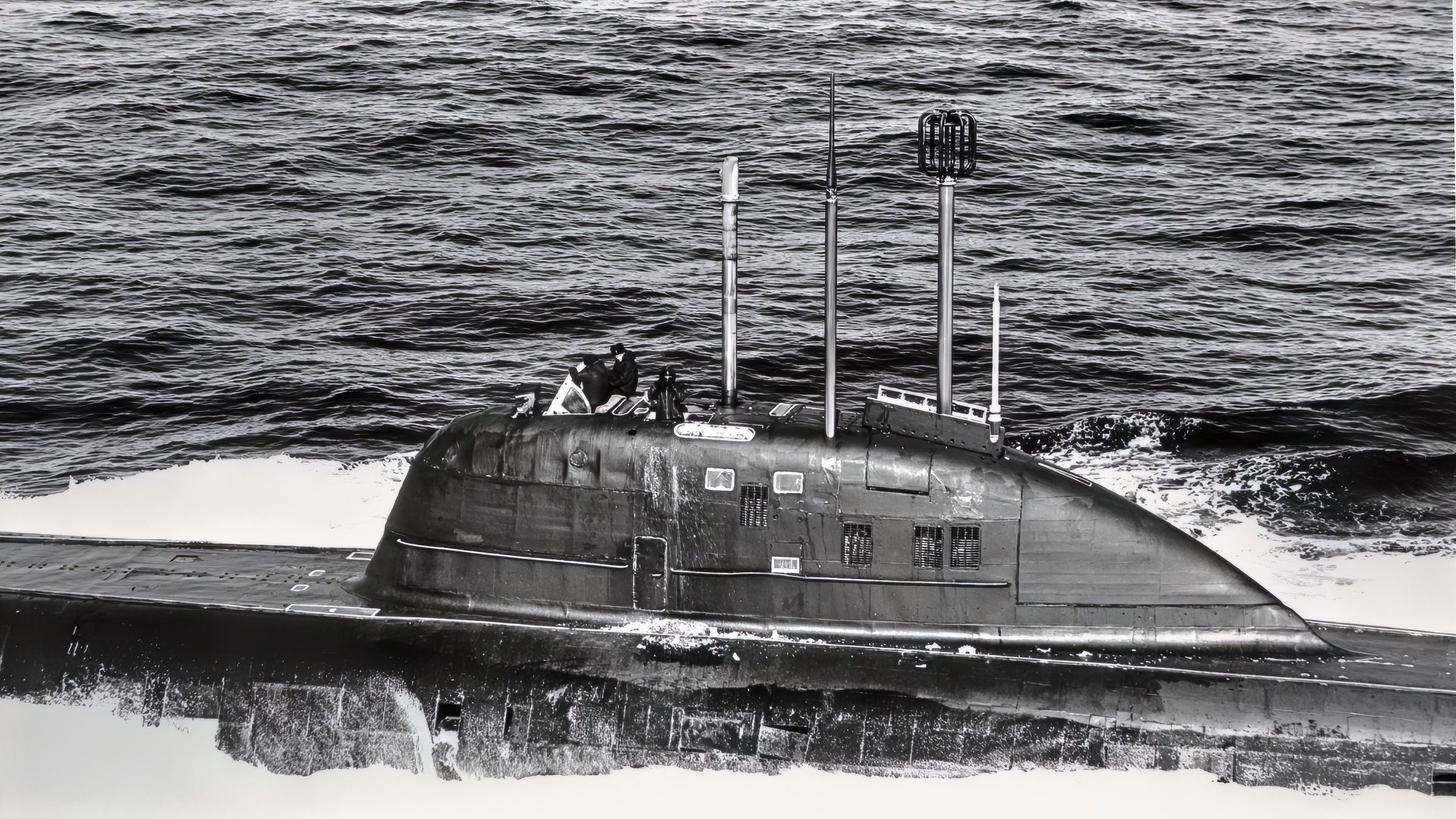
Key Points and Summary – The Soviet Navy’s K-278 Komsomolets was a one-of-a-kind Mike-class nuclear submarine with a titanium hull and record-breaking dive depth over 1,000 meters.
-On April 7, 1989, an electrical fault sparked a fire in an aft compartment while patrolling the Norwegian Sea, crippling key systems and forcing the crew to surface and abandon ship.

An aerial port quarter view of a Soviet Mike class nuclear-powered attack submarine underway.
-The boat ultimately sank to 1,685 meters with its reactor and two nuclear-tipped torpedoes, killing 42 of 69 sailors.
-The disaster exposed design flaws, raised long-term environmental fears, and turned Komsomolets into a tragic symbol of Soviet naval risk-taking and sacrifice. Survivors and families still seek recognition and lessons learned.
K-278 Komsomolets: The Soviet Super-Sub That Sank With Nuclear Weapons On Board
The K-278 Komsomolets, or Project-685 Plavnik, was a one-of-a-kind submarine that met an unfortunate end.
Due to an electrical fault, a fire broke out in the aft compartment, ultimately causing the ship to sink. The majority of the crew. The ship was lost along with its nuclear reactor and two nuclear-armed torpedoes that she was carrying.
Russia’s Only “Mike-Class” Submarine
The Komsomolets was a unique vessel, the only submarine of the Project 685 Plavnik class, known to NATO as the Mike-class.
It was designed as a prototype to test advanced technologies that could be incorporated into future Soviet submarines.
Launched in 1983 and commissioned in 1984, the Komsomolets was a marvel of engineering, featuring a titanium hull that allowed it to dive deeper than any other combat submarine of its time.
Its operational depth exceeded 1,000 meters, a capability unmatched by Western submarines.
Powered by a single nuclear reactor, it was armed with conventional and nuclear-tipped torpedoes and equipped with an escape capsule intended to improve crew survivability in case of disaster.
Despite its impressive specifications, the Komsomolets was a prototype, and prototypes often carry inherent risks.
It had not undergone the extensive testing and refinement typical of production models, and this would prove critical during its final voyage.
On the morning of April 7, 1989, the submarine was patrolling the Norwegian Sea, approximately 180 kilometers southwest of Bear Island.
At around 11:00 AM, a fire broke out in the aft compartment, likely caused by an electrical short circuit.
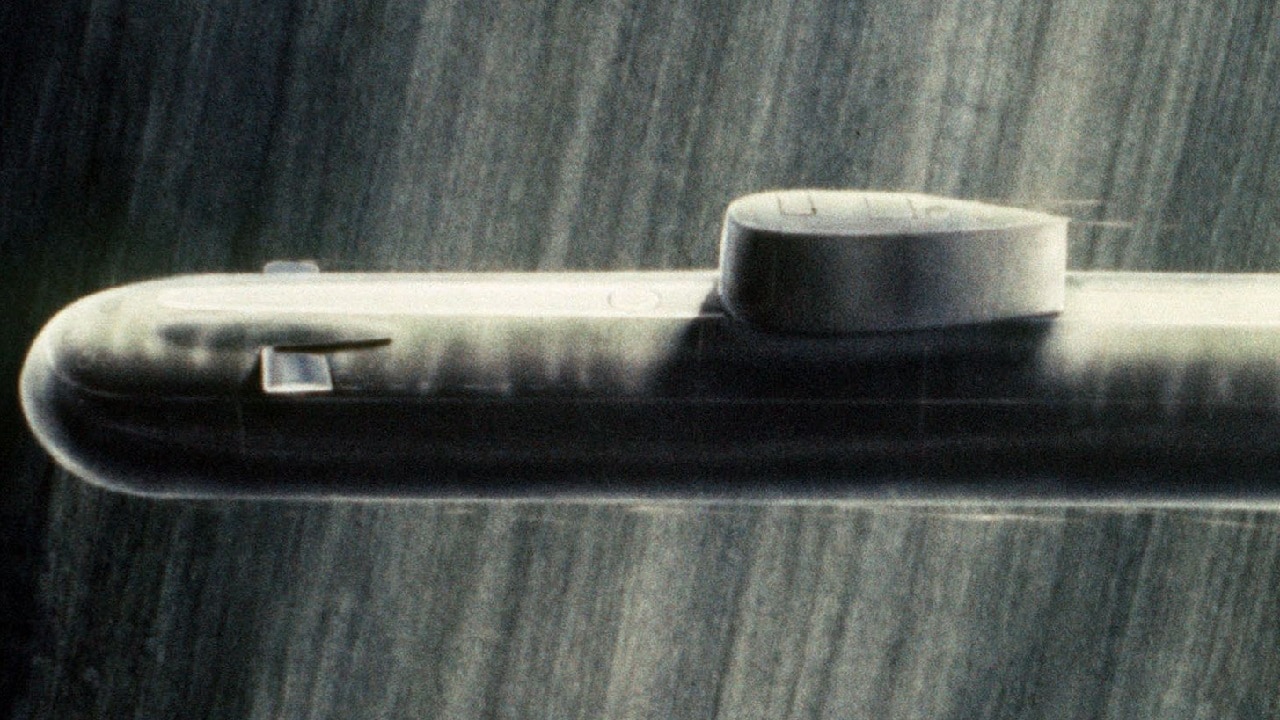
Mike-class submarine. Image Credit: Creative Commons.
The blaze spread quickly, disabling key systems and threatening the vessel’s integrity.
The Komsomolets Sinks
The crew responded swiftly, attempting to contain the fire, but the situation deteriorated rapidly. The reactor was shut down as a precaution, and the submarine began to lose propulsion and electrical power.
Smoke filled the compartments, and temperatures soared. Despite the crew’s efforts, the fire could not be extinguished. Captain Evgeny Vanin, faced with a worsening crisis, ordered the crew to abandon ship.
The submarine surfaced, but the cold waters and rough seas made evacuation perilous. The escape capsule was deployed, but only one crew member used it successfully. Others jumped into the freezing water or clung to life rafts.
At 5:08 PM, the Komsomolets sank to the ocean floor with its nuclear payload still on board, settling at a depth of 1,685 meters. Of the 69 crew members, only 27 survived, many suffering from hypothermia and exposure.
The remaining 42 perished, some in the fire, others in the icy sea. The Soviet Navy launched a rescue operation, but it was hampered by the remote location and poor weather.
A nearby fishing vessel, the Alexandr Obukhov, was the first to respond, rescuing several survivors.
However, many crew members died while awaiting help, highlighting deficiencies in Soviet emergency preparedness and coordination.
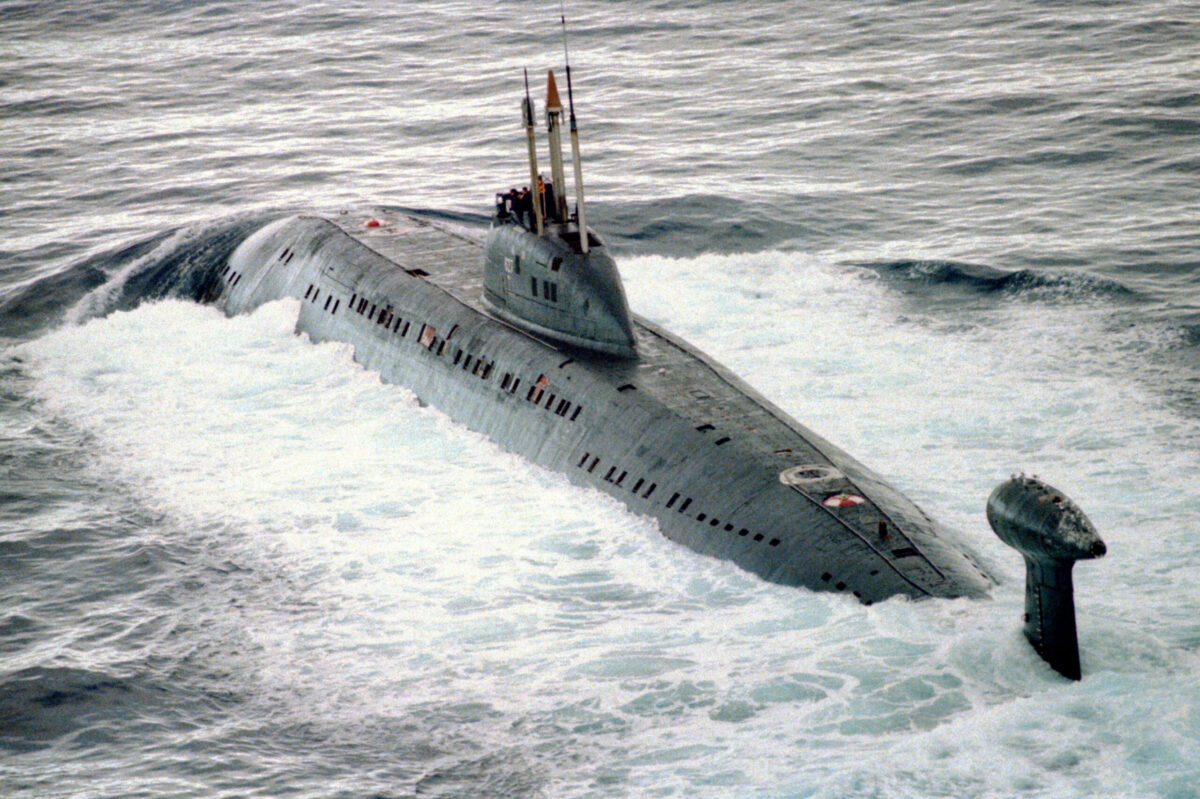
An aerial port quarter view of the Russian Northern Fleet VICTOR III class nuclear-powered attack submarine underway on the surface.
(Exact date unknown)
Immediate Aftermath
Somewhat understandably, the USSR initially tried to cover up the incident. Soviet authorities were reluctant to disclose details, especially given the presence of nuclear weapons and the potential for radioactive contamination.
It wasn’t until later that the full scope of the disaster became known. The sinking of a nuclear-powered submarine with nuclear-tipped torpedoes raised serious environmental concerns.
The Komsomolets carried two nuclear torpedoes, and its reactor remained on the seabed. Fears of radioactive leakage prompted international monitoring efforts.
No Soviet reports on the incident were ever made public in the aftermath. However, it is generally assumed that the Komsomolets was sunk due to an electrical or engineering fault.
Based on the available information, it is reasonable to conclude that the incident was not the crew’s fault, but rather a result of the ship’s design.
Once the fire started, the high-pressure air lines fed the fire like a furnace, making it virtually inextinguishable.
Despite the measures taken quickly, the submariners lacked the necessary firefighting equipment to put out or contain the fire.
Environmental Investigations
In the years following the disaster, several expeditions were launched to assess the wreck and contain potential contamination.
In 1994, a joint Norwegian-Russian expedition confirmed that the submarine was leaking small amounts of radioactive isotopes, including cesium-137.
Subsequent efforts involved sealing the torpedo tubes and reactor compartment to prevent further leakage. The loss of Komsomolets was a blow to Soviet naval prestige.
It exposed the limitations of Soviet submarine safety protocols and led to increased scrutiny of nuclear submarine operations. The incident also contributed to broader discussions about arms control and environmental responsibility in the post-Cold War era.
In Russia, the crew of the Komsomolets is still remembered as heroes, and memorials have been erected in their honor.
Vice Admiral Chernov, commander of the submarine group of which the Komsomolets was part, founded the Komsomolets Nuclear Submarine Memorial Society, a charity dedicated to supporting the family members of the sailors who died in the submarine.
In 2009, on the 20th anniversary of the sinking, Russian President Dmitry Medvedev posthumously awarded the Order of Courage to the deceased crew members. Survivors and families of the victims continue to advocate for recognition and support.
About the Author: Isaac Seitz
Isaac Seitz, a Defense Columnist, graduated from Patrick Henry College’s Strategic Intelligence and National Security program. He has also studied Russian at Middlebury Language Schools and has worked as an intelligence Analyst in the private sector.