Key Points and Summary – On paper, Russia’s Su-35 and America’s F-22 Raptor look surprisingly close. Both can sprint at around Mach 2.25, boast excellent thrust-to-weight ratios, and use extreme maneuverability and vectoring to win the merge.
-But beneath those shared performance stats, the gap widens.
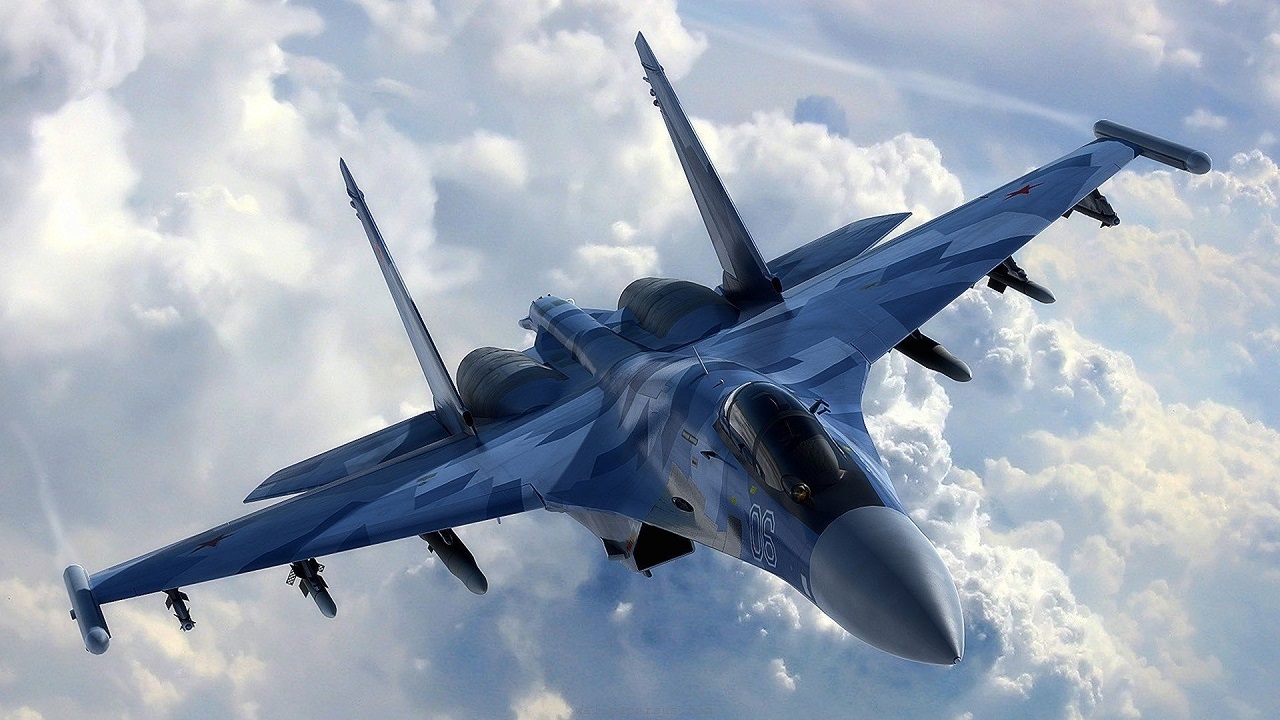
Artist rendering of a Russian Su-35 fighter. Image Credit: Creative Commons.
-The Su-35 is a highly evolved “4.5-generation” upgrade of the Su-27, with powerful sensors, heavy weapons, and strong kinematics.
-The F-22, however, is a true fifth-generation stealth fighter with a smaller radar signature, more advanced sensor fusion, and software-driven weapons upgrades.
-In any real shootout, the jet that sees first and shoots first—almost certainly the Raptor—likely wins.
Su-35 Might Be the F-22’s Toughest Foe – On Paper
Combat between an F-22 and a Russian Su-35 would be interesting for many reasons.
The planes share similar performance parameters in critical areas such as thrust-to-weight ratio and speed.
Their ability to vector, quickly maneuver, and get into position for an attack might be comparable to some extent, as the upgraded Su-35 is a modern variant of the extremely fast Russian Su-27.
However, the F-22 is a fifth-generation aircraft, and the Su-35, while advanced, is considered a fourth-generation-plus fighter. How stealthy is the Su-35?
It does look somewhat stealthy, which further raises the question of whether the Su-35 could truly challenge the F-22.
F-22 is Stealthier
The experience and skill of the pilots would, of course, be critical in determining which aircraft might prevail in an engagement, but stealth and other technical attributes matter.
The Su-35’s maximum speed is listed at Mach 2.25, and the aircraft is reported to have a 1.13 thrust-to-weight ratio. The F-22’s listed speed is identical, but the Raptor has a slightly superior thrust-to-weight ratio of 1.25.
Given these similarities, it is worth looking at other key parameters such as stealth properties, sensing, and weapons guidance and precision.
The F-22 is stealthier as a full-fledged fifth-generation aircraft, and software-driven weapons upgrades should give it a further advantage over the Su-35.
Russian Su-35—4th-Generation+
The Su-35 could almost be viewed as a mix of advanced fourth-generation and basic fifth-generation jet technologies.
Its blended wing-body configuration and horizontal fuselage make it look stealthier than an F/A-18 Super Hornet—indeed, it has an almost F-22-like rounded wing-body and dual engine.
The Russian Su-35’s configuration appears stealthy enough to have inspired the emerging Russian Su-57, a full-fledged fifth-generation stealth aircraft.
The Su-35 aircraft came about as a result of years of upgrades to the Su-27 air-defense fighter. With its high speed of Mach 2.25, the Su-35 looks well positioned to dogfight and vector in the air as an air-to-air supremacy fighter, yet it would seem unlikely that it could rival an F-22’s capabilities in this category.
However, beyond the two aircraft’s visual similarities and equal speed, some of the listed weapons capabilities are comparable as well. Further, while the claim would be tough to verify, Russian newspaper Hoboctn BNK claims the Su-35 has an F-22-like “supercruise” ability to maintain mach speeds without needing an afterburner.
The F-22’s supercruise extends dwell time and lethality while lengthening attack missions without aerial refueling. This dramatically improves survivability, especially if an F-22 finds itself locked in a dogfight and needs to sustain maneuvers.
Su-35 Upgrades
While both the F-22 and the Su-35 can take off vertically and accelerate, does the Su-35 outperform an F-22 in terms of pure thrust, acceleration, and thrust at a high rate of climb?
At the very least, the two aircraft may be comparable—a significant observation given that the F-22 is widely referred to as the world’s best air-dominance fighter jet.
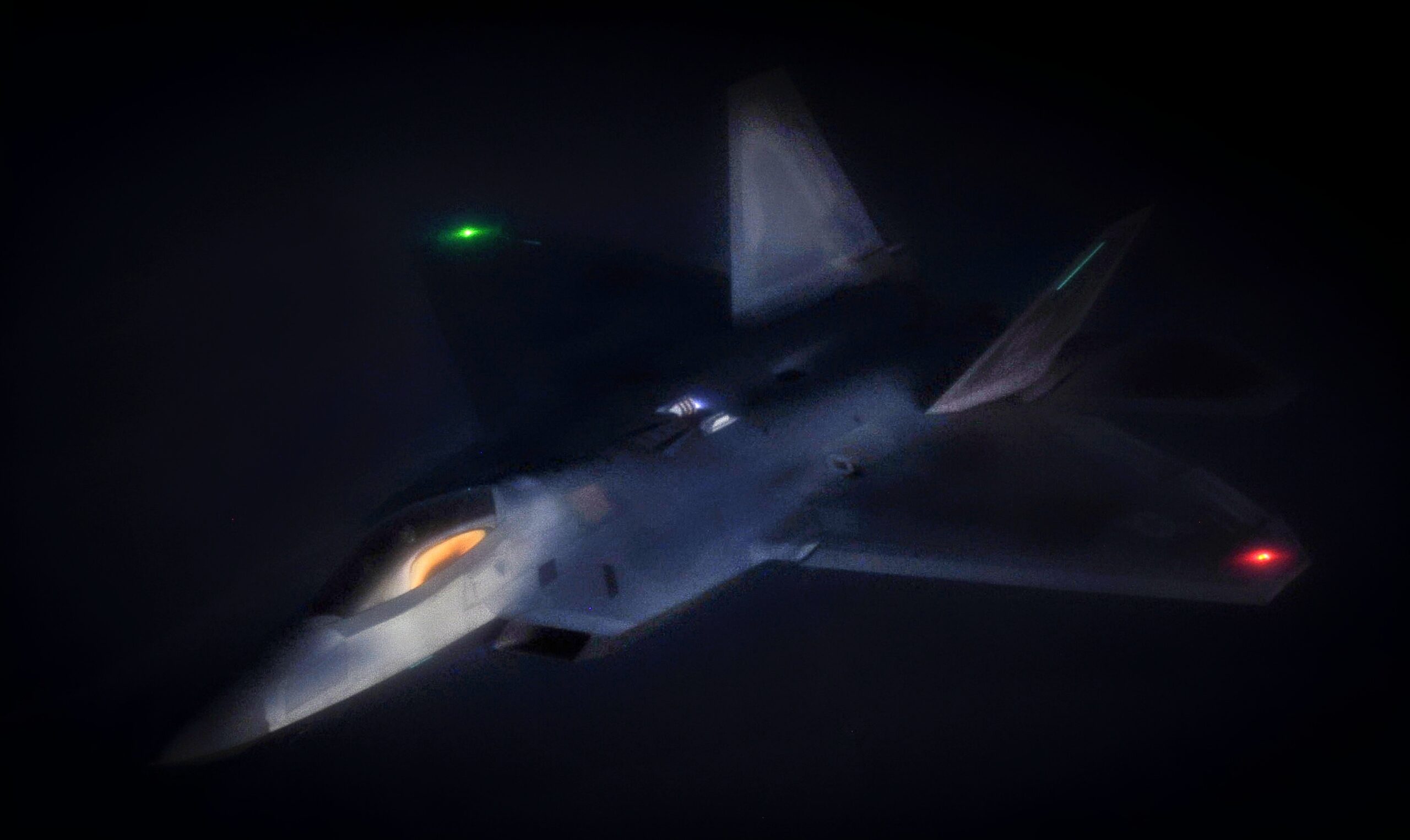
An F-22 Raptor fighter jet, assigned to the 433rd Weapons Squadron at Nellis Air Force Base, Nev., maneuvers after being refueled by a KC-135 Stratotanker during a Weapons School Integration mission over the Nevada Test and Training Range June 8, 2012. One of the most important planned aspects of this mission is holding it during the hours of darkness. (U.S. Air Force photo by Senior Airman Kevin Tanenbaum/Released)
The key to any engagement between the two aircraft might lie in their respective abilities to vector and maneuver at high speed. However, that question becomes less relevant if one fighter has superior sensing, radar, targeting, and weapons guidance.
The Su-35 operates with a passive electronically scanned array reportedly capable of tracking multiple targets out to 250 miles.
It can generate synthetic-aperture radar imagery of the ground below.
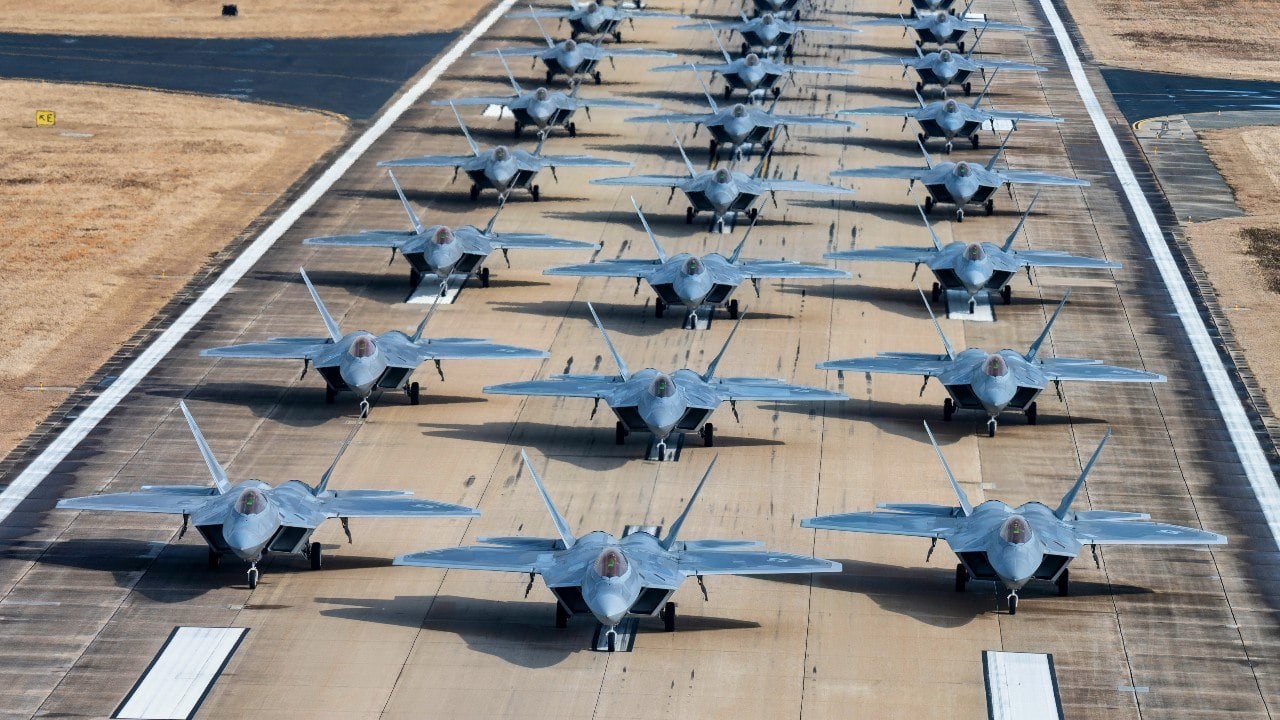
Aircraft from the 1st Fighter Wing conducted an Elephant Walk at Langley Air Force Base, Virginia, Jan. 31, 2025, showcasing the wing’s readiness and operational agility. This demonstration highlighted the wing’s capability to mobilize forces rapidly in high-stress scenarios. The wing’s fleet includes F-22 Raptors and T-38 Talons. As Air Combat Command’s lead wing, the 1 FW maintains unparalleled combat readiness to ensure national defense at a moment’s notice. (U.S. Air Force photo by Tech Sgt. Matthew Coleman-Foster)
The aircraft has a measure of computer automation with a fly-by-wire system and is also quite lethal as an air-to-ground and air-to-surface platform.
Available specs say the Su-35 can attack with an Oniks anti-ship cruise missile as well as an extensive suite of air-to-air weapons and air-to-ground weapons.
About the Author: Kris Osborn
Kris Osborn is the President of Warrior Maven – Center for Military Modernization. Osborn previously served at the Pentagon as a highly qualified expert in the Office of the Assistant Secretary of the Army—Acquisition, Logistics & Technology. Osborn has also worked as an anchor and on-air military specialist at national TV networks. He has appeared as a guest military expert on Fox News, MSNBC, The Military Channel, and The History Channel. He also has a Masters Degree in Comparative Literature from Columbia University.
More Military
The Army’s AH-64E Apache Helicopter Can Destroy Drones with Missiles
U.S. Navy Iowa-Class Battleship USS New Jersey’s ‘Comeback’ Is Now Complete
Blaze of Glory: The SR-71 Blackbird Retired Hitting Mach 3.21