Key Points and Summary – The Montana-class was meant to be the U.S. Navy’s ultimate battleship: larger than the Iowa-class, slower but far better protected, and armed with twelve 16-inch guns in four triple turrets.
-With heavier belt and deck armor, improved torpedo protection, and advanced radar fire control, the Montanas were designed to outfight Japanese heavyweights like Yamato at long range.

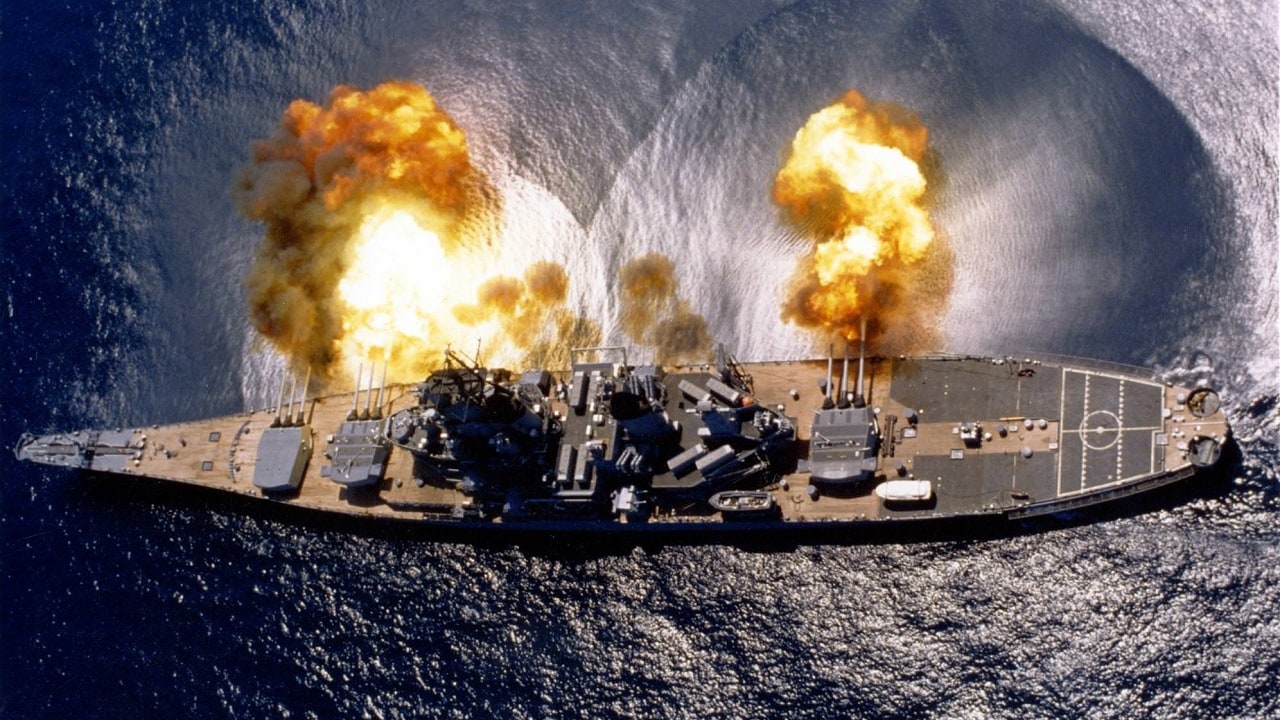
USS New Jersey (BB 62) fires her 16” guns during a training exercise at San Clemente Island during fleet training exercises conducted off the coast of California. Photographed, July 15, 1968. Official U.S. Navy Photograph, now in the collections of the National Archives.
-But by 1943, wartime realities and the rise of carrier airpower killed the program before a single keel was laid.
-Aircraft carriers, submarines, and guided missiles made such massive gun ships increasingly obsolete, leaving the Montana-class as one of naval history’s great “what ifs.”
Montana-Class Battleships: The Super–Iowas America Never Built
The Montana-class battleships were a series of five planned U.S. Navy battleships intended to succeed the Iowa-class battleships during World War II.
Although they were never constructed, the Montanas would have represented the pinnacle of U.S. battleship design, able to boast enormous size, firepower, and excellent armor protection.
However, the U.S. Navy ultimately canceled the new class of battleship, marking a turning point in naval warfare, as the rise of airpower rendered the battleship increasingly obsolete.
The Design of Montana-Class
The Montana-class differed fairly significantly from the preceding Iowa-class in several key areas.
While the Iowas were designed as fast battleships with a top speed of 33 knots, intended to escort aircraft carriers and operate alongside other fleet units, the Montanas gave up some speed for better armor and more firepower.
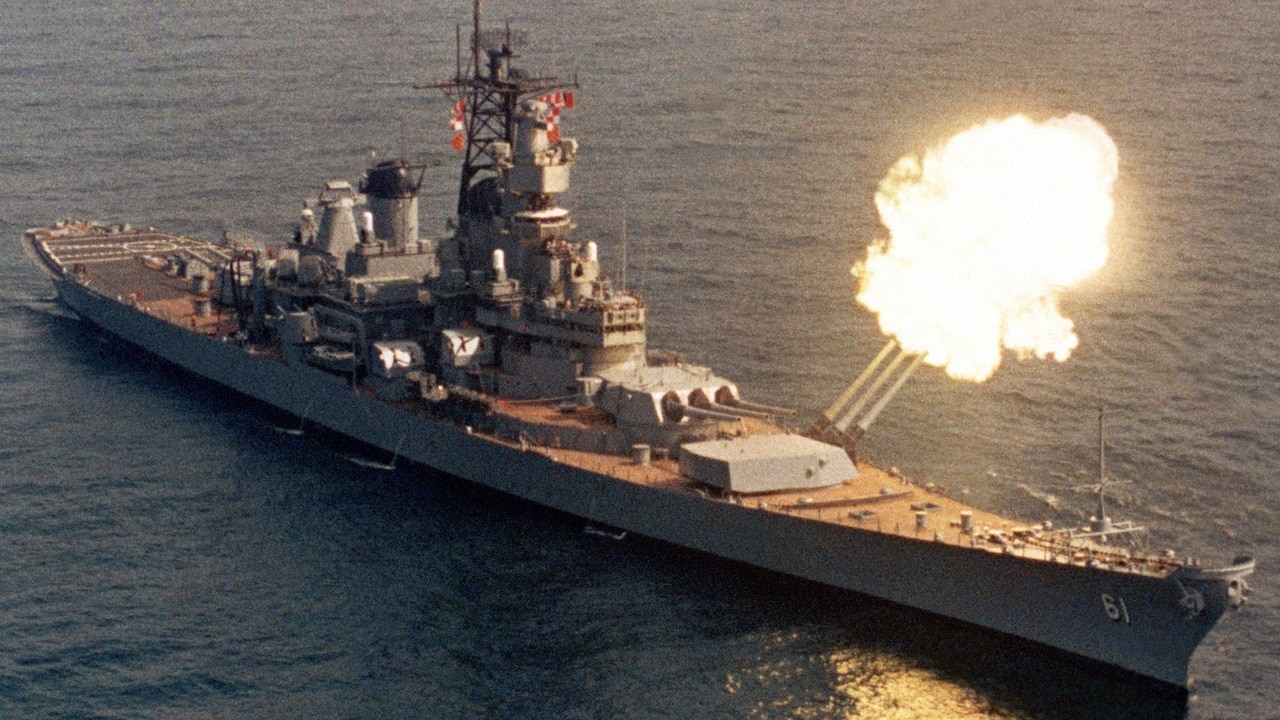
An aerial starboard bow view of the battleship USS IOWA (BB 61) firing a 2,700-pound projectile from the barrel of a forward 16-inch gun during sea trials off the coast of Mississippi. The IOWA is scheduled to be recommissioned into the fleet on April 28, 1984, after completion of modernization/reactivation construction at Ingalls Shipbuilding, Pascagoula, Mississippi.
With a maximum speed of around 28 knots, the Montana-class was somewhat slower, but it was also better suited to withstand heavy gunfire and air attacks from naval aviation.
The battleships were also larger, with a planned displacement of over 70,000 tons when fully loaded, compared to the Iowa-class’s approximate 57,000 tons displacement.
The Montana-class ships were to be armed with twelve 16-inch/50 caliber Mark 7 guns arranged in four triple turrets. This provided greater broadside firepower than the Iowa-class, which carried just nine such 16-inch guns in three, three-gun turrets.
The Montanas’ armor protection was also better than that of the Iowa-class, which featured a thicker armor belt and thicker deck armor designed to resist contemporary Japanese shells at long ranges.
The underwater protection system was improved to better withstand torpedo attacks, and the ships were designed with a more extensive subdivision internally to increase survivability.
When compared to Japanese battleships of that time like the Yamato-class, the Montanas would have been more evenly balanced between offense and defense.
While the Yamato-class carried larger 18.1-inch guns and had thicker armor, it lacked the radar fire-control systems and versatility of U.S. Navy battleships.
The Montana-class were designed with advanced fire-control technology, giving them a potential accuracy advantage in long-range engagements.
If effective, their higher accuracy could have made up for their smaller overall shell diameter compared to their Yamato-class counterparts.
Despite their design — nothing short of remarkable — the Montana-class battleships were never built.
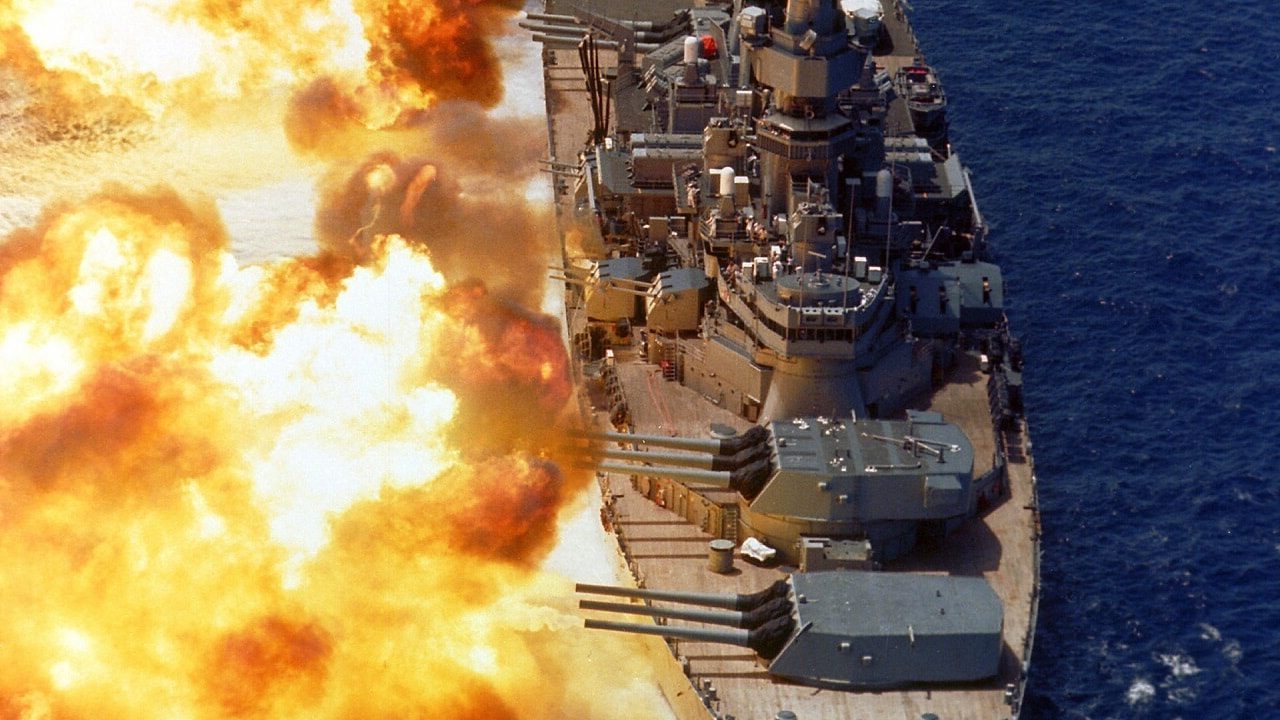
Iowa-class battleship firing off a broadside.
The demands of wartime shipbuilding forced the U.S. Navy to prioritize aircraft carriers and smaller ships like destroyers, which were proving more decisive in the Pacific Theater.
The Montanas were formally canceled in 1943 before construction began, as resources were redirected to support carrier operations and amphibious warfare in support of the United States Marine Corps.
In addition, the Panama Canal’s existing locks could not accommodate the Montanas’ larger size, which would have restricted their operational flexibility globally.
Iowa-class Forever
The Iowa-class battleships on the other hands were completed and saw extensive service during World War II. They later enjoyed prolonged service lives during the Cold War and were modernized and reactivated multiple times.
Their speed, adaptability, and capacity to carry cruise missiles and other modern armaments — as well as the ability of modern naval aviation and anti-air weaponry to keep the battleships safe — made them viable even into the late 20th century, with the last Iowa-class ship being decommissioned in the 1990s.
Had the Montanas been built, their utility in the Cold War would have been limited.
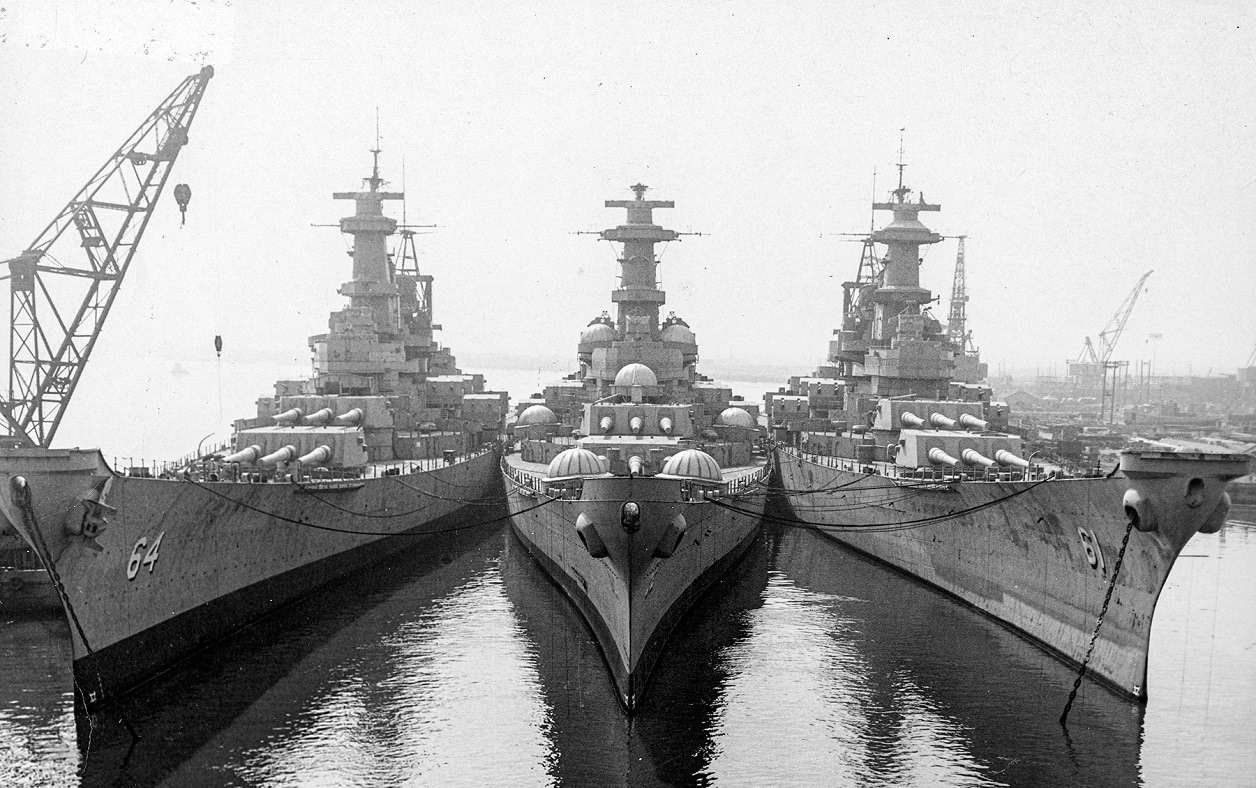
Image of Iowa-class Battleships. Image Credit: Creative Commons.
Their slower speed compared to the Iowas would have reduced their effectiveness in the evolving naval environment, where carriers and submarines play an outsized role.
By the 1950s and 1960s, advancements in guided missile technology and the shift toward airpower made heavily armored battleships like the Montanas increasingly redundant.
The Montana-class is a unique “what if” in American naval history. Had the class been able to enter service with the U.S. Navy before the end of World War II, they may have enjoyed a Cold War resurgence of greater scope than the Iowa-class purely by nature of their larger size and offensive power.
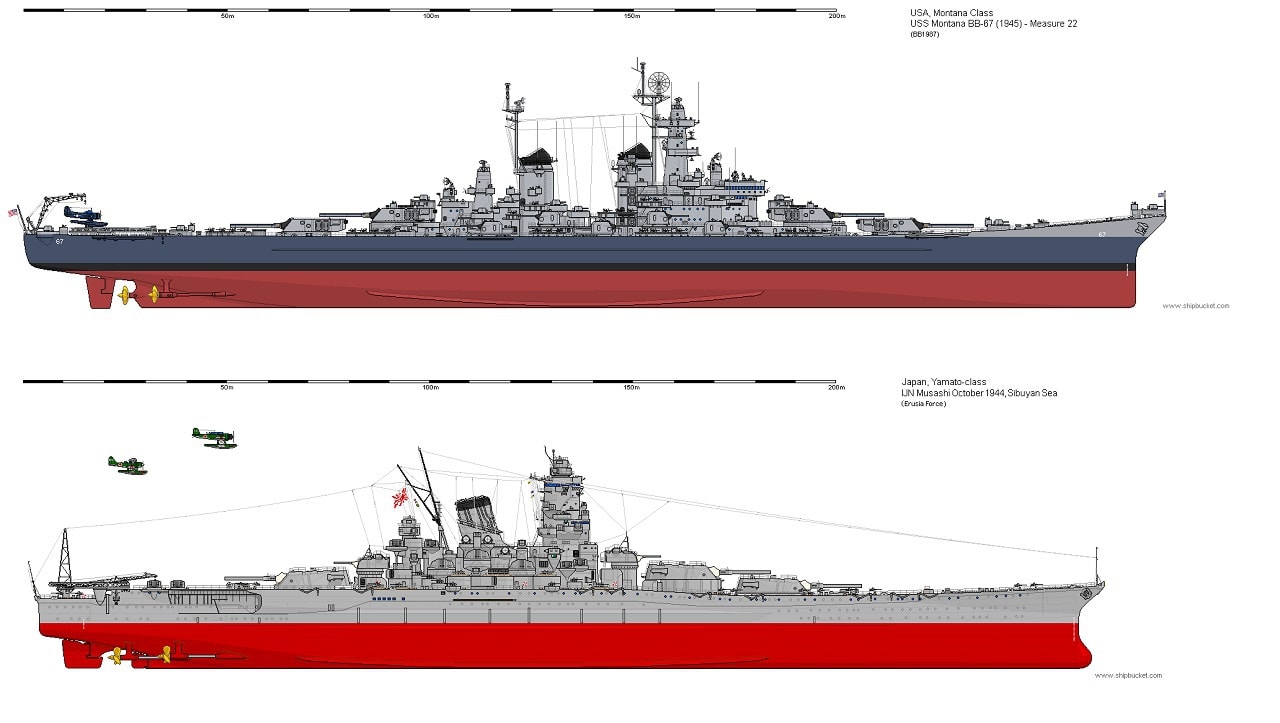
Montana-class compared to a Yamato-class battleship.
About the Author: Caleb Larson
Caleb Larson is an American multiformat journalist based in Berlin, Germany. His work covers the intersection of conflict and society, focusing on American foreign policy and European security. He has reported from Germany, Russia, and the United States. Most recently, he covered the war in Ukraine, reporting extensively on the war’s shifting battle lines from Donbas and writing on the war’s civilian and humanitarian toll. Previously, he worked as a Defense Reporter for POLITICO Europe. You can follow his latest work on X.