
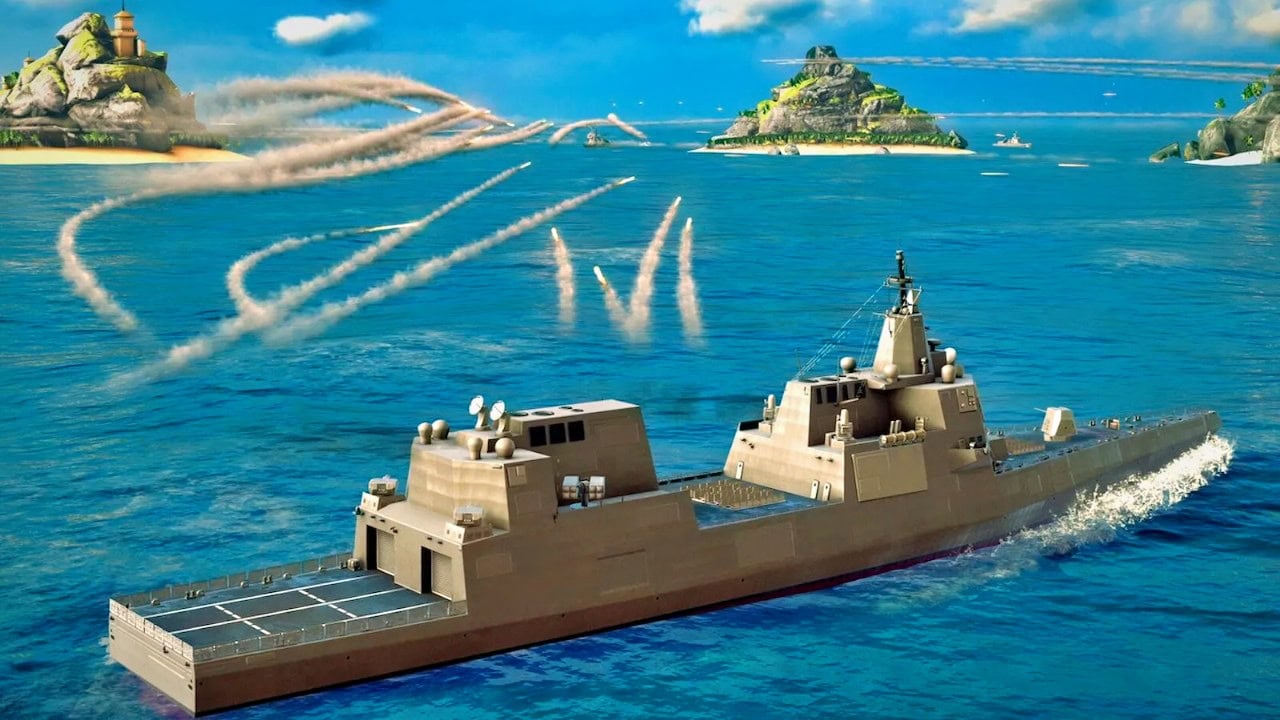
Key Points and Summary – The Navy’s DDG(X) is being designed for a Pacific war defined by missiles, drones, and lasers.
-Larger than today’s Arleigh Burkes, the 14,500-ton destroyer will replace aging cruisers with an upgraded Aegis Combat System, 96 VLS cells (some quad- or 12-packed), dual 21-cell RAM launchers, and a next-generation power system built to feed high-energy laser defenses.
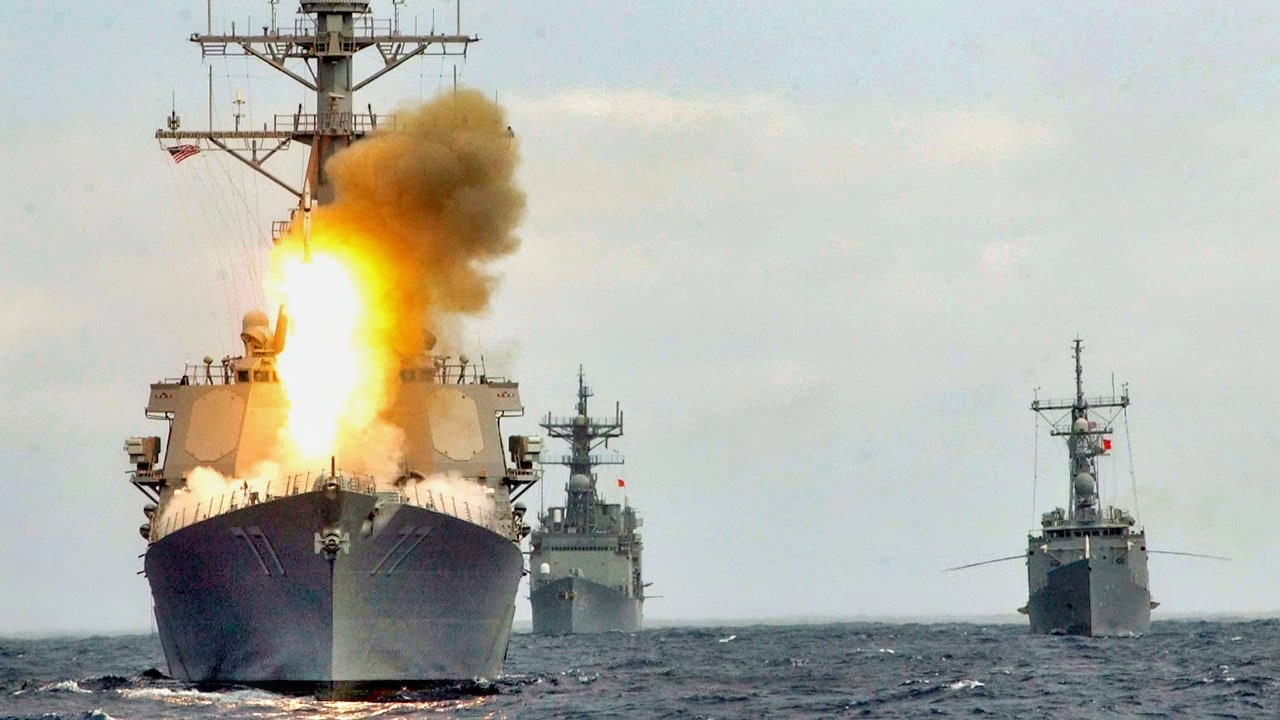
Pacific Missile Range Facility, Kauai, HI (Jul. 5, 2002) — Guided missile destroyer USS O’Kane (DDG 77) launches an SM-2 standard missile from its forward Vertical Launch System (VLS) during exercise ÒRim of the PacificÓ (RIMPAC) 2002. The guided missile frigate USS Crommelin (FFG 37) (right) and Spruance-class destroyer USS Paul F. Foster (DD 964) (center) follow in formation. RIMPAC 2002 is designed to improve tactical proficiency in a wide array of combined operations at sea, while building cooperation and fostering mutual understanding between participating nations. Countries participating this year are: Australia, Canada, Chile, Peru, Japan, the Republic of Korea and the United States. U.S. Navy photo by PhotographerÕs Mate 1st Class Chris Desmond. (RELEASED)
-With R&D ramping and first deployment targeted for the early 2030s, DDG(X) aims to escort carrier groups, hunt submarines, and soak up missile salvos without burning through finite interceptors—if its soaring unit cost and tech risk can be contained.
The U.S. Navy’s DDG(X) Laser Destroyer Is a $4.4 Billion Missile Hog
The next war in the Pacific will be about missiles and lasers.
The U.S. Navy’s DDG(X) program, which aims to build a new class of next-generation guided-missile destroyers, is gearing up for this eventuality.
The DDG(X) will be chock full of missiles and will feature a directed energy weapon for “frying” incoming projectiles to protect a carrier strike group better.
Money Is Already Flowing Into the DDG(X) Program
The Congressional Research Service, a think tank for Capitol Hill lawmakers, conducted a deep study into the program in September and revealed that the DDG(X) has a paragraph number and line item in the defense budget that will help spring the program forward.
In FY2026, the Navy is requesting $135.5 million for research and development related to the program.
The new destroyer with this injection of funding could be ready by the 2030s, according to Defense News.
The Navy has increased the size of the DDG(X), raising its displacement to 14,500 tons, 1,000 tons larger than previous proposals. This is heavier than the current DDG-51 Flight III destroyers.
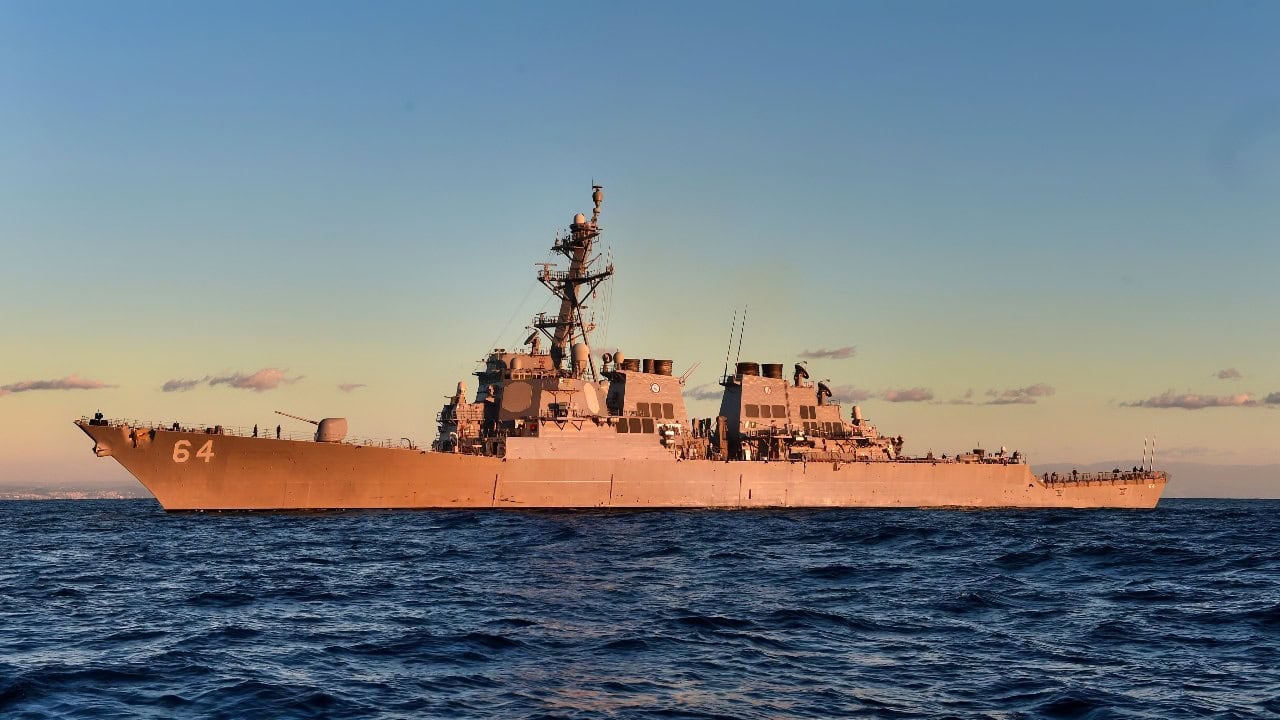
(Dec. 6, 2015). USS Carney (DDG 64) awaits the return of its small boat crew during a passenger transfer Dec. 6, 2015. Carney, an Arleigh Burke-class guided missile destroyer, forward deployed to Rota, Spain, is conducting a routine patrol in the U. S. 6th Fleet area of operations in support of U.S. national security interests in Europe. (U.S. Navy photo by Mass Communication Specialist 1st Class Theron J. Godbold/Released)
Replacing Aging Cruisers and Destroyers
DDG(X) is designed to replace Ticonderoga-class cruisers and Arleigh Burke-class destroyers. These use the vaunted Aegis Combat System that creates a protective umbrella over a carrier strike group. Aegis has an amalgamation of radar, computers, software, and interceptor projectiles. It can protect against incoming missiles, airplanes, drones, and other threats.
Aegis is not a new system, having been tested in the early 1970s and deployed on the USS Ticonderoga beginning in 1983. But it has proven its worth during engagements with Iranian-backed Houthi terrorists in Yemen who fired anti-ship missiles and drones at carrier battle groups in the Red Sea and the Gulf of Aden.
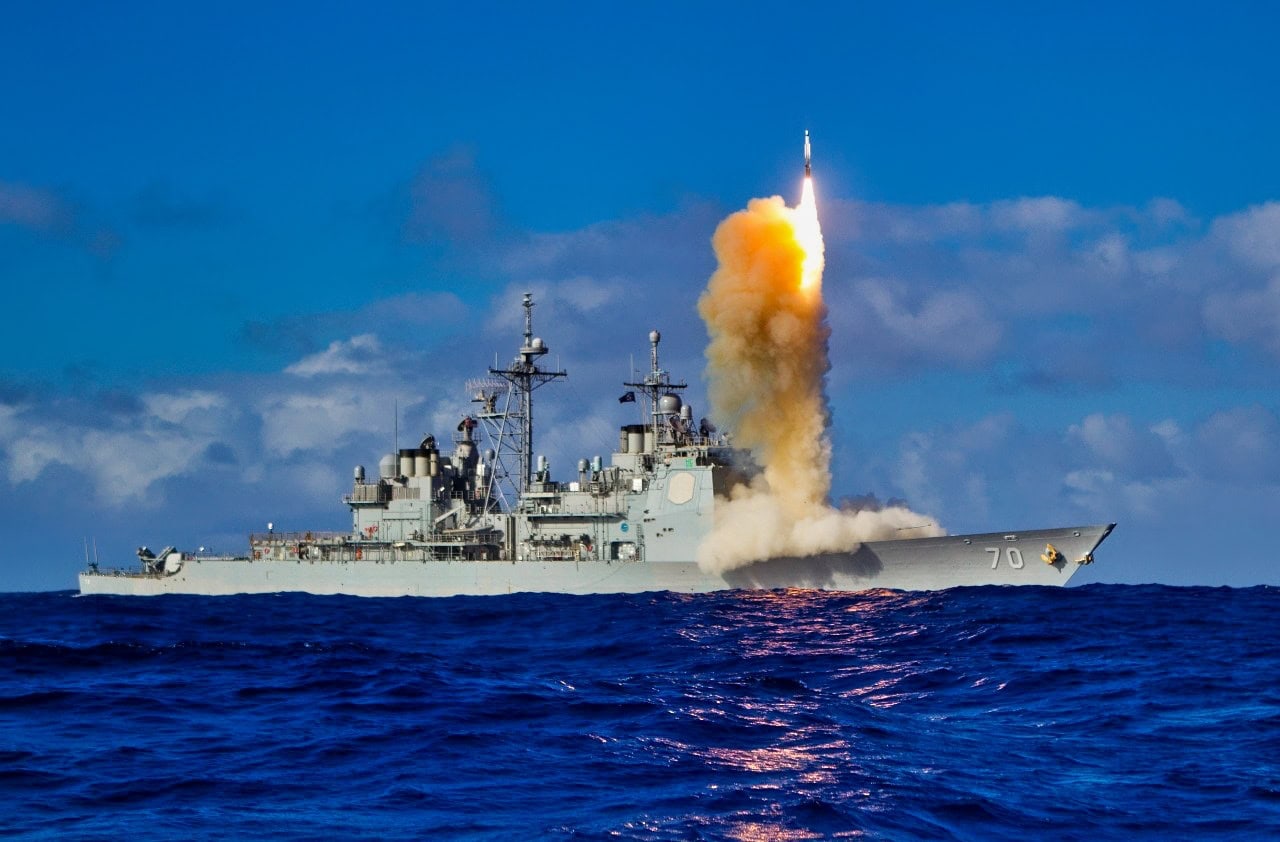
Ticonderoga-Class US Navy. Image Credit: Creative Commons.
There were some close calls, but no American ships were hit or damaged by the scads of weapons fired at the vessels.
‘Missile Hog’ Is Fattened Up With Munitions
The Ticonderoga-class, made up of 22 cruisers, will be retired in FY2027, and the Navy will begin work on the DDG(X). The next-generation warship will be a missile hog with 96 standard Vertical Launching System cells. Some of the cells will be able to launch 12 missiles. DDG(X) will also have two 21-cell Rolling Airframe Missiles. To employ all of these munitions, the newfangled ship will have a larger mid-body hull section.
DDG(X) will have a broader range, an improved Aegis Combat System, and the laser apparatus. “It will also feature a power system able to support the deployment of directed energy weapons. These use electromagnetic energy to inflict damage and can include lasers, microwaves, or particle beams,” Defense News explained.
The new destroyer will have “reduced vulnerability” due to a lessened level of noise and “underwater electromagnetic signatures.”
Price Tag Is Getting More Expensive
The DDG(X) vessels could be ready for active duty by 2032, but there are some challenges. The ship will be expensive, perhaps as much as $4.4 billion a unit. That has ballooned 33 percent from earlier estimates.
One reason is that DDG(X) will be a “clean sheet” design, making it harder to implement the vessel’s engineering and technical features.
For example, the lasers will require a substantial power system to operate, and other electronic needs multiply on the ship.
This must be better than the existing power generator on the Zumwalt-class destroyers.
But the new system will be more efficient and power-laden for the directed energy system.
Diverse Mission Set Heightens Value
The great thing about DDG(X) is its versatility. The destroyer will have heavy firepower and the ability to defend itself and the carrier strike group operating in the waters of East Asia, Europe, or the Middle East. It will be interesting to see if they can guard against enemy bogeys. The ship will be faster and stealthier. The Rolling Airframe Missiles are a great addition, and all the vertical launchers will be able to punish the enemy. The DDG(X) will also have advanced anti-submarine capabilities.
The DDG(X) program has not seen a rapid development phase. Initial design studies began in 2018, and research and development are still ongoing.
A risk that some features could be outdated by 2032 when the ship launches. In 2024, the Navy changed its recommendations to emphasize lighter displacement, greater speed and endurance, and stealthiness to win in a multi-threat environment.
Naval Sea Systems Command (NAVSEA) is leading the design and operations rather than relying solely on defense contractors.
Hopefully, NAVSEA is incorporating lessons learned from the sinking of the Russian flagship Moskva by Ukrainian Neptune anti-ship missiles at the beginning of the war.
Will DDG(X) at the lighter displacement be survivable against enemy missiles and drones? The answer lies in the improved Aegis system and the lasers that can better defend the ship. DDG(X) needs to reach high speeds quickly and lead the carrier battle group vanguard of boats.
This vessel will focus on its strength and power as an escort ship, as well as its defensive capabilities as a new Aegis-equipped vessel.
The engagement against the Houthis taught the Navy that it could quickly run out of interceptor missiles.
They are expensive and time-consuming to build, and their supply is finite. A laser, on the other hand, can fire as many bursts as possible to eliminate enemy threats.
The directed energy feature is the most critical part of DDG(X) ,and research and development about next-generation missile and drone defenders will set the program apart as the new guided missile destroyer enters service in the early 2030s.
About the Author: Brent M. Eastwood
Brent M. Eastwood, PhD is the author of Don’t Turn Your Back On the World: a Conservative Foreign Policy and Humans, Machines, and Data: Future Trends in Warfare plus two other books. Brent was the founder and CEO of a tech firm that predicted world events using artificial intelligence. He served as a legislative fellow for US Senator Tim Scott and advised the senator on defense and foreign policy issues. He has taught at American University, George Washington University, and George Mason University. Brent is a former US Army Infantry officer. He can be followed on X @BMEastwood.