

Key Points and Summary – The Medal of Honor is America’s highest award for valor, and its story is more complex than many assume.
-Of 3,528 recipients, 618—about 18.7 percent—received the medal posthumously.
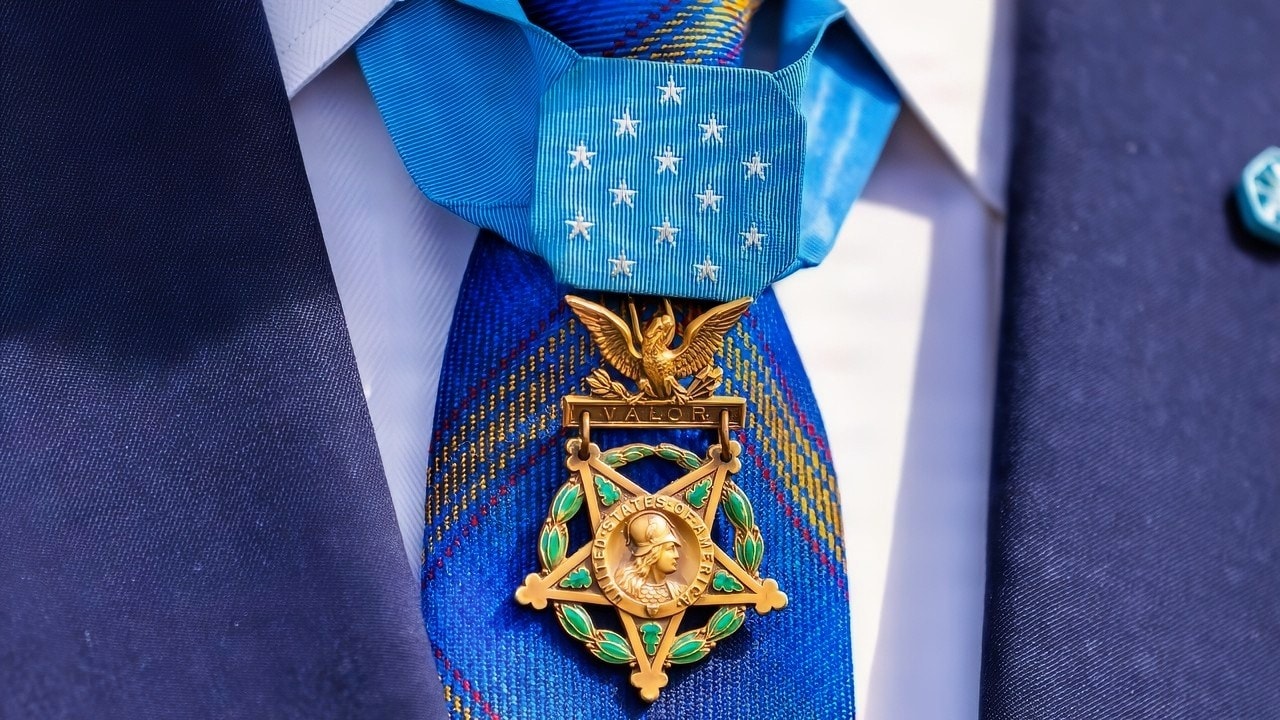
A detail photo of the Medal of Honor at the Tomb of the Unknown Soldier, Arlington National Cemetery, Va., Mar. 25, 2025. The Ceremony was hosted by Maj. Gen. Trevor J. Bredenkamp, commanding general, Joint Task Force-National Capital Region and U.S. Army Military District of Washington. (U.S. Army photos by Sgt. Christopher Grey)
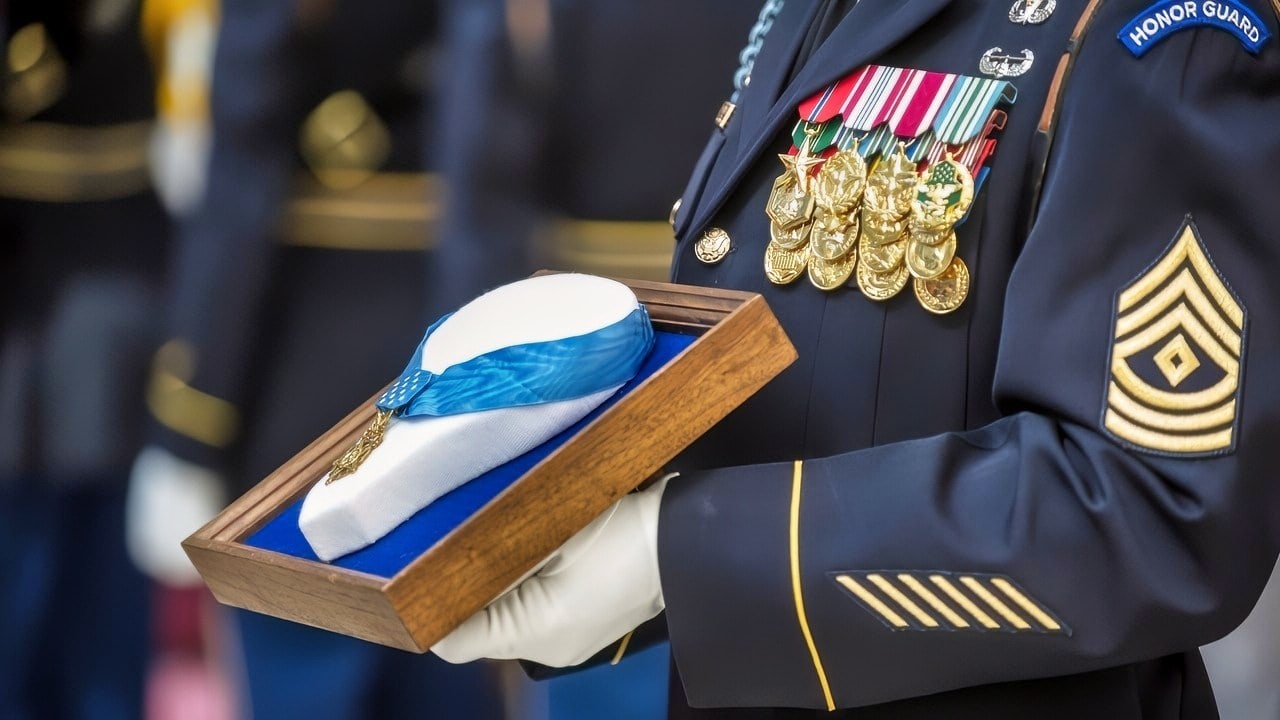
U.S. Army 1st. Sgt. Robert Durbin holds 1st Sgt. David McNerney’s Medal of Honor during an Enshrinement Ceremony at the Smithsonian National Postal Museum in Washington, D.C., on Sept. 22, 2013. The Smithsonian Institution accepted McNerney’s Medal of Honor for inclusion in the National Postal Museum collection where it will be displayed in the National Stamp Salon of the William H. Gross Stamp Gallery. (DoD photo by Staff Sgt. Teddy Wade, U.S. Army/Released)
-This piece breaks down the numbers, then zooms in on two Air Force legends whose awards came only after they were killed in action.
-Pararescueman William “Pits” Pitsenbarger died saving wounded soldiers in Vietnam, while Combat Controller John Chapman fought alone on Takur Ghar in Afghanistan.
-Both were initially given the Air Force Cross before politics were reversed and their heroism was finally recognized with the Medal of Honor.
How Many Medal of Honor Winners Received the Award Posthumously?
The Medal of Honor (MOH) is *THE* highest award for heroism in the United States Armed Forces, and appropriately, it’s not a service-specific decoration.
As tremendous an honor as the MOH is, there is a tragic downside. All too many of these medals were awarded posthumously.
The Grim Numbers Behind the MOH
Now, in fairness, and to dispel a common misconception, the majority of MOH awardees did *not* receive them posthumously.
So then, what exactly are the numbers?
According to the Congressional Medal of Honor Society (CMOHS), “Overall, only 18.7% of Medals of Honor have been awarded posthumously.” Digging deeper, we learn that throughout the decoration’s history, a total of 3,547 Medals of Honor have been awarded to 3,528 recipients; of those 3,528 heroes, 618 received them posthumously. (Meanwhile, 61 MOH winners are still living today as these words are being typed.)
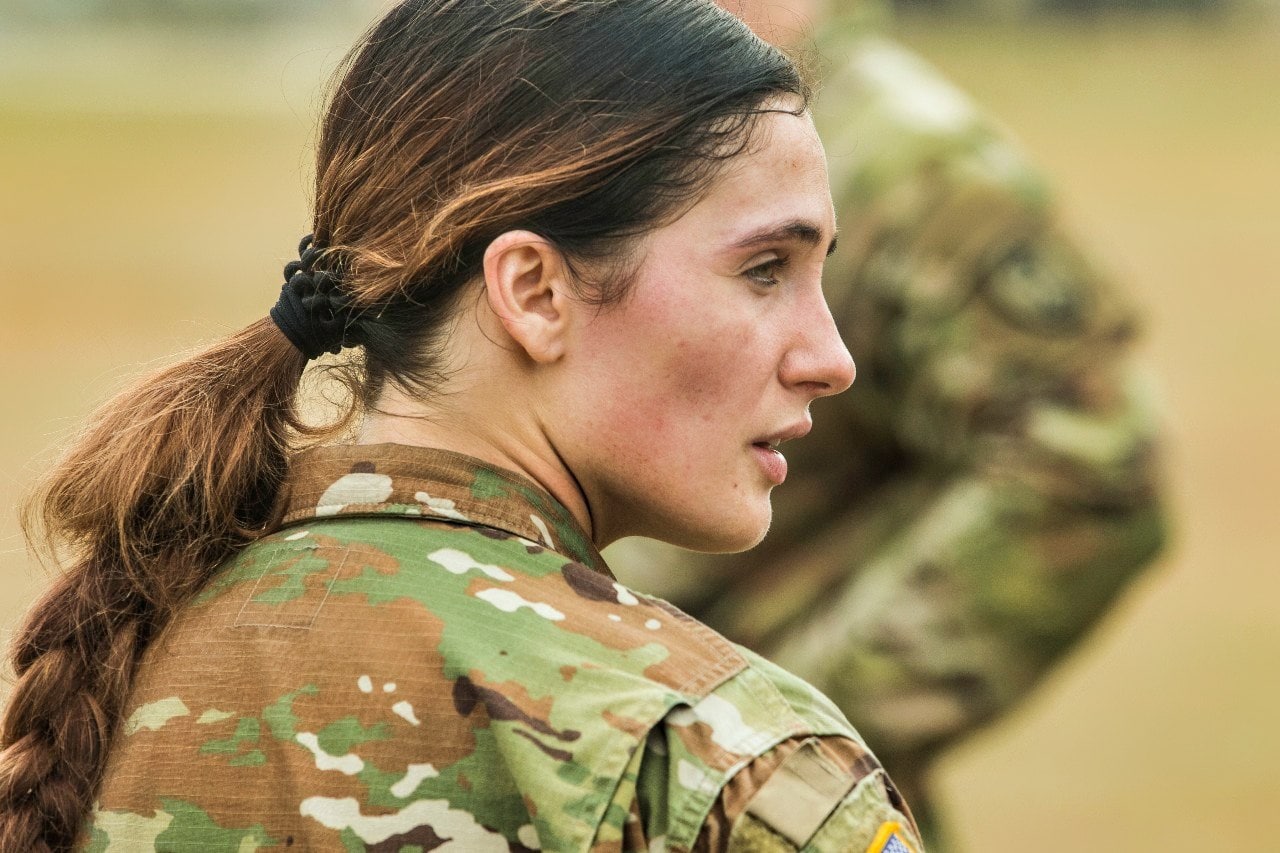
Sgt. Jamie Ortiz, an Army Signal Support System Specialist from the 542nd Military Police Company takes a break after finishing the 2-mile run portion of the Expert Soldier Badge qualification. The ESB is a portion of the Combined Brigade Best Squad Competition here in McCrady Training Center, South Carolina. The 200th Military Police Command will select the top performers to compete at the 2023 U.S. Army Reserve Best Squad Competition.
Understandably, time and spatial limitations prevent us from telling the individual stories of all 618 posthumous MOH recipients.
As a proud U.S. Air Force veteran, this writer is going to narrow it down to two USAF veterans whose stories are near & dear to my heart.
Example #1: A1C (Later SSgt) William H. Pits” Pitsenbarger
“Pits” was one of the USAF’s elite Pararescuemen, aka Pararescue Jumpers (“PJs”). The PJs are a component of the USAF’s Special Tactics Teams (STTs)—along with Tactical Air Control Party (TACP), Special Reconnaissance, and Combat Control (CCT; more on these guys in the next segment).
William Hart Pitsenbarger was born on July 8, 1944, in Piqua, Ohio, to Frank and Alice Pitsenbarger. Young “Pits” tried to join the Army to become a Green Beret whilst still a high school junior, but Frank & Alice denied their ambitious son permission to enlist early. Waiting (maybe not so patiently until graduation, Pits decided to join the Air Force instead. On New Year’s Eve of 1962, he shipped off to USAF Basic Military Training (BMT) at Lackland AFB, Texas, whereupon he volunteered for Pararescue.
Suffice to say that “Pits” graduated from BMT and the PJ pipeline alike; the latter was no small feat, as the training program has up to a 95 percent washout rate. Before long, he found himself being sent off to the Vietnam War. He completed one tour of duty, then volunteered for a second tour, ultimately completing over 250 missions.
It was during that second tour, more specifically during the Battle of Xa Cam My on April 11, 1966, that then-Airman 1st Class (A1C) Pitsenbarger had his date with destiny. He found himself aboard a Kaman HH-43F Huskie (aka “Pedro”) rescue helicopter responding to a call for evacuation of casualties incurred in an ongoing firefight between elements of the United States Army’s 1st Infantry Division (“The Big Red One“) and a sizeable enemy force approximately 35 miles east of Saigon.
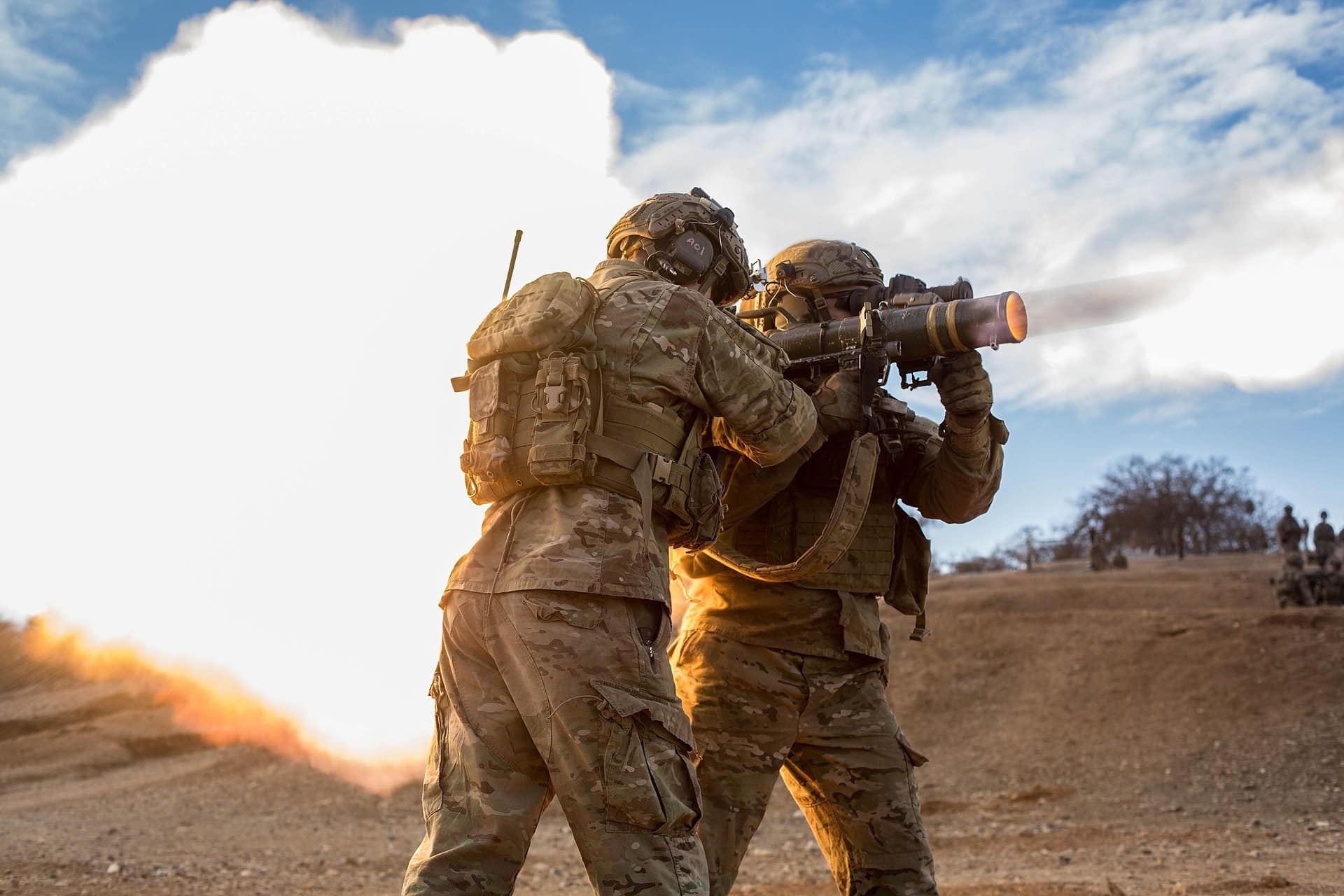
U.S. Army Rangers assigned to 2nd Battalion, 75th Ranger Regiment, fire off a AT-4 at a range on Camp Roberts, Calif., Jan 26, 2014. Rangers use a multitude of weaponry during their annual tactical training. (U.S. Army photo by Pfc. Rashene Mincy/ Not Reviewed)
Per the concluding three sentences of A1C Pitsenbarger’s official MOH citation: “In the vicious fighting that followed, the American forces suffered 80 percent casualties as their perimeter was breached, and Airman Pitsenbarger was fatally wounded. Airman Pitsenbarger exposed himself to almost certain death by staying on the ground, and perished while saving the lives of wounded infantrymen. His bravery and determination exemplify the highest professional standards and traditions of the military service and reflect great credit upon himself, his unit, and the United States Air Force.”
Right off the bat, A1C Pitsenbarger’s commanders recommended him for the MOH, but thanks to some bureaucratic meddling, he was initially downgraded to the Air Force Cross. It wasn’t until December 8, 2000, that Pits’ long-overdue Medal of Honor upgrade was finally awarded, along with a posthumous promotion to Staff Sergeant (SSgt). Both of his parents were present to accept the Medal; 14 months later, Frank passed away from cancer, whilst Alice lived until October 2019.
His heroics gained greater recognition in the public eye thanks to the 2019 motion picture The Last Full Measure. Pits remains the only PJ thus far to receive the MOH.
Example #2: TSgt (Later MSgt) John Chapman
Just like with SSgt. Pitsenbarger, Master Sergeant (MSgt) John Chapman’s MOH and final promotion alike were awarded after his death; in Chapman’s case, it was a promotion from the rank of Technical Sergeant (TSgt), and the conflict in question was Operation Enduring Freedom (OEF) in Afghanistan.
John Allan Chapman was born on July 14, 1965, in Springfield, Massachusetts, to Eugene and Terry Chapman, and grew up in Windsor Locks, Connecticut.
Unlike Pits, young John waited a couple of years after graduating high school to join the Air Force, doing so on September 27, 1985. His initial career field upon leaving BMT was an information systems operator. Circa 1990, he cross-trained into the CCT career field.
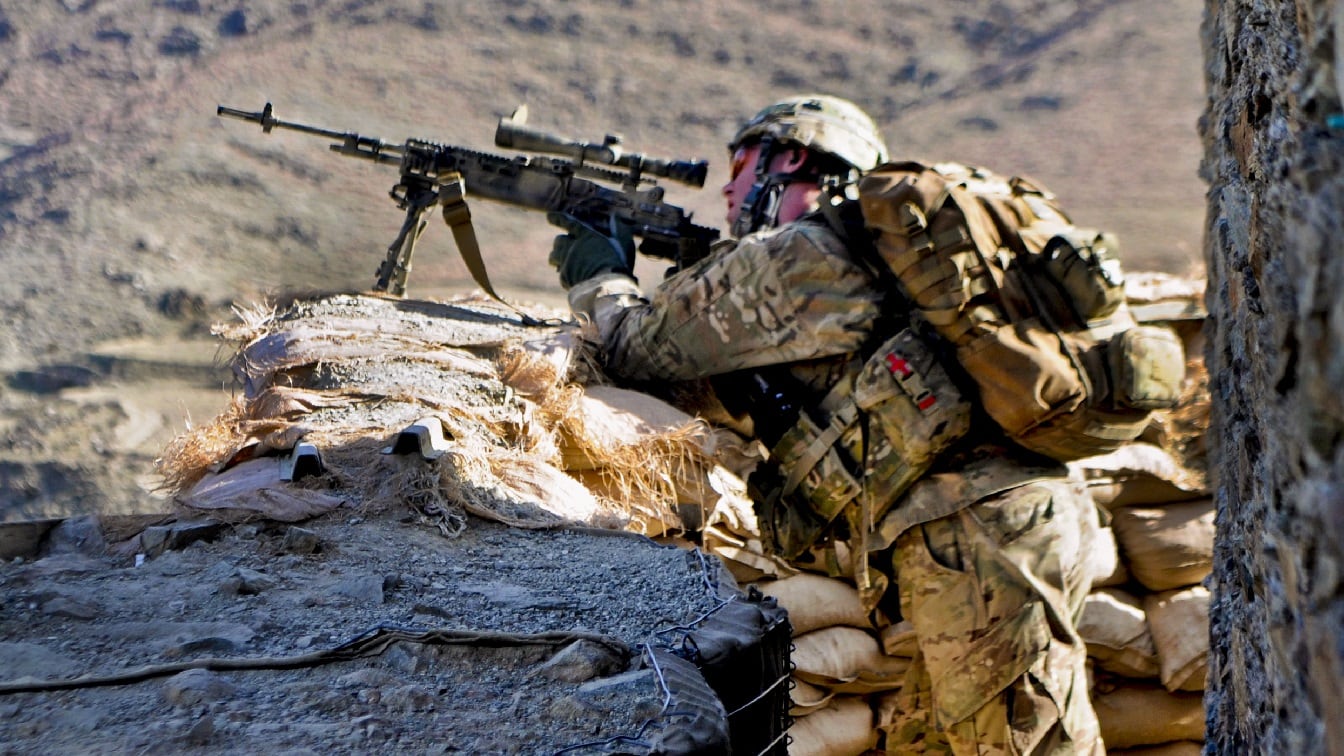
U.S. Army Sgt. Andrew Barnett scans the area using the optic lens on his M14 enhanced battle rifle outside an Afghan border police observation point in Kunar province, Afghanistan, Jan. 28, 2013. Barnett is assigned to the 101st Airborne Division’s 2nd Battalion, 327th Infantry Regiment, 1st Brigade Combat Team. U.S. Army photo by Sgt. Jon Heinrich
Long story short: whilst attached to a Navy SEAL team during the Battle of Takur Ghar on March 4, 2002, then-TSgt Chapman was mortally wounded and somehow left behind; despite being all alone with those mortal wounds, John held his ground against two dozen enemy combatants, fighting for over an hour, killing at least two insurgents, destroying an enemy fighting position, and saving the lives of his entire twenty-three-man rescue team, before finally succumbing to his wounds.
As was also the case with SSgt Pitsenbarger, MSgt Chapman’s MOH was denied due to dirty, petty politics, and therefore, he only received the Air Force Cross. However, that situation was finally rectified on August 22, 2018, when President Donald Trump presented the Medal of Honor to Chapman’s surviving family members.
The following day, John was inducted into the Hall of Heroes, and the day after that, he received his posthumous promotion to MSgt.
MSgt John Chapman was the first airman to receive the Medal of Honor since the Vietnam War; his heroic actions were also the first Medal of Honor actions captured on video.
HOOYAH, SSgt Pitsenbarger and MSgt Chapman.
About the Author: Christian D. Orr, Defense Expert
Christian D. Orr is a Senior Defense Editor. He is a former Air Force Security Forces officer, Federal law enforcement officer, and private military contractor (with assignments worked in Iraq, the United Arab Emirates, Kosovo, Japan, Germany, and the Pentagon). Chris holds a B.A. in International Relations from the University of Southern California (USC) and an M.A. in Intelligence Studies (with a concentration in Terrorism Studies) from American Military University (AMU). He is also the author of the newly published book “Five Decades of a Fabulous Firearm: Celebrating the 50th Anniversary of the Beretta 92 Pistol Series.”