
Key Points and Summary – President Trump’s December 16 proclamation expands U.S. travel restrictions, adding partial limits on Antigua and Barbuda and Dominica effective January 1.
-The White House cites “citizenship-by-investment” programs that historically issued passports without a residency requirement.

A Lufthansa Boeing 747-400 takes off at Frankfurt Airport. Image Credit: Creative Commons.
-Tourism operators and insurers warn fewer travelers could mean emptier flights, weaker hotel demand, and harder access to U.S. shopping, schooling, and medical care—links that shape daily life for many families.
-Antigua’s Prime Minister Gaston Browne says his government tightened the program and will seek direct engagement with Washington.
-Dominica’s leaders say the same, warning the policy could chill investment. Officials hope talks reverse this.
Travel Ban Takes Effect January 1—Why Antigua and Dominica Are Worried
Donald Trump has imposed travel bans on so many countries that it can be difficult to keep track of them all.
On top of the travel bans issued during his first term, Trump issued an executive order on his first day back in office, titled “Protecting the United States From Foreign Terrorists and Other National Security and Public Safety Threats.”
In June, Trump got more specific about which countries would be affected, declaring that he would “fully restrict and limit the entry of nationals of the following 12 countries: Afghanistan, Burma, Chad, Republic of the Congo, Equatorial Guinea, Eritrea, Haiti, Iran, Libya, Somalia, Sudan, and Yemen.”
The president also declared his intention to “partially restrict and limit the entry of nationals” from seven more countries: Burundi, Cuba, Laos, Sierra Leone, Togo, Turkmenistan, and Venezuela.
Then, on December 16, Trump further expanded the restrictions, with another proclamation, this time keeping the restrictions on the original 12 countries in place, while adding ” full restrictions and entry limitations” on Burkina Faso, Mali, Niger, South Sudan, and Syria, as well as to “individuals holding Palestinian-Authority-issued travel documents.”
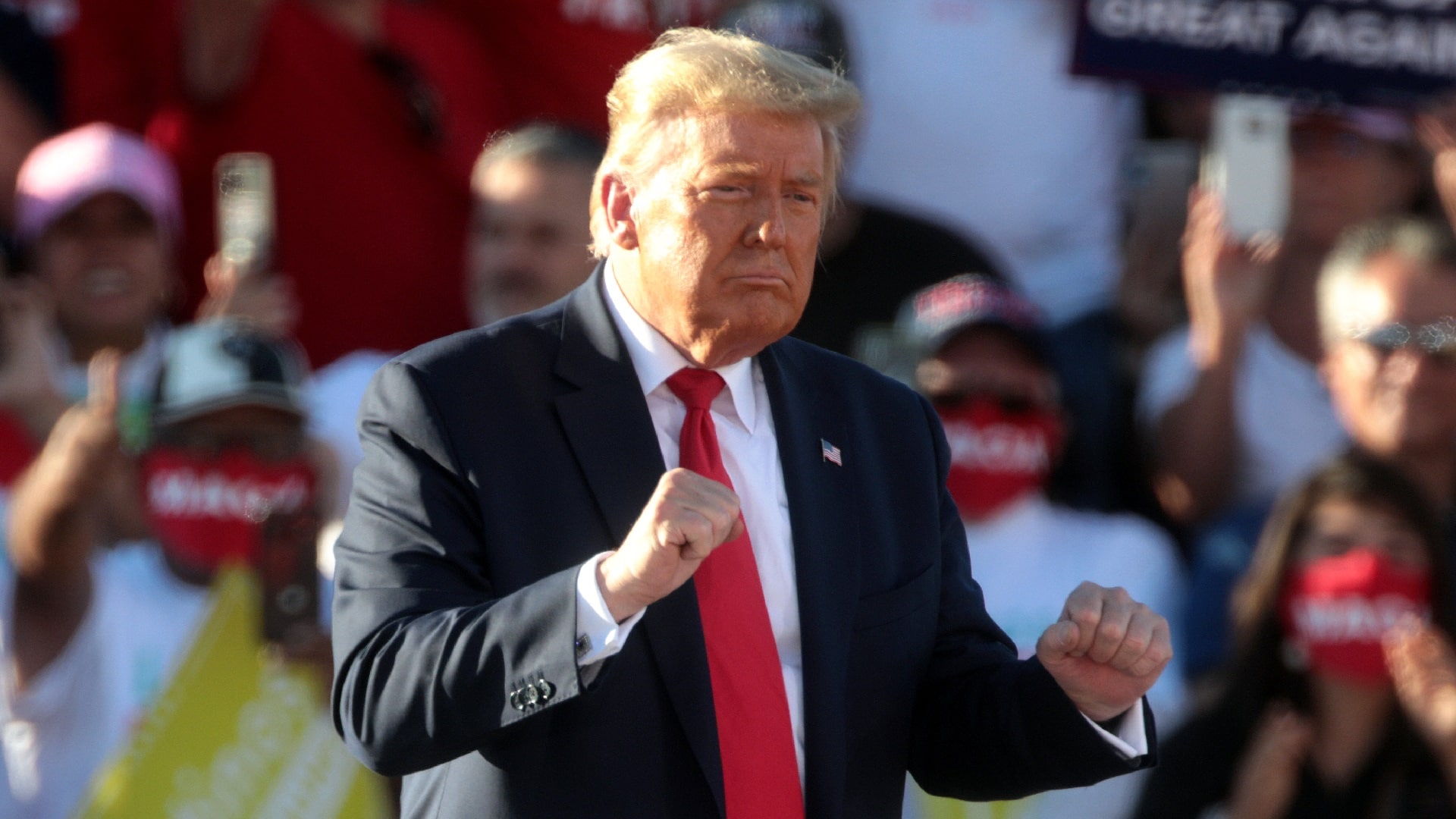
President of the United States Donald Trump dancing at the conclusion of a “Make America Great Again” campaign rally at Phoenix Goodyear Airport in Goodyear, Arizona.
Trump also added full restrictions on Laos and Sierra Leone, which were previously subject only to partial restrictions, while continuing partial restrictions on Burundi, Cuba, Togo, and Venezuela. As for Turkmenistan, because it has “engaged productively with the United States and demonstrated significant progress since the previous Proclamation,” in the White House’s words, its ban on non-immigrant visas has been lifted. However, the suspension of entry for Turkmen nationals seeking to become immigrants remains in place.
And the White House has added partial restrictions and entry limitations on 15 more countries: Angola, Antigua and Barbuda, Benin, Cote d’Ivoire, Dominica, Gabon, The Gambia, Malawi, Mauritania, Nigeria, Senegal, Tanzania, Tonga, Zambia, and Zimbabwe.
The inclusion of two of those countries, Antigua and Barbuda and Dominica, has raised fears of “economic disruption” in the region, Reuters reported Thursday.
The changes go into effect on January 1.
Fears in the Caribbean
The president’s proclamation includes justifications for each move. For those countries, it states only that “Antigua and Barbuda has historically had Citizenship by Investment (CBI) without residency,” and also that Dominica “has historically had CBI without residency.”
This has sparked panic in countries where tourism is a significant part of the economy. The bans, per Reuters, have “threatened to slow local economies, disrupt air travel routes and cut long-standing family ties, even as some Caribbean countries remain outside the formal ban.”
“It’s going to have a huge impact here in Antigua and Barbuda,” said Eli Fuller, founder of tour operator Adventure Antigua. Eli Fuller, founder of tour operator Adventure Antigua, told Reuters about the policy change. “If they’re unable to travel, that leaves empty, well, half-empty flights.”
“Health is a big reason why a lot of people travel to the United States to seek medical attention, medical expertise that’s available in the United States,” Darren Matthew-Ward, medical services manager at Brysons Insurance Agency, told Reuters. “That is going to be a big, big, big problem.”
“This news has really taken off in Antigua and Barbuda like no other news issue in quite some time because it affects everyone. Everybody’s affected,” Matthew-Ward added.
The Reuters story added that in those countries, going back and forth to the U.S. has long been “deeply embedded in everyday life.”
“Going to the U.S., it’s a big part of growing up,” one anonymous man told Reuters.
“Whether it’s for shopping, visiting family, or studying, our lives have been deeply linked to the U.S. in many ways.”
One political leader also weighed in.
“We have engaged in good faith, accepted practical suggestions, and taken concrete steps to ensure that our programme presents no risk whatsoever to the security of the United States,” Antigua and Barbuda’s Prime Minister Gaston Browne told Reuters.
Per IMI Daily, Brown added that he is “deeply disappointed that Antigua and Barbuda has been included in this proclamation on the stated ground that our Citizenship by Investment Programme has historically operated without a residency requirement.”
The prime minister said he will write to Trump and Secretary of State Marco Rubio, “offering the full engagement and cooperation of the Government of Antigua and Barbuda to address any concerns.”
Antigua’s Ambassador to the United States, Sir Ronald Sanders, contacted the State Department immediately after the restrictions were announced, IMI Daily said.
“Golden Passports”
Bloomberg News wrote about the rationale for the latest bans. It states that it was over those nations having “Golden Passport” programs. Also, the leaders of those countries were not warned that the restrictions were coming.
Both countries, Bloomberg said, have “historically allowed wealthy foreigners to buy passports without having residency,” though they have tightened rules in recent years and raised prices.
“So-called golden passports give visa-free access to the European Union, the UK and other countries, making them popular with nationalities that would usually be required to apply for travel permits,” the Bloomberg story said. “The five Caribbean nations with CBI programs have extended citizenship to at least 88,000 people, including many Chinese, Russians, and Nigerians, according to a EU report in 2023.”
This, per Bloomberg, has threatened to compete with the “Trump Gold Card,” which offers eligible foreign nationals a chance to receive U.S. residency for $5 million.
“Foreign nationals can sign up now and secure their places on the waiting list for the Trump Platinum Card. When launched, and upon receipt of a $15,000 DHS processing fee and $5 million contribution, they will have the ability to spend up to 270 days in the United States without being subject to U.S. taxes on non-U.S. income.”
Antigua’s prime minister, Browne, has also discussed the military buildup and possible confrontation with Venezuela.
The prime minister told Bloomberg that “the hint of armed confrontation in our waters reverberates instantly through hotel bookings, airlines, foreign investment, and the livelihoods of hundreds of thousands of families.”
About the Author: Stephen Silver
Stephen Silver is an award-winning journalist, essayist, and film critic, and contributor to the Philadelphia Inquirer, the Jewish Telegraphic Agency, Broad Street Review, and Splice Today. The co-founder of the Philadelphia Film Critics Circle, Stephen lives in suburban Philadelphia with his wife and two sons. For over a decade, Stephen has authored thousands of articles that focus on politics, national security, technology, and the economy. Follow him on X (formerly Twitter) at @StephenSilver, and subscribe to his Substack newsletter.