
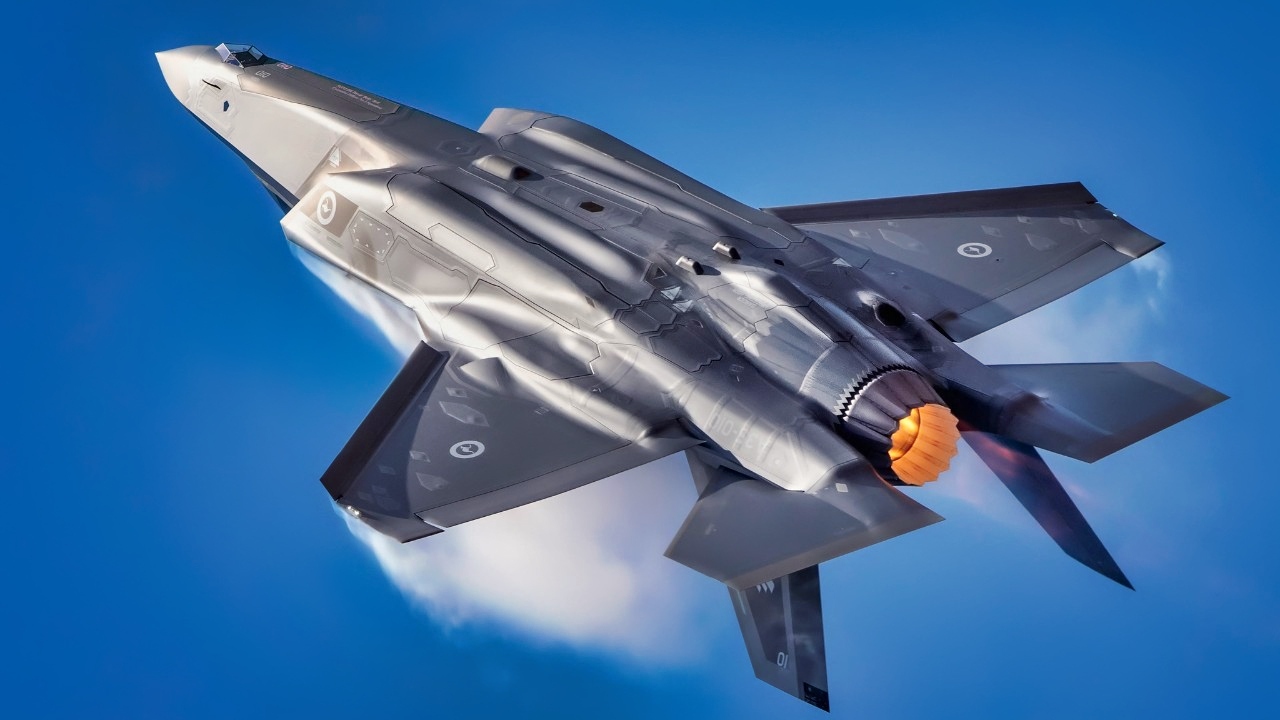
Key Points and Summary – Canada has become the first non-EU state to join Europe’s SAFE defense initiative, unlocking access to billions in EU-backed projects for Canadian industry.
-SAFE’s “buy European” rules, however, could complicate Ottawa’s paused F-35 deal and boost Saab’s Gripen pitch, especially if jets are built in Canada.
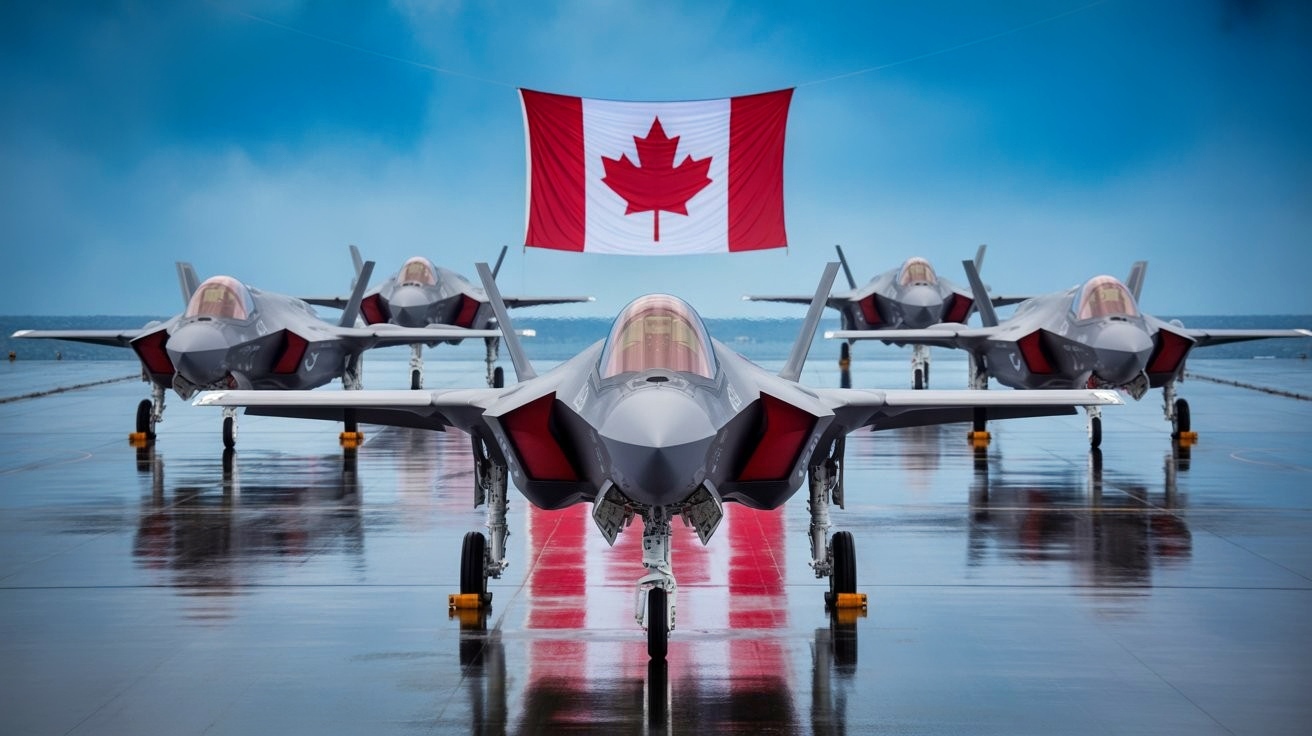
F-35 Fighters in Canada. Image Created by Ideogram.
-The move also risks political blowback from Washington and Donald Trump, even as leaked data show the F-35 easily outscored the Gripen in Canadian evaluations.
-Analysts warn Canada’s tight defense budget and small fleet make a split buy unrealistic, forcing Ottawa to choose between industrial politics and combat performance.
Canada’s SAFE Deal With Europe Has a Message for the F-35
Canada has not, at least as of yet, dropped its deal to purchase F-35s from the US. But it has taken one big step towards Europe.
The office of Prime Minister Mark Carney announced on Monday that Canada will participate in the European Union’s Security Action for Europe (SAFE) program.
The effect of the deal, which follows Canada’s agreement earlier this year on a Security and Defence Partnership with the EU, is “unlocking billions of dollars in potential defence opportunities for Canadian businesses,” per the Canadian government press release.
“SAFE provides up to $244 billion in loans to EU Member States to support large-scale defence projects, including acquiring critical capabilities such as ammunition, missiles, drones, artillery systems, and infantry weapons,” the government statement said.
Canada is the first non-EU country to join the program, although recent discussions between the EU and the UK did not result in that country joining the alliance.
“As all 27 EU Member States increase defence investments, greater cooperation on procurement opens massive new opportunities for Canadian manufacturers to build and export Canadian-made technologies and capabilities.
Negotiations are complete, the parties said, and Canada and the EU will now work to ratify a bilateral SAFE agreement.
“In a dangerous and divided world, Canada and Europe are elevating our defence partnerships to rapidly procure new equipment and technology, accelerate NATO targets, and catalyse tremendous opportunities for our defence manufacturers,” Prime Minister Carney said in a statement.
“Canada’s participation in SAFE will fill key capability gaps, expand markets for Canadian suppliers, and attract European defence investment into Canada.”
F-35 Questions for Canada
It’s not clear what this means for Canada’s 2023 deal to purchase more F-35 fighter jets from the US, which has been under review for several months. At issue is whether Canada will purchase the next tranche of the jets or will buy them from someone else, possibly Sweden.
The Eurasian Times this week looked at whether the EU deal will jeopardize the possibility of F-35s.
“SAFE is meant to fund big joint projects, but there’s a catch. Only 35 percent of the funds dedicated to any project carried out under the program can be used to purchase weapons from countries that are not signed on to the plan,” the report said. The US is not part of the SAFE plan.
“Notably, since the US has not signed the SAFE initiative, the big US defense firms can only bid for a slice of the big-ticket defense acquisition plans initiated under SAFE,” that report said.
Saab is pushing to get Canada to purchase Gripen jets, instead of the F-35s, with the idea that many of them would be produced in Canada.
Risking Trump’s Ire
The Eurasian Times analysis also looked at how the SAFE deal could push the US and Canada further apart.
“While the agreement with the EU on SAFE helps Carney show Trump that he has other options, the move could also backfire, further antagonizing Trump,” the report said. However, it noted that the US and Canada remain together as part of a long list of alliances, including NATO, the G-7, Five Eyes, NORAD, and many others.
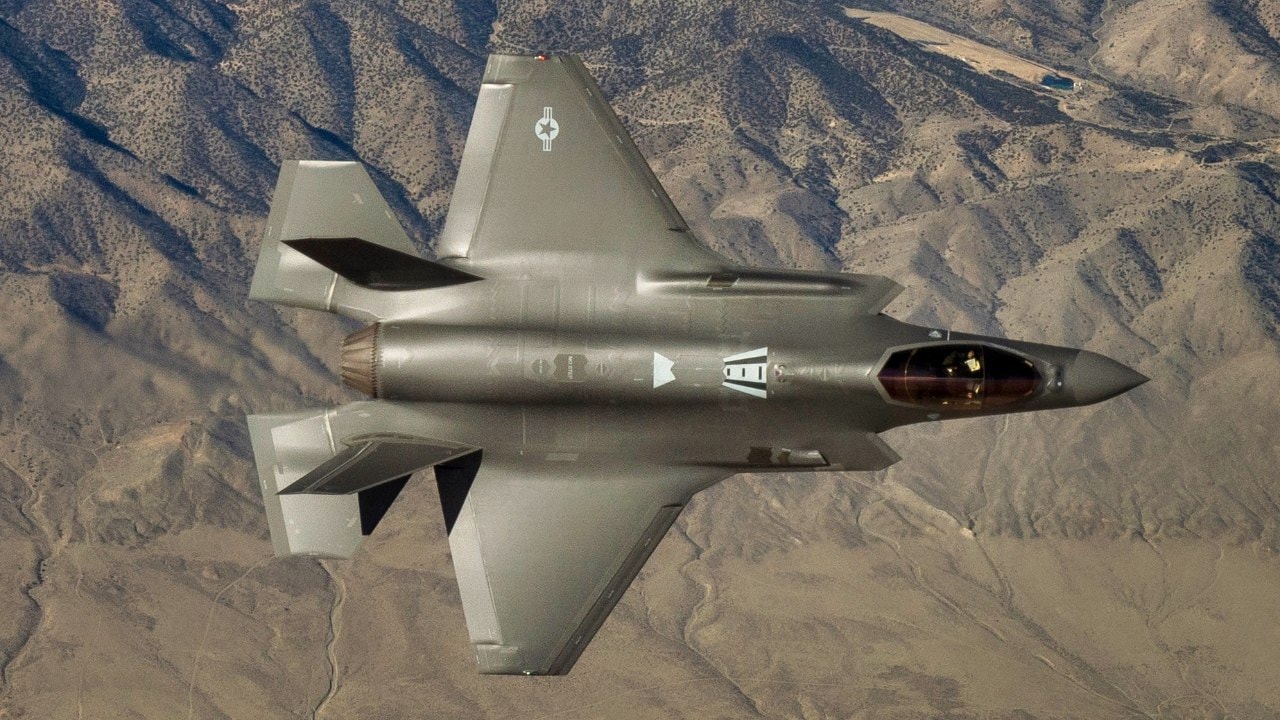
Two U.S. Air Force F-35A Lightning IIs, assigned to the 4th Fighter Squadron from Hill Air Force Base, Utah, conduct flight training operations over the Utah Test and Training Range on Feb 14, 2018. The F-35 is designed to provide the pilot with unsurpassed situational awareness, positive target identification and precision strike in all weather conditions. (U.S. Air Force photo by Staff Sgt. Andrew Lee)
A story on Monday in Canada’s National Post newspaper stated that Canada “risks Trump’s ire” if it chooses the Swedish Gripens over the American F-35s.
“As the Liberal government review winds down amid escalating trade tensions—including a warning from Ambassador Pete Hoekstra that a trade deal would be off without the F-35 buy—a debate has reignited, pitting Lockheed Martin’s stealth fighter jet against Saab’s Gripen,” the newspaper said.
President Donald Trump already suspended trade talks over the broadcast in Canada of a TV commercial that invoked Ronald Reagan and his opposition to tariffs. And while the U.S. president has not commented publicly on the F-35 question, he may react negatively if the American jet is spurned.
A Split Buy? F-35 and Gripen?
Could Canada split the difference and buy some of each? That idea has been bandied about throughout the process.
However, multiple experts quoted by the National Post called it the worst option.
“The long-term costs of maintaining a mixed fleet would be much higher than a single fleet,” Philippe Lagassé, a Carleton University professor and procurement expert, told the newspaper. “But the government may determine that these costs are worthwhile from a defence industrial perspective.”
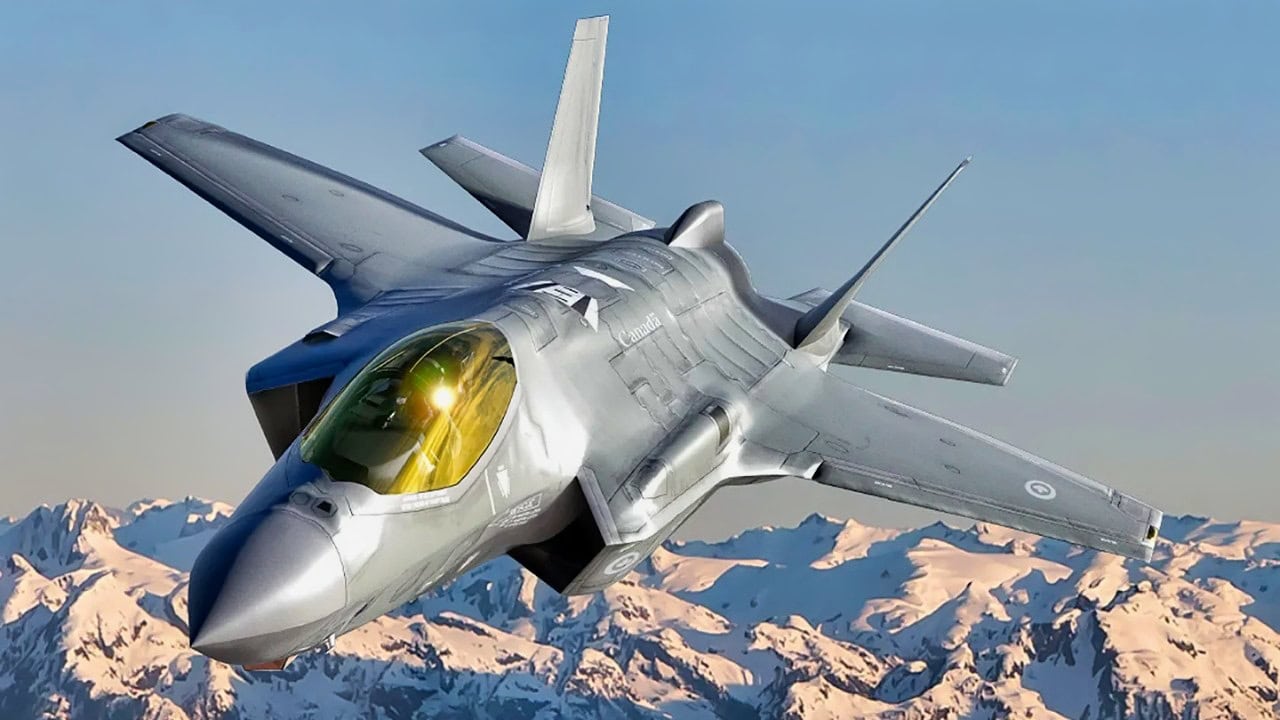
Canada F-35. Image Credit: Creative Commons.
Michael O’Hanlon, director of foreign policy research at the Brookings Institution think tank, agreed.
“Canada doesn’t have a big enough military budget to be trying to please all people by buying six of this type and 12 of the other type,” he said. “Canada is already punching below its weight in terms of defence budget and the size of its air combat capabilities.”
The question, per the National Post analysis, is whether politics should take precedence over procuring the superior jet.
The Air Force F-35 Smiles: “Winner by a Mile”
Late last month, leaked data showed that the F-35 was the clear winner in a 2021 test of the two jets by the Department of National Defence (DND).
“The F-35 got a score of 95 per cent on military capabilities, with a total of 57.1 points out of 60,” Radio Canada reported. “By contrast, the Gripen-E finished with a score of 33 per cent, netting 19.8 points out of 60.”
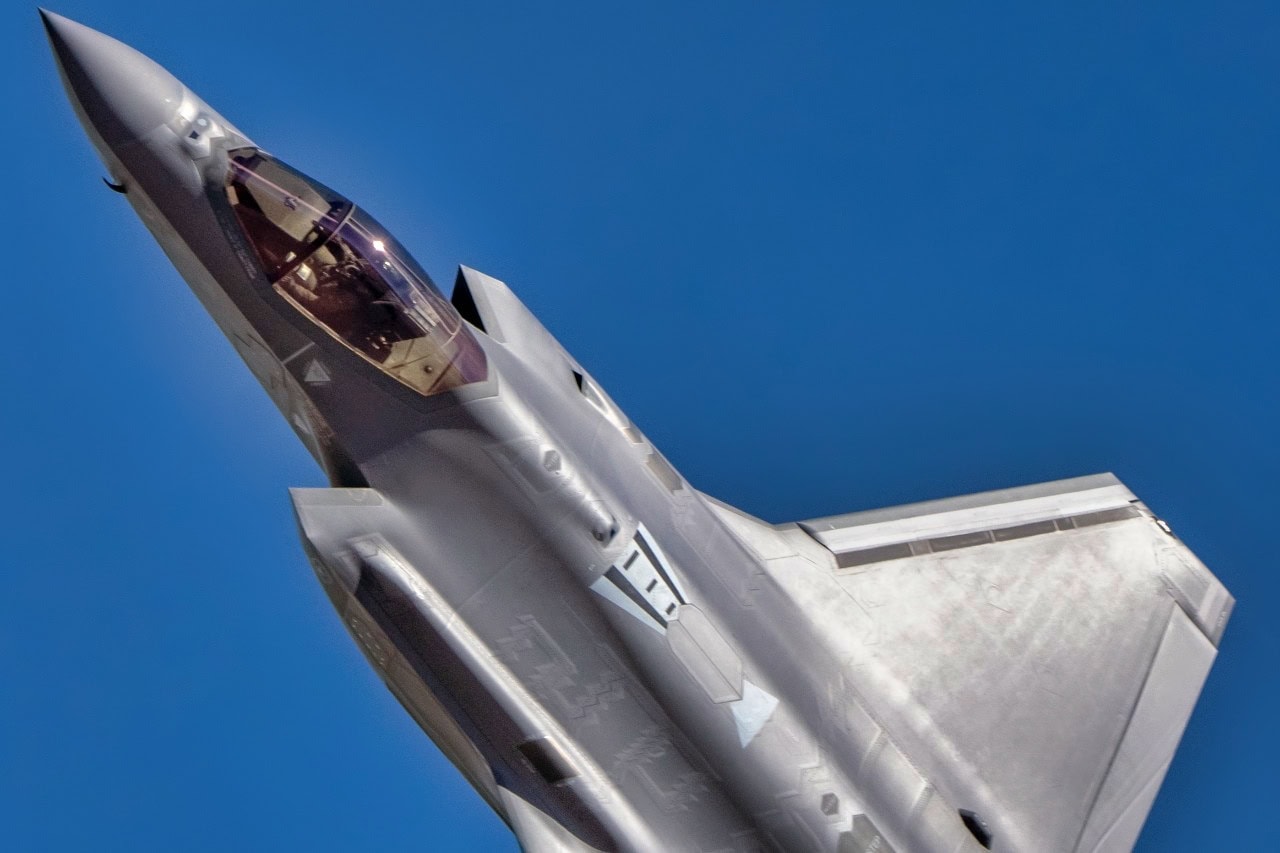
U.S. Air Force Maj. Kristin “BEO” Wolfe, F-35A Lightning II Demonstration Team pilot and commander, flies during the 2021 Reno Air Races, Reno, Nev., Sept. 18, 2021. The 2021 Reno Air Races featured performances from the U.S. Air Force F-35A Demo Team and the U.S. Air Force Thunderbirds. (U.S. Air Force photo by Capt. Kip Sumner)
That test was conducted before the previous Prime Minister, Justin Trudeau, agreed to proceed with the original F-35 purchase, even though Trudeau had promised not to do so while running in 2015.
“The capability assessment here says that there is a clear-cut winner, no contest, no ambiguity,” David Perry, president of the Canadian Global Affairs Institute, said, per Radio Canada. “I’d expected that [the F-35] was going to be a clear winner, but this is a winner by a mile.”
About the Author: Stephen Silver
Stephen Silver is an award-winning journalist, essayist, and film critic, and contributor to the Philadelphia Inquirer, the Jewish Telegraphic Agency, Broad Street Review, and Splice Today. The co-founder of the Philadelphia Film Critics Circle, Stephen lives in suburban Philadelphia with his wife and two sons. For over a decade, Stephen has authored thousands of articles that focus on politics, national security, technology, and the economy. Follow him on X (formerly Twitter) at @StephenSilver, and subscribe to his Substack newsletter.